
Peptides
October 16, 2026
Zenagamtide: one molecule versus a drug combination
On this page
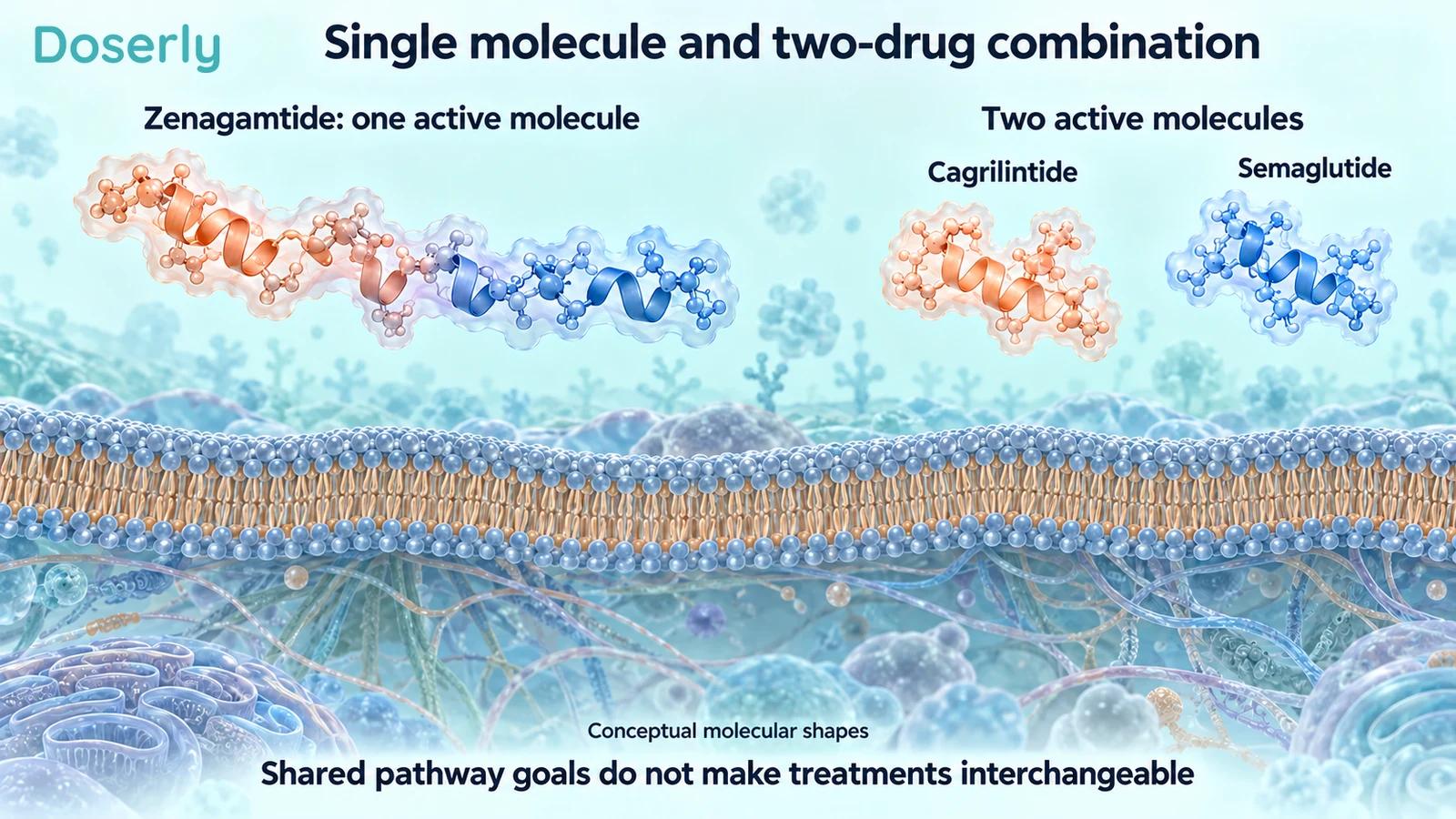
“GLP-1 plus amylin” can describe two different approaches to developing a medicine. One is to give two active drugs together. Another is to design one molecule with activity at more than one receptor system.
Zenagamtide, previously called amycretin, follows the second approach. Cagrilintide plus semaglutide follows the first. Both pursue overlapping biological goals, but they are not interchangeable versions of the same treatment.
The distinction affects molecular design, exposure, dose finding and the evidence needed to judge benefit. It also helps explain why a promising mechanism cannot establish that one approach will be more effective, easier to tolerate or more convenient than the other.
The zenagamtide guide covers the broader development program. Here, the focus is what “one molecule” actually means—and what it does not prove.
One peptide contains two functional regions
The primary preclinical paper describes amycretin as a 68-amino-acid peptide. A GLP-1 receptor agonist region and an amylin receptor agonist region are connected by a short peptide linker. The molecule also includes a fatty-acid-based side chain intended to support prolonged exposure through reversible albumin binding.
That is a designed molecular entity. It is not a vial containing separate semaglutide and cagrilintide molecules, and it is not created by mixing two finished medicines. Primary molecular and preclinical report
The amylin-active portion is based on a modified calcitonin-related sequence. This matters because the everyday label “amylin agonist” describes receptor activity, not necessarily a molecule copied directly from native human amylin.
The authors explain that simply linking familiar peptide sequences can substantially reduce activity at one target. Preserving useful activity across both systems was therefore a development challenge, not an automatic consequence of joining two pieces.
A molecular diagram can communicate the architecture. It cannot, by itself, predict the eventual balance of clinical effects.
Receptor activity is more nuanced than “two signals”
Zenagamtide is commonly described as a GLP-1 and amylin receptor agonist. The primary laboratory work also demonstrated activity at calcitonin receptors.
Amylin receptors are complexes formed from a calcitonin receptor and a receptor activity-modifying protein, often shortened to RAMP. Different partner proteins create different amylin receptor subtypes. This relationship makes the biology more complicated than a picture of two entirely unrelated switches.
The preclinical investigators tested activity in engineered cell systems expressing relevant human and animal receptors. They measured signaling responses across concentrations, allowing them to characterize potency under the assay conditions.
Those experiments establish that the molecule can activate the tested targets. They do not establish how much of a person's weight change is attributable to each target, or that the molecule activates all receptors equally in every tissue.
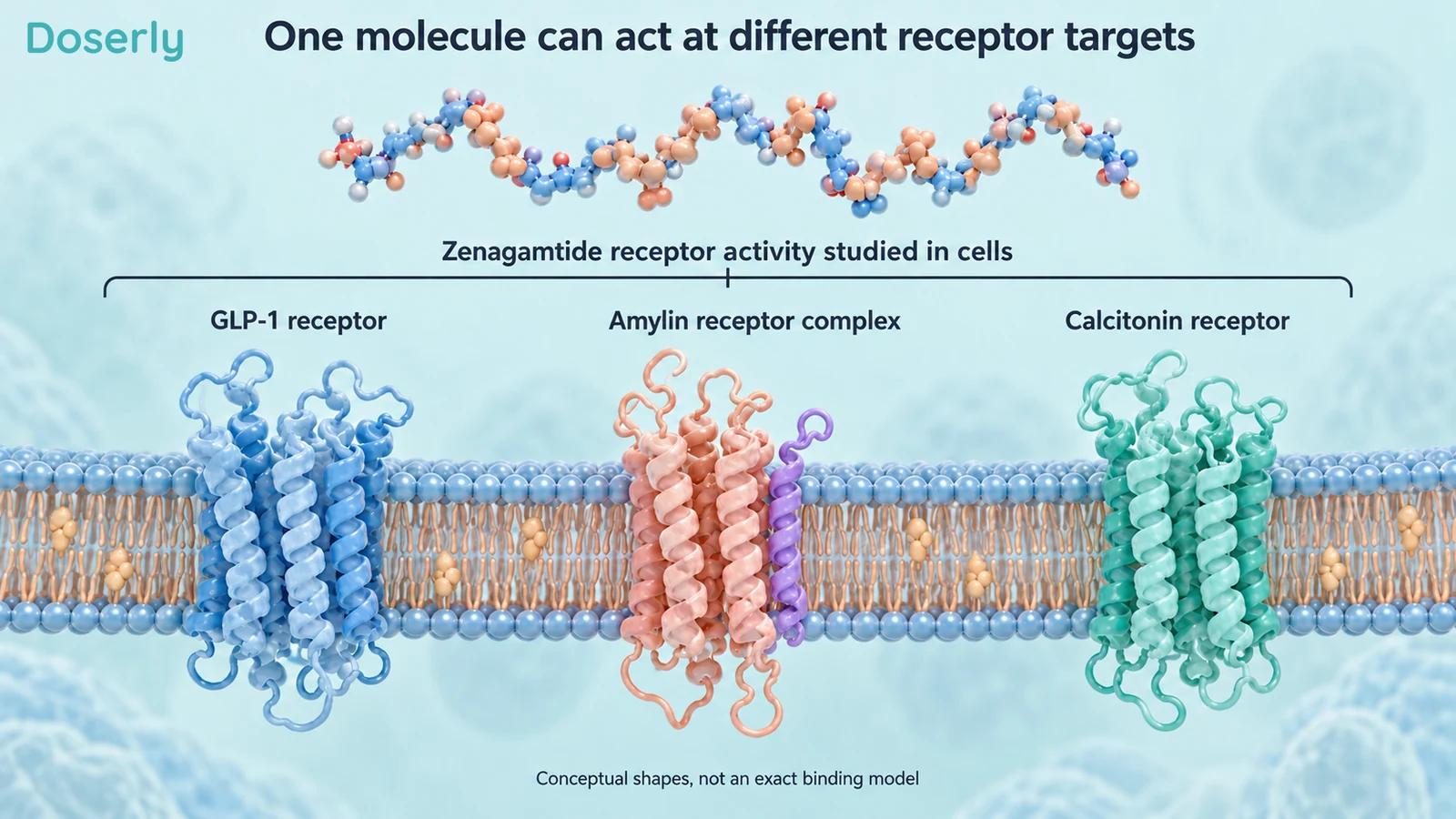
The 2026 human papers preserve the fuller description, identifying zenagamtide as an agonist of GLP-1, amylin and calcitonin receptors. That is a useful reminder that a convenient class label should not replace the measured pharmacology. Subcutaneous phase 2 publication
One molecule does not mean one receptor at a time—or two at once
A molecule with activity at different receptors can interact with those targets wherever the relevant exposure and biological conditions permit. The phrase “dual agonist” does not mean that one molecule must physically bridge two receptors simultaneously.
That distinction matters in visual explanations. Showing a peptide attached to two distant receptor structures can imply a binding mechanism that has not been demonstrated. A conceptual illustration should show the range of tested targets without inventing a literal docking arrangement.
It also matters clinically. The receptors are part of interconnected biological systems. Activating more than one target does not guarantee that their effects add linearly, and a laboratory potency ratio does not translate directly into a fixed ratio of appetite, glucose or adverse effects.
A useful candidate must achieve an acceptable balance across exposure, biological activity and tolerability. That balance is tested through dose finding and clinical outcomes rather than inferred from the number of target names in a description.
How a two-drug combination differs
CagriSema combines cagrilintide, an amylin analogue, with semaglutide, a GLP-1 receptor agonist. The active ingredients remain two distinct molecules.
In the phase 3 REDEFINE-1 trial, the combination was studied alongside each component alone and placebo. That design can estimate what the combined treatment adds beyond either individual medicine under the tested conditions. REDEFINE-1 primary report
A single-molecule trial does not usually have a directly equivalent “half of the molecule” comparison. Removing or altering a functional region can change the molecule's structure, exposure and activity. Mechanistic studies can investigate contributions, but the intact candidate remains the intervention tested in people.
The cagrilintide guide provides context for that separate amylin program.
There is also a distinction between co-administration and co-formulation. Two medicines can be given within the same treatment regimen without being manufactured in one preparation. A device can contain separate compartments or deliver more than one active ingredient without turning them into one molecule.
The number of injections, the number of active molecules and the number of receptor targets are therefore three different descriptions.
Dose flexibility is a development tradeoff
With two separate active molecules, researchers can investigate different component doses and schedules. In a fixed combination product, practical flexibility may still be constrained by the product design and tested regimen.
With one intact multi-target molecule, increasing the administered dose changes exposure to the whole molecule. The balance of its receptor activities is largely a property of its design and the biological system, rather than two independently adjustable prescriptions.
That is neither an automatic advantage nor an automatic disadvantage. A well-designed single molecule may provide a useful balance. A two-drug regimen may offer a useful way to explore component contributions. Both approaches need clinical evidence.
The important question is whether the tested regimen delivers worthwhile benefit with acceptable burdens. It is not whether one approach sounds more elegant in a molecular illustration.
The same reasoning applies to side effects. Combining functional regions into one peptide does not remove gastrointestinal symptoms, and using two molecules does not prove that adverse effects will simply add together. Actual rates, severity and discontinuations must be measured.
The animal findings explain the rationale, not the human outcome
The amycretin preclinical program investigated food intake, body weight, energy expenditure, insulin sensitivity and liver-related outcomes in rodents.
One rat experiment included a calorie-restricted group whose weight trajectory was matched to the drug-treated group. That comparison helped investigate whether the observed effect involved more than reduced food intake.
Energy expenditure was lower in the weight-matched calorie-restricted group than in the amycretin group. However, amycretin did not raise expenditure above the vehicle-control group. Describing the finding as a proven metabolism-boosting effect would therefore distort even the animal result.
The body-composition findings also do not establish that the medicine preserves human muscle. The investigators acknowledged limitations of the measurement method and the need for human studies.
These experiments support hypotheses worth testing. They should not be converted into claims that zenagamtide prevents metabolic adaptation in people, protects lean tissue or treats liver disease. Those outcomes require appropriate human evidence.
Early human evidence shows activity, with important limits
The 2025 subcutaneous phase 1b/2a study randomized 125 participants across five parts and followed different regimens for up to 36 weeks. Safety was the primary focus, with weight and pharmacokinetic outcomes also assessed.
The part escalating to 60 mg produced an estimated mean weight change of −24.3% at week 36, compared with −1.1% in its placebo group. The paper also reported substantial withdrawal, including many discontinuations for reasons other than treatment-emergent adverse events. 2025 subcutaneous primary report
That is a strong early signal for the intact molecule. It does not tell us the separate contribution of each receptor target, and it does not prove superiority to CagriSema.
REDEFINE-1 studied a much larger population over 68 weeks. Its treatment-policy estimate was −20.4% for cagrilintide plus semaglutide and −3.0% for placebo. Comparing that number with the early zenagamtide estimate ignores differences in duration, population, sample size and analysis.
A higher number from one trial is not a head-to-head result. The scientific interest in zenagamtide does not depend on pretending that such a comparison has already occurred.
Later diabetes studies broaden the evidence
The 2026 subcutaneous phase 2 report studied 262 randomized adults with type 2 diabetes over 36 weeks. Its primary endpoint was change in HbA1c, and it demonstrated reductions relative to placebo across the tested dose groups. Most adverse events were gastrointestinal and mild to moderate, with serious events reported separately.
A companion oral report studied 186 participants and also used HbA1c change as the primary outcome. These studies strengthen the evidence that the molecule has clinically relevant metabolic activity in a different population. Subcutaneous report, oral report
They still do not partition the clinical result into a GLP-1 contribution, an amylin contribution and a calcitonin-receptor contribution. A clinical trial of the intact molecule tests the net effect of the treatment strategy.
That is usually the most relevant initial clinical question. Mechanistic precision remains valuable, but it should not be confused with proof that a receptor diagram can forecast an individual's response.
Oral development is another distinct question
Zenagamtide's single-molecule design has been investigated in both oral and subcutaneous formulations. The first-in-human oral study demonstrated measurable exposure and supported further development, but it was an early multipart trial with safety as its primary focus. Oral phase 1 publication
A single molecule can still require different formulations and dose-finding programs for different routes. Oral delivery does not become equivalent to injection because the active sequence is the same.
Nor does “one molecule” automatically mean one tablet, one injection or a simpler final routine. The tested preparation, dose amount, administration conditions and eventual device determine those practical details.
For a reader, the correct sequence is to identify the molecule, then the formulation and regimen, then the clinical evidence. Skipping the middle step makes it easy to transfer a result to the wrong treatment context.
What would demonstrate a useful advantage?
A meaningful advantage would need to appear in outcomes that matter: sustained benefit, tolerability, treatment continuation, usable administration or health outcomes established in suitable studies.
A direct comparison could help determine whether zenagamtide offers a different benefit–burden balance from a two-drug approach. Longer trials could clarify durability and less common risks. Patient-reported outcomes could help establish whether a proposed convenience is experienced as one.
The molecular design makes zenagamtide scientifically distinctive. It provides a plausible way to influence several receptor systems within one active peptide. The clinical value of that design remains a question for the actual formulation, regimen and population studied—not a conclusion that follows from counting molecules.
Sources
- Amycretin structure, receptor activity and rodent studies.
- 2025 injected amycretin trial.
- 2025 oral amycretin trial.
- 2026 subcutaneous zenagamtide phase 2 trial.
- 2026 oral zenagamtide phase 2 trial.
- Cagrilintide plus semaglutide REDEFINE-1 report.