
Supplements
October 16, 2026
NMN can raise a biomarker without proving a longevity benefit
On this page
Nicotinamide mononucleotide, usually called NMN, is involved in the body’s production of nicotinamide adenine dinucleotide, or NAD. NAD participates in energy-related reactions and serves as a substrate for enzymes involved in cellular maintenance. That biology explains why researchers are interested in NMN.
The consumer promise is often much broader: more energy, better metabolism or slower aging. Human trials have shown that NMN can increase blood NAD-related measurements. They have not shown that taking it extends human life, and the results for physical or metabolic function are more specific and less consistent than a general longevity claim suggests.
The distinction is particularly clear in a trial published in September 2026: blood NAD rose, while the main hearing outcome and physical-performance measurements did not significantly improve. Below, we’ll place that result alongside earlier studies rather than treating either the positive or neutral findings as the whole story. Our NMN guide covers the compound’s broader background.
What a higher NAD measurement tells you
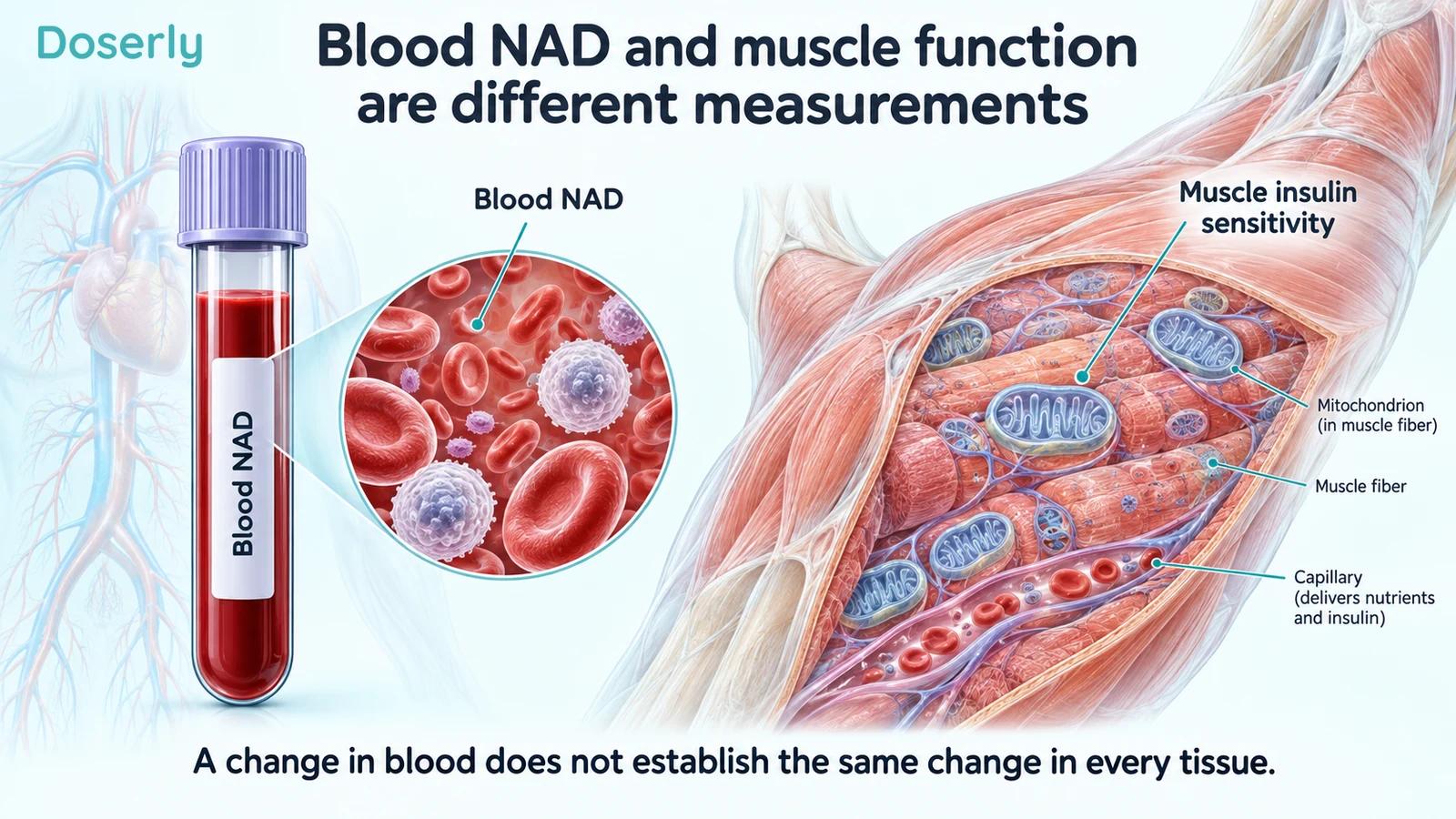
NAD is involved in reactions that transfer electrons during metabolism. Its oxidized and reduced forms, NAD+ and NADH, are related but not identical measurements. Researchers may assay whole blood, selected blood cells or tissue samples, and those results should not be treated as one universal “cellular energy level.”
Increasing a blood measurement shows that the intervention affected the pathway in the sampled material. It does not establish how much NAD changed in every organ or whether the change improved an outcome that matters to the person. The NMN trials use different measurements, populations and formulations, which is one reason their results need to be read individually. Older-men NMN trial.
This does not make a biomarker result meaningless. It is a useful step in determining whether an intervention reaches its intended biological pathway. The next question is what happens downstream: better glucose handling, improved physical function or fewer clinical problems.
The muscle-insulin finding in women with prediabetes
A 2021 randomized, blinded trial studied postmenopausal women with overweight or obesity and prediabetes for ten weeks. NMN improved insulin-stimulated glucose disposal and aspects of insulin signaling in skeletal muscle compared with the pattern seen with placebo. Yoshino and colleagues.
The official NIDDK explanation identifies 25 participants and emphasizes the tissue-specific result. Muscle became more responsive to insulin, but liver insulin response did not improve, and fasting glucose did not differ significantly between groups. NIDDK trial explanation.
Insulin sensitivity describes how effectively tissues respond to insulin’s signals. A muscle finding is relevant because muscle contributes substantially to glucose handling. It is still not equivalent to reversing prediabetes or preventing diabetes complications.
The selected population also limits generalization. The trial does not tell us that a young healthy adult, a man with diabetes or a person seeking more subjective energy would receive the same benefit. It establishes a specific physiological signal worth testing further.
Why the clamp test is more specific than a home glucose reading
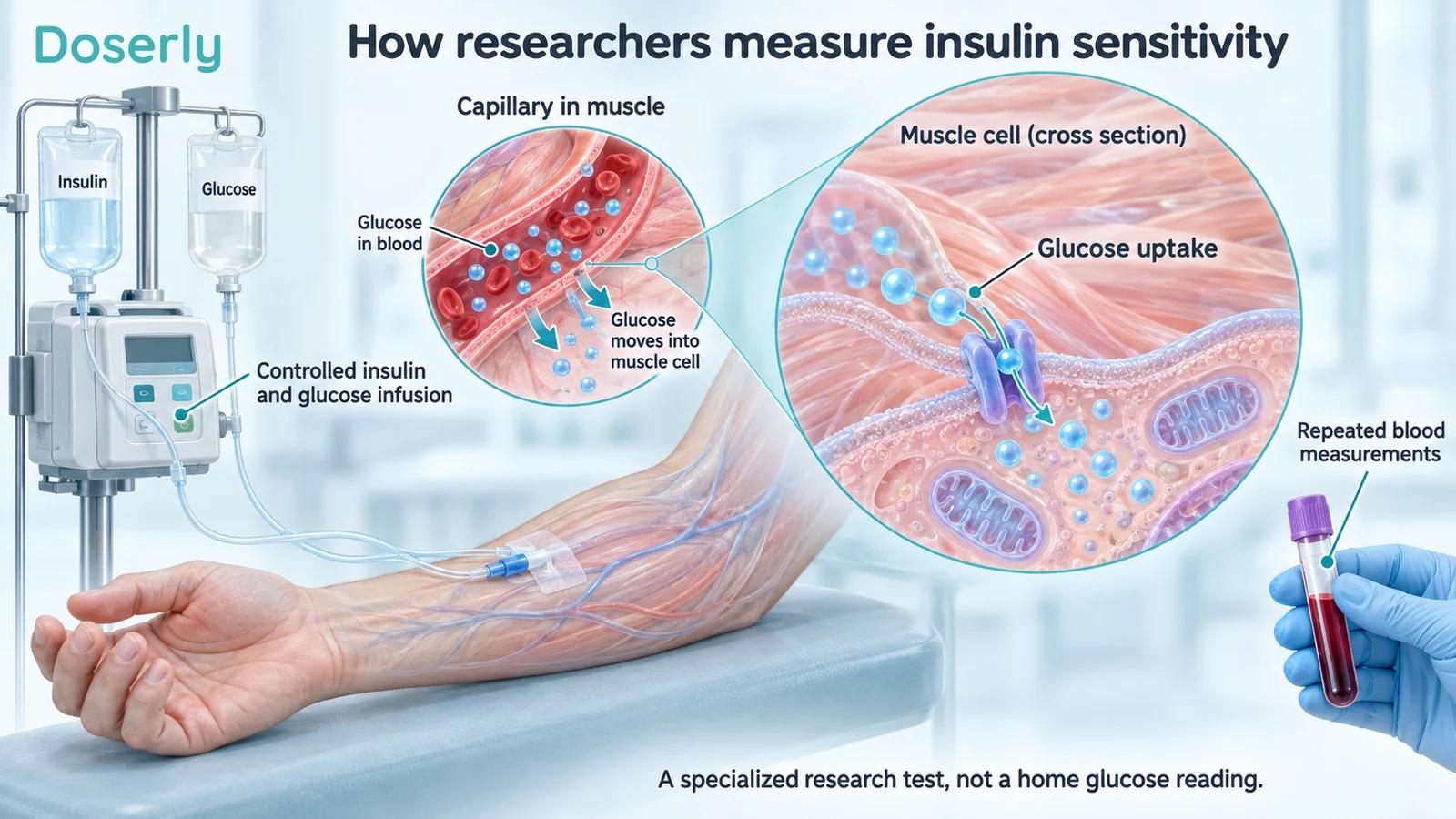
The investigators used a hyperinsulinemic-euglycemic clamp. In this research procedure, insulin is delivered under controlled conditions while glucose delivery is adjusted to keep blood glucose stable. Repeated measurements help estimate how the body responds to insulin.
The test can detect a physiological change that may not appear as a lower fasting glucose value. That helps explain why the muscle finding and the unchanged fasting result can coexist. They are different outcomes, not contradictory descriptions of the same measurement. Primary muscle-insulin study.
A home glucose meter or continuous glucose monitor does not reproduce a clamp. Changes in meals, exercise, sleep and medicines affect everyday readings, so an apparent change after starting NMN does not establish the same mechanism observed in the trial.
An older-men trial had an important operational problem
A 2022 study randomized 42 older men to 250 mg NMN daily or placebo. Blood NAD increased, and the authors reported nominally significant findings for gait speed and left-hand grip strength, without a significant body-composition effect.
However, a supplier error meant that 22 participants received the opposite supplement after the six-week visit. Their twelve-week data were excluded, leaving twenty participants for that part of the analysis. The paper reports the error openly. Igarashi and colleagues.
That limitation materially reduces confidence in a broad functional conclusion. “Nominally significant” also indicates that an individual statistical result should be interpreted cautiously when several outcomes are tested. It is not equivalent to a replicated improvement in overall strength or independence.
The useful finding is that oral NMN affected NAD metabolism under these conditions, with some functional signals requiring confirmation. The trial should not be presented as a clean, complete twelve-week demonstration in all 42 randomized participants.
What the 60-day dose-comparison trial adds
Another randomized trial enrolled 80 healthy middle-aged adults into four groups: placebo or 300, 600 or 900 mg NMN daily for sixty days. Blood NAD increased in the NMN groups. The authors also reported improvements in six-minute walking distance and some self-reported health measurements.
HOMA-IR, an estimate of insulin resistance calculated from fasting glucose and insulin, did not differ significantly from placebo at the end. The study also used a calculator described as “blood biological age,” but that computed result is not a measurement of years of life gained. Yi and colleagues.
With only about twenty participants per group and multiple secondary measurements, the results need larger independent confirmation. A dose associated with the largest short-term biomarker or walking response in one experiment is not automatically an optimal lifelong dose.
The reported amounts are study exposures, not a recommendation to escalate treatment until a laboratory number rises. A benefit assessment needs to include safety and the actual clinical goal.
Does timing improve sleep or daytime fatigue?
A twelve-week Japanese trial randomized 108 older adults into four groups: NMN or placebo taken in the morning or afternoon. The NMN amount was 250 mg daily. Researchers assessed sleep questionnaires, fatigue and physical tests.
The afternoon NMN group showed favorable changes in drowsiness and a repeated sit-to-stand task. But drowsiness also improved in the afternoon placebo group, and sit-to-stand performance improved across all groups. Sleep and physical-performance trial.
This matters when interpreting a claim that afternoon NMN is proven to improve sleep. Improvement from a group’s own starting value is not the same as clear superiority over the appropriate placebo comparison. The largest within-group effect is not automatically the largest treatment effect.
The study raises a timing question; it does not establish a universal schedule or a treatment for persistent fatigue. If fatigue is the concern, identifying its cause remains more useful than assuming it reflects low NAD.
An uncontrolled study is a different level of evidence
A 2024 report followed eleven healthy middle-aged Japanese men taking NMN for eight weeks. It found increased NAD in peripheral blood mononuclear cells, a selected group of immune cells. A small subgroup with high insulin responses after glucose loading also showed a possible metabolic change.
The study had no placebo group and was open-label, meaning participants and researchers knew treatment was being given. The insulin subgroup contained only three people. Open-label NMN study.
Such work can help establish feasibility and identify measurements for future trials. It cannot reliably separate treatment effects from normal variation, expectations or other changes over time. Three people with a favorable result do not establish a treatment for hyperinsulinemia.
Even the phrase “long-term” in a paper title needs its actual duration alongside it. Eight weeks may be useful for early research, but it is brief compared with the years implied by a longevity routine.
The September 2026 trial: more NAD without broader functional benefit
A newly published, peer-reviewed accepted report tested 1,250 mg NMN daily for twenty-four weeks in adults aged at least 65. Whole-blood NAD and related metabolites increased. The primary hearing outcome did not significantly improve, and neither did the reported physical-performance measures.
Some body-composition, lipid-related and dietary-behavior findings were nominally significant but did not remain significant after correction for multiple testing. The authors describe them as exploratory. September 2026 trial.
The publisher identifies this as an early accepted version that may receive further edits. The study was industry-funded, with relevant company employment disclosed. The accessible abstract provides the outcome pattern; it does not support an estimate of a personal hearing or mobility benefit.
This is a useful update because it directly illustrates the article’s central distinction. A sustained biochemical response can coexist with no significant improvement in the clinical measurements chosen for the trial. Raising the amount or extending observation to six months did not make those outcomes automatically positive.
How should you compare apparently conflicting results?
Put the studies side by side by population and endpoint before comparing their headlines. An insulin-sensitivity measurement in women with prediabetes and a hearing test in older adults are not competing measurements of one universal benefit. A favorable result for the first cannot rescue a neutral result for the second. Equally, the later neutral trial does not erase the earlier physiological observation. Each narrows a different question about what NMN might do.
What remains unknown about long-term use?
The trials differ in age, baseline health, duration, formulation and outcome selection. Most are relatively small, and even the twenty-four-week study does not answer whether years of use prevent disability, cancer, cardiovascular events or death.
Short-term tolerability should be described at that scale. A study that reports no major safety signal in its selected participants cannot rule out uncommon adverse effects, interactions or risks in people it did not enroll. The 2026 authors themselves call for careful safety monitoring. Twenty-four-week report.
None of these studies establishes that combining NMN with another NAD precursor or a polyphenol improves the balance of benefit and harm. That would be a new formulation with its own research question. The NAD precursor guide explains the broader category without making those combinations interchangeable.
Product identity matters too. A trial of a defined oral preparation does not automatically validate a different delivery system, a mixture with undisclosed amounts or a product whose actual contents are uncertain.
What would make an NMN discussion useful for you?
Start with the problem you want to address. Muscle insulin resistance, walking limitation, poor sleep and a general desire to live longer are different goals. The same blood NAD increase cannot stand in for all of them.
Ask which trial most closely matches your situation and which outcome improved. For prediabetes, the small muscle study is a physiological lead, not a replacement for established management. For sleep or physical performance, look at the placebo comparison and the later neutral findings as well as the favorable results.
A dated Doserly record can document products, amounts, symptoms and concurrent changes for a clinician. It cannot establish lifespan benefit or make a calculated biological-age result a treatment target. Avoid interpreting every fluctuation as proof that the pathway is working.
NMN’s human research is more informative than a simple “works” or “doesn’t work” verdict. It shows biological activity, some specific signals and important limits. The next useful step is better evidence linking that activity to durable clinical benefit—not treating the biomarker itself as the promised benefit.
Sources
- Yoshino et al., 2021.
- NIDDK explanation of the muscle-insulin trial.
- Igarashi et al., 2022.
- Yi et al., 2023.
- Kim et al., 2022.
- Open-label study, 2024.
- Twenty-four-week randomized trial, September 2026.