
HRT
October 16, 2026
Micronized Progesterone: What “Bioidentical” Can Tell You—and What It Can't
On this page
“Bioidentical” sounds as though it should settle a treatment decision. In reality, it answers a narrower question: whether a hormone's molecular structure matches a hormone made by the body. It does not tell you how much reaches a target tissue, whether a particular regimen protects the uterine lining, or whether one medicine is safer than another over many years.
Micronized progesterone is a useful example. It is available in regulated prescription products and has evidence for specific clinical uses. It is also discussed in ways that blur together molecular identity, manufacturing, symptom relief and long-term safety.
A better discussion separates those claims. The same molecule can be delivered in different formulations, and evidence for a prescribed oral regimen does not automatically validate a cream, a different schedule or a custom mixture.
What the two words actually mean
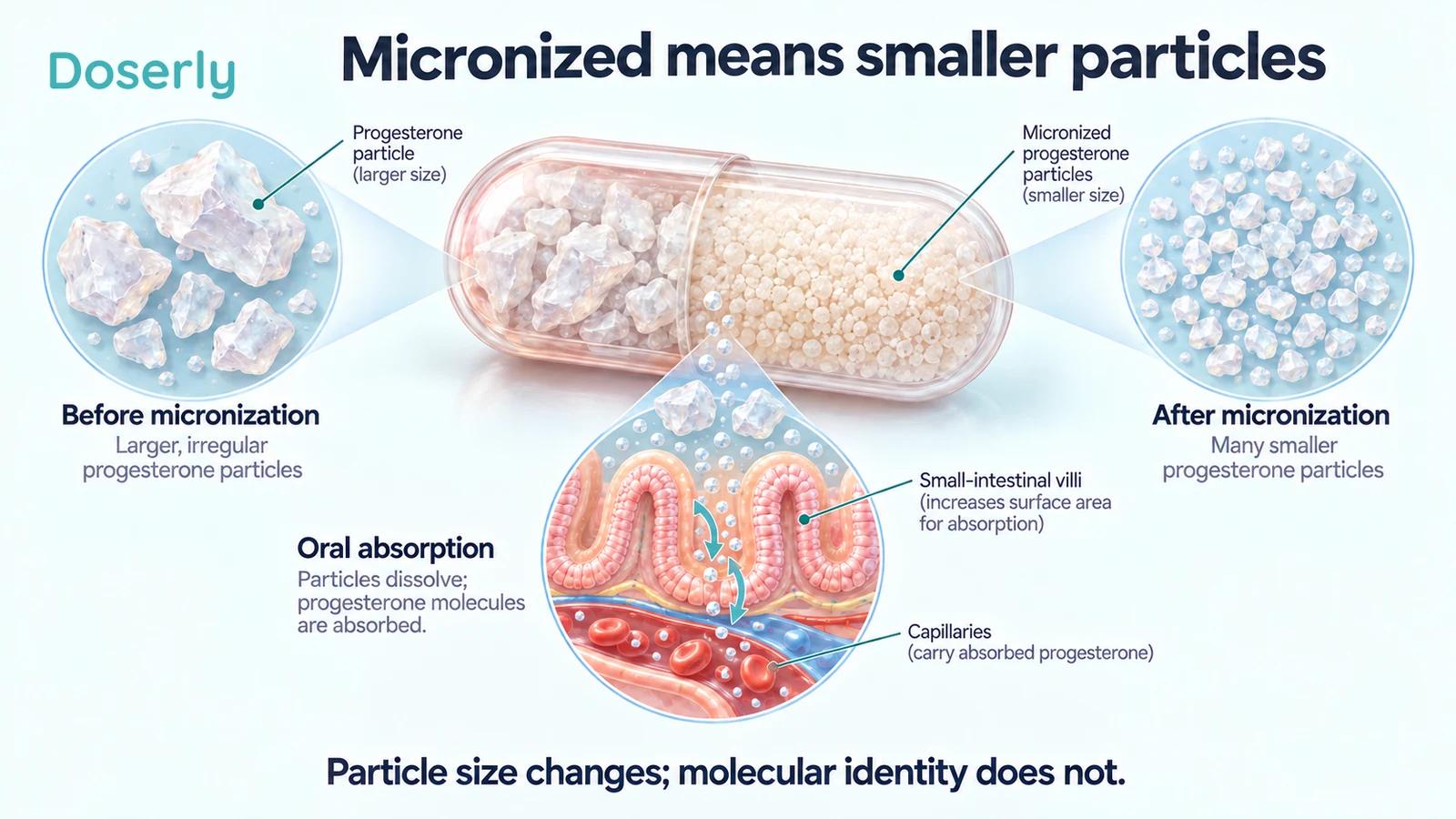
Progesterone is the hormone. “Micronized” describes a manufacturing process that reduces particle size to improve oral bioavailability. The 2026 US Prometrium label states that its progesterone is chemically identical to progesterone of ovarian origin and that micronization increases oral bioavailability. It also states that absolute bioavailability is not known. Prometrium prescribing information, 2026
That is more precise than assigning a universal absorption percentage to every oral product. Particle size, formulation and administration all belong to the delivery question; molecular identity belongs to the chemistry question. Neither alone answers the clinical-outcome question.
The term progestogen covers substances with progesterone-like activity, including progesterone and other medicines often called progestins. Different members of that group are not chemically identical, but the distinction is not a simple ranking from “natural and harmless” to “synthetic and dangerous.”
A treatment made through pharmaceutical manufacturing can contain a molecule identical to an endogenous hormone. Conversely, a molecule with that identity can still cause adverse effects. The body's ability to recognize a hormone is the reason it acts, not a guarantee that every exposure is appropriate.
Bioidentical does not mean compounded
FDA-approved medicines can contain hormones identical to those naturally produced by the body. The FDA explicitly distinguishes these products from compounded preparations marketed as bioidentical, for which it does not have evidence of greater safety or effectiveness. FDA menopause information
Compounding can meet an individual need when an appropriate approved formulation is unavailable, but it does not create a new clinical trial for the resulting product. ACOG recommends approved menopausal hormone therapies over routinely prescribing compounded alternatives when approved options exist. It also explains that potency and pharmacokinetics may be inconsistent in compounded formulations. ACOG clinical consensus, 2023
The practical question is not whether a clinic uses the word bioidentical. It is what the dispensed product actually contains, how it is manufactured, what route and schedule are prescribed, and which evidence supports the intended use.
The micronized progesterone guide can help identify common formulation questions. The compounded HRT guide addresses the separate manufacturing and oversight discussion.
Endometrial protection is a specific clinical job
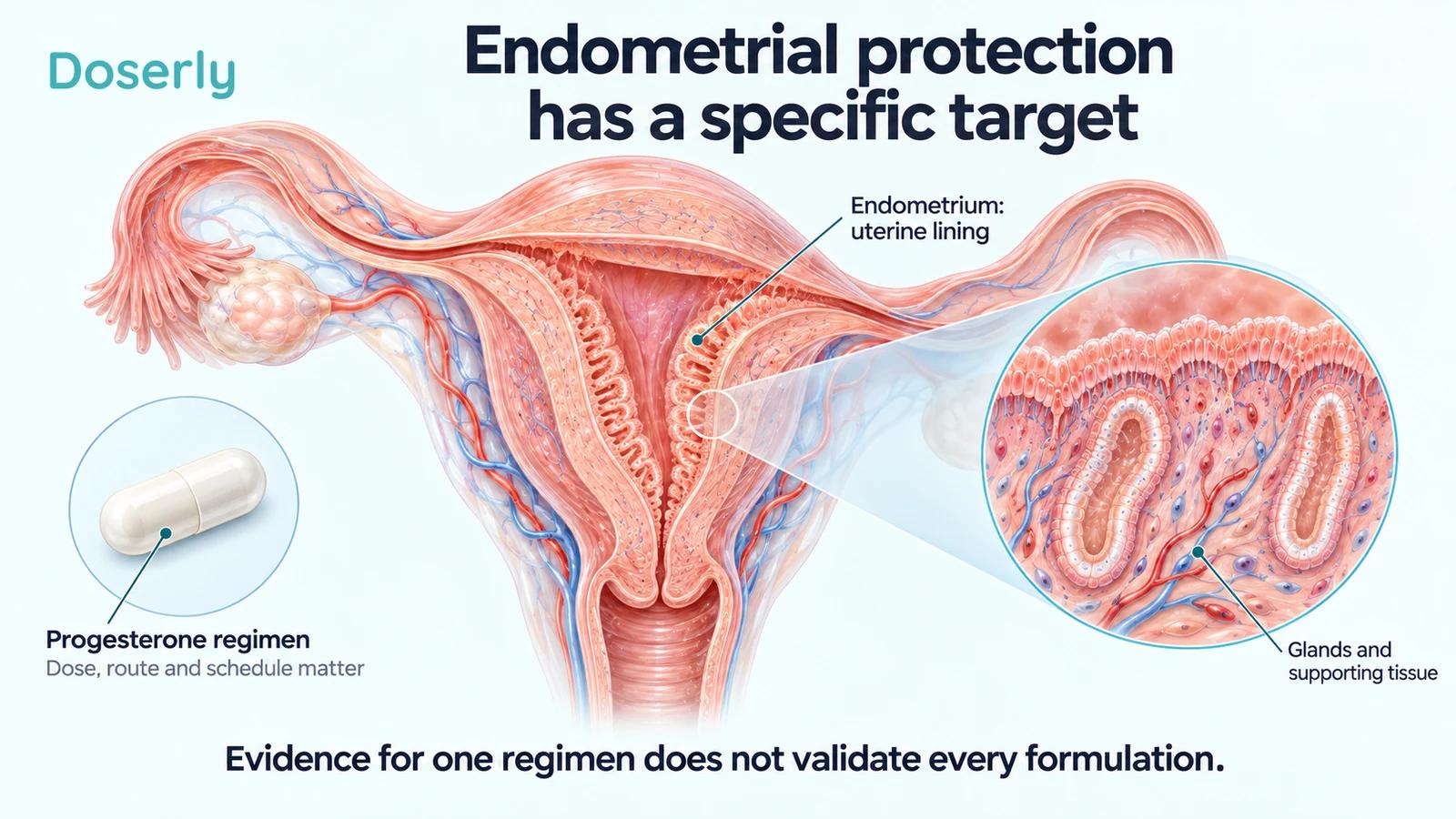
Systemic estrogen can stimulate the endometrium, the lining inside the uterus. In someone with a uterus, an appropriate progestogen regimen is generally used to oppose that stimulation. This is not primarily about whether the person notices a progesterone effect. It is about what happens in a tissue over time.
The PEPI trial directly examined endometrial histology. It randomized 596 postmenopausal women aged 45–64 to placebo, conjugated equine estrogen alone, or one of three estrogen-plus-progestogen regimens for three years. One regimen combined daily estrogen with 200 mg oral micronized progesterone for twelve days of each 28-day cycle. PEPI endometrial trial, 1996
Estrogen alone increased hyperplasia. The three combination regimens had rates of hyperplasia similar to placebo. The progesterone finding therefore supports a defined oral regimen alongside a defined estrogen dose, assessed with tissue outcomes.
It does not establish that progesterone should be taken only when someone feels unbalanced, nor that any product labeled progesterone provides equivalent protection. The tested schedule is part of the evidence, not an incidental detail that can be discarded.
Dose and schedule belong to the whole prescription
The British Menopause Society advises that progestogen exposure should be proportionate to estrogen exposure. Its clinician tool distinguishes sequential regimens, with progestogen given during part of a cycle, from continuous combined regimens, with daily progestogen. It also warns that inadequate dose or duration can compromise endometrial protection. BMS endometrial-protection guidance
This is why a dose seen online should not be copied without considering the estrogen prescription and the clinical situation. A trial dose is useful for understanding what was studied. It is not an instruction that every reader should follow that dose.
If estrogen is increased, the progestogen plan may need review. If progesterone is poorly tolerated, the response should be a discussion about alternatives, route or regimen rather than silently reducing the days taken while continuing estrogen unchanged.
A clear written schedule matters especially when estrogen and progesterone are dispensed separately. Record what each medicine is intended to do and which days it is prescribed. That prevents a symptom-relief medicine from being remembered while the protection component is treated as optional.
Breast-cancer comparisons are promising but not settled
The French E3N cohort is frequently cited in discussions of progesterone. Among 80,377 postmenopausal women followed for a mean of 8.1 postmenopausal years, estrogen-plus-progesterone use had a breast-cancer relative risk of 1.00 compared with never-use, with a confidence interval of 0.83–1.22. Estrogen combined with other progestogens had a higher estimate of 1.69. E3N cohort analysis
That difference is clinically interesting. It is also observational: participants were not randomly assigned to otherwise identical regimens differing only in progestogen. Treatment selection, duration and other characteristics may influence the comparison.
The estimate of 1.00 should not be translated into a lifetime guarantee of no breast-cancer risk. It describes a particular analysis with uncertainty and follow-up limits. Nor can it show that every micronized-progesterone combination is safer than every alternative for every outcome.
NICE's current recommendations say the evidence is insufficient to establish whether the breast-cancer risk increase differs for preparations containing micronized progesterone or dydrogesterone compared with other progestogens. That is an important qualification alongside the favorable cohort findings. NICE recommendations
A clinician may still prefer micronized progesterone for a particular person. The honest explanation should identify the supporting evidence and its limits, rather than presenting the word bioidentical as proof.
Sleep effects need their own evidence
Progesterone and its metabolites can affect the nervous system, and oral treatment may cause drowsiness. That makes sleep an understandable area of interest, but feeling sleepy is not the same outcome as treating chronic insomnia or improving next-day functioning.
One randomized study included only eight healthy postmenopausal women without sleep complaints or vasomotor symptoms. Participants received progesterone or placebo for three weeks. Sleep was similar on an undisturbed recording night; progesterone reduced disruption on the night when repeated blood sampling disturbed sleep. Laboratory sleep trial, 2011
That is useful mechanistic evidence, but it is a small laboratory experiment in people without insomnia. Its findings should not be advertised as a general guarantee of restorative sleep for everyone taking an HRT dose.
A larger Canadian trial randomized 189 perimenopausal women to 300 mg oral micronized progesterone at bedtime or placebo for three months after a baseline month. The primary vasomotor-symptom score did not differ significantly between groups. Participants reported perceived improvements in night sweats and sleep quality, which were separate outcomes. Perimenopause randomized trial, 2023
The trial was underpowered to exclude a clinically meaningful vasomotor benefit. That uncertainty cuts both ways: it does not prove no benefit, and it does not turn the nonsignificant primary result into a successful primary endpoint. The dose and progesterone-only setting also differ from many combined-HRT regimens.
Tolerability is part of effectiveness
The Prometrium label warns about dizziness and drowsiness and directs bedtime administration. It also lists peanut oil among the inactive ingredients and contraindicates use in people allergic to peanuts. Those are product-specific details that the reassuring word bioidentical does not convey. Prometrium prescribing information, 2026
Check the ingredients of the actual dispensed product rather than assuming every brand or generic uses the same excipients. Tell the prescriber about troublesome sedation, dizziness or other symptoms, especially if they interfere with taking the regimen as directed.
A medication that is theoretically suitable but repeatedly skipped because of adverse effects is not functioning as the prescribed regimen. That is a reason to revisit the plan, not a personal failure. There may be other progestogen options or clinician-directed approaches suited to the person's circumstances.
The BMS notes that vaginal progesterone use within HRT may be considered in some situations but has limited evidence and may be outside the product license. Changing route is therefore a prescribing decision, not a simple workaround based on the fact that the capsule contains the same molecule. BMS endometrial-protection guidance
Ask what the evidence is proving
When evaluating a claim, identify the endpoint. A study of uterine biopsy results addresses endometrial protection. A sleep study addresses sleep under its particular conditions. A cohort examining breast-cancer incidence addresses an association over follow-up. None can stand in for all the others.
Then identify the product and comparison. Oral micronized progesterone with estrogen, progesterone alone and progesterone applied to skin are different exposures. A favorable comparison against one progestin does not establish superiority over every available regimen.
Finally, ask whether the proposed use matches the population studied. Perimenopausal participants with fluctuating cycles, healthy postmenopausal volunteers and people with substantial medical histories are not automatically interchangeable.
These questions are practical tools for a consultation. They help turn a broad claim such as “this is safer” into a discussion about which outcome, compared with what, for whom, and with how much certainty.
Keep the identity and the regimen in the same record
For follow-up, record the product name, route, prescribed schedule, estrogen regimen and any changes. If symptoms occur on particular days, note those dates without assuming the pattern proves causation. Include missed doses and the reason for them; that information can materially change the review.
Doserly can keep those details alongside sleep, bleeding and other symptom notes. It cannot confirm endometrial protection from a symptom score or determine whether a treatment is appropriate. The value is a more accurate account of what was prescribed and what was actually taken.
Micronized progesterone has a legitimate evidence base and a specific place in menopause care. “Bioidentical” describes its molecular relationship to endogenous progesterone. The decisions that matter still depend on formulation, exposure, clinical purpose and the strength of the evidence for each outcome.
Sources
- FDA Prometrium prescribing information (2026)
- FDA menopause information
- ACOG compounded bioidentical menopausal hormone therapy consensus (2023)
- PEPI endometrial histology randomized trial (1996)
- BMS progestogens and endometrial protection, current PDF
- E3N cohort: breast-cancer associations by HRT type
- NICE menopause recommendations
- Progesterone laboratory sleep randomized trial (2011)
- Perimenopause progesterone randomized trial (2023)