
HRT
October 16, 2026
Menopause-specific CBT: treating symptom burden is a real outcome
On this page
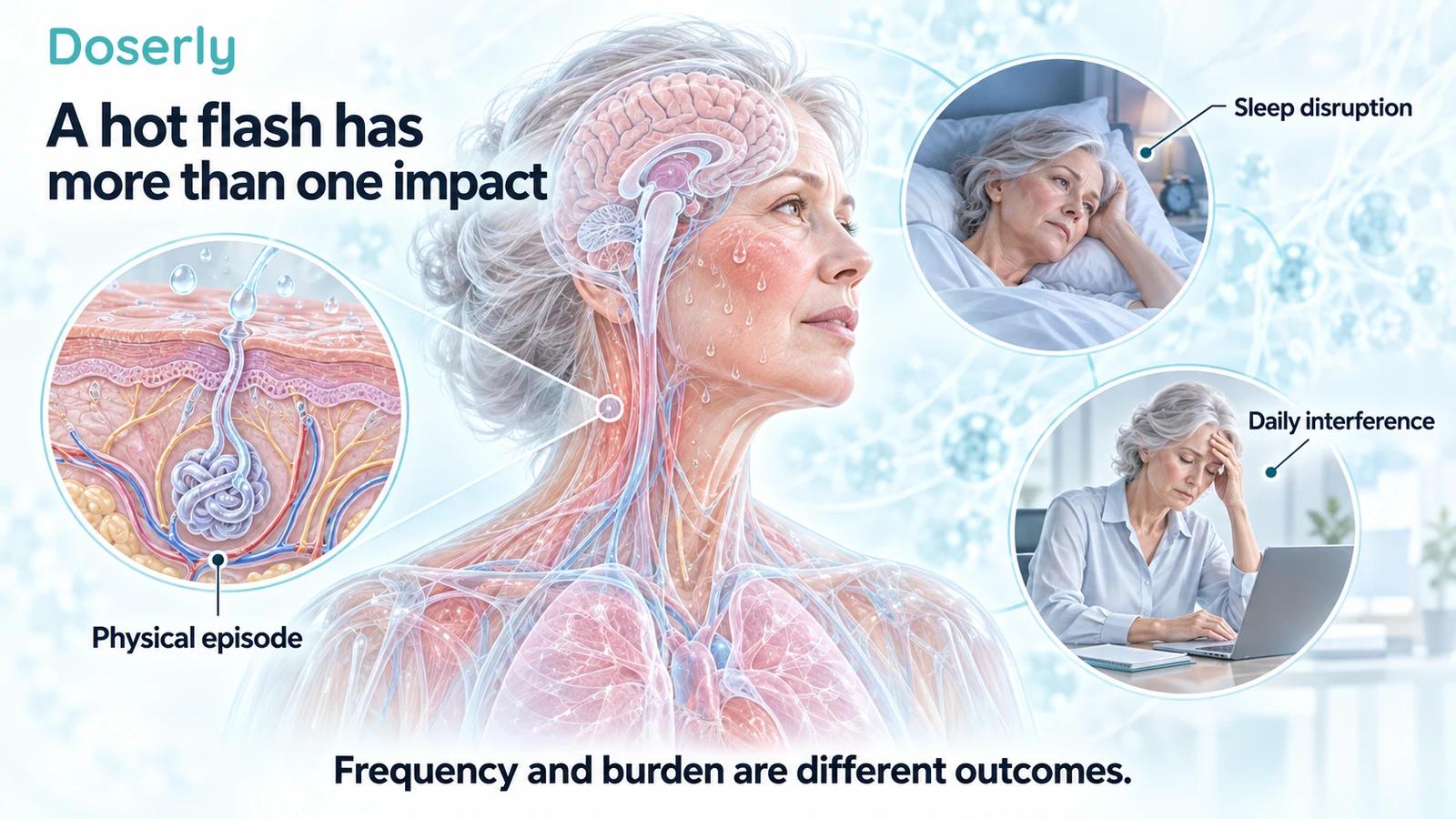
A hot flash can last minutes and disrupt much more than those minutes. It may interrupt a presentation, start a cycle of worry about the next episode, or leave someone awake long after the sweating has stopped. Reducing that disruption is a legitimate treatment goal, even when a therapy does not eliminate every physical episode.
That is the central idea behind menopause-specific cognitive behavioral therapy, or CBT. It is a structured approach to the thoughts, behaviors and sleep patterns surrounding symptoms. Its evidence should be judged by what the programs actually measured, not by assuming that psychological treatment means the symptoms are imaginary—or by promising that changing thoughts will switch off menopause physiology.
Frequency, severity and burden ask different questions
Frequency is how often a symptom occurs. Severity describes the intensity of an episode. Burden includes how distressing, bothersome or disruptive the experience is. These measures overlap, but they are not interchangeable.
Consider someone who still experiences a hot flash during a meeting but no longer feels compelled to leave the room or spend the next hour anticipating another one. The episode count may be unchanged while interference falls. Another person may have fewer night sweats yet remain awake with persistent insomnia. A lower count does not automatically mean that sleep or daily function has recovered.
These are illustrative examples, not promises about a particular treatment. Their purpose is to show why a study can legitimately select symptom bother or daily interference as an outcome. What a person wants to improve should also shape the treatment discussion. A clinician should not decide that fewer episodes are the only valid success—or that feeling less bothered is enough when the person still wants help with severe physical symptoms.
What menopause-specific CBT involves
The studied programs are more than general encouragement to relax. In MENOS 1, for example, participants attended six weekly 90-minute group sessions. The program included education about symptoms, discussion of reactions and avoidance, practical sleep strategies, home practice and planning for setbacks. It used a treatment manual and trained delivery, rather than an undefined package of wellness advice. MENOS 1 primary report.
A person might work on the expectation that an episode will make a social situation impossible, identify what happens after waking with a night sweat, or practice returning to an activity instead of avoiding it. The aim is to make the symptom experience more manageable. It is not to argue someone out of accurately noticing heat, sweating, exhaustion or the need for medical assessment.
The word “specific” matters. A generic meditation app, a motivational course and a structured menopause-focused CBT program are not automatically the same intervention. Nor can one component inherit the evidence for the entire package. If a program included several techniques, the trial generally cannot tell us that one breathing exercise alone produced the result.
MENOS 1 demonstrated the difference between burden and count
MENOS 1 randomized 96 women with problematic hot flashes and night sweats after breast-cancer treatment to usual care or usual care plus group CBT. The primary outcome was a problem rating reflecting how bothersome and disruptive the symptoms were. At nine weeks, the adjusted difference favored CBT by 1.67 points on the ten-point scale; a benefit was also present at 26 weeks. MENOS 1.
The frequency findings were different. The study did not find a significant between-group difference in reported hot-flash and night-sweat frequency at either follow-up. Physiological monitoring also did not establish a clear reduction attributable to CBT. That makes the study especially useful for understanding the outcome: the evidence of reduced burden should not be rewritten as evidence that CBT stopped the underlying episodes.
The breast-cancer context matters too. Treatment choices can be constrained in this population, and symptoms may be associated with cancer treatment as well as natural menopause. A positive result in that setting is valuable, but the participants should not disappear from the description when the finding is applied to a broader audience.
There are also design limitations. Participants knew whether they attended therapy, and the usual-care comparison did not fully match the additional attention provided by group sessions. Self-reported outcomes remain important, but expectations and contact can contribute to them. These limitations qualify the interpretation; they do not turn the reported improvement into an invalid experience.
MENOS 2 extended the question to group and self-help formats
MENOS 2 enrolled 140 women with at least ten problematic hot flashes or night sweats per week. It compared group CBT and guided self-help CBT with a no-treatment control. At six weeks, both formats improved the problem rating by about two points more than control; smaller differences remained at 26 weeks. The trial also reported reductions in night-sweat frequency. MENOS 2 primary report.
That last finding is a reason to avoid the opposite oversimplification: it is too strong to say CBT can never affect reported frequency. Results vary by trial, symptom type and measurement. The more defensible conclusion is that improvement in burden is a central, directly studied benefit, while frequency effects are not uniform enough to promise elimination of episodes.
The format results also offer a useful access perspective. A program does not always have to be delivered in the same room as a therapist to be studied. But a guided self-help intervention is still a defined intervention, with materials and support. Its evidence should not be transferred to every product described as self-help.
For someone choosing a service, the practical questions are what it contains, what guidance is available, how much practice it requires and whether the content is appropriate to the person's symptoms. A format that worked on average in a trial may be difficult for an individual because of language, disability, work patterns, caring responsibilities or digital access.
CBT for insomnia has a more specific sleep target
Menopause-specific CBT and CBT for insomnia, usually called CBT-I, overlap but are not identical labels. A program focused on hot-flash burden may include sleep strategies; CBT-I directly targets persistent insomnia using a structured sleep intervention.
In a MsFLASH trial, 106 perimenopausal or postmenopausal women with insomnia symptoms and frequent hot flashes received telephone-delivered CBT-I or menopause education. Six sessions were delivered over eight weeks. Insomnia Severity Index scores fell by 9.9 points in the CBT-I group versus 4.7 points with education. Daily hot-flash frequency did not differ significantly between groups, while hot-flash interference improved more with CBT-I. MsFLASH insomnia trial.
This is another example of a useful benefit that is not explained by fewer counted episodes alone. It also shows why someone whose main problem is prolonged wakefulness may need a different treatment emphasis from someone whose main problem is embarrassment during daytime flushing.
CBT-I should not be reduced to a list of sleep-hygiene tips or a self-directed instruction to spend less time in bed. The studied intervention was structured and supported. The clinician or qualified therapist should consider other sleep problems and the person's situation when choosing an approach. Persistent unrefreshing sleep, breathing concerns or marked daytime sleepiness deserve assessment rather than being automatically assigned to menopause-related worry.

What NICE recommends—and what it does not
NICE's menopause guideline recommends considering menopause-specific CBT for vasomotor symptoms alongside HRT, when HRT is contraindicated, or when a person prefers not to take HRT. It also includes menopause-specific CBT for sleep problems associated with vasomotor symptoms and CBT for associated depressive symptoms that do not meet criteria for a depression diagnosis. NICE recommendations.
“Consider” is meaningful wording. It invites a discussion about suitability and preference; it is not a requirement to complete therapy before being allowed a medication discussion. NICE continues to recommend offering HRT for menopause-associated vasomotor symptoms. The presence of CBT in the guideline does not erase that recommendation.
The evidence review also acknowledges variability. Benefits differed by outcome measure, and the evidence quality for vasomotor outcomes ranged from moderate to very low. The guideline's rationale supports discussing several delivery formats without claiming that one format has been proved best for everyone. NICE evidence review, NICE rationale.
Those qualifications make the recommendation more useful. They explain why a reasonable person might choose CBT alongside medication, prefer a different option, or stop a program that does not help. Treatment is not a test of attitude or willingness to cope.
A respectful offer of therapy starts with validation
Someone who has repeatedly been told that symptoms are “just stress” may understandably hear a therapy referral as another dismissal. A good explanation should name the physical symptoms, explain the intended outcome and preserve access to medical evaluation. The question is whether a structured intervention can reduce an additional layer of disruption, not whether the person has earned help by coping better.
A useful offer might be: “We can discuss treatment for the hot flashes, and this program may also help with the worry and wakefulness that follow them.” That wording makes room for several treatment targets. It does not force a choice between acknowledging physiology and addressing behavior.
The same principle applies when treatment falls short. If symptoms remain severe, the next step is to review the diagnosis, program fit, access barriers and other options. It is not appropriate to infer that the person failed to think positively enough. A limited response is clinical information, just as it is with a medicine.
Make the program concrete before committing time
Ask whether the service uses a menopause-specific approach, a CBT-I approach or general CBT, and what outcomes it is designed to address. Clarify who provides support, how sessions are delivered, what home practice is expected and how progress will be reviewed. These details help distinguish a studied approach from a broad wellness label.
NICE acknowledges that access can be difficult and that clinicians trained in CBT may not be familiar with menopause-specific work. Waiting times and local availability therefore belong in the plan. A referral that cannot be accessed is not equivalent to receiving the treatment. NICE access information.
Before the first session, choose a small number of goals in ordinary language. Examples include returning to sleep more easily after a sweat, remaining in a meeting despite a flash, or spending less time worrying about an episode. Keep symptom frequency separate if reducing the number is also important. That makes it possible to recognize partial benefit without pretending that every treatment goal has been met.
At follow-up, discuss what changed in daily life, what remained difficult and whether the practice burden was manageable. Medication changes, major stressors or changes in sleep opportunity may also affect the picture. The aim is useful feedback, not proving that a single intervention deserves all the credit.
Keep other health needs visible
A program designed for menopause symptom burden does not replace treatment for a diagnosed depressive disorder or an independent sleep disorder. NICE explicitly directs clinicians to manage suspected or diagnosed depression using the relevant depression guidance alongside menopause care. NICE recommendations.
The Doserly menopause and mental-health guide provides broader context, while the nonhormonal treatment guide describes other symptom-treatment options. Menopause-specific CBT fits within that range of care. Its strongest practical argument is straightforward: less distress, better sleep and less interference can be worthwhile outcomes, provided the person chooses those goals and the evidence is described accurately.
Explore the research
- MENOS 1 randomized trial.
- MENOS 2 randomized trial.
- MsFLASH telephone CBT-I trial.
- NICE menopause recommendations.
- NICE CBT evidence review, 2024.
- NICE rationale and impact.
- NICE access to CBT information.