
HRT
October 16, 2026
Menopause hormone pellets: what happens if treatment needs to change?
On this page
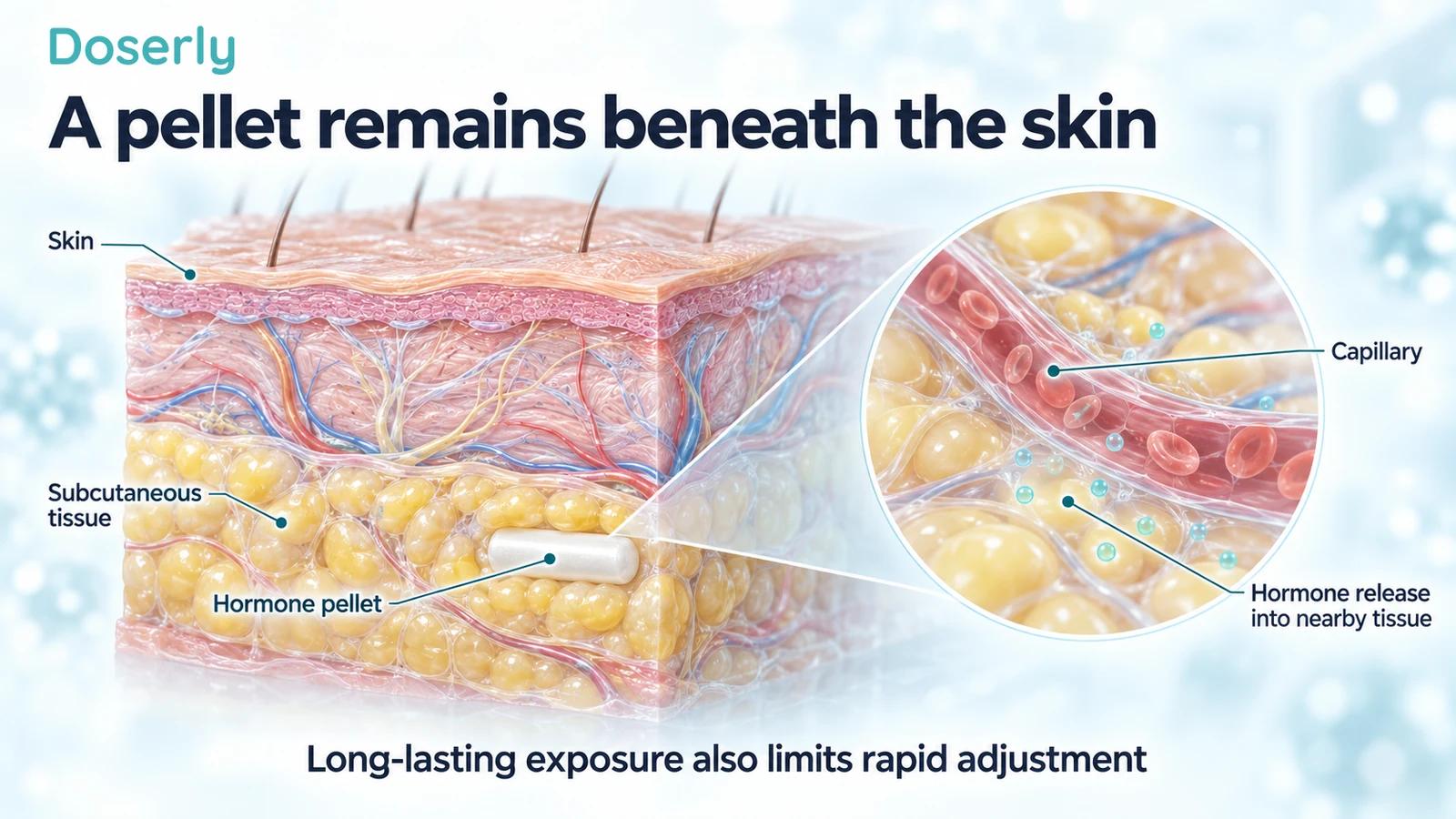
A hormone treatment that lasts for months can sound appealing when daily tablets, gels or patches feel inconvenient. Pellets are small implants placed beneath the skin, where they release hormone over time. For someone seeking relief from menopause symptoms, fewer daily tasks may be a genuine advantage.
The question to ask before implantation is equally practical: what happens if the treatment is not right for you? Symptoms can change, adverse effects can emerge and hormone exposure can be higher than intended. A long duration then becomes part of the problem to manage, rather than simply a convenience.
This article focuses on compounded hormone pellets offered for menopause care, often containing estradiol, testosterone or both. It does not assume that every implant has the same composition or regulatory status. The exact product, indication and country matter. Our compounded bioidentical HRT guide explains those distinctions in more detail.
Long-acting is not the same as easily adjustable
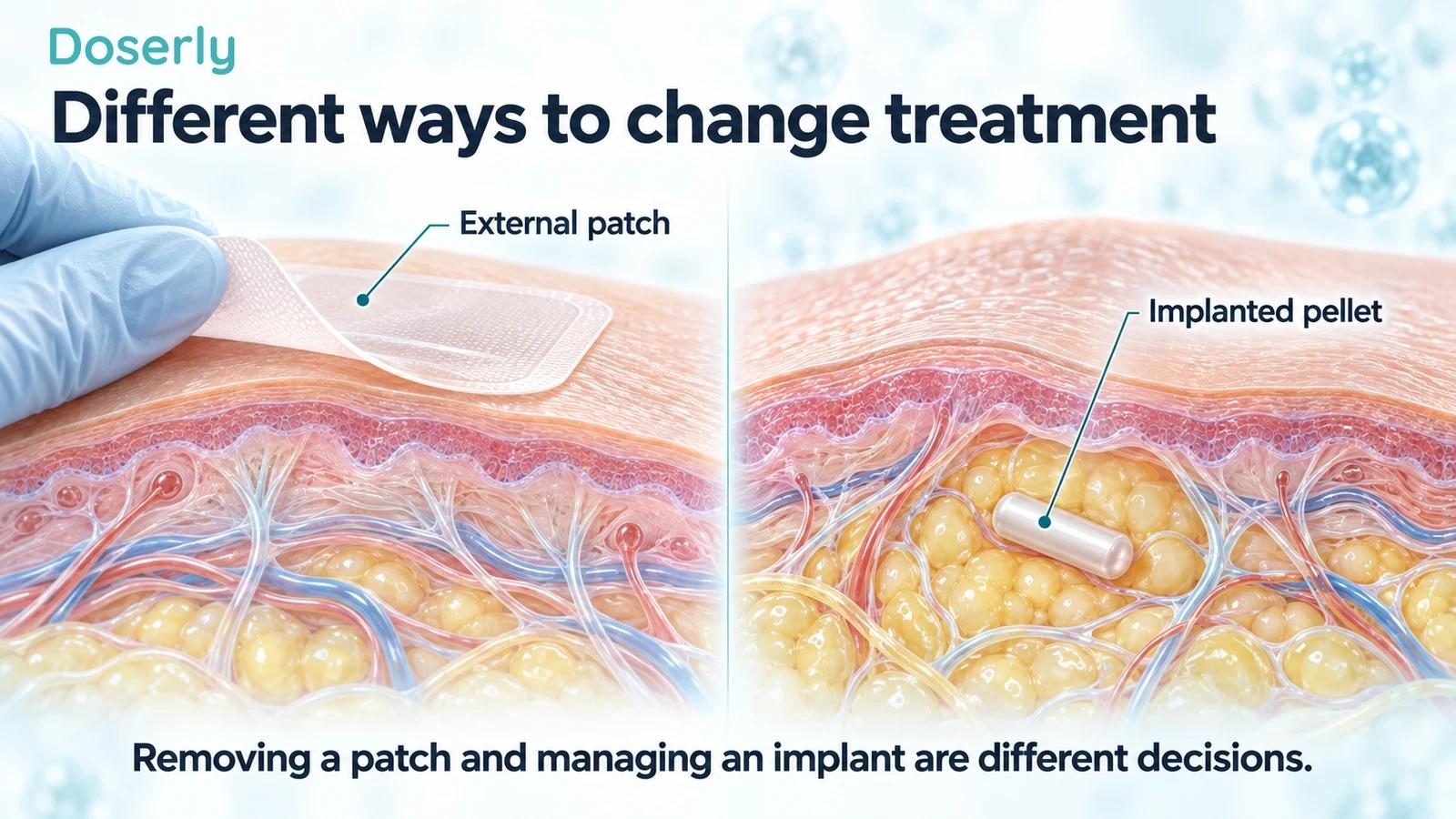
With a daily medicine, the next dose can often be changed under medical supervision. An external patch can be removed, although its effects do not necessarily disappear immediately. An implanted pellet is different: the dose has already been placed beneath the skin and may continue releasing hormone.
ACOG recommends alternatives to testosterone pellets because of limited safety evidence and concerns about removal. Its broader recommendation is to use approved menopausal hormone products when they can meet the patient's needs rather than routinely choosing compounded products. ACOG clinical consensus
This does not mean every pellet is literally impossible to remove in every circumstance. It means stopping exposure is not the routine equivalent of peeling off a patch or omitting the next tablet. Before a procedure, the clinician should explain whether removal is feasible, when it might be considered and what management is possible if symptoms persist while the implant remains active.
The distinction matters particularly when trying a hormone for the first time. If you do not yet know whether a formulation helps or causes unwanted effects, the ability to adjust treatment is part of its usefulness. Convenience and flexibility should both be included in the decision.
What “bioidentical” does—and does not—tell you
“Bioidentical” generally describes a hormone with the same molecular structure as one made by the body. It does not identify a manufacturing standard, approved indication, dose or delivery method. Some approved medicines contain estradiol or progesterone matching endogenous hormones; compounding is not required simply to obtain such ingredients.
FDA states that it does not have evidence that compounded bioidentical hormones are safer or more effective than approved menopause hormone therapies. Compounded preparations have not undergone the same premarket review for safety, effectiveness and quality. FDA menopause information
An ingredient can therefore be familiar while a particular formulation remains inadequately studied. The amount delivered, consistency between preparations and duration of exposure all matter. A reassuring word on a brochure cannot answer those questions.
The useful follow-up is specific: “What exactly is in this implant, who prepares it, and what evidence applies to this preparation?” If the answer refers only to general benefits of estrogen or testosterone, it has not yet addressed the product being proposed.
Why the formulation needs its own evidence
A medicine's route affects how hormone reaches the circulation and how exposure changes over time. Evidence for one route does not automatically establish the performance of another. This is especially important when a clinic uses findings from transdermal testosterone studies to promote implanted testosterone.
The global testosterone consensus supports treatment for carefully assessed postmenopausal HSDD, or distressing low sexual desire, using exposures appropriate to female physiology. It does not recommend preparations that produce supraphysiological concentrations, including pellets or injections when they do so. Global testosterone consensus
That leaves several questions a product-specific study would need to answer: how consistently it delivers hormone, what symptom improves compared with a suitable alternative, how often adverse effects occur and how they are managed. Demonstrating that hormone levels rise is only one part of the answer. A higher concentration is not itself proof of a better outcome.
A claim that a pellet is “steady” also needs evidence of the actual concentration pattern. Long release does not guarantee the same exposure in every patient or prove that symptoms will track neatly with blood levels. It is reasonable to ask for the product-specific basis of that claim.
What a comparative medical-record study found
A 2021 study reviewed records from 539 postmenopausal women, including 384 receiving pellet hormone therapy and 155 receiving approved hormone therapy. Reported side effects occurred in 57.6% of pellet users and 14.8% of the comparison group. Among women who had a uterus before treatment, abnormal bleeding was recorded in 136 of 246 pellet users, or 55.3%, and 12 of 79 comparison patients, or 15.2%. Peak estradiol and testosterone measurements were also higher in the pellet group. Jiang and colleagues
These are concerning associations, not randomized estimates of the risk caused by every pellet. Patients, prescribing choices, doses and documentation may have differed between groups. The findings cannot tell a new patient that her personal probability of an adverse effect is exactly 57.6%.
They do show why broad assurances of superior safety are unwarranted. A comparative observational study reporting higher exposure and more adverse effects deserves attention, while its design prevents a simple causal ranking of every possible preparation.
What adverse-event reports can reveal
FDA has also discussed reports involving compounded hormone pellets. In a 2019 statement, it explained that many reports lacked the detail needed for confident attribution. The agency could attribute a limited subset, including pellet extrusion and cellulitis, to compounded testosterone pellets. Extrusion means an implant emerges through the skin; cellulitis is an infection of skin and nearby tissue. FDA adverse-event reporting statement
Such reports help identify potential problems, but they do not provide a reliable event rate. We do not necessarily know how many people received the product, whether every event was reported or what other factors contributed. A report is neither proof that a product caused every listed symptom nor something to ignore because it is not a randomized trial.
For a person considering implantation, the practical implication is to ask about both hormone effects and procedure-related complications. A treatment can involve risks from what it releases and from the process of placing an implant. A good consent discussion covers both.
How strong is the broader compounded-hormone evidence?
At FDA's request, the National Academies examined the clinical utility of compounded bioidentical hormone therapy. Its 2020 assessment found limited high-quality evidence supporting claims of safety and effectiveness and highlighted concerns about inconsistent information and oversight. FDA summarizes those conclusions on its compounding site. FDA summary of the National Academies assessment
This is not a finding that every compounded prescription is inappropriate. Compounding can meet a specific need when a suitable commercial product cannot. It is a reason to ask why compounding is necessary in the individual case and whether an approved alternative can provide the required ingredient and route.
Nor does an evidence gap mean symptom relief cannot occur. Hormones are biologically active, and people may feel better. The unresolved question is whether a particular product provides a favorable and predictable balance of benefit and harm compared with available options. Testimonials cannot measure that balance on their own.
Uterine protection remains a separate responsibility
For someone with a uterus receiving systemic estrogen, the plan generally needs adequate progestogen to protect the uterine lining. Testosterone is not a substitute for that protection. The delivery of estrogen through an implant does not remove the need to consider the endometrium.
FDA advises discussing whether both estrogen and progestogen are needed and notes the uterine-cancer concern with estrogen alone in people with a uterus. FDA menopause information
Ask how protection will be provided, what happens if doses are missed or not tolerated, and how new bleeding will be evaluated. A blood hormone level alone does not establish that the lining is adequately protected. Bleeding should not automatically be explained away as an expected sign that the pellet is “working.”
This is one reason a seemingly simple implant can still require ongoing medication and follow-up. Fewer tasks associated with one part of treatment do not necessarily mean the entire regimen is simpler.
Blood tests cannot make every uncertainty disappear
Selected blood tests may help a clinician investigate unexpectedly high exposure, especially with testosterone. They do not establish that an implant is clinically effective, prove long-term safety or replace assessment of symptoms and adverse effects. ACOG also cautions against using unvalidated hormone tests as a routine basis for customizing compounded treatment. ACOG consensus
Before paying for a testing package, ask what each result will change. If a level is higher than intended, what action is possible while the pellet remains in place? If symptoms return while the level remains elevated, will the clinician reassess other explanations before adding more hormone?
The answer should connect testing to a concrete plan. Repeating measurements without an agreed response does not solve the problem of a long-acting exposure. Our HRT monitoring guide explains how symptoms, history and selected investigations fit together.
Questions to settle before the procedure
The most helpful conversation starts with the symptom and the alternatives. Ask which outcome the pellet is intended to improve and whether evidence supports the exact ingredient, formulation and exposure. Then ask why this route is preferable in your situation to a more adjustable option.
The follow-up plan should be equally clear. Who will respond to unwanted effects? What symptoms need prompt contact? What will happen if hormone levels are higher than intended, if bleeding develops or if the insertion site becomes painful, red or drains? How will further implantation be decided rather than simply scheduled automatically?
Ask for the product details and treatment record in a form you can share with another clinician. This is especially useful if you move, change clinics or need care before the next planned visit. Knowing the ingredient, amount, insertion date and prescriber helps the next team understand the exposure already present.
If you already have pellets, the same questions remain useful. Do not attempt removal or make compensating hormone changes yourself. Seek a medication review, describe symptoms accurately and discuss the plan before another procedure. Feeling better is relevant; so are tolerability, ongoing exposure and whether the original treatment goal is still appropriate.
The decision is more informed when it includes what happens after implantation, including what happens if the plan needs to change.
Explore the research
- ACOG clinical consensus, 2023: compounded therapy and pellet-specific concerns.
- Jiang and colleagues, 2021: comparative retrospective records, not a randomized safety trial.
- FDA adverse-event reporting statement, 2019: pellet reports and attribution limits.
- FDA summary of the National Academies assessment, 2020: gaps in compounded-hormone evidence.
- FDA menopause information: approved versus compounded treatment and uterine protection.
- Global testosterone consensus, 2019: indication and exposure limits.