
HRT
October 16, 2026
Menopause Brain Fog: Why Dementia-Prevention Claims Go Too Far
On this page
Losing a familiar word during a meeting can feel different when it starts happening around menopause. You may wonder whether the problem is poor sleep, changing hormones, stress—or the first sign of something more serious. Those questions deserve attention without turning every lapse into a forecast of dementia.
The evidence supports a careful distinction. Cognitive changes can occur during the menopause transition. Hormone therapy may be appropriate for menopausal symptoms. Neither statement establishes that starting hormone therapy prevents Alzheimer disease or other dementias.
That distinction matters especially after the FDA’s 2026 hormone-label changes. Removing a warning from a prominent box is a regulatory change, not a new trial demonstrating dementia prevention. The useful question is what a study actually measured, in whom, and for how long.
Brain fog is a description, not a dementia diagnosis
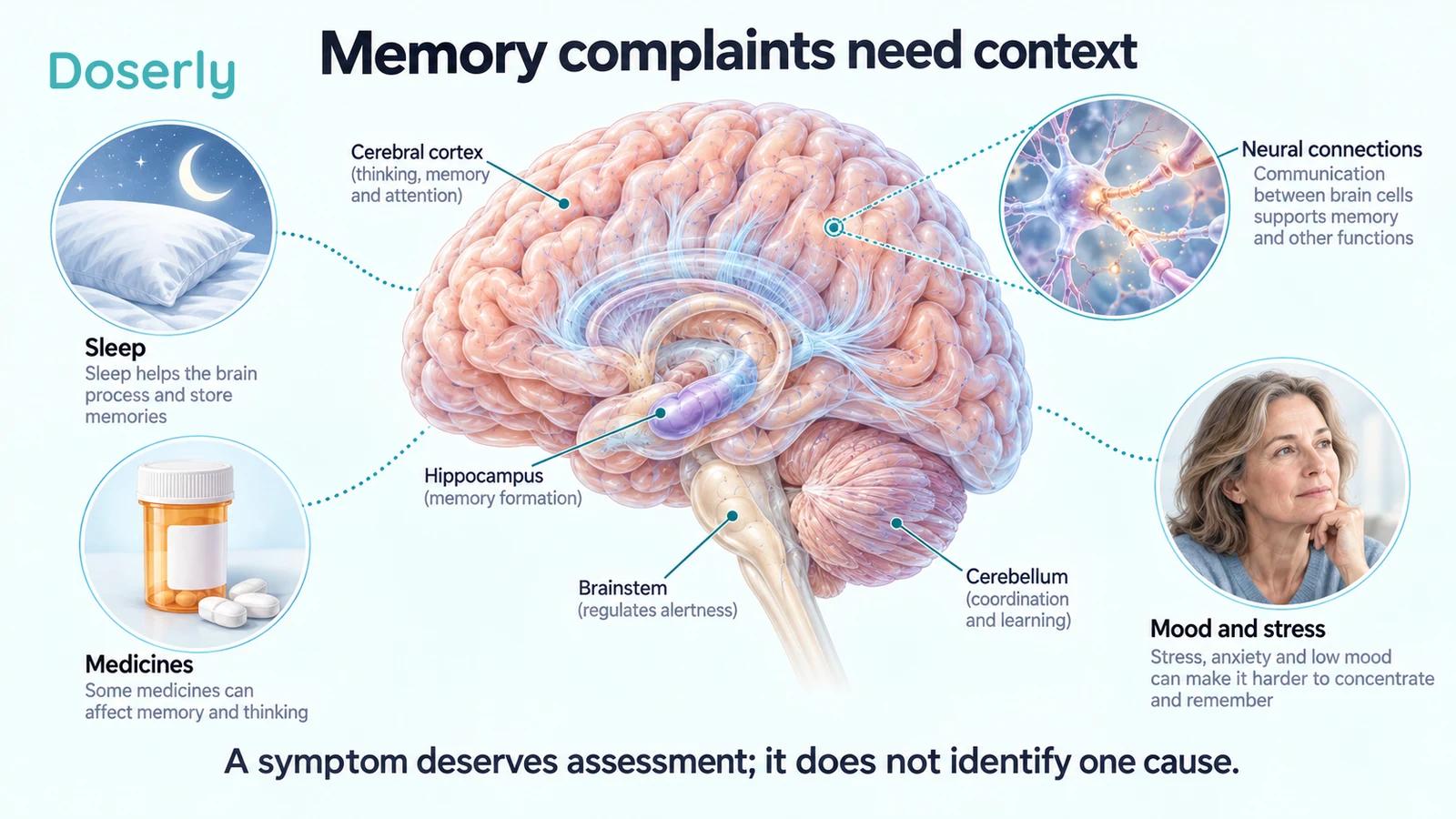
“Brain fog” is an everyday label for experiences such as difficulty concentrating, finding words or keeping information in mind. It tells a clinician what you are noticing; it does not identify a single cause or establish a particular disease.
Research uses several different outcomes. A questionnaire can measure how troublesome memory feels. A standardized test can measure performance on a specific task. A clinical dementia assessment asks a much broader question about cognitive decline and its effect on everyday functioning. Improvement in one outcome cannot simply be substituted for improvement in another.
This is also why a photograph of a brain, a plausible hormone mechanism or a personal account of feeling clearer cannot establish prevention. Those observations may help generate questions. A prevention claim needs evidence that the treatment changes the later clinical outcome.
What the menopause-transition research actually found
The Study of Women’s Health Across the Nation followed 2,362 women for four years and tested processing speed, verbal memory and working memory. Its findings help explain why some women notice changes without showing that menopause inevitably produces progressive cognitive deterioration. SWAN cognitive study, 2009
A key detail was the expected improvement from taking a test repeatedly. Processing-speed scores improved with repeated testing before menopause, in early perimenopause and after menopause, but that improvement was absent in late perimenopause. The usual improvement in verbal recall was absent during early and late perimenopause and returned after menopause.
That is more specific than “women lost their memory.” The study detected changes in learning across repeated assessments, with a pattern suggesting that some transition-related effects were temporary. It did not show that every woman develops brain fog, that all symptoms resolve on a particular schedule, or that the findings predict dementia.
SWAN was observational. Its hormone-use findings cannot establish that prescribing hormones causes better cognition. Treatment users and nonusers can differ in ways that matter to test performance and health. The study describes a transition; it does not supply a dementia-prevention prescription.
The older-women trial behind the dementia warning
The Women’s Health Initiative Memory Study, or WHIMS, provides randomized evidence that must be interpreted in its actual population. The combined-treatment trial enrolled 4,532 women aged 65 or older without probable dementia at baseline. It compared daily oral conjugated equine estrogen plus medroxyprogesterone acetate with placebo. WHIMS combined-treatment trial, 2003
Over approximately four years, probable dementia occurred in 40 women assigned hormones and 21 assigned placebo. Rates were 45 versus 22 cases per 10,000 person-years: about 23 additional cases per 10,000 person-years in the hormone group. The hazard ratio was 2.05, with a 95% confidence interval of 1.21–3.48.
The rate denominator matters. Those numbers are not percentages of all women, and they are not the number of cases expected after one prescription. They describe incidence over accumulated follow-up in this particular trial.
The result supports concern about initiating that regimen in women aged 65 and older. It does not directly estimate the effect of a different regimen started during perimenopause. Equally, excluding younger women from the trial does not supply evidence that younger initiation prevents dementia. An unanswered question remains unanswered in both directions.
The estrogen-alone WHIMS trial was different: 2,947 women aged 65–79 who had undergone hysterectomy received conjugated equine estrogen or placebo. There were 28 probable dementia cases with estrogen and 19 with placebo; the hazard ratio was 1.49, with a confidence interval of 0.83–2.66. That dementia estimate was not statistically significant. It should not be described as another trial proving that estrogen alone doubled dementia risk. WHIMS estrogen-alone trial, 2004
For the broader context of the two hormone trials and their different populations, see the WHI study guide.
Trials closer to menopause did not demonstrate cognitive benefit
Researchers have also tested hormones in younger, recently postmenopausal women. Those studies address an important gap, but their outcomes still need to be named accurately.
KEEPS-Cog enrolled women averaging 52.6 years of age and about 1.4 years beyond their last menstrual period. It compared low-dose oral conjugated estrogens, transdermal estradiol and placebo; the active groups also received cyclic micronized progesterone. Of 693 women who consented to the cognitive study, 662 contributed to the cognitive analyses. KEEPS-Cog trial, 2015
Neither active regimen improved cognition compared with placebo. Although the intervention was planned for four years, average cognitive follow-up was about 2.85 years, and roughly one quarter lacked cognitive data at the final assessment. The participants were relatively healthy, with low cardiovascular risk.
These details limit the conclusion. KEEPS-Cog did not establish a cognitive advantage in its population over its follow-up. It was not a decades-long dementia-prevention trial. A neutral test result cannot prove lifelong safety, and it cannot be relabeled as evidence of future protection.
ELITE-Cog tested the timing hypothesis more directly by comparing oral estradiol with placebo in women less than six years or at least ten years past menopause. Women with a uterus also received cyclic vaginal progesterone. The modified intention-to-treat analysis included 567 women, with average treatment duration of 57 months. ELITE-Cog trial, 2016
Estradiol did not improve verbal memory, executive function or global cognition. There was no significant early-versus-late difference in the treatment effect on verbal memory; the interaction P value was 0.88. Starting closer to menopause did not produce the hypothesized cognitive benefit in this trial.
Neither trial answers every question about symptoms during perimenopause, premature ovarian insufficiency, every formulation or much longer follow-up. They do, however, make it inappropriate to present the timing hypothesis as an established cognitive benefit.

Why large observational studies can produce different headlines
Observational databases can follow far more people and capture later-life diagnoses that smaller trials cannot. Their size is valuable, but treatment is not randomly assigned. Associations may reflect the treatment, differences between people who receive it, or both.
A Danish study compared 5,589 women with dementia with 55,890 controls. Combined estrogen-progestogen use was associated with a higher dementia rate, with an adjusted hazard ratio of 1.24. The association was also observed among women who used treatment at age 55 or younger. The authors cautioned that an underlying predisposition among women needing treatment could help explain the association. Danish registry study, 2023
A hazard ratio of 1.24 does not mean 24% of users developed dementia. Nor does adjustment eliminate every possible difference between treated and untreated women. Symptoms that lead someone to seek hormones can themselves be related to other health characteristics.
A UK study using two large primary-care databases included 118,501 dementia cases and 497,416 controls. It did not find an overall increase in dementia associated with menopausal hormone therapy. It did find an association between longer combined-treatment use and Alzheimer disease, a more specific outcome. UK database study, 2021
These results should not be reduced to choosing whichever headline feels reassuring or alarming. The studies differ in prescribing patterns, exposure histories, diagnosis definitions and possible confounding. “All dementia” and “Alzheimer disease” are related but nonidentical outcomes. Neither database study establishes that hormones prevent dementia, and neither can settle all causal questions raised by the other.
What changed in 2026—and what did not
On February 12, 2026, the FDA announced approval of updated labeling for the first six menopausal hormone products in its labeling initiative. The changes removed cardiovascular disease, breast cancer and probable dementia risk statements from those products’ boxed warnings. That announcement should not be read as saying that every product label changed simultaneously. FDA labeling announcement
The FDA’s consumer menopause information still explicitly advises against using hormone therapy to prevent memory loss or Alzheimer disease. Hormone therapy remains a treatment option for appropriate menopausal symptoms; the warning-box decision did not create a dementia-prevention indication. FDA menopause information
A label change can reasonably prompt a fresh discussion about an individual treatment decision. It cannot change what WHIMS, KEEPS-Cog or ELITE-Cog measured. Keeping the regulatory question separate from the research endpoint prevents both outdated blanket warnings and unsupported promises.
Feeling better still matters
Suppose someone starts treatment for troublesome hot flashes, sleeps more comfortably and reports feeling more focused during the day. That improvement matters to her daily life. It is reasonable to document it and discuss whether the overall treatment is helping.
What it does not establish is why cognition improved or whether dementia risk changed. A symptom diary has no untreated comparison group. Sleep, mood, workload and other treatments may change at the same time. A better week is a meaningful observation, but it is not a long-term prevention experiment.
A treatment discussion can therefore stay specific: Which symptoms are we treating? What would a useful improvement look like? When will we reassess? What risks and alternatives matter for this person? These questions support a decision without requiring a promise about Alzheimer disease.
The menopause and mental health guide provides related context for discussing mood and cognitive concerns. Its role is to support that conversation, not to replace evaluation of persistent or progressive changes.
Bring the pattern to an assessment
Memory complaints should not automatically be attributed to menopause. The National Institute on Aging lists sleep problems, medication effects, depression, anxiety, thyroid problems and low vitamin B12 among possible contributors. Assessment depends on the person’s history and findings; this is not a recommendation for everyone to order the same panel of tests. NIA memory and aging information
For an appointment, record concrete examples rather than only a severity score. Note when the difficulty began, whether it is changing, and whether it coincides with poor sleep, night sweats, a medication change or a stressful period. Bring prescription medicines, over-the-counter products and supplements to the review. Do not stop prescribed treatment simply to test a theory.
Difficulty managing familiar tasks, getting lost in familiar places or increasing confusion deserves clinical attention. Those changes are not something to dismiss as ordinary brain fog. The NIA recommends discussing noticeable memory changes with a clinician, who can decide whether further assessment is needed.
A diary can make the conversation more precise, but it cannot diagnose dementia or prove that hormones are responsible. The useful goal is a clear account of symptoms, function and treatment response—not a self-assigned diagnosis based on one bad day.
A more accurate promise
The evidence leaves room to take menopause-related cognitive complaints seriously while declining a dementia-prevention claim. SWAN describes changes during the transition. WHIMS identifies risk in older women receiving specific regimens. KEEPS-Cog and ELITE-Cog do not establish cognitive benefit from the regimens they tested. Large database studies add important observations but do not resolve causation.
Hormone therapy decisions should be anchored to the symptoms and indications being treated, the person’s circumstances and periodic reassessment. “This may help the menopausal symptoms we are targeting” is a different claim from “this will protect your brain from dementia.” Current evidence does not justify treating those sentences as interchangeable.
Sources
- SWAN cognitive study (2009)
- WHIMS combined-treatment dementia trial (2003)
- WHIMS estrogen-alone dementia trial (2004)
- KEEPS-Cog randomized trial (2015)
- ELITE-Cog randomized trial (2016)
- Danish dementia registry study (2023)
- UK dementia database study (2021)
- FDA labeling announcement (2026)
- FDA menopause consumer information
- NIA memory and aging information