
Peptides
October 16, 2026
Melanotan I vs Melanotan II: similar names, different evidence
On this page
Melanotan I and Melanotan II are different peptides. They belong to the same broad melanocortin research story, but they are not two strengths of one medicine. Their similar names can obscure differences in molecular structure, human studies, formulations and regulatory status.
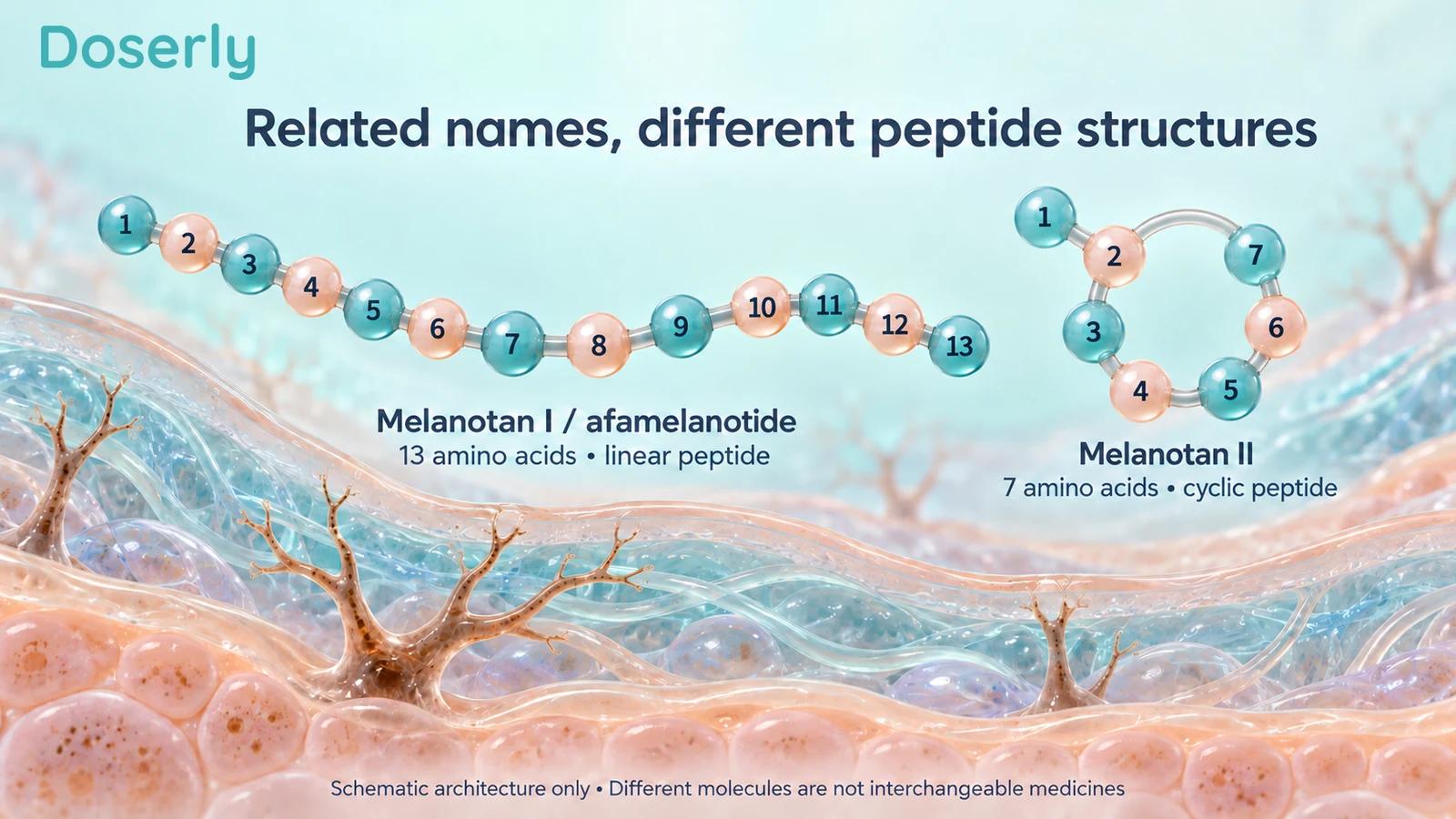
Melanotan I is an earlier name for afamelanotide, the active ingredient in the approved Scenesse implant for erythropoietic protoporphyria, or EPP. Melanotan II is a separate cyclic peptide studied in small early human experiments involving pigmentation and erectile responses.
That distinction prevents two common errors: using Scenesse’s approval to validate Melanotan II, and treating every adverse report involving “melanotan” as if it described the approved afamelanotide implant. A useful comparison identifies the molecule, the actual product and the clinical question before discussing whether the evidence is favorable.
Start with the molecule, then identify the product
Afamelanotide is a 13-amino-acid peptide related to alpha-melanocyte-stimulating hormone. Melanotan II is a shorter, seven-amino-acid analogue with a cyclic bridge. The Scenesse label describes afamelanotide’s structure; the original Melanotan II phase I report describes its cyclic heptapeptide architecture. Scenesse prescribing information, Melanotan II pilot study.
A peptide’s shape and sequence influence its interaction with biological targets. Similarity provides a reason to compare the compounds scientifically, not a reason to assume equivalent effects in people.
Even the same molecule can appear in different products. Scenesse is a manufactured subcutaneous implant. A vial advertised as Melanotan I, a nasal spray labeled Melanotan II and an implant administered in an EPP clinic differ in more than their names. The ingredient claim, formulation, route and quality controls all need to be identified.
What the receptor language does—and does not—mean
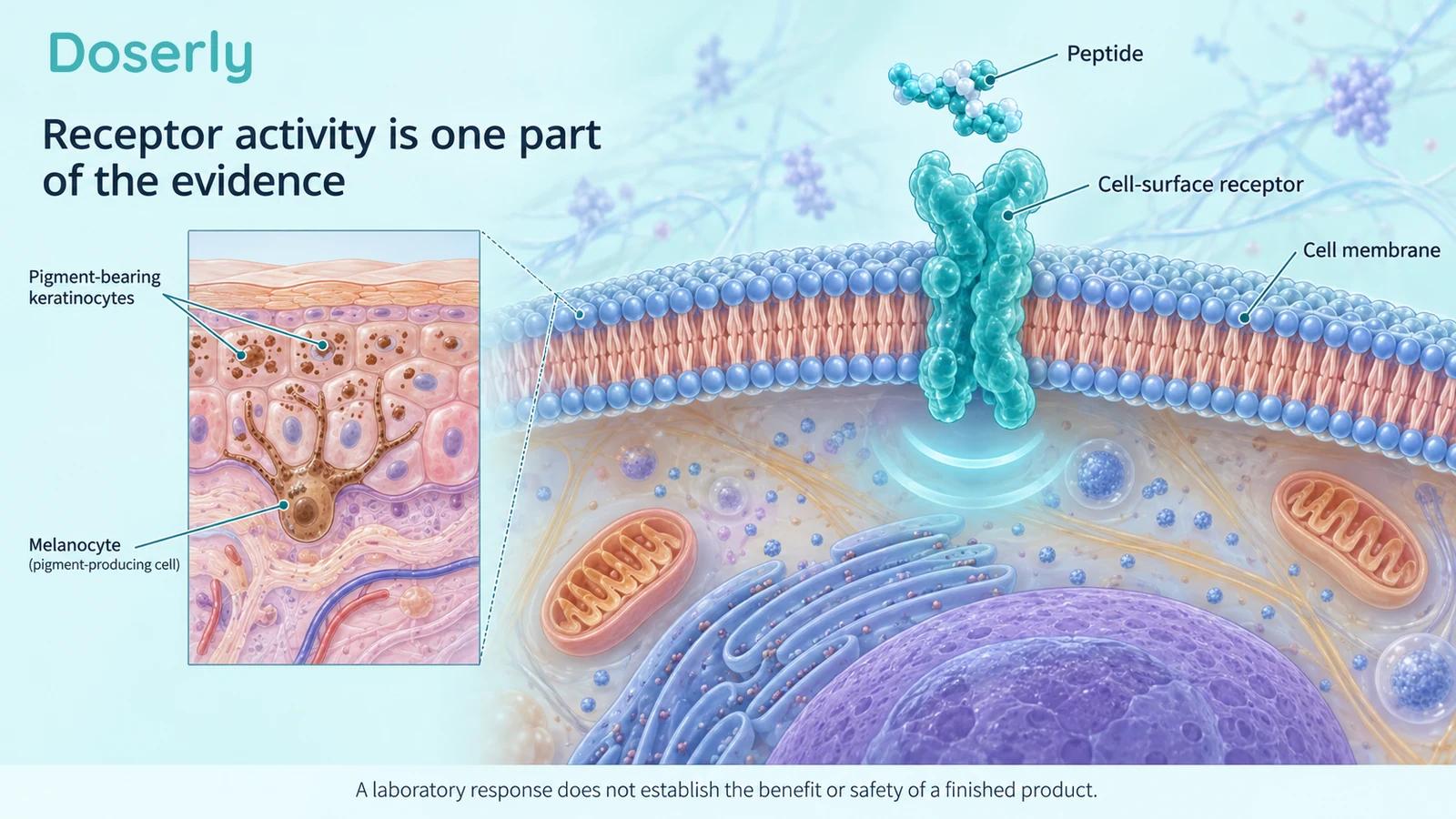
Afamelanotide is often described as targeting the pigment-related melanocortin-1 receptor, or MC1R. The approved label says it binds predominantly to MC1R. That wording is more careful than saying it acts exclusively on pigment cells.
Laboratory work has reported activity of NDP-MSH, another name used for afamelanotide in research, across melanocortin receptor subtypes other than MC2R. A 1997 receptor study also showed how modifying short peptide sequences changed receptor activity. Original receptor pharmacology study.
A cell assay measures a response under defined laboratory conditions. It does not show how much drug reaches each human tissue after a particular preparation, or establish the probability of a clinical side effect. The receptor result should therefore not be converted into a complete map of what either product does in the human brain or body.
The approved afamelanotide evidence addresses EPP
Scenesse’s US indication is to increase pain-free light exposure in adults with a history of EPP phototoxic reactions. It is not an approval for cosmetic tanning or for Melanotan II. US label.
The 2015 randomized afamelanotide publication measured disease-related outcomes in EPP. In its US trial, the median accumulated pain-free direct-sunlight exposure over six months was 69.4 hours with afamelanotide and 40.8 hours with placebo. The result belongs to the implant, population and diary endpoint studied. Randomized trial report.
European regulators identified reliability problems in earlier studies and based pivotal efficacy evaluation on the US study. The European authorization under exceptional circumstances also required continued evidence collection. EMA assessment, EMA overview.
These details matter when a seller invokes “clinical trials.” A paper about a supervised implant for EPP does not establish the effectiveness of a different peptide or a different finished preparation.
What the first Melanotan II study showed
The 1996 pilot phase I study included three healthy male volunteers. It used a single-blind, placebo-controlled schedule and observed both pigmentation and other effects. Two participants developed increased pigmentation; nausea, fatigue or sleepiness, yawning and spontaneous erections were among the reported observations. Dorr and colleagues.
This is human evidence, but its scale and purpose are limited. Three participants cannot define a reliable frequency of uncommon harms, establish long-term safety or describe how a broad population will respond.
The study also does not support a consumer “loading” or “maintenance” schedule. Early experiments help investigators decide what deserves further study. A dose explored in that setting is not automatically an established regimen for unsupervised tanning, and this article does not translate it into one.
Sexual-response studies answer another question
Melanotan II was also investigated in men with erectile dysfunction. A 1998 double-blind, placebo-controlled crossover study enrolled ten men with no known organic cause of their dysfunction. Original 1998 trial.
A separate 2000 crossover study enrolled ten men with organic risk factors. It reported more erectile activity with Melanotan II than placebo during the monitored period, alongside more nausea and stretching or yawning. Original 2000 trial.
These studies demonstrate why Melanotan II should not be treated as a pigment-only intervention. They do not establish a favorable long-term benefit–risk balance for cosmetic use, nor do they make an online product an approved erectile-dysfunction treatment.
A crossover design means the same participant receives different study conditions at different times. Multiple injections or observations from one person should not be counted as separate independent participants. That distinction is important when small studies report percentages by injection rather than by patient.
A third name sometimes appears in the same discussion: bremelanotide, the ingredient in Vyleesi. Its US label concerns acquired, generalized hypoactive sexual desire disorder in certain premenopausal women; it explicitly excludes use for enhancing sexual performance. Vyleesi is not Melanotan II, and its approval cannot be used to validate Melanotan II tanning or erectile-dysfunction products. Keeping the exact ingredient name attached to an approval prevents a related research history from becoming a false product equivalence. Vyleesi prescribing information.
A comparison of the actual evidence questions
Question
Which molecule?
- Afamelanotide / Melanotan I
- Linear 13-amino-acid analogue
- Melanotan II
- Cyclic seven-amino-acid analogue
Question
What relevant human evidence is discussed here?
- Afamelanotide / Melanotan I
- Manufactured implant trials and follow-up in EPP
- Melanotan II
- Small early pigmentation and erectile-response experiments
Question
What does the approved US product address?
- Afamelanotide / Melanotan I
- Pain-free light exposure in adults with EPP
- Melanotan II
- Scenesse approval does not apply to this molecule
Question
What cannot be borrowed?
- Afamelanotide / Melanotan I
- Implant results cannot validate a different preparation
- Melanotan II
- Afamelanotide efficacy, monitoring experience and approval cannot be transferred
Question
Does a visible tan prove cancer protection?
- Afamelanotide / Melanotan I
- No
- Melanotan II
- No
The table is an evidence comparison, not a ranking of tanning products. One compound having more developed clinical evidence for a specific disease does not create a general recommendation to use it for another purpose.
Why “more selective” is not a safety rating
A marketing comparison may portray Melanotan I as the “safer” option because it is described as more focused on pigmentation. That claim needs more than a receptor label.
Clinical safety depends on the product, exposure, patient characteristics, adverse outcomes measured and duration of observation. A head-to-head comparison would need to define those factors before a relative-risk claim could be interpreted.
The evidence discussed here does not provide a robust comparative safety rate for unsupervised cosmetic Melanotan I versus Melanotan II use. Differences in the kinds of studies available make a simple numerical ranking particularly misleading.
Likewise, a person who experiences no nausea has not established that a product is safer. Tolerating an immediate effect does not rule out another adverse outcome, and absence of a sensation cannot verify the product’s identity.
Case reports need exact product names
A 2012 case report described systemic toxicity and rhabdomyolysis after a man injected a product obtained online. Laboratory analysis of the injected material confirmed Melanotan II. The patient also had other clinical findings and a positive opiate screen, which remain part of the case context. Original toxicology report.
Confirmation of the substance makes this more informative about exposure than a report using only the generic word “melanotan.” It still describes one person, not the incidence of toxicity among users or a comparative risk against afamelanotide.
Other reports may lack chemical verification or involve multiple products. A 2026 melanoma report included Melanotan II followed by I, tanning-bed exposure and other risk factors. It cannot assign the observed cancers to one peptide. Original melanoma report.
Preserving these details avoids both exaggeration and false reassurance. A serious event can warrant concern without providing a precise causal estimate.
Product quality is a separate source of uncertainty
A compound can have a well-described chemical identity while a product carrying its name remains poorly characterized. The label on a vial does not establish its amount, purity, stability or suitability for administration.
FDA’s compounding safety page identifies potential concerns for Melanotan II involving aggregation, peptide-related impurities and immunogenicity for certain routes. It also references serious adverse-event reports. Those statements describe concerns; they do not establish the frequency of each event or prove causation in every report. FDA safety information.
This uncertainty cannot be removed by citing an old trial. The material administered in that study and the finished product currently offered may not be equivalent. A visible biological response is also not a quality-control test.
A spray is not an established substitute for an injection
Changing the route can change absorption and local exposure. Avoiding a needle does not, by itself, establish that a nasal product delivers a predictable amount or has a favorable safety profile.
The Australian TGA warns against unapproved melanotan tanning products, including products sold in different forms. Its warning concerns their lack of assessment and potential harm; it does not make a claim that every route has an identical risk. TGA warning.
Historical afamelanotide pharmacokinetic research illustrates why route matters: a small study compared different routes and found different measurable exposure. That study was about Melanotan I, however, and cannot supply a nasal Melanotan II dose conversion. Original route-comparison study.
Similar-looking results can conceal different tradeoffs
Imagine two people report a similar tan after using products with these names. One may have used sunbeds, another may have avoided them; the preparations, timing and amount may differ. A photograph cannot separate those factors.
The same problem applies to reports of appetite or sexual effects. A personal observation can be worth reporting to a clinician, but it does not establish a receptor-specific mechanism or a predictable effect in another person.
For a meaningful comparison, the outcome needs to be defined in advance. Faster visible darkening, fewer acute symptoms, sustained disease benefit and fewer serious adverse events are separate goals. A product cannot be declared “better” without specifying which goal was measured and what evidence supports the comparison.
How to check a claim before accepting it
Start with the full molecule name and formulation in the paper. Then check whether people actually received it, rather than whether it was applied to cells or administered to animals. Identify the population, comparator, outcome and follow-up.
If the claim concerns safety, look for the number of people and length of observation, not just the number of laboratory measurements. If it concerns approval, look for the named product, jurisdiction and indication. If it concerns a case report, check whether the exposure was verified and what else was happening.
The Doserly Melanotan I guide and Melanotan II guide keep the two evidence records separate. That separation is the useful starting point: related biology can inform research, but clinical conclusions belong to the molecule, preparation and outcome that were actually studied.
Sources
- Scenesse prescribing information.
- Dorr et al.: Melanotan II phase I pilot.
- Haskell-Luevano et al.: melanocortin receptor pharmacology.
- Langendonk et al.: afamelanotide EPP trials.
- EMA: Scenesse assessment.
- EMA: Scenesse overview.
- Wessells et al.: 1998 erectile-response trial.
- Wessells et al.: 2000 erectile-response trial.
- Nelson et al.: Melanotan II systemic toxicity.
- Vadner and Smith: mixed-exposure melanoma case.
- FDA: compounding safety concerns.
- TGA: unapproved tanning products.
- Dorr et al.: Melanotan I route-comparison study.
- Vyleesi prescribing information.