
Supplements
October 18, 2026
Magnesium and blood pressure: what deficiency, supplements and human studies tell us
On this page
Magnesium can help lower blood pressure in some people. The more useful question is who is likely to benefit, how much of a difference to expect, and whether a supplement addresses an actual nutritional problem.
You may have heard a doctor explain that magnesium helps blood vessels relax. There is real physiology behind that explanation. There are also human trials showing lower blood pressure after supplementation, particularly in selected patients with low magnesium. But the research does not support treating magnesium as a reliable replacement for blood-pressure medication, or assuming that a high reading means you are deficient.
The distinction matters because two people can buy the same supplement and have very different experiences. One might have a low magnesium level, diabetes and a medicine that increases magnesium loss. Another might already have adequate intake and normal blood pressure. They are not starting from the same place.
Here is how the deficiency connection, clinical trials and popular interviews fit together, with practical ways to interpret the evidence without losing the promising parts of the story.

What magnesium has to do with blood pressure
Blood pressure describes the pressure blood exerts against blood-vessel walls. The top number, systolic pressure, is measured when the heart contracts; the bottom number, diastolic pressure, is measured between beats. Both matter. A diagnosis depends on properly measured, persistent elevations and the clinical setting, rather than one stressful reading. American Heart Association: understanding readings
Small arteries help regulate resistance to blood flow. Their walls contain smooth muscle, which can contract or relax. Magnesium influences calcium-dependent activity in these cells and signaling from the endothelium, the vessel's inner lining. Researchers also study its interactions with sympathetic nervous activity, aldosterone and inflammation. Much of the detailed pathway evidence comes from experimental models; it does not establish how much each pathway contributes when a person takes an oral supplement. 2024 review of mechanisms and clinical implications
That helps explain a phrase you will hear in interviews: magnesium is a “natural calcium-channel blocker.” It is a shorthand for some of its biological effects, not a statement that a capsule is interchangeable with a prescribed calcium-channel blocker. A medicine has a specific formulation, dose-response profile and clinical evidence base. A nutrient also has to be considered in relation to the person's starting nutritional status.
Think about the difference between needing enough of something for normal function and getting additional benefit from more of it. The first does not automatically establish the second. This is why a convincing explanation of vascular physiology needs to be followed by the question: what happened in controlled human trials?

Does magnesium deficiency contribute to high blood pressure?
It is a plausible contributor in some people, and one worth investigating. It is not an explanation that can be assigned to everyone with hypertension.
First, the word deficiency gets used for several different findings:
Finding
Low estimated dietary intake
- What it tells you
- Food choices may not supply enough magnesium consistently
- What it does not establish
- That a blood test will be low, or that magnesium caused the blood pressure
Finding
Low serum magnesium
- What it tells you
- The circulating concentration is below the laboratory's reference range
- What it does not establish
- The cause of the loss or the exact amount missing from body stores
Finding
Possible depletion despite a normal serum result
- What it tells you
- Clinical context may justify further assessment
- What it does not establish
- That everyone with a normal test has a hidden deficiency
Most magnesium is in tissues, including bone and muscle, rather than circulating in blood. The intestines govern absorption; the kidneys regulate how much is retained or excreted. That makes a serum test useful but incomplete. A normal result does not perfectly measure total stores, while an abnormal result is a reason to look for a cause. Depending on the situation, clinicians may consider urine or other measurements. No single result should be interpreted in isolation. MedlinePlus: magnesium testing
Low magnesium can develop through gastrointestinal losses, impaired absorption or excessive urinary loss. Persistent diarrhea, certain illnesses, some medicines and poorly controlled diabetes can matter. A clinician may check potassium and calcium as well, because these disturbances can occur together. Symptoms such as fatigue, weakness or cramps are not specific enough to diagnose magnesium deficiency by themselves. MedlinePlus: magnesium deficiency
Some blood-pressure medicines deserve particular attention here. Thiazide and loop diuretics can increase urinary magnesium loss. This does not make them ineffective treatments; it makes electrolyte monitoring relevant. NHS Specialist Pharmacy Service
A small randomized study in women taking hydrochlorothiazide reported improved blood-pressure control and endothelial function after magnesium supplementation, without improvement in arterial stiffness. Its narrow population and multiple measured outcomes limit generalization. Still, it illustrates a worthwhile clinical question: is a correctable mineral problem accompanying an otherwise useful treatment? Cunha and colleagues, 2017
This is a more useful starting point than asking whether the supplement is “good for blood pressure” in the abstract. A history of low results, a relevant medication, or ongoing losses creates a different clinical question from a wellness advertisement aimed at everyone.
It also explains why nutritional adequacy and hypertension management should happen together. Finding a deficiency deserves attention even if correcting it does not bring blood pressure fully to target. Conversely, a better magnesium result does not automatically mean the hypertension has been adequately treated.

What population studies can and cannot tell us
People who eat magnesium-rich diets often differ from people who do not in many other ways. They may eat more fiber, consume different amounts of sodium and potassium, exercise more or have different access to healthcare. Statistical adjustment helps, but it cannot perfectly separate all of these factors.
In the Women's Health Study, researchers followed 28,349 women who initially reported normal blood pressure. Higher magnesium intake was associated with a modestly lower risk of developing hypertension over roughly a decade. The association weakened after adjustment: the highest-versus-lowest intake comparison had a confidence interval that included no difference, although the overall trend remained statistically significant. Original prospective study
The Framingham findings were less supportive. Among 2,520 participants eligible for the hypertension analysis, baseline serum magnesium did not predict new hypertension over approximately eight years. This was a study of a blood measurement, not a trial correcting documented deficiency, so it does not settle the supplementation question either. Framingham original report
Together, these studies make a simple claim such as “low magnesium is the cause of high blood pressure” too strong. They also show why the way magnesium is measured matters. Dietary intake, circulating concentration and response to treatment answer related but different questions.
How much does supplementation lower blood pressure on average?
A 2025 meta-analysis combined 38 randomized trials involving 2,709 participants. Compared with control, the pooled changes were −2.81 mmHg systolic and −2.05 mmHg diastolic. The median treatment duration was 12 weeks.
Effects varied substantially. Participants with low magnesium had larger pooled reductions, approximately 6/5 mmHg, while the normal-blood-pressure subgroup did not show a statistically significant benefit. The analysis found no clear dose-response relationship. Its search ended in May 2024, so the publication year should not be mistaken for coverage of every subsequent trial. Argeros and colleagues, 2025
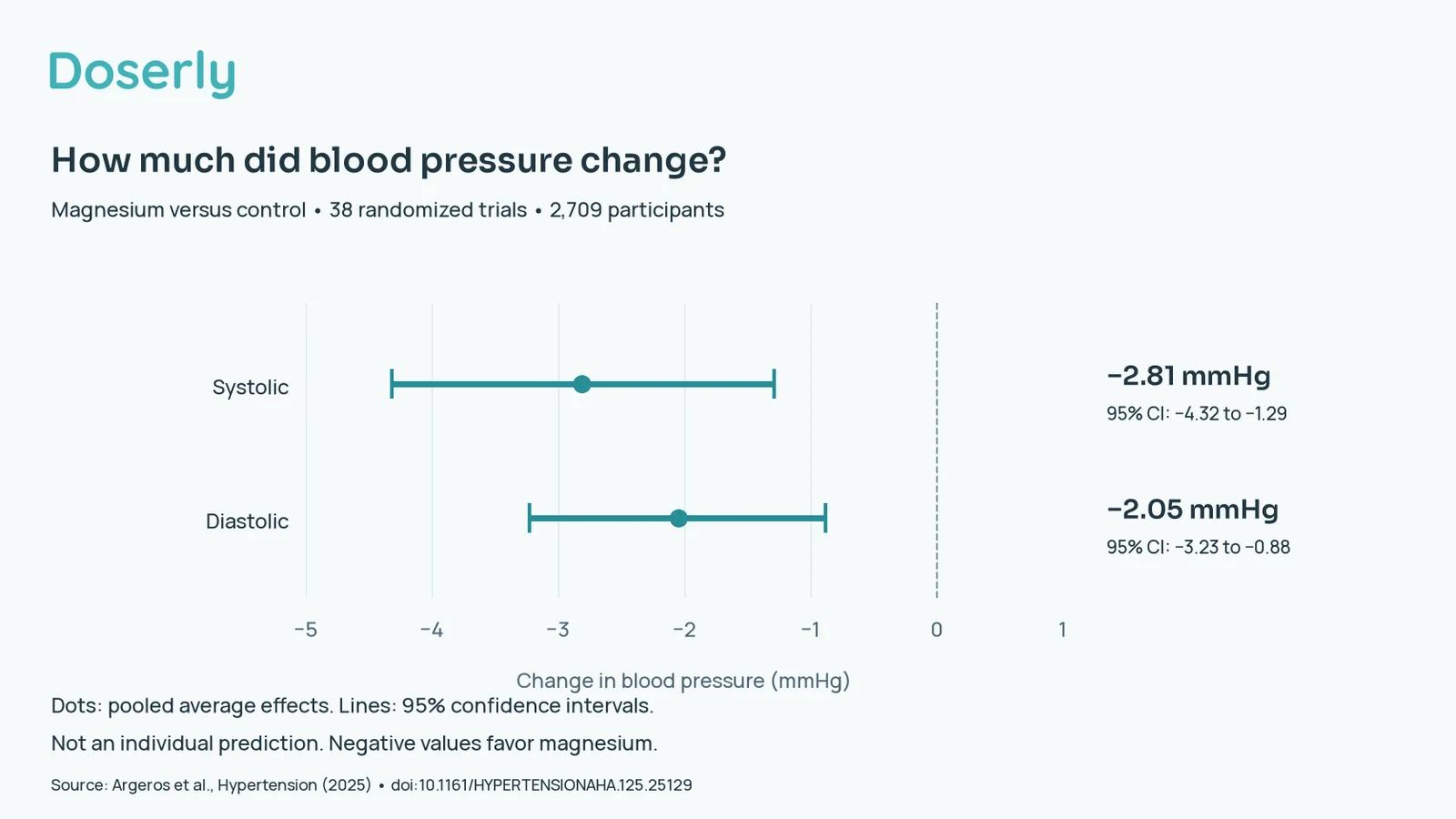
For comparison, an earlier analysis of 34 double-blind, placebo-controlled trials reported reductions of about 2.00/1.78 mmHg over a median three months. The overall picture is therefore a small average effect, with important variation between studies. These reviews share some underlying trials; they are not two entirely independent collections of patients. Zhang and colleagues, 2016
A small average can still be relevant, but it should not become a personal promise. If someone starts at 150/95, subtracting a few points would still leave elevated pressure. That example is arithmetic, not a prediction of response. It illustrates why a potentially helpful addition may still leave a need for other treatment.
Why some trials report much larger improvements
One especially relevant randomized trial enrolled 82 adults with type 2 diabetes, hypertension and low serum magnesium. They were receiving captopril and were assigned magnesium chloride providing 450 mg elemental magnesium daily or placebo for four months; 79 completed the study.
Systolic pressure fell by 20.4 mmHg in the magnesium group versus 4.7 mmHg with placebo. Diastolic reductions were 8.7 versus 1.2 mmHg. The differences between those changes are approximately 15.7 and 7.5 mmHg, respectively. These are much larger than the pooled averages, but they came from a highly selected population receiving an additional intervention alongside medication. Guerrero-Romero and Rodríguez-Morán, 2009
That is a strong reason to take the deficiency question seriously. It is not a reason to advertise a 20-point drop to every supplement buyer. The 20.4-point figure includes the full change within the treated group; the placebo comparison is essential.
A more recent single-blind study in people with type 2 diabetes analyzed 60 participants after two months. It reported a 12 mmHg systolic decline within the magnesium group, versus 4.17 mmHg in controls. Its short duration and single-blind design limit confidence, and “300 mg magnesium citrate” does not clearly establish the elemental amount. This small 2026 study is encouraging additional evidence, not a new dependable treatment estimate. Ranjbar Arani and colleagues, full report
The practical lesson is to ask who was studied before asking which dose they received. Baseline magnesium, starting blood pressure, diabetes, concurrent treatment and the comparison group can all change what a result means.
The trials that did not find the expected benefit
A useful counterexample is a 2022 randomized trial of 164 adults with overweight or mild obesity. Participants received magnesium citrate, oxide, sulfate or placebo for 24 weeks. Each active group received 450 mg magnesium daily. None of the formulations improved blood pressure or the primary measure of arterial stiffness compared with placebo, even though supplementation changed magnesium measurements. Schutten and colleagues
That finding separates three claims that supplement marketing can blend together: a product delivers magnesium, it changes a laboratory measure, and it improves a clinical outcome. The first two do not guarantee the third.
Even low magnesium does not guarantee a measurable blood-pressure response. A small crossover trial in 14 people with insulin-treated type 2 diabetes and low serum magnesium compared six weeks of supplementation with placebo. Serum magnesium increased, but blood pressure and the primary insulin-sensitivity outcome did not improve significantly. Its size and duration limit the conclusions, but it belongs in the discussion alongside the positive diabetes trial. Drenthen and colleagues
A balanced interpretation can accommodate both results. Correcting a genuine deficiency remains a reasonable clinical goal. Predicting a large blood-pressure reduction for a particular person requires more information than the word “deficient.”
Which doctors and interviews are discussing this?
Several credible communicators have covered the connection. Their interviews are useful introductions, especially when followed by the underlying studies. They should not be treated as additional clinical trials.
Dr. Sanjay Gupta on ZOE Science & Nutrition
The January 29, 2026 episode, “4 lifestyle changes that lower high blood pressure,” features the York-based cardiologist Dr. Sanjay Gupta and nutrition scientist Professor Sarah Berry. Around 29 minutes, Gupta discusses magnesium in the wider context of diet, sleep, alcohol and vascular health. Later, Berry places magnesium among the many nutrients supplied by a plant-rich diet. Official episode and transcript
This is a plausible match for a recently encountered doctor interview, particularly if the conversation covered food and blood pressure more broadly. It is not a magnesium supplementation trial, and the comments about modern diets do not diagnose deficiency in an individual viewer.
Dr. Mark Hyman with James DiNicolantonio
Their episode “How Common Mineral Deficiencies Impact Our Health” discusses low magnesium, medications and vascular relaxation. Hyman is a physician; DiNicolantonio holds a PharmD and works in cardiovascular research. The conversation is particularly relevant to the deficiency-focused version of this topic. Official episode and YouTube video. The episode also carries supplement sponsorship, which is useful context when evaluating product claims.
One distinction deserves clarification when listening to this and similar interviews: intravenous magnesium in pre-eclampsia or eclampsia is primarily used to prevent or treat seizures. It is not evidence that an over-the-counter oral supplement can substitute for treatment of pregnancy-related hypertension. NICE discusses magnesium sulfate and blood-pressure medicines separately, and does not recommend magnesium supplements solely to prevent hypertensive disorders of pregnancy. NICE pregnancy guideline
Dr. Rhonda Patrick on FoundMyFitness
Patrick, a biomedical scientist with a PhD, covers blood pressure in “The Science of Magnesium and Its Role in Aging and Disease.” The relevant chapter begins around 1:03:14. Her discussion links vascular mechanisms, the earlier trial meta-analysis and magnesium-rich foods. Watch the chapter or read the official transcript.
This is a helpful science explainer, but older effect estimates should be read alongside newer trials. Discussion of possible long-term cardiovascular or brain benefits also goes beyond what a short blood-pressure study can directly establish.
A deeper deficiency argument from DiNicolantonio
In “The Story of Magnesium, the Missing Mineral,” DiNicolantonio again discusses vessel relaxation and medication-related magnesium loss; the January 2025 episode reaches the hypertension discussion around 18:32. Episode and publisher transcript
The useful question to bring to these conversations is not whether a speaker sounds enthusiastic. It is whether a claim refers to low intake, a measured deficiency, a specific patient population or a general population benefit. Those distinctions can turn a broad statement into something a clinician can actually evaluate.
Food first is a substantive intervention
Magnesium-rich foods include beans, nuts, seeds, leafy vegetables and whole grains. For most nonpregnant adults, the recommended total intake is 400–420 mg daily for men and 310–320 mg for women, depending on age. These amounts include food; they are not automatic supplement prescriptions. NIH magnesium fact sheet

The original DASH feeding trial randomized 459 adults to different dietary patterns. The combination diet, rich in fruits, vegetables and low-fat dairy and lower in saturated fat, reduced blood pressure by about 5.5/3.0 mmHg more than the control diet overall. It changed several nutrients together, so the result cannot be attributed to magnesium alone. Original DASH trial
That is an advantage for eating, even though it complicates the research attribution. You do not need to isolate one nutrient's contribution to benefit from a well-supported dietary pattern.
A practical approach is to improve meals you already eat: add beans to a soup or salad, include an unsalted nut or seed topping, or replace a refined-grain breakfast with oats. These are examples rather than a prescribed menu. Food allergies, kidney disease and other dietary restrictions can change what is appropriate.
Do not assume that taking magnesium cancels out a high-sodium diet. Magnesium and sodium are different parts of the blood-pressure discussion. Likewise, a combined electrolyte product may contain potassium or substantial sodium; its effects and suitability cannot be inferred from the magnesium amount alone.
Glycinate, citrate, oxide: does the form matter?
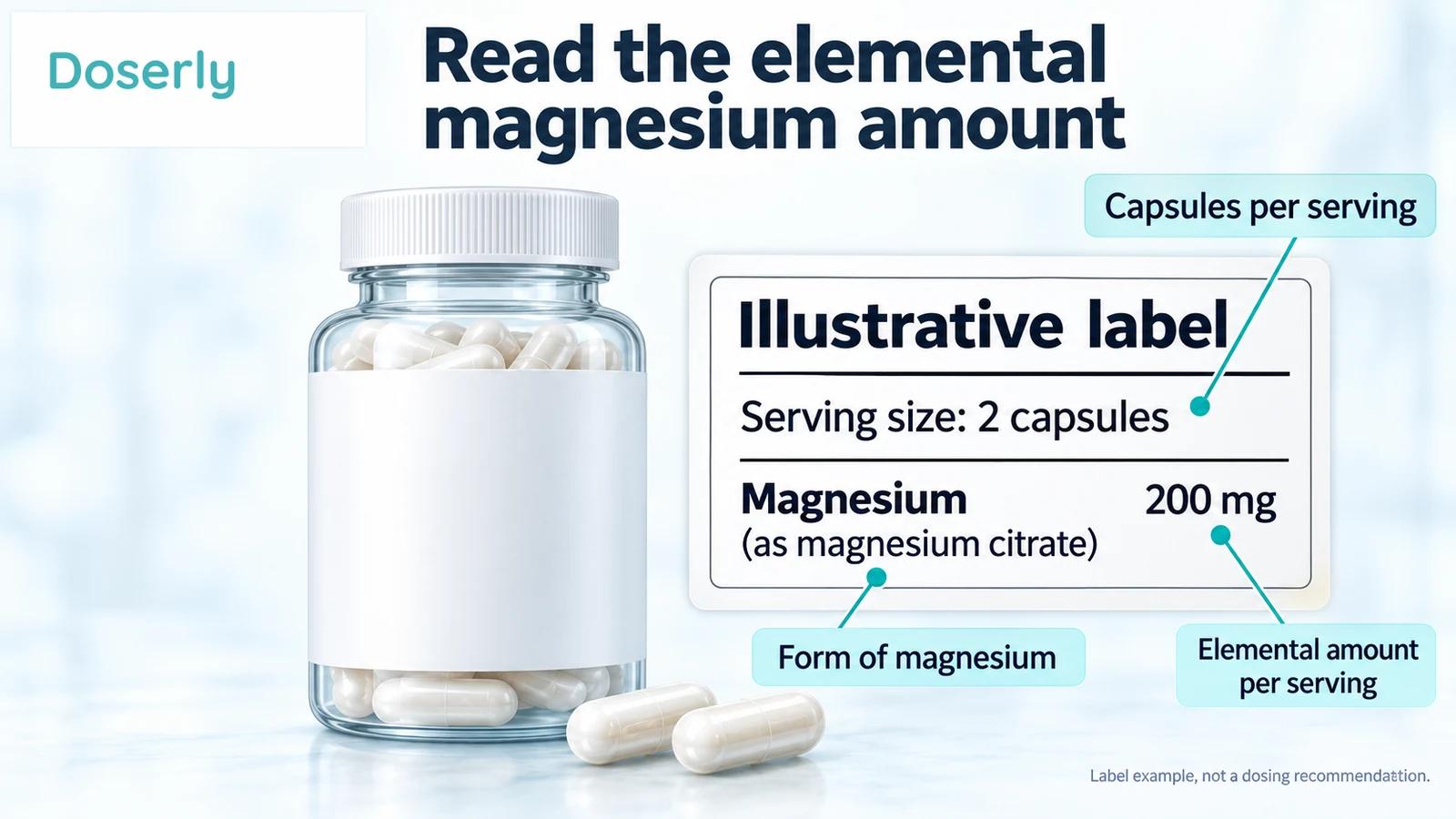
The first number to understand is elemental magnesium, the amount of magnesium itself. The weight of an entire magnesium-containing compound is different. A large number on the front of a bottle may not be the elemental amount supplied by one capsule.
Consider the illustrative label below. If two capsules supply 200 mg of magnesium, one capsule supplies 100 mg. “As magnesium citrate” identifies the form. It does not mean you should add the citrate compound's weight to the magnesium amount. The serving size and nutrient amount need to be read together.
Some forms differ in solubility, absorption and gastrointestinal tolerability. That does not establish a clinically superior blood-pressure effect. In particular, there is no basis here for declaring glycinate, threonate or a premium blend the universal winner. The direct comparison trial above did not find blood-pressure benefit from any of its three tested forms.
This distinction is useful when comparing an affordable supplement with a much more expensive one. A claim about absorption needs evidence about absorption. A claim about treating hypertension needs clinical outcome evidence. A brand cannot substitute the former for the latter.
Our magnesium supplement guide covers the broader differences between forms and uses. For the separate sleep question, see magnesium labels and sleep evidence. A product marketed for sleep has not necessarily been shown to lower blood pressure.
Dose, medicines and kidney function deserve attention
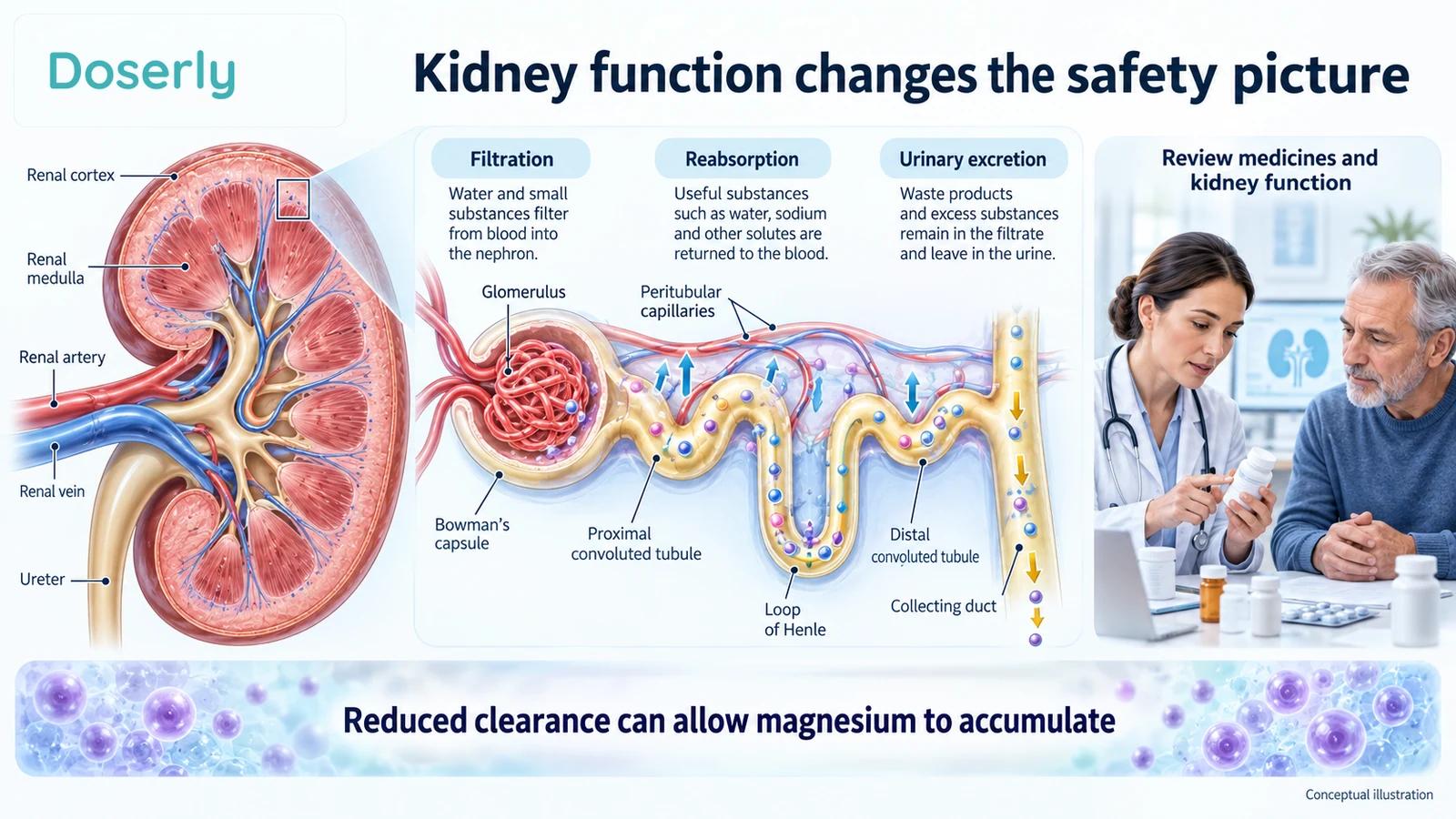
The US adult upper limit of 350 mg daily from supplements and medicines excludes magnesium naturally present in food. It is not a target dose for hypertension. Trials sometimes use more under supervision. Diarrhea, nausea and cramping can limit oral use, and impaired kidney clearance increases the risk of magnesium accumulation and toxicity. NIH safety guidance
Check the complete medication list, including laxatives and antacids. Magnesium can interfere with absorption of some antibiotics and oral bisphosphonates, so timing may need to be separated according to the specific medicine. A pharmacist can help reconcile the products and schedule. NIH interaction guidance
Medication combinations can matter. In a study of 11,490 intensive-care admissions, the association between prior proton pump inhibitor use and low magnesium was concentrated among patients also using diuretics. This was observational evidence in hospitalized patients, not an estimate of every user's risk. It supports reviewing the full prescription list when magnesium is low. Danziger and colleagues
It is also worth being precise about regulation. FDA permitted a qualified magnesium-and-hypertension health claim in 2022, with wording acknowledging inconsistent and inconclusive evidence. That was not approval of magnesium as a hypertension drug. The decision predates some newer research, but remains useful context when a label suggests an official endorsement. FDA qualified health claim announcement
How to tell whether blood pressure is actually improving
A compelling personal story often begins with a high reading and ends with a lower one after a supplement. The missing details are usually the readings in between, measurement technique and everything else that changed.
Use a validated upper-arm monitor with a correctly sized cuff. Rest quietly for five minutes; avoid exercise, smoking and caffeine for 30 minutes beforehand. Sit with your back and feet supported, use a bare upper arm and support it at heart level. Take two readings a minute apart and record both. Your clinician can specify the schedule and how to compare averages. AHA home-monitoring instructions

Record supplement changes alongside medication changes, illness, sleep and major changes in diet or activity. If several things improve together, a better average is still welcome, but you cannot confidently assign the entire change to magnesium.
For example, someone might start a supplement during the same week they stop taking readings immediately after coffee and begin sitting quietly first. The later readings are more useful, but the comparison cannot isolate a supplement effect. This is why a careful home record and a randomized trial answer different questions.
Do not change prescribed treatment based on a single good result. Current hypertension guidance combines lifestyle changes with medication when appropriate, using average pressure and cardiovascular risk to guide decisions. Magnesium can be discussed within that plan. 2025 AHA/ACC guideline summary
Questions worth bringing to an appointment
You do not need to arrive with a self-diagnosis or a supplement protocol. A short set of specific questions can make the discussion more productive:
- Do my diet, medical history or medicines give us a reason to assess magnesium?
- If my result is low, what might be causing the loss, and do other electrolytes need checking?
- Is my kidney function compatible with the supplement I am considering?
- What does the label supply per serving, including other products I already take?
- Which blood-pressure averages and follow-up interval should we use to judge progress?
Bring the actual bottle or a clear label photo. “I take magnesium” leaves out the amount, serving size, formulation and other ingredients that might matter.
Can magnesium work quickly?
The oral studies discussed here generally evaluated treatment over weeks or months. They do not establish magnesium as a rescue treatment for an unusually high reading. Immediate sensations such as relaxation are not a substitute for a measured blood-pressure trend.
Does a normal blood test rule out every magnesium problem?
No, but it also does not establish a hidden deficiency. The value becomes more informative alongside diet, symptoms, medicines, kidney function and any ongoing losses. Further testing should answer a clinical question rather than simply produce another number to optimize.
Does better sleep prove it lowered blood pressure?
No. Sleep and blood pressure are related topics, but feeling that you slept better does not measure either magnesium status or a blood-pressure effect. Evaluate each outcome separately rather than assuming one benefit proves another.
What about very high readings?
If systolic pressure is above 180 or diastolic above 120 mmHg, repeat after at least a minute if you have no emergency symptoms and seek immediate clinical guidance if it remains that high. With chest pain, breathlessness, weakness, vision changes or difficulty speaking, call emergency services. Do not wait for a supplement to work. AHA urgent-reading guidance
Where magnesium fits in a sensible blood-pressure plan
The strongest reason to consider magnesium is a plausible or documented need, not the expectation that every capsule produces a dramatic drop. The research supports a modest average benefit, contains promising results in selected deficient patients, and also includes well-conducted trials with no measurable improvement.
Those findings make room for a useful middle position: take magnesium nutrition seriously, investigate relevant deficiency risks, and judge treatment by reliable measurements. Keep food quality, medication review and the broader causes of hypertension in the same conversation. Magnesium may be one helpful part of that work, especially when something is missing, but the blood-pressure goal still needs to be achieved and maintained.