
TRT
October 16, 2026
Low testosterone with low LH: why the cause matters more than the label
On this page
Testosterone production begins with signals from the brain. Luteinizing hormone, usually shortened to LH, is one of those signals: it is released by the pituitary gland and stimulates testosterone production in the testes. When testosterone is low, the LH result helps explain whether the testes are receiving an appropriate signal.
Low testosterone together with low or inappropriately normal LH suggests a secondary, or central, pattern of hypogonadism. The word “secondary” describes the part of the system involved. It does not tell you whether the cause is temporary, medication-related, congenital or a structural pituitary problem.
That distinction changes the conversation. Raising testosterone may address a deficiency, but identifying why the signal is inadequate can uncover a different treatment, a fertility issue or another hormone problem that needs attention. The aim is to understand the pattern before allowing “low T” to become the whole diagnosis.
Why an LH result can be normal and still be informative
Laboratory reference intervals describe results commonly found in a comparison population. They do not describe the response that would be appropriate in every physiological situation.
If testosterone production falls because the testes cannot respond normally, LH often rises as the pituitary increases stimulation. When testosterone is low but LH stays low or within the ordinary range, that response may be inadequate for the situation. This is what clinicians mean by inappropriately normal. The result is being interpreted in relation to another hormone, rather than in isolation.
FSH, or follicle-stimulating hormone, contributes additional information about reproductive function. LH and FSH are not interchangeable tests, and neither directly measures the number or quality of sperm. The Endocrine Society recommends using them to distinguish testicular from hypothalamic-pituitary patterns after hypogonadism is established. Diagnostic guideline.
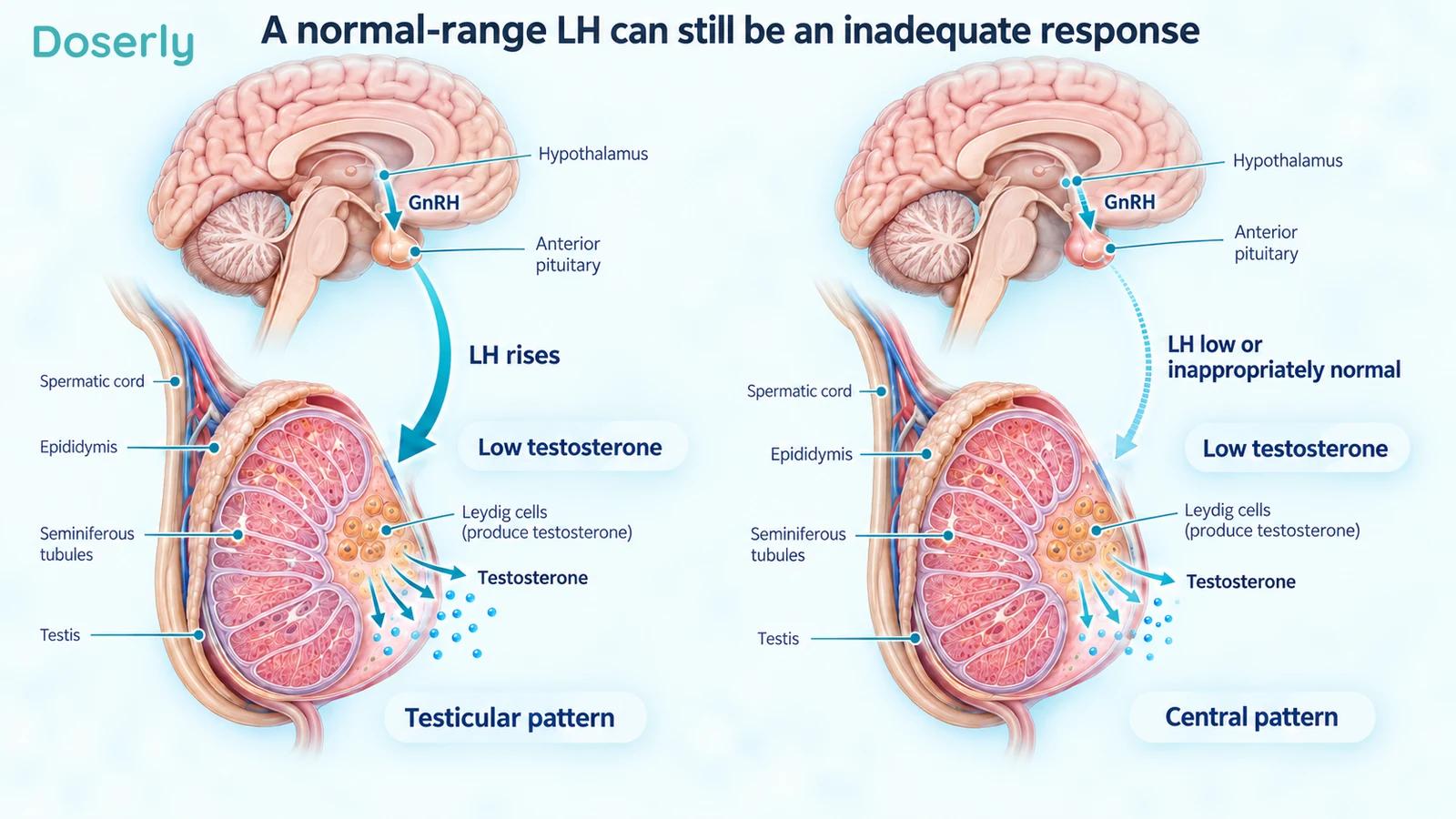
These are simplified physiological patterns, not a diagnosis from one sample. Hormone arrows are conceptual; their width does not represent a measured concentration.
First establish that the testosterone finding is real
Before explaining a low number, the clinician needs to know whether it is reproducible and clinically relevant. A diagnosis generally combines compatible symptoms with consistently low testosterone, confirmed with repeat morning testing. A blood sample during acute illness or under different conditions can complicate comparison with a prior result.
Total testosterone also depends on binding proteins, especially sex hormone-binding globulin, or SHBG. If SHBG is altered, a total result may not reflect the free fraction as expected. A suitable free-testosterone assessment can help when the total result is borderline or binding is abnormal. Endocrine Society guideline.
Bring the actual reports, including time of collection, units and reference intervals. If two laboratories use different methods or units, a change in the printed number may be less straightforward than it looks. The Doserly guide to TRT blood work provides a useful introduction to these measurements.
It is equally important to say whether the sample was taken before or during hormone treatment. Low LH while taking testosterone can be an expected effect of the treatment's feedback on the brain. It cannot be read as a clean picture of the untreated system. The same caution applies after recent exposure to anabolic-androgenic steroids or other medicines that alter reproductive signaling.
Functional suppression and structural disease are different possibilities
Some central patterns develop in association with obesity, systemic illness, inadequate energy availability or medication effects. These are often described as functional causes when relevant organic disease has been excluded. Potential reversibility depends on the actual cause and what changes; it is not guaranteed by the label.
Other causes involve the pituitary or hypothalamus more directly. A mass, prior surgery, radiation, infiltrative disease or a congenital signaling disorder can produce a similar testosterone-LH pattern. Clinical history matters because the blood pattern alone cannot separate all of these possibilities. European guidance on functional hypogonadism specifically requires excluding organic causes before settling on that diagnosis. European Academy of Andrology guideline.
Think of the distinction as an investigation question: what explains inadequate stimulation in this person? Someone with a recent medication change and previously normal reproductive function presents a different history from someone who never completed puberty normally. Neither history should be reduced to a standard internet “restart” plan.
The secondary hypogonadism guide explains common causes and clinical evaluation. It can help you identify details to bring to the appointment, especially past puberty, fertility, head injury, cancer treatment and hormone use.
Why prolactin may be measured
Prolactin is another pituitary hormone. When it is persistently elevated, it can suppress reproductive function. One possible cause is a prolactinoma, a usually benign pituitary tumour that produces prolactin. Other explanations for an elevated result also need consideration, including medicines and physiological circumstances.
A prolactinoma can cause low testosterone, reduced sexual function and fertility problems. A larger tumour may also affect nearby structures, producing headaches or visual changes. Evaluation can therefore include both hormone measurements and imaging, depending on the findings. NIDDK prolactinoma information.
A modestly elevated prolactin result is not, by itself, a tumour diagnosis. The clinician may repeat the test and review medicines and other explanations. Conversely, a low testosterone result should not distract from persistent headaches or visual symptoms that need their own assessment.
The treatment difference is important. A prolactinoma may be treated with medicines that reduce prolactin and tumour size. Simply supplying testosterone would not answer whether that underlying condition was present or adequately treated. This is one reason evaluating the cause can matter even when testosterone replacement would raise the blood level.
Does treating prolactin restore testosterone?
It can, but recovery is not universal. A 2024 study analysed 97 men with prolactinomas treated with dopamine agonists, medicines commonly used to lower prolactin. Eighty-five had low testosterone at diagnosis; 77 of the overall cohort had macroprolactinomas, meaning larger tumours. Reported recovery from hypogonadism was 43% at six months, 50% at twelve months and 54% at twenty-four months. Constantinescu and colleagues.
These observational results show why finding the cause can alter treatment and follow-up. Some men recover gonadal function while the prolactinoma is treated; others continue to need assessment for persistent deficiency. The percentages describe this selected clinical cohort, not every patient with a raised prolactin result.
They also do not justify a fixed waiting period for everyone. Tumour size, symptoms, other pituitary deficits, fertility goals and the course of prolactin and testosterone all influence decisions. A clinician may need to address symptomatic deficiency while continuing treatment of the underlying condition.
Who needs a pituitary MRI?
Not every man with low testosterone and low LH needs the same imaging work-up. Clinicians consider the severity and persistence of the hormone abnormality, prolactin, other pituitary findings and symptoms suggesting a mass. AUA guidance identifies very low testosterone, sustained prolactin elevation and unexplained failure of gonadotropin production as reasons to consider pituitary imaging. AUA testosterone-deficiency guideline.
A 2021 study explored laboratory predictors of abnormal hypothalamic-pituitary MRI. It began with a series of 609 men with secondary hypogonadism seen for sexual dysfunction, but only 126 formed the MRI analytical sample; a separate 50-man cohort was used for validation. Forty-six of those 126 had an abnormal MRI finding. Cipriani and colleagues.
The selected denominator matters. It would be misleading to tell every reader with low LH that the study found roughly one in three such men has a pituitary lesion. The imaged group was selected in clinical practice, and abnormal findings are not all equivalent to a causative tumour. The study helps investigate how to select patients for imaging; it is not a universal risk calculator.
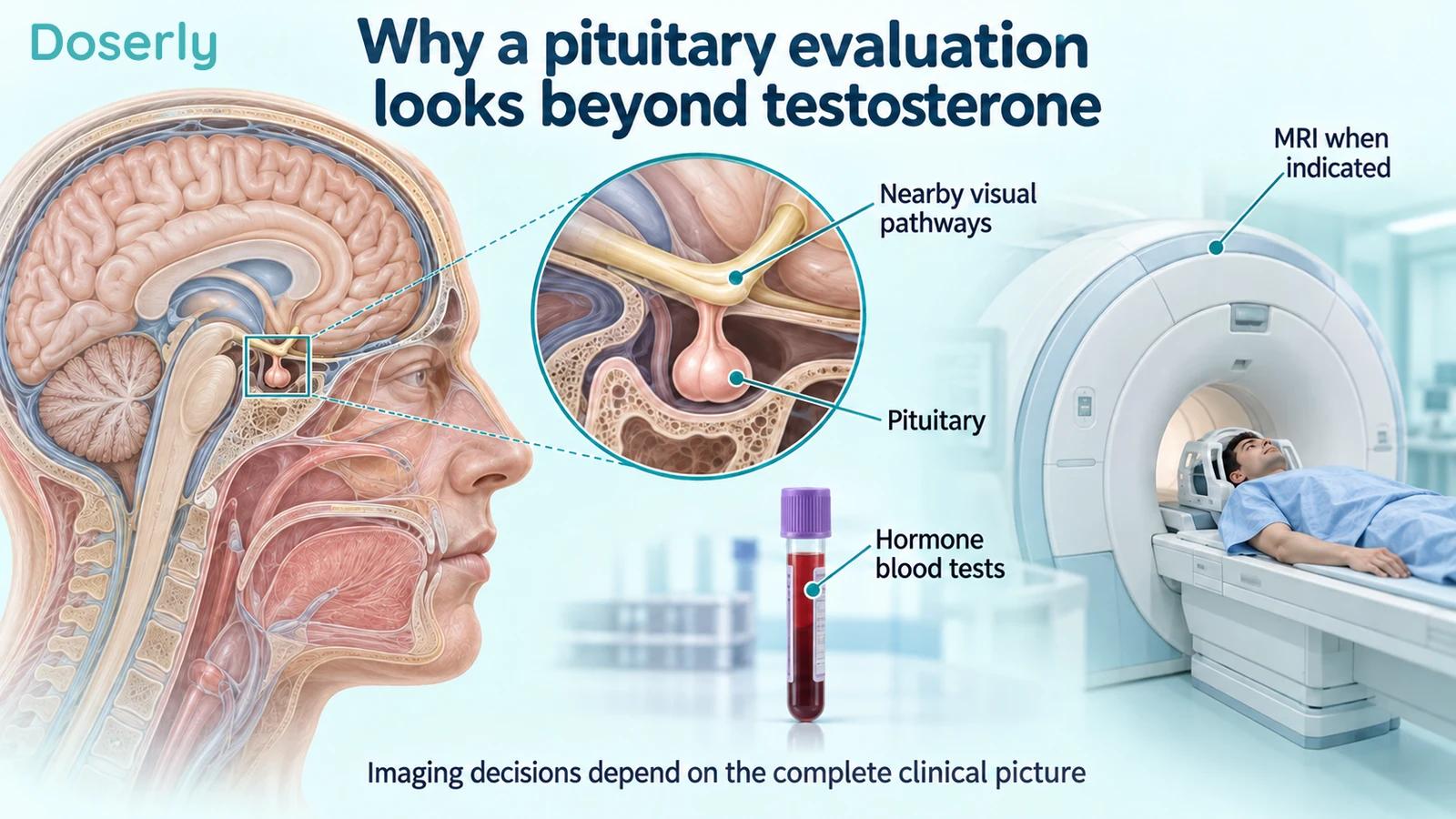
Blood tests assess hormone function; MRI examines structure. The visual pathways lie near the pituitary, helping explain why visual symptoms can affect the urgency of assessment. This is conceptual anatomy, not an image of a tumour.
Why other pituitary hormones may matter
The pituitary contributes to several hormone systems. If disease affects more than reproductive signaling, testosterone may be only one part of the problem. Clinicians may assess thyroid and adrenal function and other axes according to the history and findings.
For central thyroid dysfunction, for example, interpreting TSH alone can be inadequate; free thyroxine provides important information. Suspected adrenal insufficiency raises a different set of clinical priorities from isolated low testosterone. The Endocrine Society's hypopituitarism guideline describes evaluation and replacement across these systems. Hypopituitarism guideline.
This does not mean that everyone needs every hormone test. It means the work-up should follow the suspected condition. Ask what each proposed test would clarify and how its result could change the plan. That gives you a better understanding than collecting a large panel without an explanation.
New severe headache with visual disturbance, collapse or marked illness warrants urgent medical assessment rather than waiting for a routine testosterone follow-up. The concern is the acute clinical picture, not a particular number on an old hormone report.
Fertility changes the treatment question
If you want to conceive, say so at the start. Testosterone replacement can raise circulating testosterone while suppressing the signals needed for sperm production. It is therefore different from treatment intended to stimulate the testes in a man with inadequate gonadotropins.
Specialist treatment for hypogonadotropic hypogonadism can involve gonadotropins, depending on the cause, testicular development and reproductive goals. Semen analysis and the partner's circumstances also matter. EAU guidance discusses treatment directed at sperm production rather than using testosterone as infertility therapy. EAU male-infertility guideline.
These approaches require a diagnosis and monitoring. The fact that stimulating treatment is appropriate for some men does not make it suitable for every low-LH result. A prescription that changes a laboratory value is not, on its own, proof that the original cause has been identified or fertility restored.
Making the next appointment useful
A concise history can move the investigation forward: symptoms and their timing, prior untreated hormone results, current and previous medicines, puberty and fertility history, and any headaches or visual changes. If you have already started testosterone, include the product and dates so the clinician knows which measurements may be treatment-influenced.
Ask what the testosterone-LH combination suggests, which causes remain plausible and whether additional testing would change treatment. If imaging is recommended, ask what prompted it and what an incidental finding would mean. If imaging is not recommended, ask what future symptoms or results would change that decision.
The important result is a coherent explanation and follow-up plan. Low LH can be a valuable clue, but the clue becomes useful when it is connected to the person's history, repeat measurements and treatment goals. That is how evaluation moves from correcting a number to treating the right problem.
Sources
- Endocrine Society testosterone guideline, 2018.
- European Academy of Andrology functional hypogonadism guideline, 2020.
- NIDDK: Prolactinoma.
- Constantinescu et al., 2024: gonadal recovery in treated prolactinoma.
- AUA testosterone-deficiency guideline, 2018.
- Cipriani et al., 2021: MRI selection research.
- Endocrine Society hypopituitarism guideline, 2016.
- EAU male-infertility guideline.