
TRT
October 16, 2026
Jatenzo, Tlando and Kyzatrex: compare the treatment plan, not a ranking
On this page
Jatenzo, Tlando and Kyzatrex are oral testosterone undecanoate products. All can deliver testosterone through a capsule, and all require attention to food, laboratory monitoring and safety. Their shared ingredient does not make them interchangeable, nor does it establish that one is best for everyone.
A useful comparison begins with what would change in daily life: whether the prescribed dose can be adjusted, when blood must be collected, how reliably meals fit the schedule and what follow-up the product requires. It also asks whether the evidence being quoted measures testosterone exposure, symptoms or long-term clinical outcomes.
The US labels and development studies answer several of these questions. They do not provide a randomized three-way comparison proving a winner. This article explains how to read the differences without turning separate study percentages into a league table. For broader background, see our oral testosterone guide.
The same ester can have different instructions
Testosterone undecanoate is testosterone attached to a fatty-acid ester. The surrounding formulation influences how it is absorbed. A capsule’s milligram strength therefore cannot be used as a simple conversion rule between products.
Tlando’s prescribing information explicitly says it is not substitutable with other oral testosterone undecanoate products. That is an important practical warning for anyone changing prescriptions because of cost, insurance coverage or availability. A switch needs a new product-specific plan. Tlando label.
The same principle applies to laboratory interpretation. If a result was collected according to one product’s instructions, do not assume the identical collection time is appropriate after a switch. Keep the exact brand and formulation in the medication record.
Our separate guides to Jatenzo, Tlando and Kyzatrex provide product background. The current supplied prescribing information remains the source for the actual regimen.
Adjustable dosing and fixed dosing solve different problems
Jatenzo and Kyzatrex labels include clinician-directed titration: the prescribed amount can be changed according to appropriately timed testosterone measurements. Tlando uses a fixed regimen with monitoring to determine whether treatment should continue or be discontinued. Jatenzo label, Kyzatrex label, Tlando label.
A fixed regimen may reduce the number of adjustment decisions. It does not eliminate testing, and it does not mean the same exposure will suit every patient. An adjustable regimen provides flexibility, but that flexibility depends on collecting and interpreting measurements correctly.
Neither feature is automatically superior. Someone may value a simpler routine, while another may need a formulation whose label allows more adjustment. The prescribing clinician has to consider response and tolerability along with that preference.
“Does not require titration” should therefore not be heard as “does not require follow-up.” The questions are different: one concerns changing the amount, while the other concerns whether treatment remains appropriate.
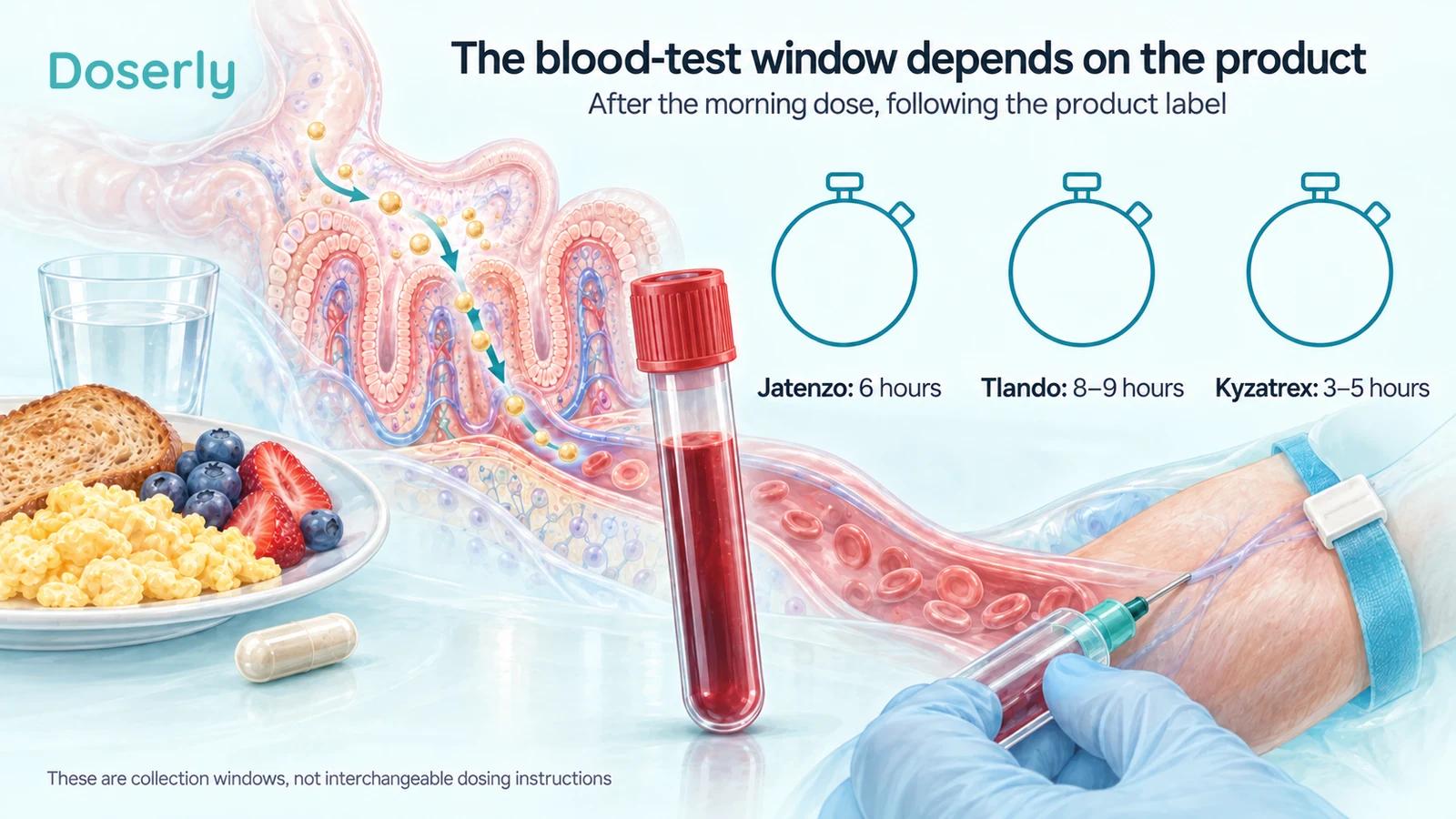
Blood-test timing is a meaningful difference
The monitoring windows in the labels differ:
Product
Jatenzo
- Testosterone sample relative to the morning dose
- Six hours afterward
Product
Tlando
- Testosterone sample relative to the morning dose
- Eight to nine hours afterward
Product
Kyzatrex
- Testosterone sample relative to the morning dose
- Three to five hours afterward
These are collection instructions for on-treatment monitoring, not suggested dosing intervals. The labels also specify when testing should begin after starting or changing treatment. Follow the instructions supplied by the prescriber and laboratory for the actual product. Jatenzo label, Tlando label, Kyzatrex label.
For someone working shifts or living far from a laboratory, the practical difference can be substantial. An appointment available only early in the morning may not fit the prescribed post-dose window. Discuss this before choosing a formulation rather than discovering the difficulty at the first follow-up.
Record both dose and collection times. If the plan was not followed, tell the clinician; that information can prevent an inappropriate adjustment based on a poorly contextualized result.
What do the reported success percentages measure?
Jatenzo’s label reports 145 of 166 men, or 87%, achieving its average testosterone endpoint after approximately four months. Tlando’s label reports 80% of 95 men within a 24-hour average serum range of 300–1080 ng/dL at day 24. Kyzatrex’s label reports 122 of 139 men, or 88%, within its average plasma range of 222–800 ng/dL at day 90. Jatenzo clinical study, Tlando clinical study, Kyzatrex clinical study.
These are useful demonstrations of replacement exposure. They are not directly comparable symptom-response rates. The studies differ in duration, measurement conditions and definitions of the target range, including serum versus plasma measurements.
It would be inaccurate to conclude that an 88% result makes one brand one percentage point more effective than a brand reporting 87%. The apparent precision comes from placing unrelated estimates next to each other, not from a randomized comparison.
An average also does not describe every moment of the day. A participant can meet an average-exposure endpoint while having higher and lower concentrations between samples.
Look at the actual study design
The Jatenzo development report included 166 participants assigned to oral treatment and 56 to a topical comparator over three to four months. That comparison helps answer a formulation-development question; it does not compare Jatenzo with Tlando or Kyzatrex. Primary Jatenzo report.
Tlando’s fixed-regimen study enrolled 95 men and assessed exposure after approximately 24 days without dose adjustment. The short duration is relevant when interpreting what the study can establish about longer-term outcomes. Primary Tlando report.
Kyzatrex’s six-month, open-label study treated 155 men. The report explains that 16 participants from one site were excluded from pharmacokinetic analyses because of sample-handling concerns, while remaining in non-pharmacokinetic safety analyses. That distinction helps explain why the label’s efficacy denominator is 139 rather than 155. Primary Kyzatrex report.
These details are not technical trivia. They tell you what the denominators mean and why a percentage should not be lifted out of its study and used as a universal prediction.
Laboratory normalization and symptom improvement are not identical
A person usually considers TRT because of symptoms and an established diagnosis, not because they want a particular graph. Development studies must demonstrate that a formulation delivers testosterone appropriately, but that is only part of the clinical decision.
If the intended outcome is improved sexual function, energy or daily functioning, ask what evidence addresses that outcome in people like you. An exposure endpoint cannot be silently substituted for a patient-reported benefit.
This also shapes follow-up. If testosterone exposure is appropriate but the main symptom remains, the next discussion may include other contributors to the symptom. Automatically aiming for a higher laboratory number is not the only possible response.
The reverse is also true: improvement in how someone feels does not establish that blood pressure, hematocrit or other monitored measurements are acceptable. A good treatment review considers both benefit and safety.

Can blood-pressure results identify the safest brand?
All three labels address blood-pressure increases. Their separate studies do not establish a reliable cardiovascular safety ranking. Differences in participants, baseline hypertension, measurement methods and follow-up can affect the observed averages.
FDA’s 2025 action emphasized blood-pressure information after reviewing ambulatory studies and the TRAVERSE cardiovascular trial. Removal of older boxed-warning language about major cardiovascular outcomes did not remove the need to monitor pressure. FDA labeling action.
A person with hypertension needs an individualized discussion, including how pressure will be measured and what findings would change the plan. A smaller mean change in a different study cannot guarantee a smaller change in that person.
Likewise, a development study with few serious events cannot rule out uncommon harms. Short trials can be informative about drug delivery and common adverse effects while leaving longer-term cardiovascular questions less precise.
Food, monitoring and everyday logistics belong in the comparison
All three labels direct taking the product with food. Discuss what that means for your usual schedule and ask for the specific instructions rather than borrowing advice from another capsule.
The monitoring burden also extends beyond testosterone. Tlando’s label, for example, includes prolactin assessment before treatment and again after starting it. That is a product-specific consideration that can disappear in a comparison focused only on capsule count or a headline percentage. Tlando prescribing information.
Cost and access can affect whether a plan is sustainable, but they are personal and change over time. Confirm actual coverage, supply and follow-up costs with the pharmacy and clinic. A theoretical preference is less useful if obtaining the medicine reliably is difficult.
Think about travel and work as well. Can you maintain the prescribed routine, store the medicine appropriately and obtain a correctly timed sample? These are legitimate clinical considerations, not minor inconveniences to be dismissed.
Shared risks still matter when choosing between capsules
Some questions will not be solved by choosing a different oral brand. Exogenous testosterone can suppress sperm production, and a normal testosterone measurement does not establish preserved fertility. If having children matters now or later, discuss that separately before treatment. Oral administration should not be interpreted as a fertility-preserving feature. Kyzatrex prescribing information.
The same applies to red-cell monitoring. Hematocrit is a measure of the share of blood volume occupied by red cells; an increase may require a clinician-directed response even when testosterone exposure is appropriate. A product comparison that lists only hormone normalization rates misses this part of treatment. Jatenzo prescribing information.
Before deciding, identify which issue is genuinely product-specific and which belongs to testosterone treatment more broadly. A different sampling window might resolve a scheduling problem. A different capsule does not automatically resolve an unexplained symptom, a fertility concern or an abnormal hematocrit.
This distinction can also prevent unnecessary switching. If the current treatment is being reconsidered, define the reason first: inadequate exposure despite correct use, an adverse effect, an impractical schedule or access difficulty. The next prescription can then be judged against that concrete problem rather than an expectation that a more highly ranked brand will improve everything.
What should happen when changing products?
A switch should begin with a clear new prescription and monitoring plan. Ask which old instructions no longer apply, when the new regimen starts and when follow-up will occur. Do not assume that matching milligrams or capsule counts produces equivalent exposure.
Keep old and new product names distinct in your record. Document the change date so a laboratory result can be linked to the correct formulation. If several clinicians share your care, ensure they have the same medication list.
A simple example shows why this matters. A person remembers only “testosterone capsules” and brings a result collected six hours after the morning dose. Without the product name, the clinician cannot know whether that timing matches the intended monitoring method. The missing detail is clinically meaningful.
If the switch was prompted by an adverse effect, record that reason as well. The follow-up should assess whether the original problem improved, not just whether the new product produced a testosterone result.
A better comparison ends with a workable plan
The best choice is the product whose instructions, expected benefits and monitoring requirements fit the individual’s clinical situation. That decision may change if response, tolerability, coverage or daily routine changes.
Ask the prescriber to explain the reasoning in practical terms: why this formulation, how it will be monitored, what improvement is expected and what would lead to reconsideration. That conversation is more informative than asking which brand “wins.”
The three products share a therapeutic purpose, but the available evidence should be read on its own terms. Use the oral testosterone guide and the product-specific guides to prepare questions, then confirm the current label and personal plan with the clinician and pharmacist.
Sources
- Tlando US Prescribing Information
- Jatenzo US Prescribing Information
- Kyzatrex US Prescribing Information
- A New Oral Testosterone Undecanoate Formulation Restores Testosterone to Normal Concentrations in Hypogonadal Men
- A New Oral Testosterone (TLANDO) Treatment Regimen Without Dose Titration Requirement for Male Hypogonadism
- A Phase III, Single-Arm, 6-Month Trial of a Wide-Dose Range Oral Testosterone Undecanoate Product
- FDA Issues Class-Wide Labeling Changes for Testosterone Products