
HRT
October 16, 2026
HRT is not contraception: the perimenopause detail that gets missed
On this page
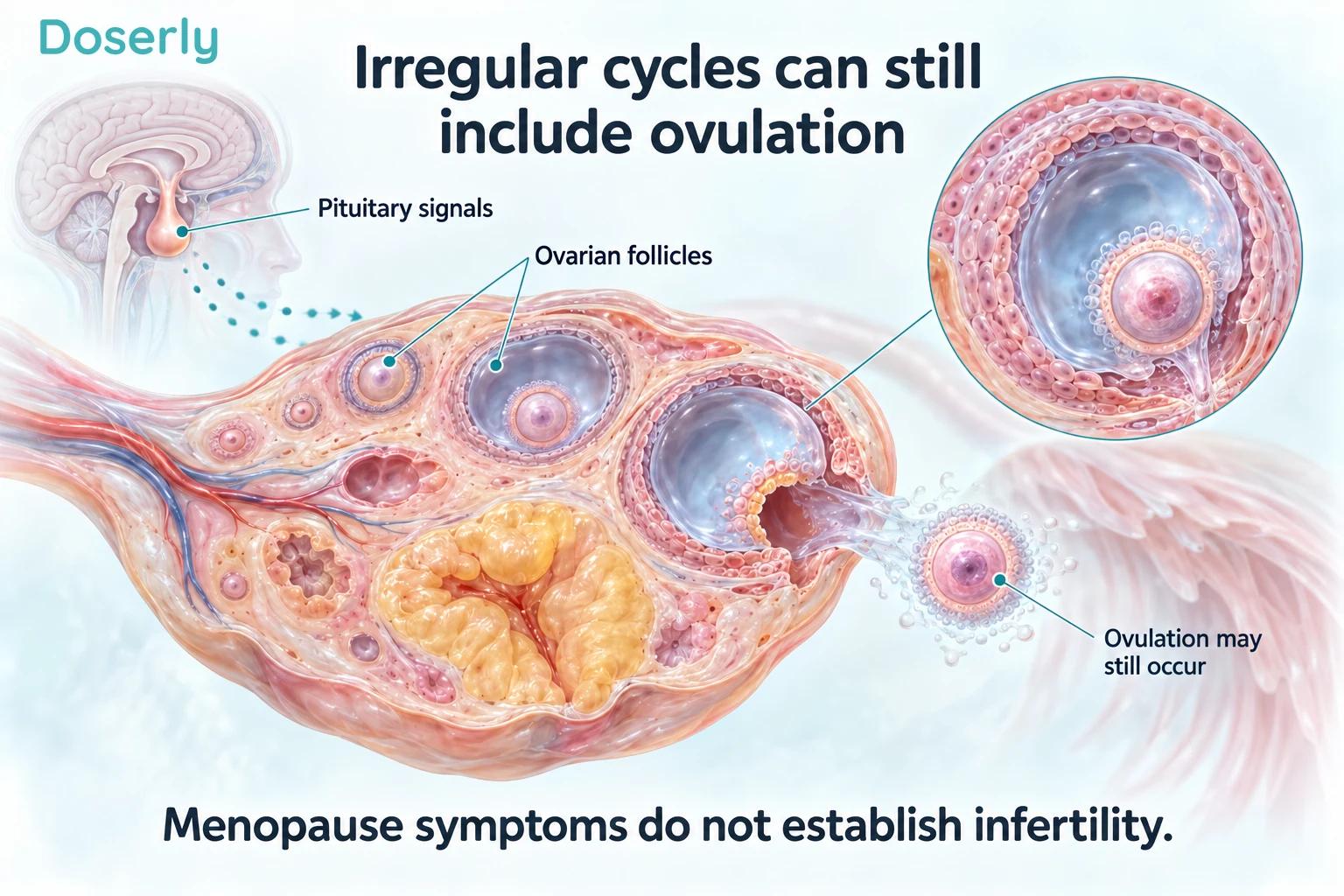
Perimenopause can bring hot flashes, changing periods and months when a cycle seems to disappear. It can also include ovulation. Feeling menopausal, having irregular bleeding or starting hormone replacement therapy does not establish that pregnancy is no longer possible.
Menopausal HRT is not a contraceptive. Its estrogen and progestogen components are prescribed for menopause-related needs, not to provide reliable pregnancy prevention. If avoiding pregnancy matters, a separate contraceptive plan is needed until it is appropriate to stop. FSRH guidance for people over 40.
This is easy to miss because HRT and some contraceptives contain hormones with similar names. The distinction is the actual product, dose, regimen and evidence for its purpose. It helps to separate three goals from the beginning: relieving symptoms, protecting the uterine lining when necessary, and preventing pregnancy.
Why irregular periods do not mean infertility
The menopause transition is variable. Ovarian follicles can respond inconsistently to hormonal signals, producing changes in cycle length and hormone concentrations. Some cycles do not include ovulation; others can. A long gap without bleeding does not necessarily identify the final menstrual period while the transition is still unfolding.
The STRAW+10 staging framework uses menstrual patterns and supporting hormonal information to describe reproductive aging. It does not provide a calendar that reliably predicts an individual’s last ovulation. STRAW+10 consensus.
CDC guidance states that contraceptive protection is still needed after age 44 for people who want to avoid pregnancy. Spontaneous pregnancy becomes less common with age, but uncommon is not impossible. CDC contraception guidance.
This is particularly relevant when symptoms have become the focus of care. A successful treatment for night sweats may improve daily life while doing nothing dependable to prevent pregnancy. Our perimenopause guide explains the transition’s broader pattern.
What the progestogen in HRT is doing
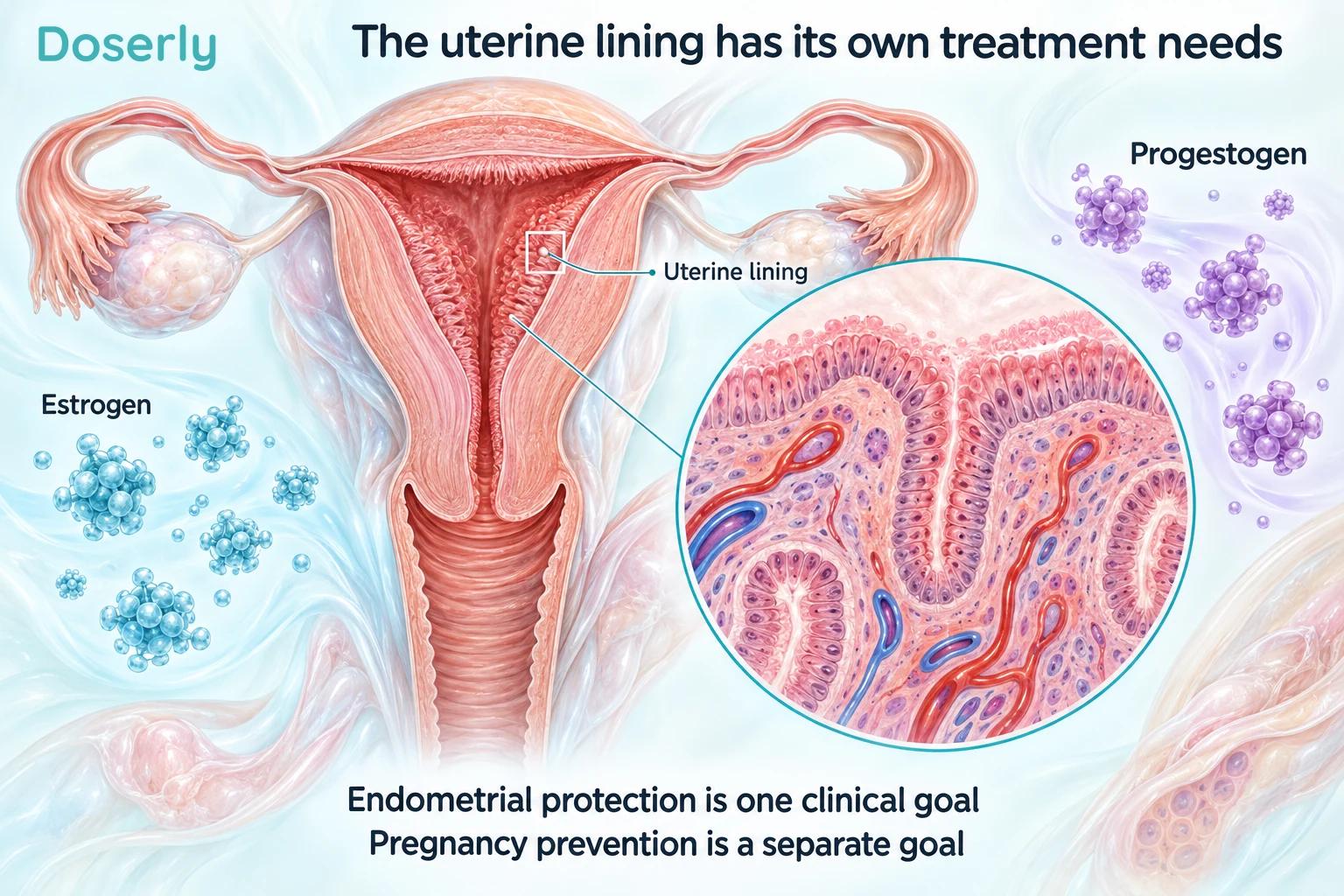
If you have a uterus and use systemic estrogen, a suitable progestogen is generally needed to protect the uterine lining, also called the endometrium. Estrogen can stimulate that lining; the progestogen component helps prevent excessive growth.
That protective role does not make every HRT regimen contraceptive. A progestogen prescribed for part of the month as HRT should not be treated as interchangeable with a contraceptive pill. Continuous combined HRT is also not established pregnancy prevention simply because it contains hormones every day. FSRH over-40 guidance.
The reverse assumption can be wrong too. A contraceptive that contains progestogen does not automatically provide adequate endometrial protection alongside systemic estrogen. The specific method and supporting evidence must be checked.
A useful medication review therefore gives each product a job. One may treat hot flashes; another may prevent pregnancy; a particular device may serve both contraception and uterine protection. If the purpose is unclear, ask the prescriber to write it beside the medicine’s name.
Can contraception also help menopause symptoms?
For medically eligible people, combined hormonal contraception can sometimes address contraception, cycle control and menopause symptoms together. This includes certain pills, patches and rings. It is a different treatment strategy from adding standard menopausal HRT to an existing contraceptive regimen.
FSRH guidance discusses combined hormonal contraception as an alternative to HRT for suitable people under 50, with a later transition to another method when appropriate. The person’s medical history and local guidance determine suitability. FSRH combined contraception guideline.
Do not combine a contraceptive pill and systemic HRT on your own because both appear to contain familiar hormones. The prescriber should decide whether one strategy can meet the goals or whether a different contraceptive method should accompany HRT.
For someone already doing well on contraception, the question is not necessarily “When do I switch to HRT?” It may be “What symptoms remain, is this method still appropriate for my health, and how will we make the eventual transition without a gap in protection?”
Method choice depends on more than age
A contraceptive review considers blood pressure, smoking, migraine history, clotting history, cancer history, medications and personal preferences. Some conditions make estrogen-containing contraception unsuitable while leaving other options available.
CDC’s Medical Eligibility Criteria organize recommendations by the specific method and condition. They also emphasize person-centered decisions: effectiveness matters, but so do tolerability, access, bleeding preferences and whether the person wants a method they control directly. US Medical Eligibility Criteria.
An age-related increase in risk is a reason to review the method, not a reason to leave someone without contraception. If one method becomes unsuitable, discuss an alternative and how to switch safely.
It is also worth distinguishing contraception from protection against sexually transmitted infections. A method that prevents pregnancy may not provide infection protection. New partners or changed relationships can make barrier protection relevant even when pregnancy risk has become small.
Where a hormonal IUD can fit
A suitable levonorgestrel intrauterine device can provide contraception and, in the appropriate formulation and duration of use, the progestogen component needed with systemic estrogen. That can simplify care for someone with a uterus who needs both symptom treatment and pregnancy prevention.
However, not all hormonal IUDs have the same evidence for HRT protection. The device’s contraceptive lifespan may also be longer than its accepted interval for protecting the lining during estrogen treatment. The insertion date and exact device matter. FSRH over-40 guideline.
The practical question is not just “Is my IUD still working?” Ask, “Is it still suitable for each job we are relying on it to do?” Our levonorgestrel IUD guide explains this distinction in more detail.
A copper IUD is another contraceptive option, but it does not supply progestogen for endometrial protection. Likewise, a progestogen-only pill or implant used for contraception should not automatically replace the separately prescribed progestogen in an HRT plan.
Why bleeding can become a confusing signal
Hormonal contraception may reduce or stop bleeding. Sequential HRT may produce scheduled bleeding, and other regimens can alter bleeding patterns too. A bleed caused by a treatment schedule does not prove that ovulation occurred. No bleeding on a suppressive method does not prove that natural menopause has occurred.
This means the familiar rule about counting months since the last period cannot be applied identically to everyone taking hormones. The clinician needs to know what method was used during that interval.
NICE explicitly notes the difficulty of identifying menopause in people using hormonal treatments. It advises against using FSH to identify menopause while taking combined estrogen-progestogen contraception or high-dose progestogen. NICE menopause recommendations.
If bleeding becomes heavy, persistent, unexpected after a settled pattern, or otherwise concerning, it deserves assessment. Do not assume the explanation is simply perimenopause. Pregnancy, medication effects and uterine or cervical causes may need consideration according to the situation.
A hormone panel cannot guarantee that contraception is unnecessary
Follicle-stimulating hormone, or FSH, can rise as ovarian feedback changes. During perimenopause, however, hormone concentrations fluctuate. Exogenous hormones can also alter the result. A single high FSH value is not a dependable certificate that future ovulation cannot occur.
CDC notes that no reliable laboratory test confirms definitive loss of fertility, and FSH assessment may not accurately determine when someone is no longer fertile. CDC guidance.
There are selected method-specific circumstances in which clinicians use FSH as part of a stopping strategy, particularly for some older users of progestogen-only contraception. That is a defined clinical pathway, not permission to interpret a commercial hormone panel independently.
Avoid stopping contraception simply to see what a blood test shows. If a change is needed to clarify menopause status, the clinician can plan it with continued pregnancy protection and explain how long the replacement method is needed.
When can contraception stop?
The answer depends on age, natural menstrual history and the method being used. US guidance describes continuing contraception until menopause or approximately ages 50–55, with individualized assessment. It does not prescribe one universal stop date for everyone. CDC guidance.
UK FSRH guidance generally allows stopping at age 55 because spontaneous conception is exceptionally rare. For people not using hormonal contraception, its approach to amenorrhea differs below and above 50. Hormonal methods require their own instructions because they can hide the natural bleeding pattern. FSRH guidance.
Those are jurisdiction-specific clinical rules, not interchangeable snippets to assemble yourself. Ask which rule applies to your exact method and history. If an IUD remains necessary for HRT-related uterine protection after contraception is no longer needed, it still requires review for that separate purpose.
Stopping contraception and stopping HRT are therefore different decisions. Someone may no longer need pregnancy prevention but still benefit from menopause treatment, or may stop HRT while still needing contraception.
Plan the switch, not just the destination
Gaps often occur during a transition: a pill is stopped, a patch is started, or an older device is assumed to cover a new role. Before changing anything, establish the start and stop dates, whether overlap or backup protection is needed, and who will confirm the plan.
For example, someone may be offered systemic estrogen for hot flashes while already taking a progestogen-only contraceptive. The contraceptive may remain useful for pregnancy prevention, but the prescriber still needs to address the uterine lining. The presence of a progestogen on the medication list does not settle that second question.
Another person may have no periods with a hormonal IUD and assume menopause is complete. The absent bleeding may reflect the device. The decision about contraception needs the age and method-specific pathway, while the device’s role in HRT needs its own date check.
These examples are not dosing instructions. They illustrate why a medication plan should identify each goal explicitly. Bring the device card or insertion date, exact product names and recent bleeding pattern to the appointment.
If there may already have been a gap
If you have had sex that could result in pregnancy without effective contraception, seek timely advice from a clinician or pharmacist about emergency contraception and pregnancy testing. HRT is not emergency contraception. The best option and timing depend on the situation, medicines and method used. FSRH guidance for women over 40.
Do not wait for a hot flash, a bleed or a hormone result to decide whether the question matters. Perimenopause does not make pregnancy symptoms reliably distinguishable from other symptoms, and an early negative test may need follow-up according to clinical advice.
At the next routine visit, ask for a short written answer to three questions: what treats my symptoms, what protects my uterine lining if needed, and what prevents pregnancy? Knowing when each part is due for review makes the plan easier to follow.
A practical handover can prevent a misunderstanding when different clinics manage contraception and menopause care. Record the actual method, product name, insertion or start date, reason for use, and the advice about when it needs review. Include the estrogen and progestogen components of HRT separately where they are separate products.
For example, “continue the coil” may be intended as contraception advice, while another clinician is relying on that same device for endometrial protection. Making both purposes explicit allows the relevant duration to be checked for each. It also makes clear what must be reconsidered if the device is removed.
Ask for clarification when the instructions use only the word “hormones.” A written plan should identify which medicine changes, when the change occurs, and what maintains pregnancy prevention during the transition. This is a communication safeguard, not a universal switching schedule; the exact instructions depend on the methods involved.
Sources
- FSRH contraception over 40 guideline, amended May 2025.
- CDC: when contraception is no longer needed, 2024.
- US Medical Eligibility Criteria, 2024.
- STRAW+10 reproductive aging consensus, 2012.
- FSRH combined hormonal contraception guideline, 2023.
- NICE menopause recommendations.