
HRT
October 16, 2026
HRT and GLP-1 treatment: separate goals, coordinated care
On this page
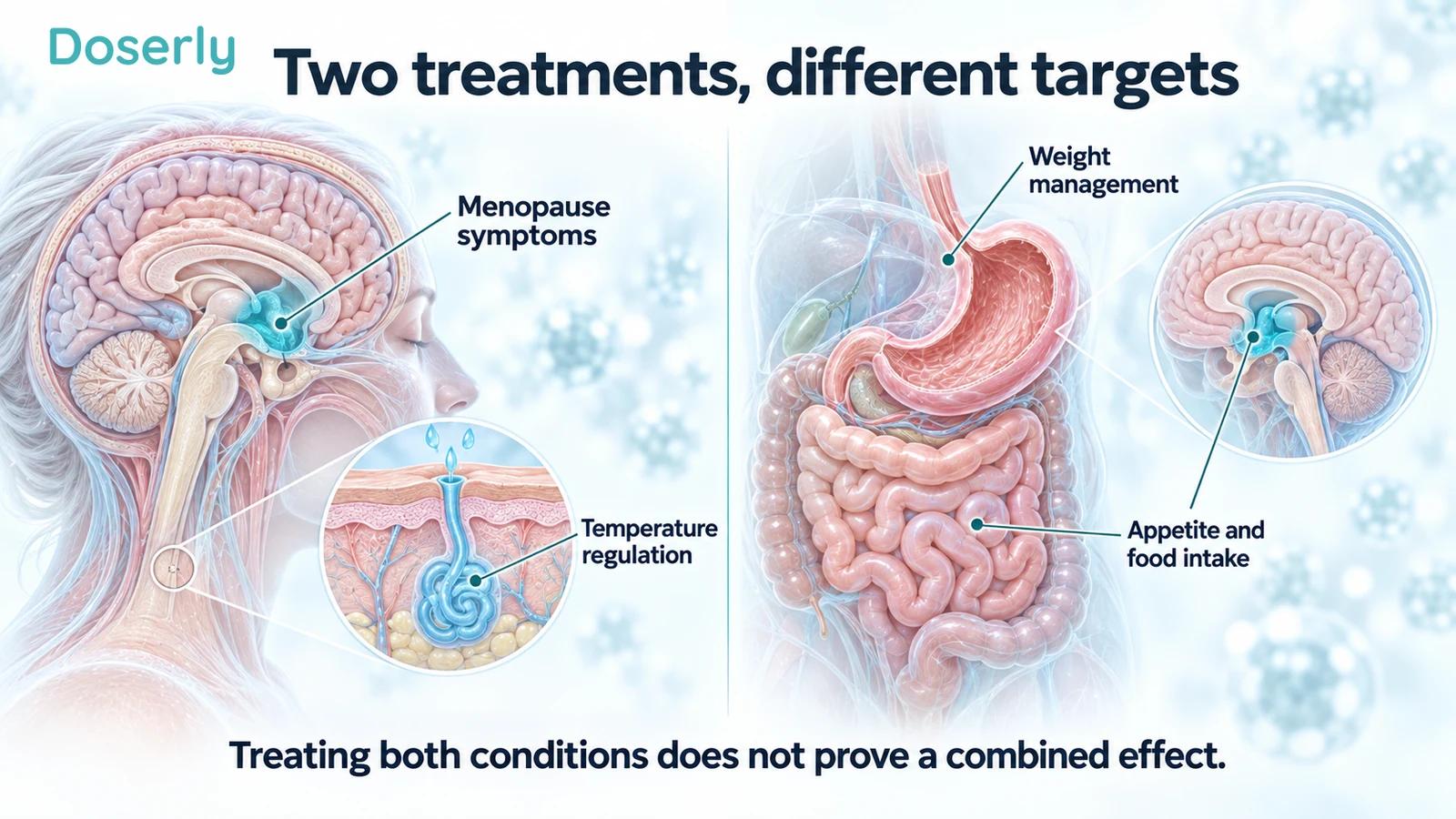
Menopause symptoms and weight-related health problems can arrive in the same period of life. Someone may need help with disruptive night sweats while also receiving treatment for obesity or type 2 diabetes. Using hormone replacement therapy (HRT) and a medicine such as semaglutide together can therefore be a reasonable clinical situation. It does not, by itself, establish a proven combination that “resets” menopause or metabolism.
The practical questions are more specific. What is each medicine treating? Is there evidence that one improves the response to the other? Could changes in digestion affect oral medicines? And who will review side effects when more than one prescriber is involved?
Those questions matter because the evidence is uneven: large trials support particular uses of weight-management medicines, while direct studies of their combination with menopause hormone therapy are much more limited. Keeping the goals separate makes it easier to benefit from appropriate treatment without expecting a result the combination has not demonstrated.
What each treatment is intended to do
HRT treats defined problems associated with menopause, particularly bothersome hot flashes and night sweats. Depending on the formulation and clinical situation, it also has roles in genitourinary symptoms and bone protection. It is not prescribed simply to make every midlife symptom disappear or to produce substantial weight loss. Treatment selection depends on individual benefits, risks and preferences. NICE menopause recommendations
GLP-1 receptor agonists, including semaglutide, mimic signaling by glucagon-like peptide-1, a gut hormone involved in appetite and glucose regulation. Tirzepatide is related but different: it acts at both GLP-1 and glucose-dependent insulinotropic polypeptide, or GIP, receptors. The precise medicine, product and indication matter; the category name alone does not specify what has been approved or studied. British Menopause Society clinical guidance
For example, relief of night sweats and a reduction in body weight are separate outcomes. If both improve while two treatments are used, that is useful clinically. It does not tell us that the drugs amplify one another, or that either would have failed when used alone.
What the large semaglutide trial established
STEP 1 randomized 1,961 adults with overweight or obesity, without diabetes, to weekly injected semaglutide or placebo alongside lifestyle intervention for 68 weeks. The target semaglutide dose was 2.4 mg weekly. Mean weight change was −14.9% with semaglutide and −2.4% with placebo. Gastrointestinal symptoms were common, and more semaglutide participants discontinued because of gastrointestinal events. STEP 1 primary report
This is strong evidence for the studied weight-management intervention in that population. It was not a trial randomizing menopausal women to HRT plus semaglutide versus semaglutide alone. It cannot answer whether starting hormones increases semaglutide's effect, whether the combination treats menopause symptoms more effectively, or which HRT regimen should accompany it.
The dose above describes the research, not a schedule to follow independently. Products, formulations and approved uses can differ. A clinician should identify the exact medicine being prescribed and the health outcome it is intended to improve, rather than relying on the shorthand “a GLP-1.”
The combination study is interesting—and small
A 2024 retrospective study examined 106 postmenopausal women receiving semaglutide for overweight or obesity. Sixteen used systemic hormone therapy and 90 did not. At 12 months, the reported mean total body-weight loss was 16% in hormone users and 12% in nonusers. The study also reported earlier follow-up measurements. Semaglutide and hormone-therapy cohort
These women were not randomly assigned to use HRT. Hormone users and nonusers may have differed in symptoms, treatment access, health, adherence or other factors that influence weight change. Statistical adjustment can address measured differences but cannot reliably remove every unmeasured one. The small hormone-therapy group also limits precision and assessment of uncommon adverse effects.
The finding is therefore an association worth testing, not proof that HRT caused extra weight loss. It does not justify starting HRT solely to improve semaglutide response. Nor does it establish a preferred estrogen route, progesterone regimen or sequence for the combination.
For a patient already using both medicines for appropriate reasons, the result may be reassuring that the combination is a legitimate research question. It should not become a promised percentage on a clinic's sales page. Your own response may be very different from either group's average.
What would a convincing combination trial need?
A useful study would define its population carefully: menopausal stage, obesity or diabetes status, baseline symptoms, and reasons for considering HRT. It would then compare treatments under otherwise similar conditions, with clear follow-up and a prespecified main outcome.
If the claim is that HRT improves weight loss on semaglutide, weight outcomes need to be compared after random assignment to a suitable hormone intervention or control. If the claim concerns hot flashes, those symptoms need to be measured directly. If the goal is preserving strength during weight loss, a body-weight endpoint alone is insufficient.
Safety would need equal attention. Bleeding, tolerability, discontinuation and relevant metabolic outcomes cannot be inferred from a favorable average weight change. This is a description of the evidence required to answer the question, not an established combination protocol.
Until that evidence is available, clinical care can still proceed. A person does not need a trial of every possible medication pairing before receiving treatment for two conditions. But clinicians should distinguish ordinary coordinated prescribing from a claim that the pair has a special, proven combined benefit.
Oral progestogen exposure is a practical concern
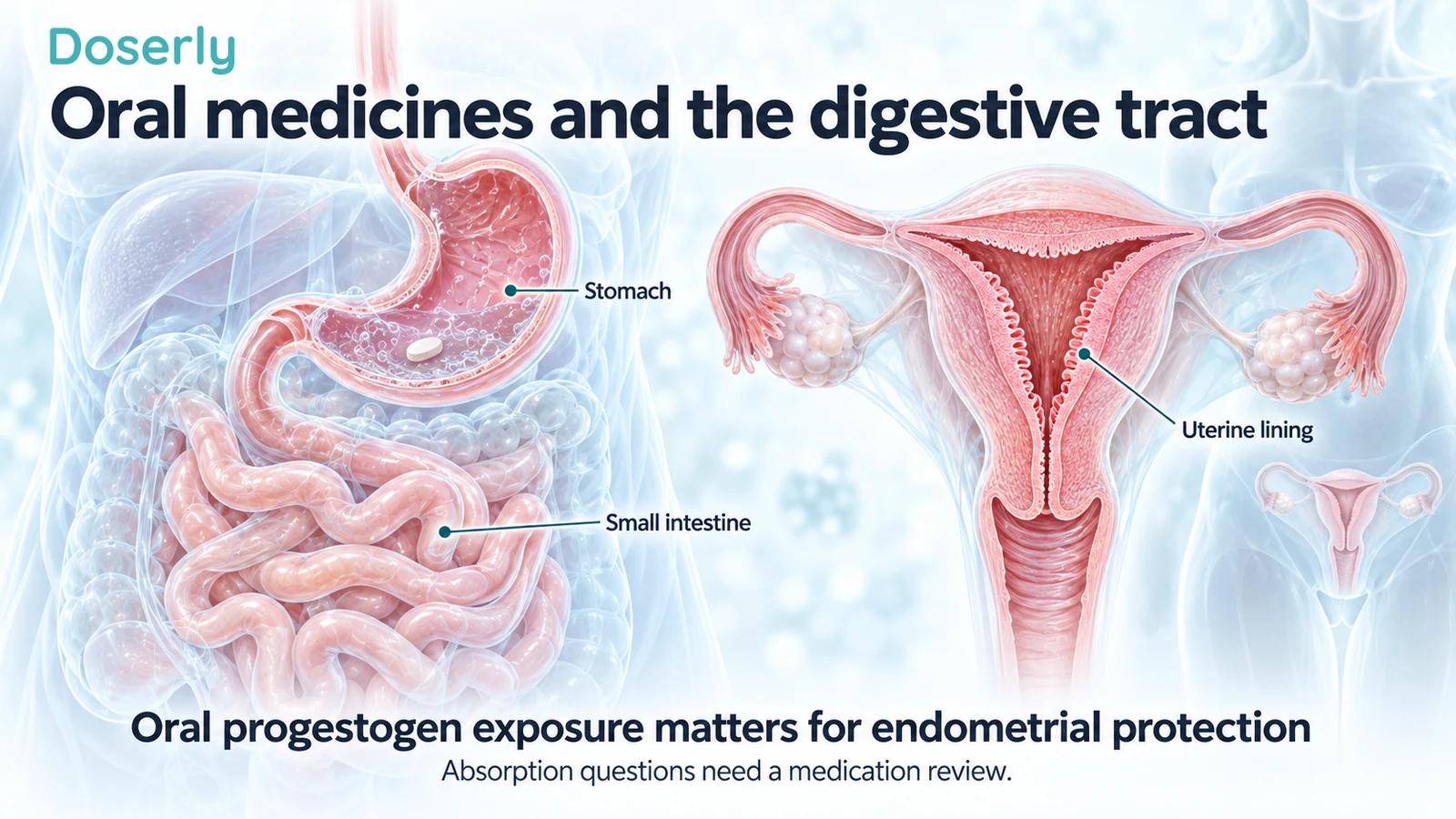
For people with a uterus who use systemic estrogen, adequate progestogen is generally needed to protect the endometrium, the uterine lining. That protective role remains important even when symptom relief is excellent. Our micronized progesterone guide explains why it is part of many HRT regimens.
Semaglutide and tirzepatide delay gastric emptying, and vomiting or diarrhea may complicate oral medication use. The British Menopause Society raises concern about possible effects on oral progestogen exposure while explicitly acknowledging that direct data on HRT absorption, dosing requirements and endometrial outcomes are lacking. This is a clinical precaution under uncertainty, not evidence that the combination causes endometrial cancer or routinely makes HRT fail. BMS guidance
Ask the prescriber to review the whole regimen, including the route of estrogen and how uterine protection is provided. Do not assume that moving estrogen from a tablet to a patch resolves every issue if the progestogen is still taken orally. Likewise, do not double a progesterone dose or change its schedule based on an online precaution; the appropriate response depends on the actual regimen.
Contraception is a separate question from HRT
Menopause hormone therapy is not contraception. If pregnancy remains possible, the contraceptive plan needs its own review. Evidence about a contraceptive tablet also cannot automatically be transferred to every oral HRT product: the ingredients, doses and intended outcomes differ.
The US Zepbound label advises people using oral hormonal contraception to switch to a nonoral method or add a barrier method for four weeks after starting tirzepatide and four weeks after each dose increase. This specific instruction reflects tirzepatide's effect on oral contraceptive exposure. It should not be generalized into an identical rule for every GLP-1 medicine or interpreted as a complete HRT dosing instruction. Zepbound prescribing information
Bring contraceptives, HRT and weight-management medicines to the same medication review, even if different services prescribed them. “Hormones” is too broad a description for an interaction check. The clinician or pharmacist needs the product names, routes, schedules and timing of recent changes.
Side effects should not disappear inside a success story
A lower weight does not cancel out persistent nausea, inability to eat adequately or an unresolved bleeding problem. Nor should improved sleep automatically be taken as evidence that a medicine is suitable in every other respect.
The Wegovy label includes warnings about pancreatitis, gallbladder disease, severe gastrointestinal reactions and kidney injury associated with volume depletion. It also carries a thyroid C-cell tumor warning based on rodent findings; whether that risk occurs in humans is unknown, and the product is contraindicated with a personal or family history of medullary thyroid carcinoma or MEN2. Persistent severe abdominal pain or inability to keep fluids down needs prompt medical advice. Wegovy prescribing information
This is not an exhaustive safety list. It illustrates why a treatment plan needs explicit instructions about symptoms that warrant contact and who should be contacted. When two clinics are involved, it is especially useful to agree which team will assess nausea, medication exposure, bleeding or a change in glucose control.
Unscheduled bleeding should be reported and assessed according to its timing, severity and the person's risk factors; it should not automatically be attributed to a weight-management injection. Professional guidance emphasizes reviewing the HRT preparation and progestogen exposure while deciding whether investigation is needed. BMS unscheduled-bleeding guidance
Track separate outcomes without making life a trial
A useful record can be brief. For menopause treatment, note the symptom you hoped to improve and whether it is less disruptive. For weight-management treatment, note the agreed health goal, tolerability and relevant measurements. Add the dates of medication changes so the sequence is clear.
Consider an illustrative example: night sweats improve after HRT starts, then appetite and weight change after semaglutide is introduced. That sequence helps describe the experience, although it still cannot prove every cause. If both medicines begin together, the clinician has less information about which change accounts for a new symptom. Recording the timeline helps the review without turning your own care into an uncontrolled experiment.
Daily function matters alongside weight. If eating becomes difficult or strength declines, tell the team rather than interpreting rapid loss as automatically better. The treatment goal should include tolerability and the ability to maintain adequate nutrition, activity and ordinary life.
Questions that make coordinated care concrete
At your next review, ask what each medicine is treating and what would count as enough benefit to continue. Ask whether the prescriber has reviewed all oral medications, including contraception and progestogen, and what to do if vomiting prevents a dose from staying down. Clarify which symptoms need prompt attention and which clinician will respond.
It also helps to ask when the plan will be reassessed. A medicine that works well now may need review if another treatment changes, a new health condition appears or access becomes difficult. Our HRT monitoring guide explains why symptoms, history and the actual regimen matter alongside selected tests.
The strongest reason to use two treatments is that each addresses a real need and can be monitored safely. That is a more useful foundation than a combined promise that has not yet been demonstrated.
Explore the research
- STEP 1, 2021: randomized semaglutide weight-management trial, not a trial of HRT synergy.
- Semaglutide response with and without HRT, 2024: small retrospective postmenopausal cohort.
- BMS incretin/HRT guidance, 2025: practical precautions and explicit evidence gaps.
- Wegovy prescribing information: product-specific indications and safety.
- Zepbound prescribing information: tirzepatide, oral contraception and safety.
- NICE menopause recommendations: individualized menopause care.
- BMS unscheduled-bleeding guidance: evaluation rather than assumed attribution.