
TRT
October 16, 2026
hCG on TRT: Hormone Production Is Not the Same as Proven Fertility
On this page
“Add hCG to keep fertility” is an appealingly simple explanation. It offers a way to treat low testosterone without giving up the possibility of children. It also compresses several different scientific questions into one promise.
Human chorionic gonadotropin, or hCG, can stimulate testosterone production within the testes. Small studies suggest that some men can maintain sperm production while taking hCG alongside testosterone replacement. Neither statement establishes that an add-on prescription will reliably preserve fertility for every man on TRT.
The useful question is therefore more specific: what outcome has the proposed treatment actually been shown to support, in whom, and how will it be monitored? Understanding the evidence makes the conversation more useful without dismissing a medicine that has legitimate reproductive uses.
Where hCG acts
The testes receive signals from the pituitary. Luteinizing hormone, or LH, stimulates Leydig cells to produce testosterone. Follicle-stimulating hormone, or FSH, supports the cells and environment involved in sperm development.
hCG has LH-like activity. It acts at the testes, rather than requiring the pituitary to release more LH. The PREGNYL prescribing information includes selected cases of male hypogonadotropic hypogonadism among its indications. This refers to inadequate hormonal stimulation of the testes; it is not a blanket indication for fertility preservation in everyone receiving TRT. PREGNYL prescribing information
That distinction matters because testosterone replacement suppresses pituitary signaling through feedback. hCG can provide an LH-like stimulus despite that suppression, but it does not establish that every other part of the reproductive pathway is functioning normally.
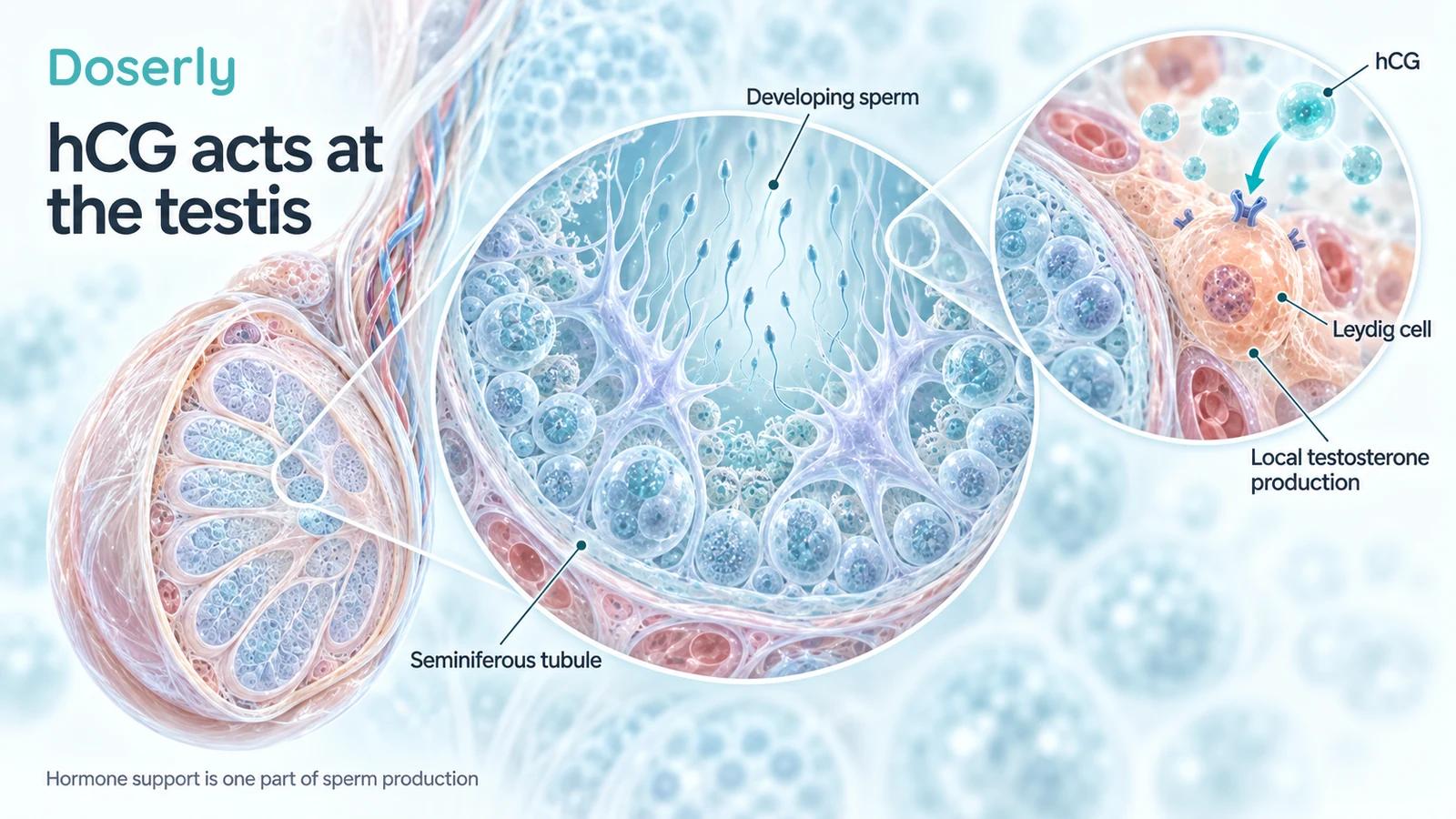
Doserly's comparison of hCG, gonadorelin and enclomiphene explains why medicines used in similar conversations are not interchangeable. Their sites of action differ, even when blood testosterone is one of the outcomes being measured.
The experiment behind the local-testosterone claim
A frequently cited 2005 study randomized 29 healthy men with normal reproductive physiology to testosterone enanthate with placebo or different hCG doses for three weeks. Researchers measured testosterone in fluid obtained directly from the testes before and after treatment.
In the testosterone-plus-placebo group, intratesticular testosterone fell by 94%. Adding hCG produced a dose-related response that maintained local testosterone much closer to, or above, the starting concentration in the higher-dose groups. Coviello and colleagues
This is valuable mechanistic evidence. It demonstrates that the testosterone concentration in blood and the testosterone environment inside the testes can move differently, and that hCG can influence the latter during experimentally suppressed gonadotropin signaling.
It is also a short experiment in healthy volunteers. It did not establish long-term pregnancy outcomes, identify a universally successful fertility regimen, or show that the measured hormone concentration alone guarantees normal sperm production.
The researchers themselves framed the work as a step toward understanding the relationship between intratesticular testosterone and spermatogenesis. Treating it as proof of preserved fertility skips the very question the experiment helped make possible to study.
The small clinical series is encouraging, with important limits
A 2013 retrospective study examined 26 hypogonadal men receiving testosterone replacement and concomitant hCG. Nineteen used injectable testosterone and seven used gel. Mean follow-up was 6.2 months, with some longer observations.
The investigators reported no deterioration in the semen parameters they assessed and no cases of azoospermia during combination treatment. Nine men contributed to a pregnancy with their partner during follow-up. Hsieh and colleagues
Those observations are relevant because they move beyond a local hormone measurement to actual semen testing and reported pregnancies. They are a reason to investigate the approach, not a reason to promise that it works universally.
There was no randomized comparison with a similar group receiving testosterone alone. The cohort was small and selected from clinical practice. Follow-up was not identical for everyone, and the report's longer observations should not be read as a full year of follow-up in all 26 men.
Nine pregnancies also cannot be converted into a reliable personal “success rate.” We would need to know who was trying, for how long, the partners' reproductive circumstances and the relevant comparison. A reported pregnancy is not automatically a reported live birth.
Why the guideline remains cautious
The 2024 AUA/ASRM male-infertility guideline recognizes research on adding hCG and other agents to exogenous testosterone. It concludes that the literature is too limited to recommend this as a general strategy for preserving spermatogenesis.
The same guideline conditionally permits hCG, selective estrogen receptor modulators and certain other approaches for infertile men with low testosterone. That recommendation addresses selected clinical circumstances and rests on limited evidence. It should not be interpreted as an endorsement of a universal TRT-plus-hCG package. AUA/ASRM guideline
A specialist may reasonably discuss options where the evidence is incomplete. The important distinction is between an individualized decision with uncertainty and a sales claim that the fertility problem has been solved.
A patient should be able to hear both parts: why the clinician thinks the option may help, and what remains unknown. Shared decisions are stronger when that uncertainty is named before treatment, rather than discovered after an abnormal semen result.
FSH and the starting diagnosis still matter
Sperm production is more than Leydig-cell testosterone output. Evidence from men with severe isolated hypogonadotropic hypogonadism illustrates why the rest of the pathway matters.
In an open clinical study, 26 men received hCG before treatment incorporating recombinant FSH. Among 19 evaluable participants, 15 developed spermatogenesis and 12 reached the study's sperm-concentration endpoint of at least 1.5 million per milliliter. Bouloux and colleagues
This was treatment of a specific deficiency, not an adjunct trial in men continuing TRT. It cannot provide a probability of success for that different situation. It does show why a fertility specialist may need to consider more than one hormonal signal and may assess semen over a prolonged treatment course.
The denominator also matters: 15 of 19 evaluable men is not the same claim as success in 15 of all 26 enrolled. Careful reading preserves the uncertainty created when some participants cannot be included in the final evaluation.
The original diagnosis guides whether stimulating the testes is likely to help. A problem primarily within testicular tissue differs from insufficient signaling to otherwise responsive tissue. The primary versus secondary hypogonadism guide explains that distinction.
Choose the measurement that matches the goal
If the goal is to improve blood testosterone, hormone testing measures that response. If the goal is to preserve sperm production, semen testing is needed. If the goal is pregnancy, the evaluation also involves the reproductive circumstances of the people trying to conceive.
These outcomes can be related without being interchangeable. A higher testosterone concentration does not tell you the sperm count. Maintaining testicular size is not a semen analysis. Feeling better does not establish that sperm production has been preserved.
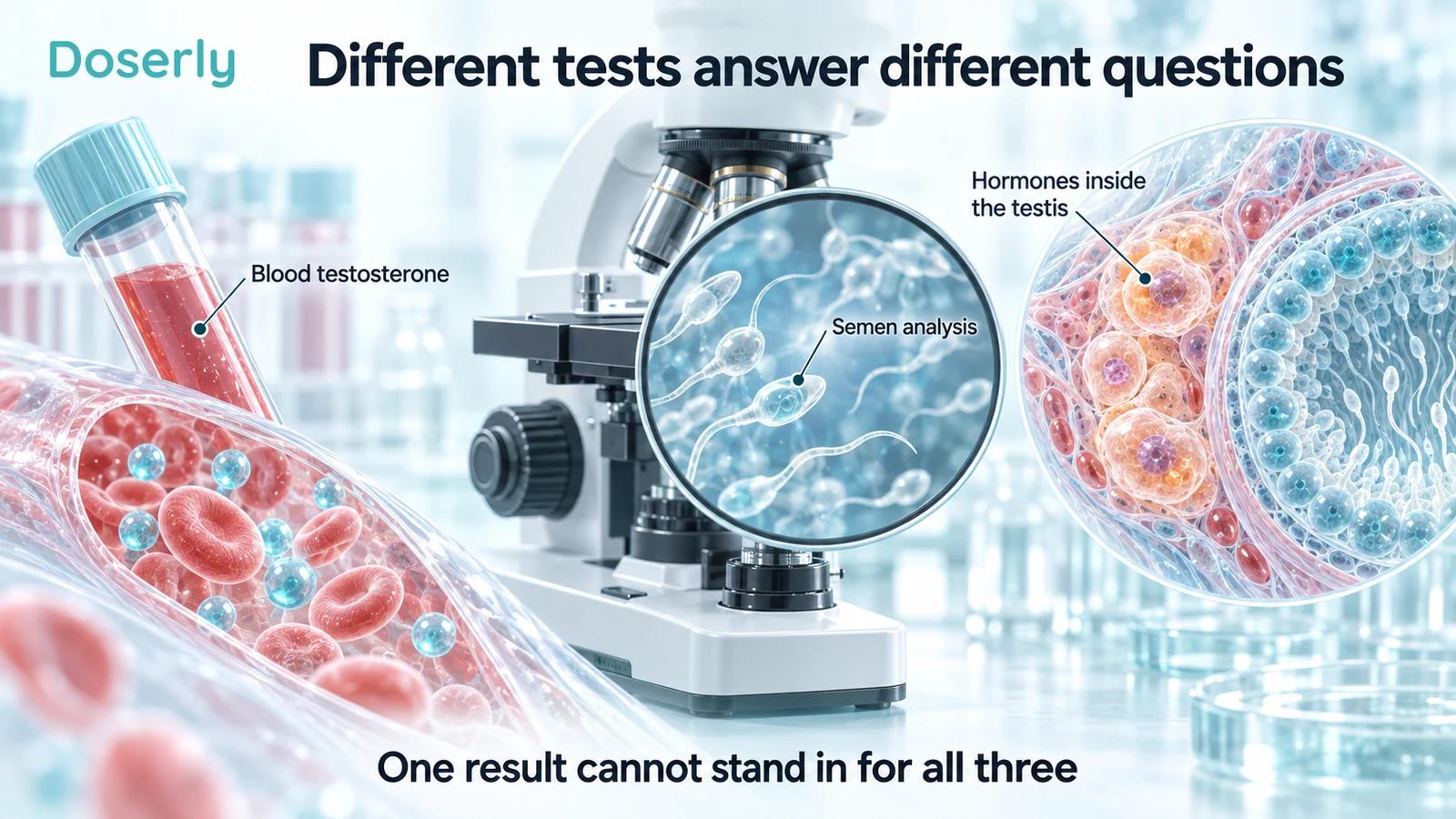
WHO's semen manual provides standardized methods for examining samples and monitoring interventions affecting spermatogenesis. Routine fertility monitoring does not require repeating the invasive testicular-fluid measurement used in the physiology experiment. WHO laboratory manual
Before starting an adjunct, ask which outcome will determine whether it is working. A plan that never measures sperm cannot provide direct evidence that sperm production is being maintained.
Preservation and recovery are different treatment problems
Studies of recovery after stopping testosterone are sometimes used to support claims about preserving fertility while continuing it. Those are different questions.
One retrospective series followed 66 men who stopped testosterone and received hCG plus a selective estrogen receptor modulator. Forty-six reached the study's total motile sperm-count threshold within twelve months. Older age and longer testosterone exposure were associated with slower recovery. Kohn and colleagues
This finding does not establish that the same outcome would occur with ongoing testosterone. It also cannot isolate hCG's contribution from stopping testosterone, the other medication or differences between patients.
For someone actively trying to conceive, the distinction has practical consequences. “Can we preserve options for several years?” and “How do we address a low sperm count now?” may lead to different treatment choices. An existing prescription should not prevent the plan from being reconsidered when the goal changes.
What a useful monitoring conversation includes
Start with the reproductive timeline. Are you trying now, considering children later, or mainly concerned about changes in testicular size? These are different priorities, and the prescription should not blur them together. A treatment prescribed primarily to limit testicular shrinkage should be described that way; it should not acquire an unmeasured fertility claim through shorthand.
Discuss a semen analysis before treatment changes when possible, especially if future fertility is important. If an initial sample is abnormal, ask how it will be confirmed and whether specialist evaluation is needed. Semen measurements vary, so a single result needs context rather than a simple pass-or-fail interpretation. AUA/ASRM guideline
Then agree on the follow-up. Who orders and reviews testing? What change would prompt reassessment? If the semen result worsens despite reassuring blood testosterone, what happens next?
A record should include medication names, formulations, changes, collection dates and results. This helps distinguish a biological change from a comparison made across different treatment periods or incomplete information. It also helps when a reproductive specialist joins care that began elsewhere.
hCG adds its own treatment burden
An additional medicine is not biologically neutral. The prescribing information describes injection-site reactions, fluid retention, gynecomastia and hypersensitivity among relevant adverse effects. A person with new breast symptoms, swelling or troublesome injection reactions should discuss them with the prescriber. Severe allergic symptoms require urgent medical attention. PREGNYL prescribing information
The label also contains extensive warnings related to ovarian stimulation. Those should not be copied into advice for men as though the same treatment context applied. Accurate safety information needs the same population distinctions as efficacy information.
Ask about the practical burden too: injections, supplies, cost, access, follow-up and what happens if treatment is interrupted. A plan that depends on an adjunct needs a clear response to missed access, rather than an assumption that the original fertility claim continues to hold.
Avoid adjusting multiple hormones in response to one symptom or an isolated laboratory value. That can make it harder to identify which change helped or caused a problem.
Read a fertility claim by asking what was counted
When a clinic or article says hCG “preserves fertility,” look for the actual endpoint. Was the study measuring testosterone in blood, testosterone inside the testes, sperm concentration, total motile sperm, pregnancy or live birth? Was testosterone continued or stopped? Were participants healthy volunteers, men with a specific hormonal deficiency, or patients already experiencing infertility?
These questions are not academic obstacles. They tell you how closely the evidence matches the decision in front of you.
hCG has a clear biological action and established uses in selected reproductive conditions. The evidence does not justify treating it as an automatic guarantee against TRT-related fertility problems. A useful plan connects the diagnosis, reproductive timeline and appropriate measurements—and includes an alternative if the intended outcome is not achieved.
For the broader discussion before or during testosterone treatment, see Doserly's TRT and fertility guide.
Sources
- Coviello et al. hCG and intratesticular testosterone during gonadotropin suppression
- Hsieh et al. Concomitant hCG during testosterone replacement
- AUA/ASRM Diagnosis and Treatment of Infertility in Men, amended 2024
- PREGNYL prescribing information
- Bouloux et al. Recombinant FSH in isolated hypogonadotropic hypogonadism
- Kohn et al. Age and duration of testosterone therapy predict sperm-count recovery
- WHO laboratory manual for human semen, sixth edition