
HRT
October 16, 2026
Fezolinetant’s liver warning: what postmarketing evidence can reveal
On this page
A medicine can reduce hot flashes and still require a more serious safety conversation after approval. Those facts are compatible. Fezolinetant’s liver warning illustrates why the evidence for a treatment keeps changing as more people use it, and why a successful trial is not the last word on uncommon harms.
For someone taking Veozah, the immediate issue is practical: use the current prescribing information, have the required liver tests, and know which symptoms need prompt action. For someone comparing treatment options, the warning belongs alongside expected symptom benefit, medical history, interactions and the feasibility of monitoring. Calling a medicine nonhormonal does not settle any of those questions.
What changed after approval
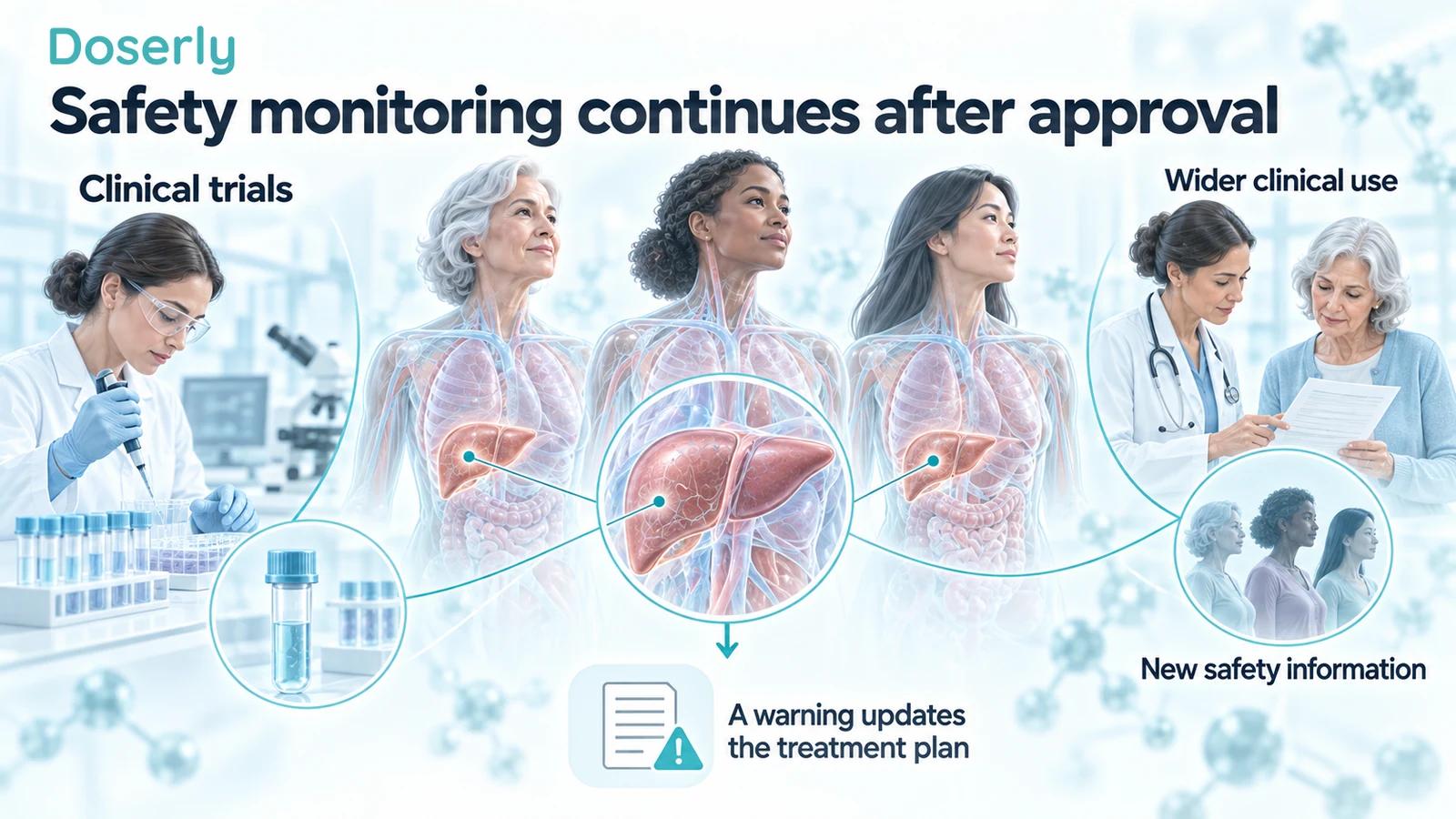
FDA approved fezolinetant in May 2023 for moderate to severe vasomotor symptoms due to menopause. In September 2024, it issued a safety communication about rare but serious liver injury and strengthened testing recommendations. On December 16, 2024, FDA added a boxed warning, its most prominent warning format. The sequence matters: the initial safety communication and the boxed warning were separate updates. FDA safety communication and update.
The September communication described a postmarketing case with liver-test abnormalities and symptoms after roughly 40 days of treatment. Improvement after stopping the medicine supported concern about a drug-related reaction. The current label describes postmarketing cases, rather than presenting that early report as the entire later safety record. Current Veozah prescribing information.
A boxed warning does not itself mean a medicine has been withdrawn or that every treated person will develop the event. It identifies a serious risk that must shape prescribing and patient information. Equally, describing the event as rare should not be used to dismiss the instructions attached to the warning. A low-probability harm can still matter greatly when its consequences are serious.
The efficacy evidence did not disappear
Fezolinetant blocks the neurokinin 3 receptor rather than supplying estrogen. Its development program tested whether that targeted approach could reduce hot flashes and night sweats. In SKYLIGHT 1, women aged 40 to 65 with at least seven moderate to severe hot flashes daily were randomized to placebo or one of two fezolinetant doses. The approved 45 mg dose produced an additional reduction of about 2.55 daily episodes versus placebo at week 12. SKYLIGHT 1 primary report.
That finding remains relevant. A later warning changes the balance between benefits and harms; it does not retroactively make the symptom comparison meaningless. The reverse is also true: a statistically convincing symptom benefit does not make subsequent safety information irrelevant.
A person who has experienced substantial relief may reasonably want to understand how monitoring changes the treatment plan. Someone with little improvement may view the same monitoring burden differently. Neither conversation is helped by reducing the choice to “effective” or “dangerous.” The useful decision combines the size of the benefit that matters to that person with the risks and practical requirements of continuing.
The Doserly fezolinetant guide covers the medicine more broadly. The narrower question here is how preapproval trials and postmarketing observations contribute different pieces of safety evidence.
What the longer trial could—and could not—show
SKYLIGHT 4 was a 52-week randomized safety study involving 1,830 treated participants across placebo and two fezolinetant dose groups. Liver-enzyme elevations above three times the laboratory upper limit occurred in 6 of 583 evaluated placebo participants, 8 of 590 receiving 30 mg, and 12 of 589 receiving 45 mg. These laboratory denominators are smaller than the total trial population and should not be silently replaced by the enrollment count. SKYLIGHT 4 primary report.
The trial reported no Hy’s law cases: a particular combination of substantial aminotransferase and bilirubin elevations without an alternative explanation that raises concern for serious drug-induced liver injury. That is useful information about what was observed in that study. It does not mean the investigators proved that serious liver injury could never occur in wider use.
A trial can be large enough to detect a common symptom benefit while remaining too small to characterize a rare adverse event precisely. It also follows selected participants, under a defined protocol, for a finite period. People who later receive a prescription may differ in health conditions, concomitant medicines and follow-up. These are reasons for continued observation, not reasons to discard randomized evidence.
Imagine a hypothetical adverse event that occurs in one of several thousand users. A trial involving several hundred people on a particular dose could readily finish without seeing it. That example is an explanation of sampling, not an estimate of fezolinetant’s liver-injury frequency. The actual frequency cannot be inferred by inserting a convenient hypothetical number into a treatment decision.
A laboratory elevation is not identical to symptomatic liver injury
Terms such as “abnormal liver tests,” “liver injury” and “liver failure” are sometimes used as though they mean the same thing. They do not. The fezolinetant evidence includes laboratory enzyme elevations observed during trials and clinically concerning postmarketing cases involving symptoms and other abnormal tests. The latter are not adequately described by saying only that an enzyme rose slightly.
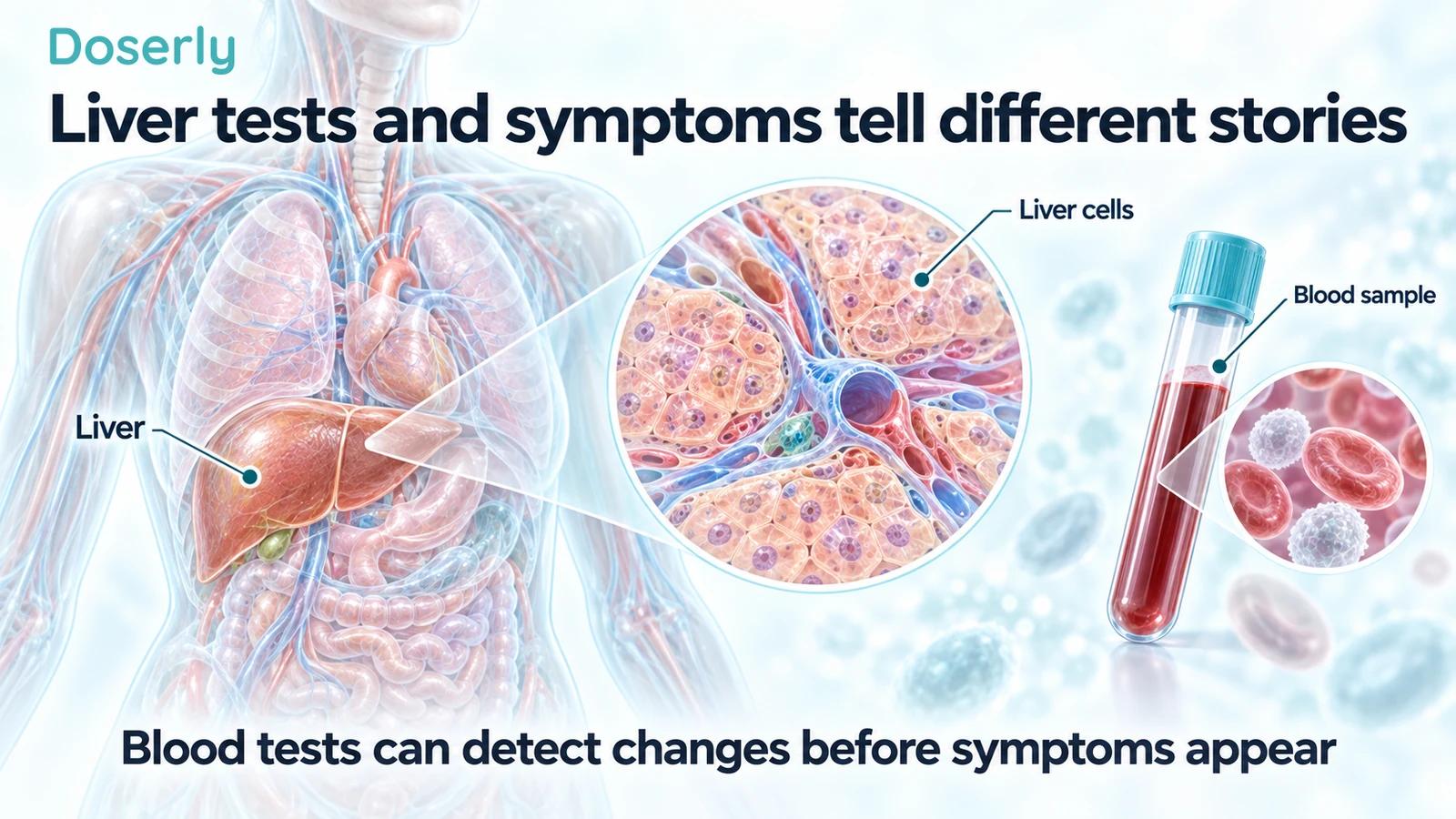
The distinction also explains why feeling well is not a substitute for testing. Trial participants with enzyme elevations could be asymptomatic. Conversely, a new symptom such as nausea does not establish that the liver is injured: assessment is needed because symptoms can have several causes. The correct response follows the medicine’s warning instructions, rather than waiting for certainty at home. Veozah prescribing information.
A test result needs its actual value, the laboratory reference range, previous measurements and clinical context. A clinician may investigate other explanations while deciding whether treatment must stop and how frequently to repeat tests. That is different from dismissing the result as “probably the medicine” or assuming every abnormality reflects irreversible damage.
Why reports can trigger action without giving an incidence rate
Postmarketing reports are useful signals, but they are not a controlled experiment or a complete census. Some events are never reported; reports may contain missing information or duplicates; other medicines and illnesses can complicate interpretation. The number of exposed people is also not necessarily known well enough to calculate a reliable rate. FDA explicitly cautions against treating dashboard report counts as proof of causation or incidence. FDA adverse-event dashboard limitations.
That limitation does not make a report worthless. A detailed chronology, laboratory pattern, exclusion of other causes and improvement after stopping can support a safety assessment. Regulators can act on a serious, credible signal while uncertainty remains about exactly how often it happens. Waiting for a perfectly precise frequency would be a different standard from asking whether a warning and monitoring change are justified.
It is therefore misleading to divide an online count of liver reports by an estimate of prescriptions and call the result an individual risk. It is also misleading to compare report totals between a newer and an older medicine as though they had equal exposure, reporting practices and time on the market. Those shortcuts produce a clean-looking number by discarding the information needed to interpret it.
What the current US monitoring plan requires
The February 2026 US label requires liver blood tests before starting and monthly during the first three months, then at months 6 and 9. Known cirrhosis, severe renal impairment or end-stage renal disease, and concomitant CYP1A2 inhibitors are contraindications. There are also laboratory thresholds that prevent initiation or require discontinuation. These are prescribing decisions using the full label, not thresholds to self-manage from an article. Current US label.
For a patient, the operational questions are straightforward. Who orders each test? Where will it be done? Who reviews the result? How will the patient hear back, including if the result is abnormal? A reminder that a test is due helps only if there is a clear route from the sample to a clinical decision.
The symptom instructions apply between appointments. FDA advises stopping Veozah immediately and contacting the prescribing clinician if symptoms suggest liver injury, including unusual tiredness, nausea or vomiting, itching, pale stools, dark urine, yellow skin or eyes, or abdominal pain. Do not wait for the next scheduled blood test to report those symptoms. FDA patient advice.
That instruction is different from deciding to stop solely because an old news story appears in a social feed. Someone without warning symptoms who is worried about treatment should arrange a review of the current plan. Someone with warning symptoms should follow the urgent instructions. An article should make that distinction clear rather than use a generic “never stop medication” sentence that contradicts the actual safety advice.
Local instructions matter
The UK MHRA also strengthened liver-safety advice in April 2025. Its recommendation includes baseline tests, monthly testing for the first three months, and subsequent testing based on clinical judgment. That wording differs from the fixed US month-6 and month-9 schedule. The point is not to choose whichever seems easier; it is to use the current instructions for the product and jurisdiction where treatment is prescribed. MHRA safety update.
The MHRA report also states that the mechanism underlying the liver injury is unknown and that the frequency of reported liver injury cannot be estimated. Those limits matter. It would be unsupported to promise that an ordinary supplement, a particular diet or simply avoiding one interaction eliminates the risk. Medication review and liver monitoring address specific concerns; neither is a guarantee that injury cannot occur.
Bring benefit and follow-up into the same conversation
A useful review starts with whether the target symptoms improved. Record hot flashes, night sweats and daily interference in a way that can be compared with the pretreatment period. Then review adverse symptoms, recent medication changes and the liver-testing schedule. Keeping these observations separate avoids interpreting all new fatigue as menopause or all improvement as evidence that safety checks are unnecessary.
The Doserly nonhormonal menopause treatment guide can help frame alternatives if the benefit, risk or monitoring burden no longer fits. The decision need not be a verdict on an entire drug class. It is a decision about a particular medicine, for a particular person, using information that continues to develop.
Fezolinetant’s warning is a concrete example of that process. Symptom trials established a benefit; later observations clarified a serious risk; prescribing instructions changed. The practical result should be better-informed care, including a clear monitoring plan and a clear response to warning symptoms.
Explore the research
- FDA September 2024 safety communication, updated December 2024.
- Veozah prescribing information, February 2026.
- SKYLIGHT 1 randomized trial.
- SKYLIGHT 4 randomized safety trial.
- FDA adverse-event dashboard limitations.
- MHRA liver-safety update, April 2025.