
Supplements
October 16, 2026
EAAs versus protein powder: what are you trying to replace?
On this page
Essential amino acids and protein powders are often advertised as competing routes to muscle growth. In practice, the useful comparison begins with the nutritional problem. Are you trying to make a meal more substantial, fit a convenient protein source into a busy day, or deliver a small amount of amino acids when a larger serving is difficult to consume?
An essential-amino-acid supplement can stimulate a measurable muscle response. A protein powder can do that too, while supplying a larger mixture of amino acids as intact dietary protein. Neither category automatically produces better long-term results simply because it raises blood amino acids or activates a signaling pathway.
EAAs may offer a compact way to deliver essential amino acids in selected circumstances. That does not make them a gram-for-gram replacement for dietary protein or an established upgrade for everyone who already eats enough. The right comparison depends on composition, population, daily diet and the outcome being measured.
What is different in the serving?
Essential amino acids are amino acids the body must obtain from the diet. Free-form EAA supplements provide them as individual amino acids. Intact dietary proteins contain amino-acid chains that are broken down during digestion. A protein powder is a concentrated food ingredient; its amino-acid composition depends on its source and formulation.
BCAAs are only three essential amino acids, so a BCAA product is not equivalent to an EAA mixture supplying the full essential set. Likewise, a product labeled “amino blend” may contain ingredients beyond EAAs. The actual label matters more than the category name. The EAA guide and BCAA guide explain those categories.
The distinction between free amino acids and intact protein matters in experiments, but it does not by itself tell us which serving is better for a particular person. Researchers must measure what happens after ingestion and choose a relevant comparison. The following trials do that in several different ways.
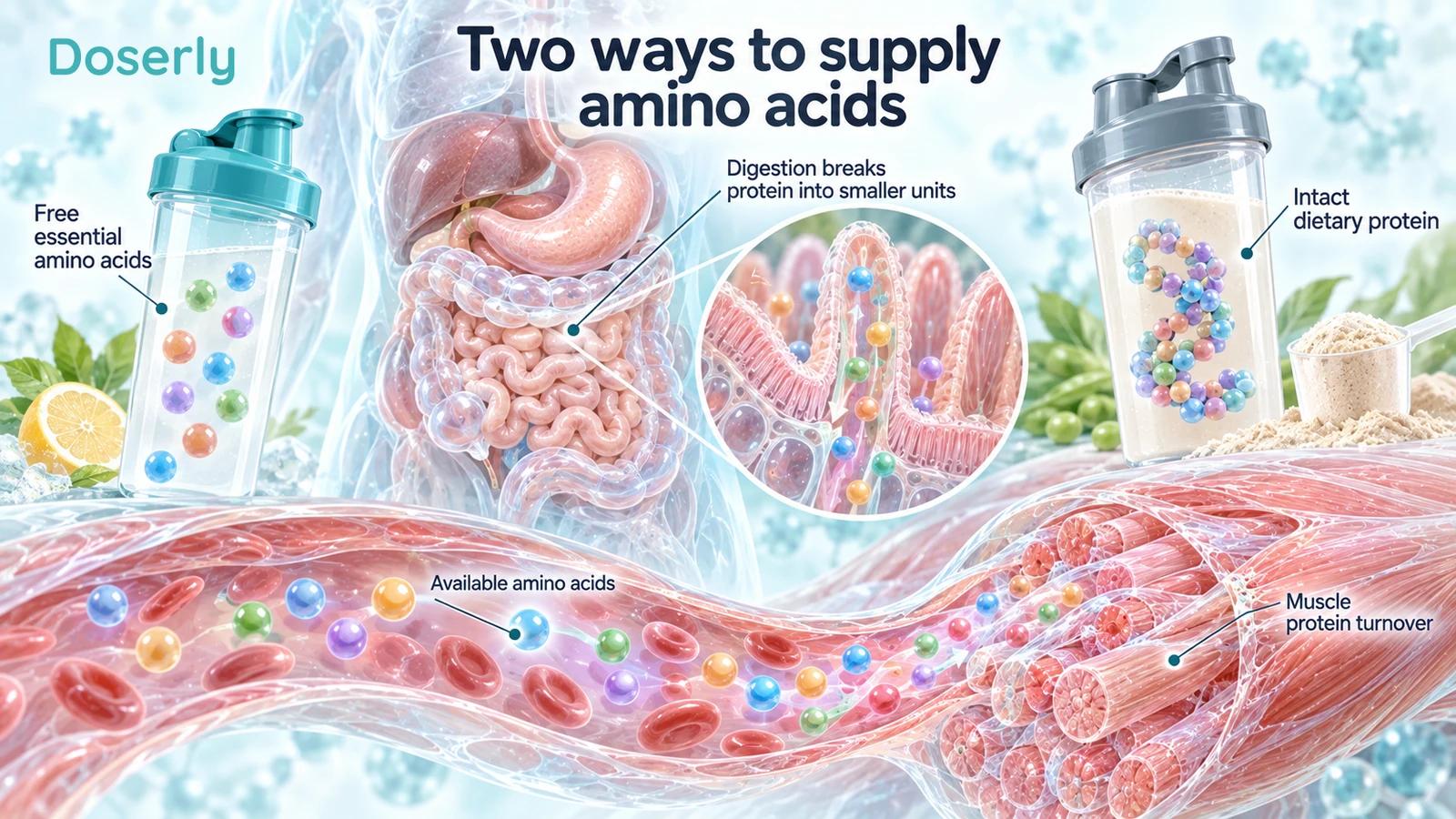
Conceptual digestion and amino-acid availability. Enlarged beads are explanatory symbols; the image does not show measured absorption speeds or superiority of either serving.
The gel study measured signaling, not muscle growth
A 2020 proof-of-concept experiment tested a leucine-enriched EAA gel in healthy younger and older adults. Participants completed conditions involving resistance exercise alone, the EAA supplement alone and the combination. Two 50 mL gels supplied 15 g of EAAs, with leucine accounting for 40% of the mixture.
The investigators measured blood amino acids and the phosphorylation of proteins involved in anabolic signaling. The gel increased amino-acid availability and produced changes in selected signaling measures, including a response after exercise plus the supplement. EAA-gel trial
These observations establish that the formulation reached the circulation and influenced the measured cellular pathways. They do not establish a measured increase in muscle-protein synthesis, muscle mass or strength: those were not the corresponding endpoints in this experiment.
A claim that the gel “activates anabolic signaling” is therefore different from a claim that it “builds more muscle than protein powder.” There was no such long-term powder comparison. The study is useful evidence about feasibility and biological response, with a narrower meaning than a growth promise.
Direct EAA-versus-whey experiments are more informative
A study in 24 older women compared 1.5 g or 6 g of leucine-enriched EAAs with 40 g of whey protein. Researchers measured muscle-protein synthesis at rest and after unilateral resistance exercise.
All three servings stimulated synthesis over the first two hours at rest. Across four hours, the response remained significantly above baseline in the 6 g EAA and whey groups, but not the smallest EAA group. After exercise, the four-hour synthesis response increased similarly across groups. Wilkinson and colleagues
This is a more direct test of muscle metabolism than a signaling assay. It also shows why time windows and exercise conditions must remain visible. Saying that every serving was identical in every circumstance would erase the resting four-hour result.
The comparison involved small groups of eight and a particular leucine-enriched formulation. It supports the possibility of stimulating an acute response with a small serving. It does not show that replacing daily food protein with that amount would preserve every nutritional outcome over months or years.
A newer study in young women reached a similar short-term result
A 2025 experiment enrolled 28 healthy young women. After unilateral resistance exercise, participants received 1.5 g of EAAs, 15 g of whey or 20 g of whey. The drinks contained different leucine amounts, and whey produced higher blood leucine concentrations.
Despite those blood differences, post-exercise myofibrillar protein synthesis did not differ significantly between drinks over the measured period. Young-women feeding trial
This finding challenges the assumption that a larger blood leucine rise must produce a larger synthesis response in every setting. It also adds evidence from women to a literature often dominated by young men.
It remains a short feeding experiment after a specific exercise session. The study did not test whether 1.5 g of EAAs could replace a 20 g protein serving at every meal, whether total dietary protein could be reduced indefinitely or whether the groups would develop equal muscle size after a long training program. Those are separate hypotheses.
An earlier comparison favored whey on another metabolic measure
A small study in 15 older adults compared 15 g of whey with the amount of essential amino acids contained in that serving, or with a nonessential-amino-acid mixture. Researchers used blood sampling across the leg to estimate phenylalanine balance as an index of muscle-protein accrual.
Balance improved after whey but not significantly after the EAA or nonessential-amino-acid mixtures. Whey and constituent-amino-acid study
This result should not be forced into the same category as every synthesis experiment. It used a different formulation, a different metabolic outcome and very small groups. A significant change within one group and not another also needs care when interpreting the size of an actual between-group advantage.
The broader lesson is that “EAAs versus whey” does not name one standardized experiment. Matching total supplement weight, matching the EAA content of whey and comparing commercially realistic servings answer different questions. A claim that omits which quantity was matched is missing an essential part of the comparison.
What happened over several months?
A 2009 placebo-controlled study randomized 14 older women to 15 g of EAAs daily or placebo for three months. Lean body mass and basal muscle-protein synthesis increased in the supplemented group, while one-repetition maximum strength did not improve. Three-month EAA study
This is longer-term evidence worth including, but seven participants per group leaves considerable uncertainty. The abstract reports the increase within the supplemented group; that should not be inflated into a precise estimate of a dependable benefit for all older adults. Lean mass and strength are also distinct outcomes.
A larger randomized study in 130 older Japanese women with reduced muscle mass tested exercise plus a daily amino-acid supplement against exercise plus placebo for three months. It found no added effect on the primary muscle-mass or strength outcomes. Exercise and amino-acid trial
The women had muscle-mass decline without the weakness and slowness specified in the study's description, and the supplement was a smaller daily serving than in the earlier experiment. These differences help define the populations and interventions; they do not justify assuming the larger dose must work. The combined evidence is more conditional than either “EAAs build muscle” or “EAAs do nothing.”
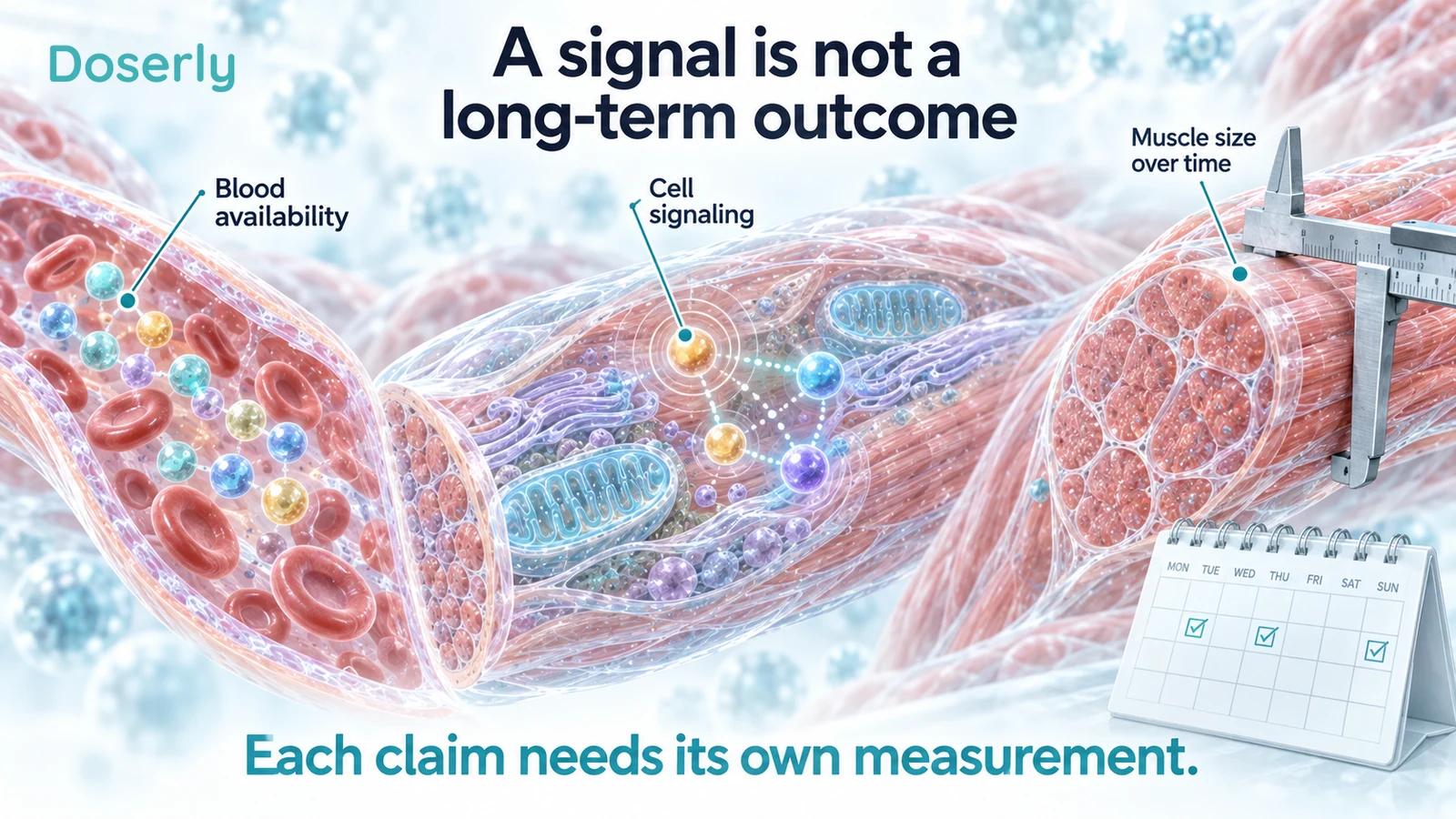
Conceptual endpoints, not a sequence of guaranteed benefits. The caliper represents size assessment rather than a claim that exposed muscle is routinely measured this way; cellular nodes are schematic.
Energy deficit changes the question again
A study in 17 adults compared EAA-enriched whey with additional EAAs against EAA-enriched whey with additional carbohydrate during energy balance and a short period of reduced energy intake. The drinks were similar in energy but differed substantially in protein and EAA content.
During the energy-deficit condition, post-exercise muscle-protein synthesis was higher with the more EAA-rich drink. The investigators also measured whole-body protein turnover, which is a separate outcome from muscle-specific synthesis. Underfeeding experiment
This was not plain EAAs versus plain whey. Both formulations contained EAA-enriched whey, and the intervention altered the total amino-acid supply. It supports further investigation of a specific nutritional strategy under energy restriction, not a general claim that adding a small EAA scoop makes dieting safe or prevents all muscle loss.
It also cannot establish a long-term body-composition advantage from a few days of controlled feeding. The findings describe metabolism under the tested conditions; the daily diet, training and duration would still matter in a sustained weight-management program.
Who has a practical reason to consider either?
A protein powder is often convenient when the problem is getting a substantial protein-containing serving into the day. It can be mixed into food or a drink and evaluated by its actual protein content, ingredients, taste and tolerance. A plant-based product may fit someone avoiding dairy; its formulation still deserves attention. Our plant-based protein guide provides that context.
An EAA preparation may be worth discussing when a compact amino-acid serving addresses a specific constraint, such as difficulty tolerating a larger supplement volume. The acute trials make that a plausible use to investigate, especially in populations studied directly. They do not establish that EAAs should replace meals in people with low appetite or inadequate overall nutrition.
A person who is losing weight unintentionally or struggling to eat needs assessment of the wider problem. Supplying selected amino acids does not, by itself, establish adequate energy, micronutrient intake or treatment of the reason eating has become difficult. A clinician or dietitian can help choose a strategy appropriate to that context.
For a healthy exerciser already meeting dietary needs comfortably, the evidence reviewed here does not establish a universal reason to add both products. Convenience can be a valid reason to choose a format. It should be described as convenience rather than attributed to an unproven advantage in muscle growth.
How to read a product claim before buying
Start with the serving label. Identify total EAAs, the listed amino acids, any added protein, and other ingredients. Do not assume a blend's total weight is all essential amino acids. Two products with the same category name may deliver substantially different interventions.
Then identify the evidence endpoint. Blood amino-acid concentration, cellular signaling, muscle-protein synthesis, lean mass and physical function form different claims. A product can have evidence for one without evidence for the others. “Clinically studied” is incomplete unless the study actually tested the product, the serving and the outcome being advertised.
Finally, ask what is being replaced. Swapping one optional drink for another differs from removing a meal or lowering total daily protein. The striking low-dose results in acute studies should prompt careful questions about formulation and context, not arithmetic that treats one gram of EAAs as several grams of food protein across an entire diet.
The evidence supports a measured choice: use the format that addresses a real nutritional constraint, and judge stronger performance claims against the corresponding human outcomes. A responsive signaling pathway is interesting biology. It is not a substitute for a suitable diet or proof of long-term superiority.
Sources
- EAA gel, amino-acid availability and anabolic signaling
- Leucine-enriched EAAs and whey in older women
- Low-dose EAAs and whey after exercise in young women
- Whey versus its constituent EAA content in older adults
- Three months of EAAs in older women
- Exercise plus amino acids versus placebo in 130 older women
- EAA-enriched whey during energy deficit