
HRT
October 16, 2026
Elinzanetant after approval: what the OASIS trials actually added
On this page
For someone whose night sweats interrupt sleep and whose hot flashes derail the working day, a new nonhormonal treatment is more than a scientific headline. It is another possible route to symptom relief. But the useful question after approval is specific: what improved, in whom, for how long, and with what follow-up?
Elinzanetant, sold as Lynkuet in the United States, received FDA approval on October 24, 2025, for moderate to severe vasomotor symptoms due to menopause. That is a meaningful treatment indication. It is not approval to treat every consequence of menopause, prevent chronic disease, or replace every effect of estrogen. The OASIS research program becomes easier to understand when those boundaries stay visible. FDA approval record.
A different route to the temperature-regulating system
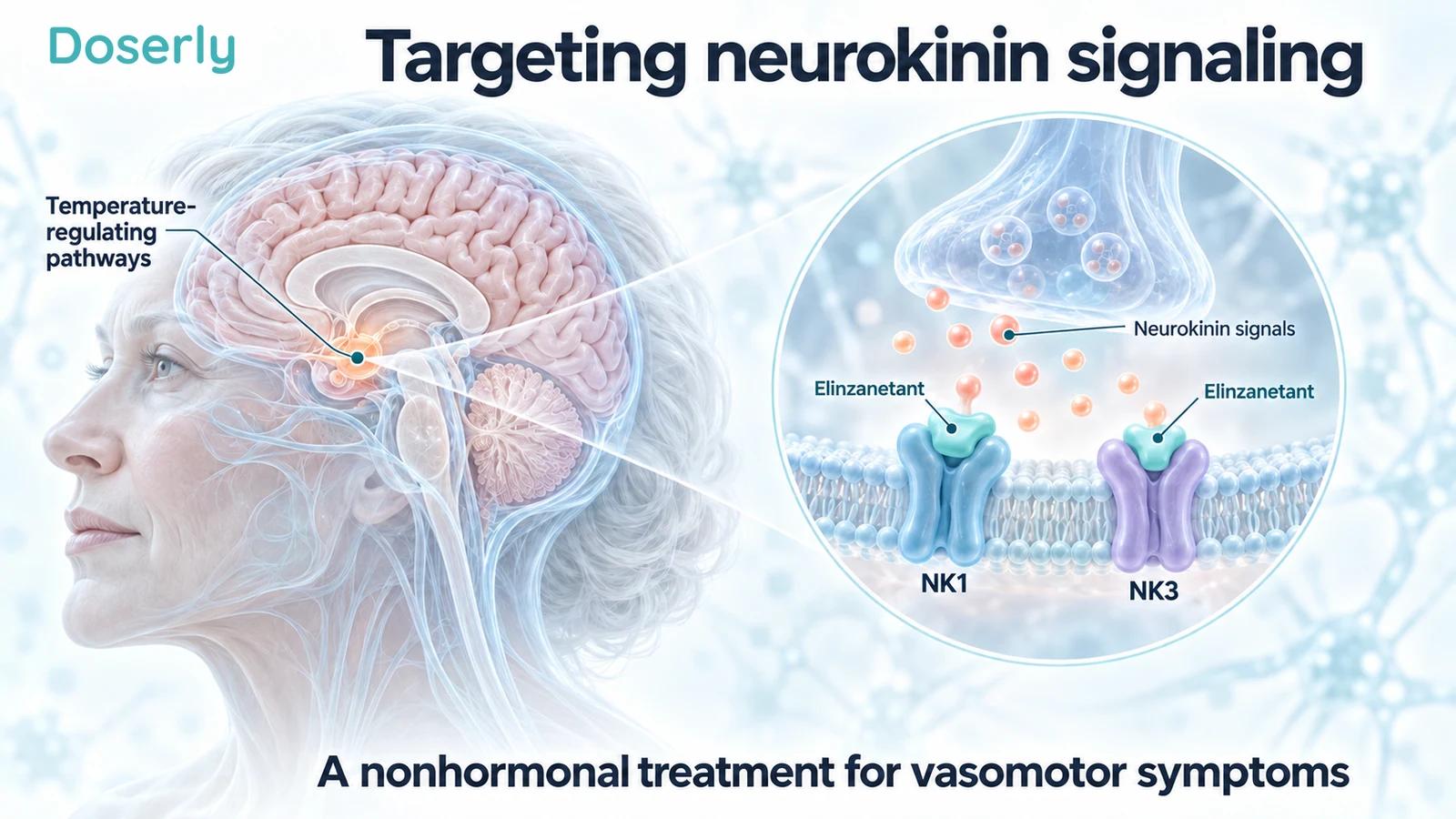
Hot flashes and night sweats are vasomotor symptoms: episodes involving the body's heat-dissipation responses. Elinzanetant acts on neurokinin signaling, blocking both neurokinin 1 and neurokinin 3 receptors. It does not supply estrogen. The current US label describes its action in pathways involved in thermoregulation, giving a biological rationale for studying it against these particular symptoms. Current Lynkuet prescribing information.
The mechanism helps explain the research question; it cannot answer the clinical question by itself. Blocking two receptor types does not automatically make a drug twice as effective as one that blocks a single type. Nor does a brain-related mechanism establish benefits for memory, depression or all forms of insomnia. Those claims require their own outcomes, populations and comparisons.
For someone considering treatment, the important distinction is between a targeted nonhormonal option and a general menopause replacement therapy. Vaginal symptoms, bone health, contraception and other health concerns may still need separate discussions. The Doserly menopause guide provides that broader context; this article focuses on what the elinzanetant trials added.
OASIS 1 and 2 established symptom efficacy against placebo
The two pivotal trials enrolled 796 postmenopausal women aged 40 to 65 with frequent moderate to severe vasomotor symptoms. Entry required at least 50 such episodes per week. Participants received elinzanetant or placebo during the first 12 weeks; after that, the placebo group switched to active treatment for another 14 weeks. The primary comparisons therefore came from the period when randomized groups still received different treatments. OASIS 1 and 2, JAMA.
Participants were not starting with occasional warmth. Average baseline symptom counts ranged from approximately 13 to 16 moderate to severe episodes per day across the trial groups. That matters when interpreting the headline reductions. A change observed in people with frequent symptoms should not be transferred automatically to someone having one or two episodes a day.
At week 4, the reduction in daily frequency was greater with elinzanetant than with placebo by an estimated 3.3 episodes in OASIS 1 and 3.0 episodes in OASIS 2. At week 12, the estimated difference was about 3.2 episodes per day in each trial. Severity also improved more with active treatment at both primary time points. These are differences between groups, not the total decrease experienced by every participant.
That distinction is important because symptoms also improved in placebo groups. A person may improve after joining a trial because symptoms fluctuate, expectations change, measurement becomes more consistent or other aspects of care change. Randomization helps separate the additional effect of the medicine from changes shared by both groups. Reporting only the active group's before-and-after improvement leaves that comparison out.
The results provide replicated evidence of benefit for the studied symptoms. They do not guarantee that a particular person will have three fewer episodes each day, or that a reduction will be sufficient for that person's life. Trial averages combine substantial responders, smaller responders and people who discontinue. The right follow-up question is whether the individual's nights, days and ability to function improve enough to justify continuing treatment.
Sleep was measured, but it remains a distinct outcome
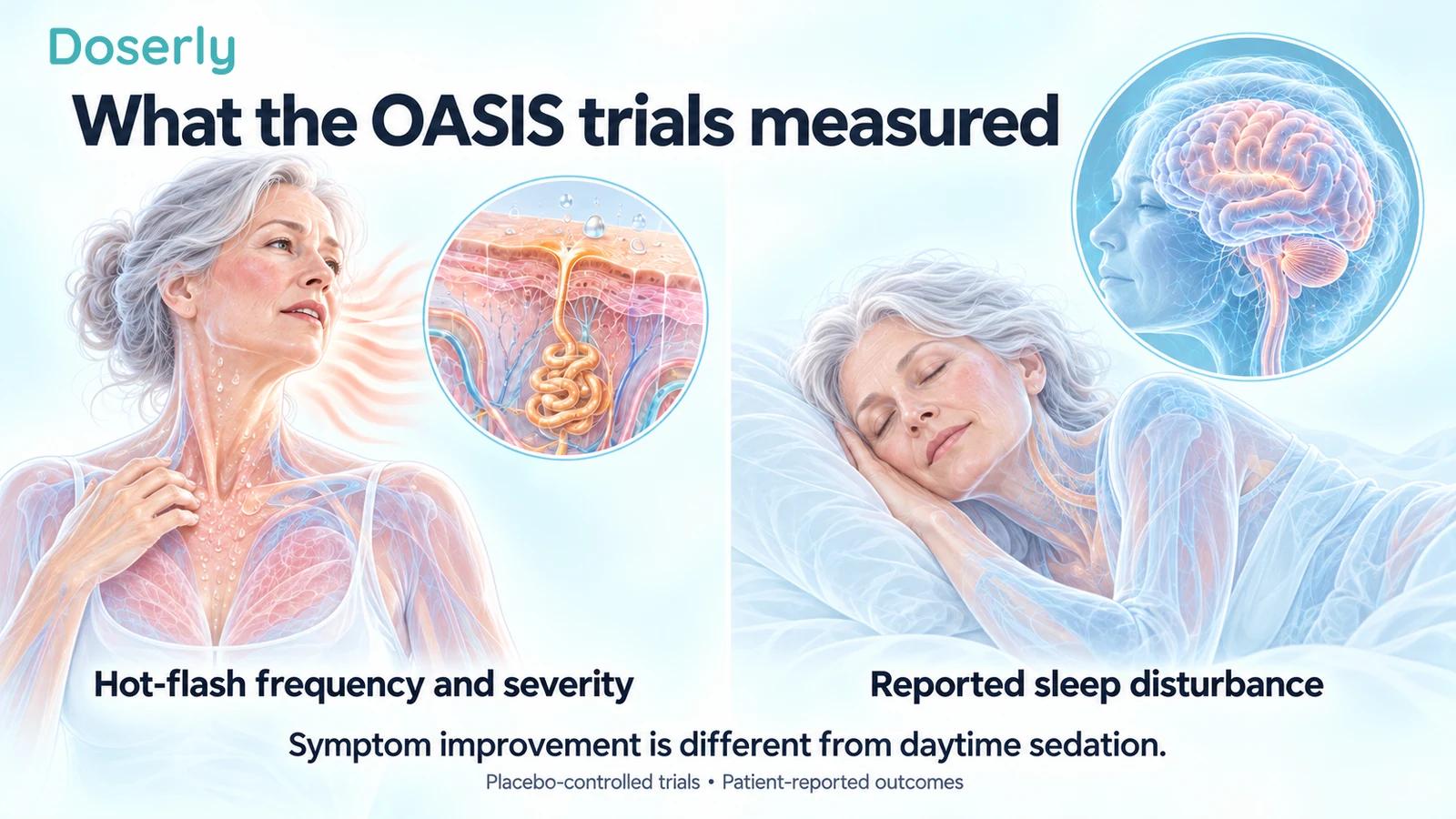
OASIS 1 and 2 also measured patient-reported sleep disturbance and menopause-related quality of life. Elinzanetant improved these secondary outcomes compared with placebo. Those findings matter: a hot-flash count alone can miss how disruptive the symptoms feel or how difficult the following day becomes. OASIS 1 and 2.
A sleep questionnaire is not a laboratory recording of sleep architecture. These trials do not establish that elinzanetant treats obstructive sleep apnea, every form of chronic insomnia, or unexplained daytime fatigue. They also do not tell us precisely how much of the reported sleep improvement came through fewer vasomotor symptoms rather than another pathway.
There is a practical reason to keep sleep benefit and sedation separate. Someone can report fewer disruptive night sweats while also experiencing unwanted daytime sleepiness from treatment. Conversely, feeling sleepy at bedtime is not proof that a medicine has corrected the cause of poor sleep. Both benefit and adverse effects deserve their own entry in a follow-up conversation.
A simple record can distinguish nights with sweats, awakenings, overall restfulness and next-day alertness. It need not become an exhaustive sleep experiment. A short, consistent set of observations is more useful than a single rating of whether the medicine is “working.” Persistent unrefreshing sleep despite improved sweats is a reason to revisit the sleep problem, not simply assume that the dose needs increasing.
Newer sleep research needs its own interpretation
The 2026 NIRVANA study went beyond the OASIS questionnaires. It randomized 110 postmenopausal women with vasomotor symptoms and objectively documented sleep disturbance, using polysomnography to measure wakefulness after sleep onset. At week 4, the estimated between-group difference favored elinzanetant by 22.5 minutes, with a 90% confidence interval from 9.5 to 35.5 fewer minutes awake. At week 12, the corresponding estimate was only 0.9 minutes less, with an interval spanning no difference. NIRVANA primary report.
That small exploratory trial adds objective sleep evidence, but its time-point differences matter. Positive post hoc analyses across the treatment period should not replace the prespecified week-12 result. Nor does this placebo comparison establish superiority over another medicine. The finding refines the sleep discussion without changing what the OASIS trials themselves measured or creating an approval for all insomnia.
OASIS 3 added a year-long placebo comparison
A short efficacy trial and a longer safety trial contribute different information. OASIS 3 randomized 628 postmenopausal women to elinzanetant or placebo for 52 weeks. Unlike OASIS 1 and 2, it did not require a minimum daily vasomotor symptom count. Participants were seeking treatment for moderate to severe symptoms, but their baseline frequency was lower on average, at about seven episodes daily. OASIS 3 primary report.
At week 12, the adjusted difference in daily symptom-frequency change favored elinzanetant by approximately 1.6 episodes. That smaller number does not demonstrate that the drug became less effective in a later trial. The population and baseline symptom burden differed. The longer placebo-controlled period also offered a different opportunity to observe tolerability and persistence of benefit.
One year of observation is valuable, especially for a treatment that may be used beyond a few weeks. It is still not lifetime safety evidence. A trial of several hundred people has limited ability to characterize uncommon harms, effects in groups excluded from enrollment, or events that emerge only after much longer exposure. Approval begins a period of broader clinical use and surveillance; it does not eliminate the need to update the evidence.
The label's safety information also helps translate “well tolerated” into something more tangible. In the 52-week trial, fatigue, dizziness and somnolence occurred more often with elinzanetant than placebo. For example, reported somnolence was 5.1% versus 1.3%. That is a group-level observation, not a prediction of who will become sleepy, but it makes alertness a reasonable part of the treatment plan. Current prescribing information.
OASIS 4 addressed a separate clinical population
OASIS 4 studied women experiencing vasomotor symptoms while taking endocrine therapy for hormone receptor–positive breast cancer or for breast-cancer prevention. Its 474 participants were aged 18 to 70, making this a different population from the postmenopausal participants in the first three trials. They were randomized in a two-to-one ratio to elinzanetant or placebo for the initial 12 weeks, followed by an active-treatment period. OASIS 4 primary report.
At week 4, the adjusted difference in daily moderate to severe symptom reduction was approximately 3.5 episodes in favor of elinzanetant. That offers direct evidence for symptom treatment in a setting where treatment choices can be constrained. It does not establish that elinzanetant changes breast-cancer recurrence, improves survival, or substitutes for the prescribed endocrine therapy.
Trial results and regulatory status must also be kept separate. As of October 15, 2026, the US label cited here remains the menopause-related indication. Bayer announced on September 29, 2026, that FDA had accepted an application to expand the indication to vasomotor symptoms caused by breast-cancer endocrine therapy and granted priority review. Acceptance of an application is not approval. The announcement is sponsor regulatory news, not an additional efficacy trial. Bayer application announcement.
For someone receiving cancer treatment, this is a discussion for the oncology team alongside the menopause clinician. The relevant questions include the treatment indication, other medicines, the current local authorization and the individual's symptom priorities. A positive trial headline cannot resolve those issues on its own.
Nonhormonal still requires a monitoring plan
The current US label requires liver testing before starting Lynkuet and repeat liver transaminase testing three months after initiation. It also identifies laboratory thresholds at which treatment should not be started, and symptoms that warrant stopping the medicine and contacting a clinician. Nonhormonal describes the treatment mechanism; it does not mean that liver assessment or follow-up is unnecessary. Lynkuet prescribing information.
The label warns about central nervous system effects and daytime impairment. Its August 2026 revision warns about seizure risk and advises counseling patients about that risk, with additional caution for a seizure history or conditions that lower the seizure threshold. It contraindicates use during pregnancy and requires pregnancy assessment when relevant. Moderate or severe liver impairment and end-stage renal disease also affect suitability. These points belong in prescribing decisions, rather than being inferred from whether a product contains hormones.
Interactions matter too. Strong CYP3A4 inhibitors, grapefruit and certain enzyme-inducing medicines should be avoided under the label; moderate CYP3A4 inhibitors require a prescribing adjustment. A pharmacist or prescriber should review the full medication and supplement list. Copying a friend's regimen or borrowing the monitoring schedule for a different neurokinin medicine can miss product-specific requirements.
What a useful treatment review looks like
Before starting, identify the problem that most needs to change: daytime episodes, soaking night sweats, interrupted sleep, or interference with work and daily life. Record a brief baseline in ordinary language. Someone whose chief concern is night-time disruption may judge improvement differently from someone who cannot get through a meeting without severe flushing.
At review, compare the same outcomes and ask about adverse effects separately. Include whether the medicine has been taken consistently, whether other treatments changed, whether liver follow-up is arranged, and whether daytime alertness is acceptable. Improvement in one domain does not require pretending that all the others improved too.
The Doserly elinzanetant guide offers a broader reference for the medicine. The central contribution of the OASIS program is more precise: replicated symptom efficacy, patient-reported sleep and quality-of-life findings, longer placebo-controlled follow-up, and additional evidence in an endocrine-therapy population. Each answers a useful question. Keeping those questions separate makes the evidence more useful at the point of care.
Explore the research
- FDA: novel drug approvals for 2025.
- Lynkuet current US prescribing information.
- OASIS 1 and 2, JAMA, 2024.
- OASIS 3, 2025.
- OASIS 4, 2025.
- Bayer: FDA acceptance of supplemental application, September 2026.
- NIRVANA sleep trial, 2026.