
Peptides
October 16, 2026
Does GLP-1 weight loss mean muscle loss? Read the measurement first
On this page
When weight falls during treatment with semaglutide or tirzepatide, some of that change can come from lean tissue. That deserves attention. It also deserves a more precise explanation than the alarming claim that a particular percentage of the weight lost was “muscle.”
Most widely shared trial numbers come from body-composition scans. Those scans distinguish fat and lean compartments, but they do not directly tell us how strong someone is, whether walking has become easier or whether the person can get up from a chair. Muscle health includes all of those questions.
The useful approach is neither to dismiss lean-mass loss nor to treat every scan change as evidence of muscle damage. Start with what was measured, then ask what it means for the person doing the losing.
What is lean mass, exactly?
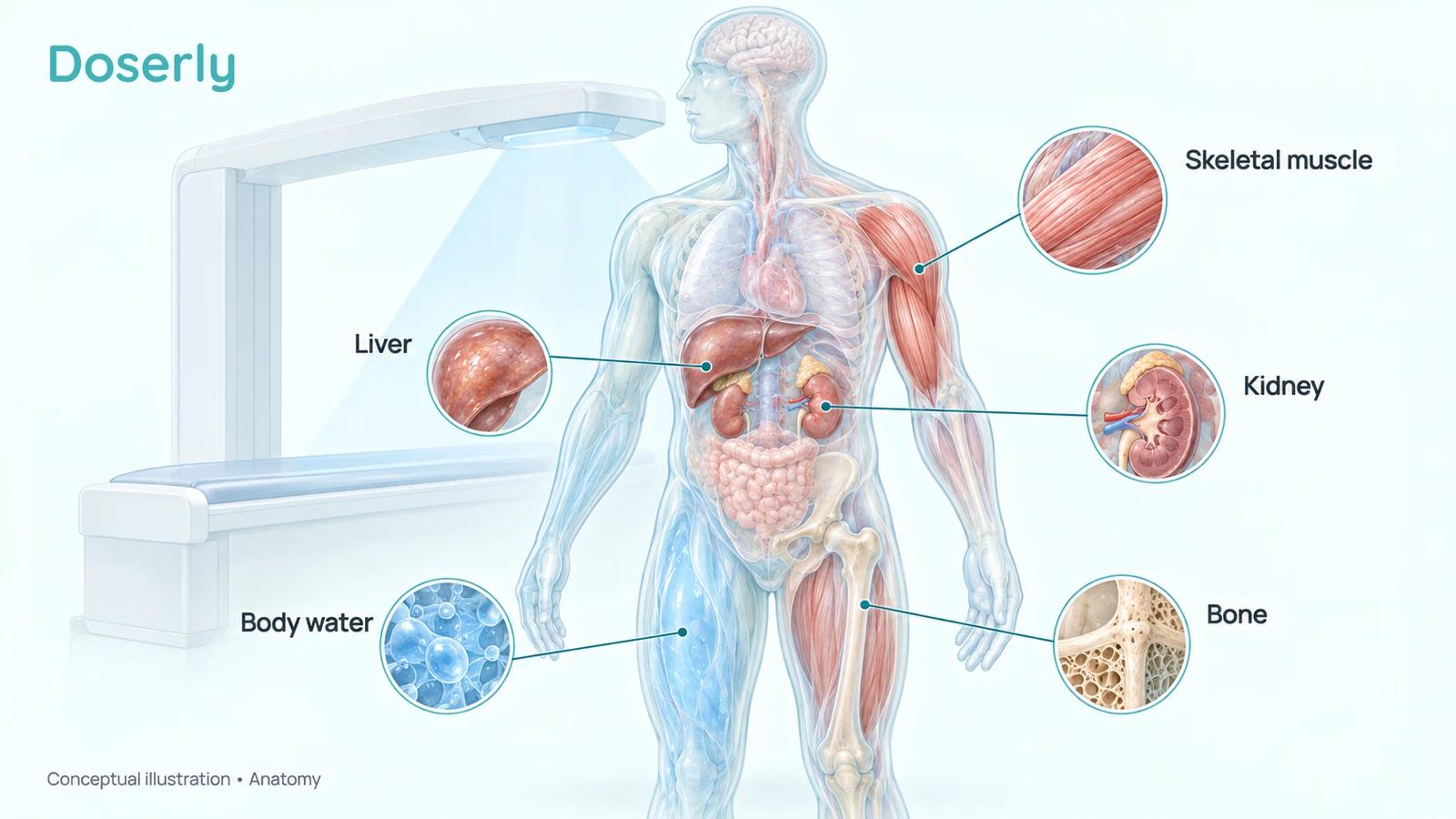
Skeletal muscle is the tissue that contracts to move your body. Lean soft tissue is a broader measurement category that includes muscle, organs and water. In a typical dual-energy X-ray absorptiometry, or DXA, body-composition assessment, bone mineral is reported separately from fat and lean soft tissue. “Fat-free mass” and “lean mass” are sometimes used loosely, so a paper's methods matter.
A change in lean soft tissue is therefore not a direct measurement of how much contractile muscle protein disappeared. Hydration can influence estimates, and the various nonfat tissues do not all have the same role. This is one reason clinical assessments combine measurements rather than diagnosing muscle disease from a single total-body number. European sarcopenia consensus
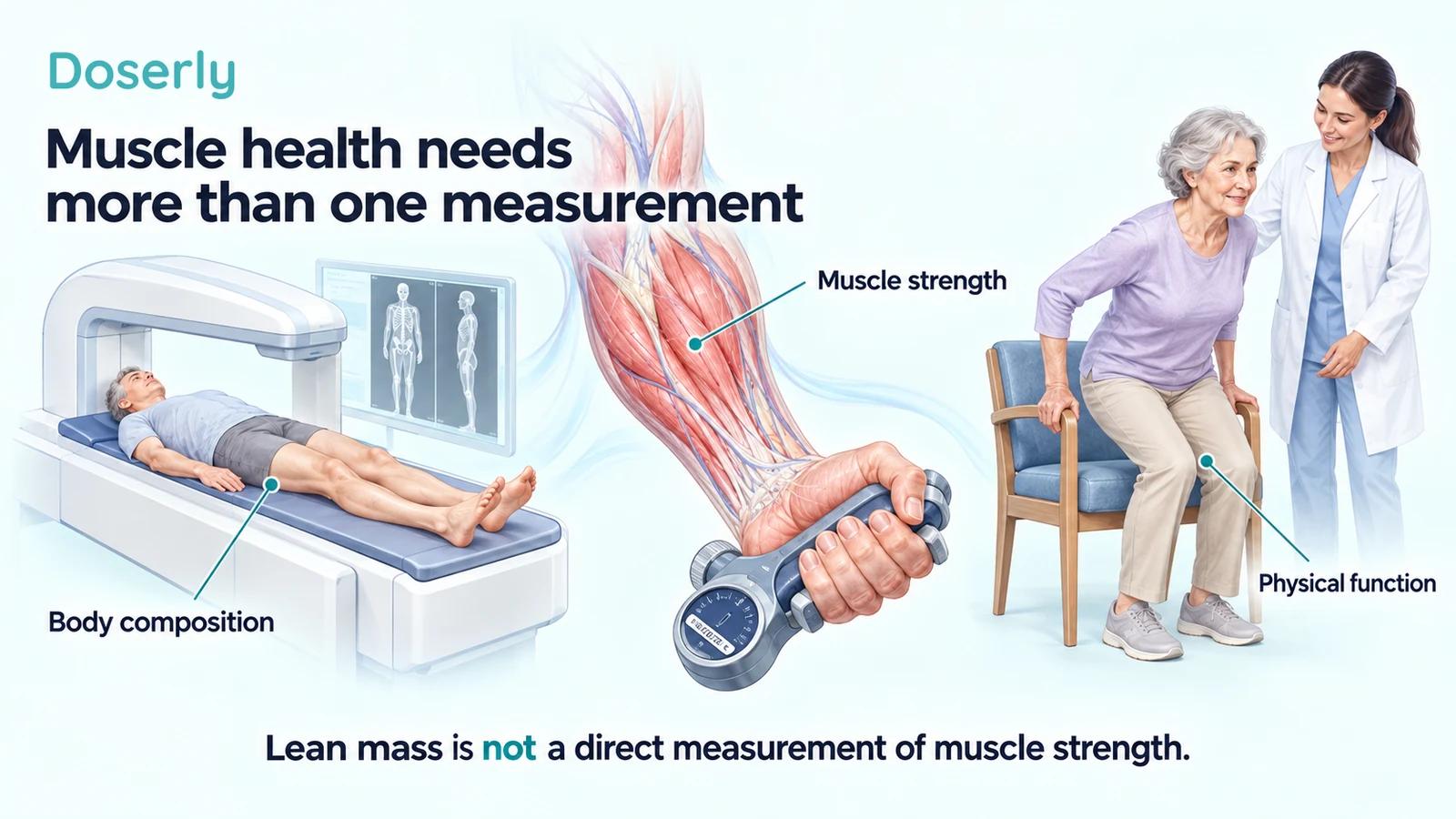
That distinction does not make the scan useless. It makes its purpose clearer. DXA can help describe the composition of weight change. A strength test answers a different question, and a walking or chair-rise assessment adds another view of physical ability.
Think of these as complementary observations. A scale says how much the whole body weighs. A composition test estimates what broad compartments contribute. Function tests ask what the body can do. None is a complete substitute for the others.
What did the semaglutide STEP 1 substudy find?
An exploratory DXA analysis from STEP 1 included 140 participants, with 95 assigned semaglutide and 45 placebo. It was a small subset of the larger trial, reported as a conference analysis. Over 68 weeks, semaglutide participants had reductions of 19.3% in total fat mass and 9.7% in total lean body mass. The proportion of body weight classified as lean increased by 3.0 percentage points. Investigators' STEP 1 poster
Those statements can all be true together. An amount can decrease while its share of the total increases if another component decreases faster. The higher lean proportion is not evidence that participants gained lean tissue, and the 9.7% reduction is not a measured 9.7% loss of muscle strength.
A simple arithmetic example helps. Imagine 100 units of body mass containing 50 units in one compartment. If total mass falls to 80 and that compartment falls to 45, the compartment has become smaller but now represents more than half the total. This is an illustration of denominators, not a reconstruction of a trial participant.
The substudy gives a useful description of body composition during treatment. Its small size and measurement choices do not support a universal muscle-loss percentage for every semaglutide user, or a prediction about one person's future mobility.
What did tirzepatide add to the picture?
A DXA substudy of SURMOUNT-1 analyzed 160 participants with baseline and end-of-study scans: 124 receiving pooled tirzepatide doses and 36 receiving placebo. At 72 weeks, average reductions with tirzepatide were 21.3% in body weight, 33.9% in fat mass and 10.9% in lean mass. Approximately three-quarters of the weight lost was fat mass and one-quarter lean mass; similar proportions were seen with placebo. SURMOUNT-1 body-composition analysis
The two sets of percentages answer different questions. A 10.9% decline in lean mass describes change relative to starting lean mass. The approximately 25% figure describes lean mass as a share of the total weight lost. Neither is a direct measure of the percentage of skeletal muscle lost.
A published correction changed the units on one figure from percentages to kilograms. That correction reinforces the importance of reading units carefully; it does not turn the abstract's percentage changes into kilograms. Figure correction
These results also should not be used as a head-to-head test against the STEP 1 substudy. The populations, selected scan subsets and study circumstances differ. A smaller lean-mass percentage in one paper would not, by itself, prove that one medicine protects muscle better than another.
Can lean mass fall while strength improves?
Yes, those measurements can move in different directions. SEMALEAN, an observational study published online in 2025 and in a 2026 journal issue, followed people receiving semaglutide in clinical care. Among 106 participants completing follow-up, lean mass initially declined and then stabilized, while handgrip strength improved by an average of 4.5 kg at 12 months. SEMALEAN study
The study is useful because it measured function alongside composition. It is not proof that semaglutide directly strengthens muscle. Without a randomized comparison, treatment, changes in activity, clinical support and other influences cannot be cleanly separated. Its participants also had severe obesity on average, which limits extrapolation to people with quite different starting circumstances.
The lesson is methodological: measure the outcome you care about. If the concern is weakness, a composition estimate alone leaves an important question unanswered. If the concern is falling, a reassuring grip result alone may still leave balance and walking unassessed.
Likewise, one improved test does not erase a substantial tissue change or establish that every participant benefited. Group averages can conceal people whose progress differs. Following several relevant measures over time gives a more useful picture than choosing whichever single result sounds most reassuring.
Is lean-mass loss the same as sarcopenia?
No. Sarcopenia is a clinical muscle disorder, not a synonym for any decline in DXA lean mass. The revised European consensus puts low strength at the center of identifying probable sarcopenia, uses low muscle quantity or quality to confirm it, and considers poor physical performance when judging severity. Other expert groups use somewhat different operational definitions. EWGSOP2 framework
That framework explains why a clinician may ask about rising from a chair, carrying objects or falls rather than focusing only on body-fat percentage. It also explains why a person can have obesity and still need careful assessment for low muscle reserve.
A home scale's “muscle” reading cannot establish this diagnosis. Nor can an article's average scan result. The label belongs to a clinical assessment with suitable measurements and interpretation, including possible explanations for weakness beyond muscle quantity.
For a reader, the practical distinction is straightforward: a concerning change should lead to a better assessment, not an automatic diagnosis. The same applies in the other direction. A favorable weight-loss graph is not a reason to ignore new difficulty with ordinary activities.
What can help protect function during weight loss?
A joint advisory from four nutrition, lifestyle and obesity organizations recommends considering nutrition, strength, function and activity alongside medication treatment. It emphasizes adequate dietary intake and resistance exercise, as well as management of gastrointestinal symptoms that make eating difficult. These are clinical priorities, not proof that one universal protein target or workout prevents all lean-tissue loss. Joint nutrition advisory
For someone whose appetite has become much smaller, the useful question is whether the food they can comfortably eat still meets their needs. A dietitian can help make that assessment practical. Medical conditions, food access, preferences and tolerability all affect the plan; an online grams-per-day target cannot account for them automatically.
Resistance activity should likewise fit current ability, pain, balance and previous experience. The goal is a sustainable way to challenge muscles, with professional help when needed. A demanding program that cannot be performed safely or continued is not made useful by appearing in a social-media checklist.
It is also worth distinguishing a recommendation from a trial result. The major body-composition substudies did not randomize participants to every possible protein intake and training schedule. They cannot tell us exactly how much a particular routine would change one person's scan.
What should you track besides weight?
Choose observations that can support a clinical conversation. These might include whether familiar daily tasks feel easier or harder, whether intake is being limited by nausea, and whether activity has changed. They need not become a daily scorecard or a reason to repeatedly test to exhaustion.
If formal testing is appropriate, consistency helps interpretation. A repeat assessment should be comparable with the first one: the same type of measurement, clear units and an understood time interval. Comparing a home impedance estimate with a clinic DXA result as if they were interchangeable can create a false impression of change.
A useful appointment summary might say: “My weight has fallen, but stairs feel harder and I have been skipping meals because of nausea.” That gives the clinician more to work with than “the scale says I lost muscle.” Conversely, improved walking and stable strength can add meaningful context to a lower lean-mass estimate without making it irrelevant.
The aim is to connect the number to symptoms and ability. When a measurement conflicts with how you are doing, the next step is to understand the mismatch, not automatically trust whichever result fits your expectations.
A scan may also report lean tissue in the arms and legs separately from the whole body. That distinction matters when comparing reports: a total-body estimate includes tissues outside the limbs, while an appendicular estimate focuses on the limbs. Neither number should be silently substituted for the other. Ask which value changed and whether it was adjusted for body size before comparing it with a diagnostic threshold. Measurement framework
This does not mean everyone needs repeated scans. Testing should answer a useful clinical question. If a measurement would not change the assessment or plan, collecting it more often may add cost and uncertainty without improving care. A clinician can help choose the information that matters for your circumstances.
How should a new study change your interpretation?
Before accepting a muscle claim, look for the population, the measurement and the comparison. Was the study randomized? Did it measure total lean mass, muscle size, grip strength or actual physical performance? Was the result an average, a subgroup finding or an individual example?
Then check the denominator. “Percent of starting lean mass” and “percent of total weight lost” can sound similar in a headline while describing very different quantities. Check whether the paper reports a change in amount, a change in proportion or both.
Finally, ask whether the conclusion reaches beyond the outcome. A body-composition study can identify a reason to monitor muscle health without proving frailty. An observational improvement in grip can encourage broader research without establishing a direct muscle-building drug effect.
Doserly's semaglutide guide and tirzepatide guide place these findings alongside the broader treatment evidence. The most useful treatment goal is a healthier, more capable person. Weight, tissue composition and physical function each help assess that goal, provided they keep their own meanings.