
Peptides
October 16, 2026
Does feeling more energetic show that SS-31 improved mitochondria?
On this page
Feeling more energetic can be meaningful. It may change whether someone finishes a workday, prepares dinner or has enough attention for a conversation. But the experience does not identify the biological process that caused it. After taking SS-31, also called elamipretide, a better day is not by itself evidence that mitochondrial function improved.
The distinction matters because “energy” appears in several different kinds of elamipretide research. Some experiments measure ATP-production capacity in muscle. Others measure walking distance, resistance to repeated contractions or a person's reported fatigue. Those outcomes are related questions, not interchangeable answers.
The human evidence makes that separation particularly useful: an acute physiological signal, early encouraging symptom results and a larger negative trial can all exist without contradiction. Here's how to interpret them and make a symptom record useful without turning it into a mitochondrial test.
Start by defining what changed
“I have more energy” might mean less sleepiness, less difficulty starting activities, less muscle exhaustion, improved concentration or a greater ability to continue physical work. A description that broad can communicate relief while still leaving the outcome uncertain.
For interpretation, translate it into something concrete: “I got through the afternoon without lying down,” “the usual walk felt easier,” or “my legs felt less heavy after the same activity.” These are examples of observations to discuss, not diagnostic criteria or proof of a drug response.
It also helps to separate capacity from what happened on a particular day. Someone might feel better but do less because their schedule changed. Another person might do more and feel equally tired afterward. A single overall rating misses that difference.
This is why trials specify an endpoint in advance. Researchers need to know whether the claim concerns symptoms, performance or physiology before they can decide what measurement would support it. The SS-31 guide explains the broader clinical evidence and approved use.
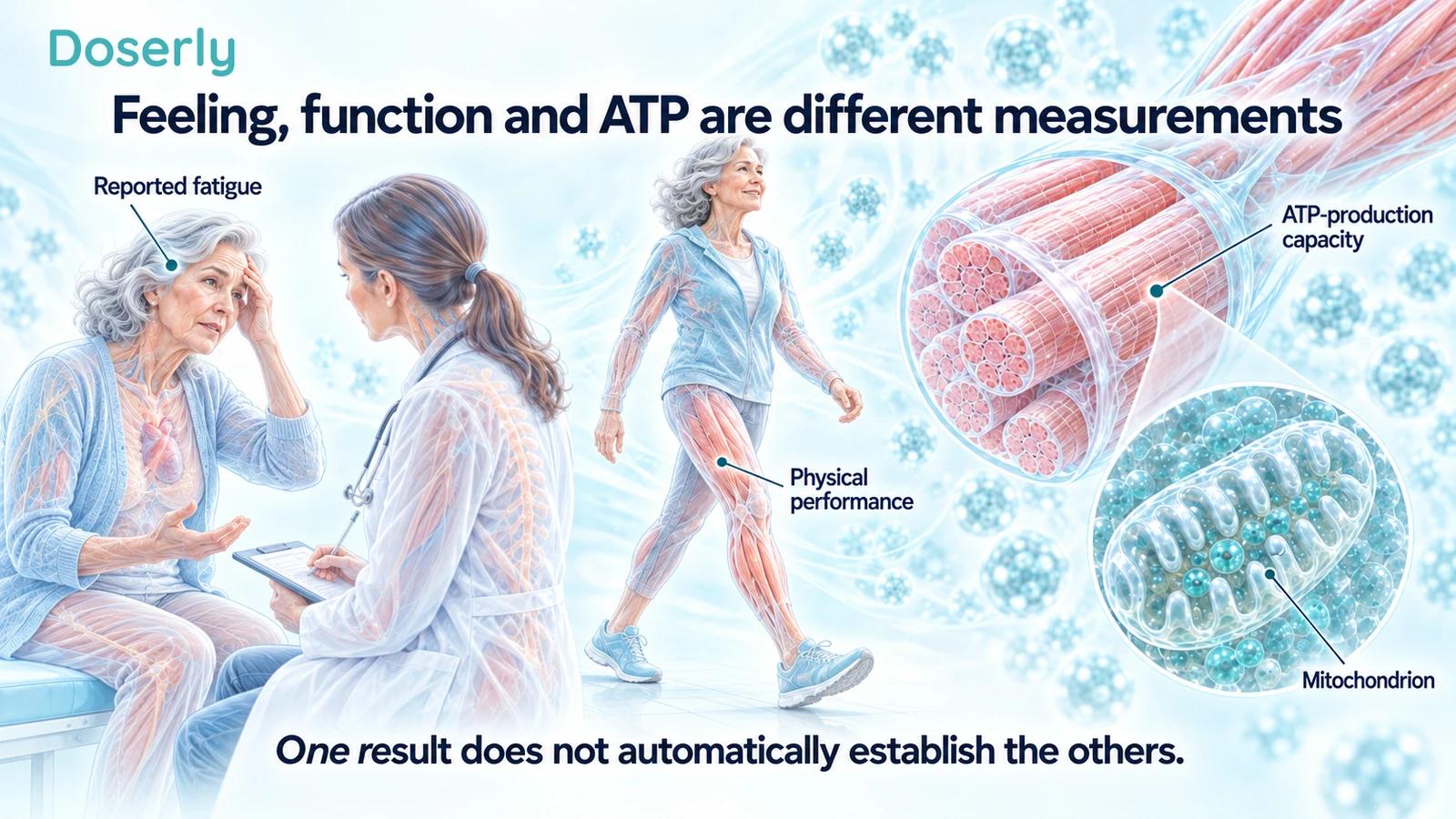
What an ATP measurement can answer
ATP is involved in transferring energy for cellular work. A research measurement of mitochondrial ATP-production capacity asks about a physiological process under specified conditions. It is more specific than a person's general sense of vitality.
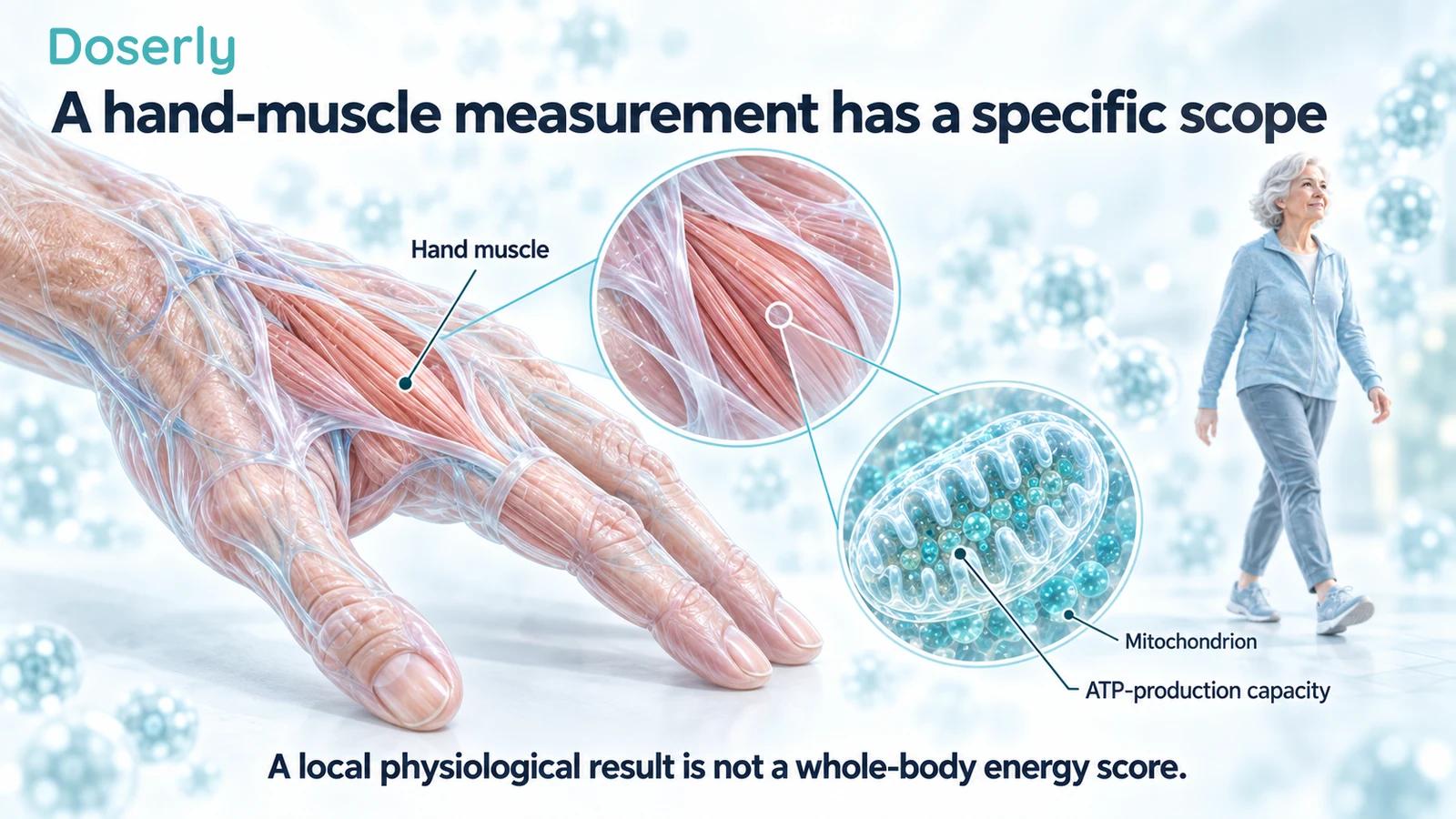
A randomized study published in 2021 enrolled 39 adults aged 60–85 selected for low mitochondrial function. After a single two-hour elamipretide infusion, the percentage-change analysis of ATP-production capacity in a small hand muscle favored treatment over placebo. The absolute-change comparison narrowly missed conventional statistical significance. At day seven, the groups no longer differed on that measurement.
The study's prespecified analysis of muscle fatigue resistance was not significant. Additional exploratory analyses suggested functional effects, but they did not have the same evidentiary status as the planned analysis. Roshanravan and colleagues, 2021
This is evidence of a measured biological response in a selected population and treatment setting. It is not evidence that every person taking SS-31 will notice more energy, or that a noticeable effect lasts indefinitely. A physiological measurement and a symptom can move differently.
A local result is not a whole-body score
The hand-muscle study gives a useful example of scope. A measurement taken from a particular muscle cannot automatically describe every tissue, every type of activity or the body's entire mitochondrial system.
Consider an analogy from everyday measurement: knowing the pressure in one tire tells you something real about that tire. It does not establish the condition of the engine or explain every change in driving performance. Likewise, a muscle measurement answers the question it was designed to answer, while other outcomes require their own assessment.
The route and time frame also belong in the interpretation. An acute infusion experiment and months of subcutaneous treatment are different exposures. Evidence should not be transferred between them simply because the molecule has the same name.
A useful description therefore includes the population, tissue, measurement and timing. “ATP-production capacity changed after an infusion in a selected older-adult study” is informative. “SS-31 increases your energy” discards the features that tell us whom the finding concerns.
Why patient-reported fatigue still matters
The limits of a symptom report do not make the symptom unimportant. If treatment is intended to make life easier, how a person feels is part of the outcome worth studying. The question is whether the evidence supports the claimed improvement and its cause.
In MMPOWER-2, 30 people with genetically confirmed primary mitochondrial myopathy received elamipretide and placebo in a blinded crossover design. Four-week treatment periods were separated by a washout. The primary walking comparison did not reach statistical significance, while several patient-reported fatigue measures favored elamipretide as secondary outcomes. The authors described those findings as signals supporting a larger trial. MMPOWER-2, 2020
A structured questionnaire can be useful without becoming a molecular assay. It records aspects of experience consistently across people and visits. It does not reveal whether a change arose through cardiolipin, ATP production or another process.
The strongest interpretation respects both points: the reported experience deserves attention, and a proposed biological explanation needs independent evidence.
What happened in the larger trial?
MMPOWER-3 enrolled 218 people with genetically confirmed primary mitochondrial myopathy and compared elamipretide with placebo over 24 weeks. The two primary outcomes were six-minute walking distance and disease-specific fatigue. Neither showed a significant benefit from treatment. MMPOWER-3, 2023
This larger result limits the general claim that elamipretide reliably improves fatigue in that population. It does not mean each participant's experience was identical. It means that the planned group comparisons did not demonstrate the expected benefit.
Reading only the earlier positive symptom findings would leave out an important test of the hypothesis. Reading only the later trial and declaring that no biological effect is possible would also overstate the result. The appropriate conclusion follows the endpoint and population actually studied.
For an individual considering an “energy” claim, the later trial is a reason to ask for evidence matched to the proposed use. A favorable mechanism or an encouraging small study cannot replace that comparison.
Why the Barth syndrome findings are a separate question
Barth syndrome has its own disease biology and development program. In the small TAZPOWER study, the blinded comparison did not meet the primary walking and fatigue endpoints. Longer open-label follow-up reported changes in function and symptoms, but without a concurrent placebo group. Original TAZPOWER report, 168-week extension
Forzinity, the prescription elamipretide product, received accelerated approval to improve muscle strength in adults and children with Barth syndrome weighing at least 30 kg. The approval concerns a specific disease and outcome. It is not a general fatigue or vitality indication. Forzinity prescribing information
This is especially relevant when marketing compresses several studies into one statement. Strength in Barth syndrome, fatigue in primary mitochondrial myopathy and acute ATP capacity in selected older adults are different claims. Their findings cannot be combined into an average promise of “more cellular energy.”
Feeling better does not establish why
Suppose someone begins an intervention after an unusually exhausting week and feels better the next week. The improvement is an observation. To attribute it specifically to the intervention, we would want to understand what else changed and what would probably have happened without it.
Perhaps the activity demands were different, sleep changed, an illness resolved or another treatment changed at the same time. These are possible alternative explanations to examine, not claims about any particular person's experience. Even a careful personal account usually cannot fully separate them.
A blinded placebo comparison helps answer a different question: does the treated group improve more than a comparable group under the study conditions? The comparison matters because “better than before” and “better because of treatment” are not the same statement.
The same reasoning applies if there is no improvement. An unchanged symptom cannot, by itself, demonstrate that no molecular interaction occurred. Experience is important evidence about experience; its ability to identify a mechanism is limited in either direction.
What a useful symptom record includes
A practical record should describe the concern you and a clinician are trying to understand. Choose wording that means the same thing each time. “Afternoon fatigue after my usual workday” is easier to interpret than a shifting mix of tiredness, mood and exercise performance under one “energy” score.
Record the activity context alongside the symptom. If a walk felt easier, note whether the route, pace and duration were comparable. If an afternoon was better, note unusual changes to the schedule. The aim is to preserve context, not to create a demanding personal research protocol.
Keep treatment changes and adverse effects in the same timeline. A record that includes only favorable days can give a misleading impression. A simple account of what happened, including missing days or uncertain observations, is more useful than reconstructing a perfect response afterward.
These records can support a clinical discussion and help describe patterns. They cannot validate an unapproved use, establish a diagnosis or prove that a peptide improved mitochondria.
For example, an entry might read: “Usual workday, afternoon fatigue similar to yesterday, shorter walk because of rain, new injection-site discomfort.” That preserves an unchanged symptom, a reason activity differed and a possible treatment burden in one place. It is more interpretable than a higher step count alone or a single global score. The example is illustrative; it is not a validated questionnaire. If a care team already uses a specific assessment, keeping that assessment consistent is preferable to repeatedly changing the scale to fit how the week felt.
Avoid turning tracking into an unsafe challenge
A symptom record does not require pushing through exhaustion or repeatedly testing maximum performance. An activity that is unsuitable for someone's condition does not become suitable because it would produce a clearer number.
Similarly, taking more of a product, changing routes or stopping prescribed treatment to “see what happens” is not a reliable way to establish mechanism. It changes risk and exposure while leaving many sources of uncertainty unresolved. Treatment decisions belong with the prescribing clinician.
Forzinity's label includes common injection-site reactions and potentially serious hypersensitivity. Feeling better does not cancel those risks, and feeling no immediate effect does not establish that increasing exposure would help. Forzinity prescribing information
The useful role of tracking is communication: making the experience and timeline easier to discuss, especially when benefit and burden do not move together.
Questions that make an energy claim clearer
Ask what “energy” means in the cited study. Was it a questionnaire, a walking test, repeated contractions or ATP-production capacity? Then ask whether the result came from the planned analysis or an exploratory one.
Check whether the participants resemble the population in the claim. A diagnosed genetic myopathy, Barth syndrome and selected older-adult physiology are not interchangeable categories. Finally, check how long the observation lasted and whether there was a concurrent control.
These questions do not dismiss the possibility of benefit. They identify the evidence that would be needed to support the particular benefit being proposed.
A better day is worth describing accurately. It becomes more useful, rather than less meaningful, when it remains a clear account of what changed instead of being asked to prove an invisible mechanism. The SS-31 guide provides the broader context for discussing those observations alongside the clinical findings.
Sources
- Roshanravan and colleagues, 2021: ATP-production capacity and hand-muscle testing.
- MMPOWER-2, 2020: early crossover trial and secondary symptom signals.
- MMPOWER-3, 2023: larger randomized walking and fatigue results.
- Original TAZPOWER report: blinded Barth syndrome results.
- TAZPOWER extension, 2024: longer uncontrolled observations.
- Forzinity prescribing information: approved indication and safety.