
HRT
October 16, 2026
Does everyone need to stop HRT at 65?
On this page
Menopause symptoms do not necessarily end on a birthday. Some people still have disruptive hot flashes, night sweats or vaginal symptoms well into their sixties. Others have few symptoms and want to reduce the number of medicines they take. Age matters to the treatment discussion, but it does not answer it on its own.
The Menopause Society’s 2022 position statement says hormone therapy does not need to be routinely discontinued after age 60 or 65. Continued treatment can be considered for persistent symptoms, quality of life or selected bone-health needs after evaluating benefits and risks. It also acknowledges limited randomized evidence about extended treatment in older people. 2022 position statement.
That recommendation is neither an automatic stop rule nor an endorsement of lifelong treatment for everyone. The useful question is: what benefit is this particular treatment providing now, and how does that compare with the person’s current risks and alternatives?
Continuing treatment and starting late are different questions
Someone who started HRT around menopause and remains well on it at 65 has a different history from someone considering their first systemic prescription at 70. The second person may be many years beyond menopause, with a different background risk of vascular disease and other conditions.
The European Society of Endocrinology recommends a targeted approach to continuation beyond 60, considering symptoms, changing risk, bone health and preferences. Its recommendations about initiation emphasize younger age or proximity to menopause. ESE guideline.
This distinction also applies after a long break. Restarting treatment after many years should not be assumed equivalent to uninterrupted use. The current medical assessment matters more than whether a prescription was tolerated decades earlier.
A clinician should therefore ask when menopause occurred, when treatment began, whether there were long gaps, what was used and why. “HRT after 65” is too broad to capture those different situations.
What changes as people get older?
The background likelihood of conditions such as stroke, blood clots and cardiovascular disease generally rises with age. A similar relative treatment effect can therefore have a different absolute impact in an older person with more risk factors.
For illustration, a relative increase applied to a low baseline risk produces fewer additional events than the same relative increase applied to a high baseline risk. This arithmetic does not supply your personal risk; it explains why a prescription may warrant more scrutiny even if its dose has not changed.
Blood pressure, smoking, diabetes, previous vascular events, cancer history and newly developed symptoms all contribute to that review. The absence of problems during earlier treatment does not guarantee that the balance will remain unchanged indefinitely. ESE guideline.
Equally, age alone does not establish that treatment has become unacceptable. The task is to evaluate the whole clinical situation rather than replacing it with a threshold.
The exact hormone regimen matters
Systemic estrogen alone, estrogen with a progestogen and low-dose local vaginal estrogen are not interchangeable exposures. People with a uterus usually need appropriate protection of the uterine lining when systemic estrogen is used.
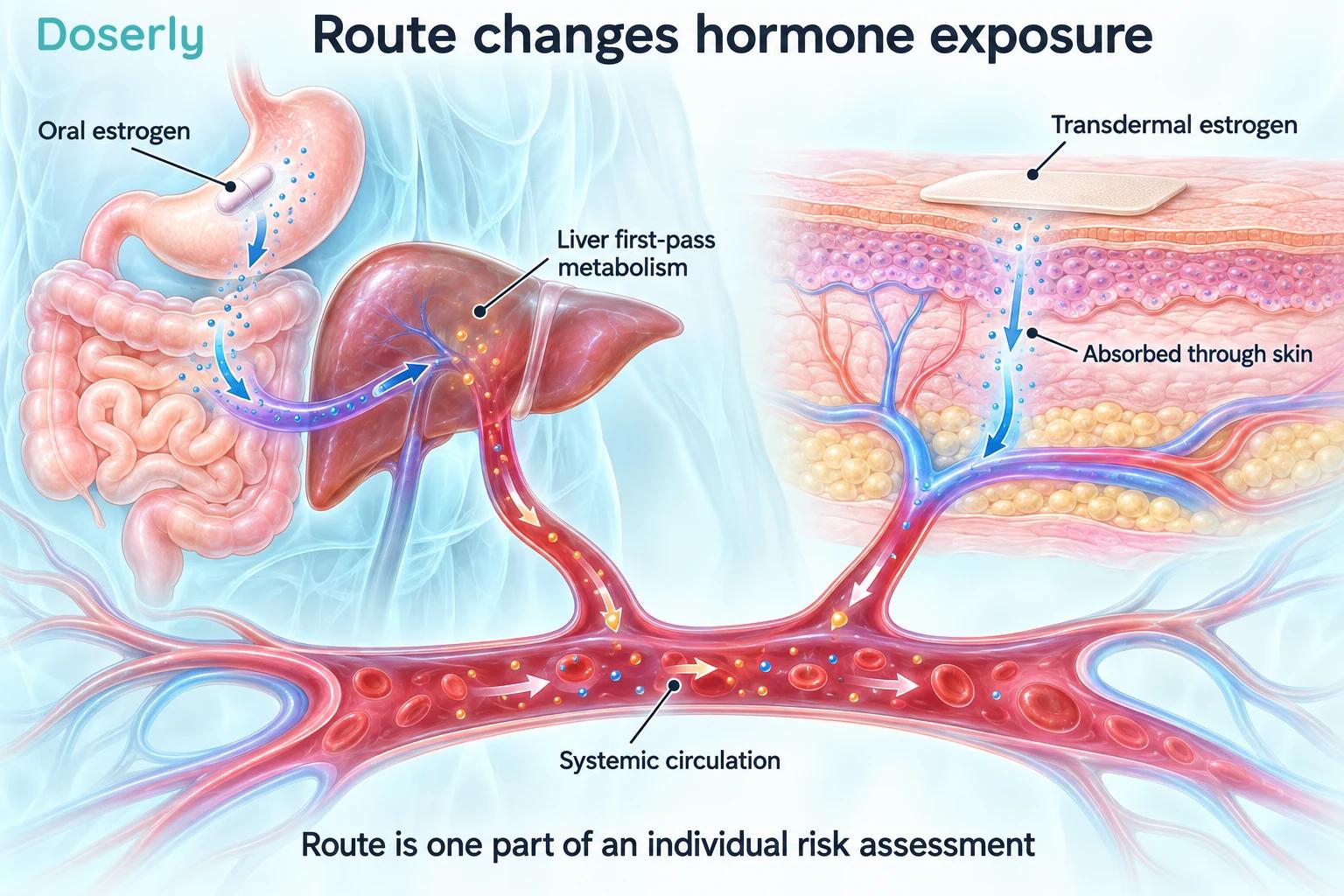
Route also matters. Oral estrogen passes through the digestive system and liver before reaching the wider circulation. Transdermal estrogen, absorbed through skin, avoids that initial liver-first passage. Guidelines consider route and dose when trying to reduce risk, particularly as age and other risk factors increase. 2022 position statement.
A patch does not make all risks disappear. Nor does the word “natural” establish that a preparation is safer. The treatment’s composition, dose, route, duration and indication need to be identified.
If the only remaining problem is local vaginal or urinary discomfort, the clinician can assess whether local treatment would meet the need. Continuing a systemic regimen and continuing local therapy require different discussions. Our vaginal estrogen guide explains that distinction.
What the memory trial actually found
The Women’s Health Initiative Memory Study, WHIMS, included 4,532 participants aged 65 or older who were free of probable dementia. They were randomized to oral conjugated equine estrogen plus medroxyprogesterone acetate or placebo.
Over approximately four years, probable dementia was diagnosed in 40 participants receiving hormones and 21 receiving placebo. The hazard ratio was 2.05, with a 95% confidence interval of 1.21–3.48. The reported rates were 45 versus 22 cases per 10,000 person-years. WHIMS primary report.
The trial does not support starting this regimen in older people to prevent dementia. It also does not answer every question about someone who started a different formulation near menopause and continued beyond 65. Acknowledging the population and formulation is necessary, but it should not be used to dismiss an unfavorable randomized result.

If memory concerns are the reason for considering treatment, they deserve their own assessment. HRT should not be presented as an established dementia-prevention strategy.
What long-term WHI follow-up can—and cannot—tell us
An 18-year mortality follow-up of the two Women’s Health Initiative hormone trials found no significant difference in pooled all-cause mortality. The reported proportions were 27.1% with hormone assignment and 27.6% with placebo, with a hazard ratio of 0.99 and a 95% confidence interval of 0.94–1.03. WHI mortality follow-up.
The assigned treatment periods were much shorter than 18 years: median durations were 5.6 years for combined therapy and 7.2 years for estrogen alone. The later follow-up therefore does not represent 18 years of continuous randomized treatment.
A broadly neutral mortality result also does not mean every individual outcome was neutral. A treatment can affect symptoms, fractures, cancer or vascular events differently while producing no clear overall difference in deaths.
This is useful context against simplistic claims that all HRT inevitably shortens life. It is not proof that indefinite treatment prolongs life or that all regimens have the same effects.
Why a ten-million-person study is not a personal safety guarantee
A 2024 analysis used prescription and encounter records for approximately 10 million Medicare women from 2007–2020. It examined hormone therapy beyond 65 by formulation, route and dose.
Estrogen-only use was associated with lower mortality compared with never-use or discontinuation, with an adjusted hazard ratio of 0.81 and a 95% confidence interval of 0.79–0.82. Other associations differed by treatment type. Medicare study.
The size makes the statistical estimates precise, but the study remains observational. People who continue therapy can differ from people who never use it or stop because of illness. Prescription records do not fully capture symptom severity, treatment motivation, adherence or every relevant health difference.
The comparison also combines never-use and discontinuation rather than randomly assigning otherwise similar people at 65 to continue or stop. It cannot establish that estrogen caused a 19% reduction in mortality, and it should not be used as a reason to start HRT for longevity.
What should a continuation review include?
First, identify the ongoing benefit. Is treatment controlling frequent night sweats, preserving sleep or helping another clearly defined problem? What happens if a dose is missed or reduced? Those observations help describe value, although they do not prove causation.
Next, update health history. A new clot, stroke, cardiovascular condition, cancer diagnosis or unexplained bleeding may materially alter the decision. Review other medicines, treatment tolerance and the ability to use the regimen correctly.
Then consider whether the same benefit could be maintained with a different dose, route or approach. The answer may be to continue unchanged, modify treatment or try stopping. The Menopause Society supports individualized assessment rather than a universal birthday-based cutoff. 2022 statement.
Document why the plan remains appropriate and when it will be revisited. “Continue because we always have” is no more informative than “stop because you turned 65.”
Bone protection needs an explicit discussion
HRT can help preserve bone and reduce fracture risk while used, but a decision about continuing it for bone protection should consider the person’s fracture risk and other available treatments. Systemic HRT is not the only way to address osteoporosis.
Ask whether bone protection is the main reason for treatment or an additional benefit while treating symptoms. If stopping is planned, the clinician can review whether bone-density assessment or another strategy is needed.
This is especially relevant when symptoms have resolved but the prescription continues because of an old scan result. The current risk, any fractures and other medical factors may be more useful than the original indication alone. ESE guideline.
Hormone therapy should also not replace cardiovascular prevention. The ESE guideline advises against using it primarily to prevent cardiovascular disease. Managing blood pressure, smoking and other established risk factors remains necessary whether treatment continues or stops.
Trying a reduction is not a test of willpower
Some people want to see whether they still need treatment. A planned reduction or cessation can be reasonable when medically appropriate, but symptoms may return. Recurrence does not mean someone has failed or become addicted.
Agree in advance how symptoms will be assessed, when review will occur and what options are available if sleep or daily function deteriorates. If treatment is being stopped because of a new contraindication, the follow-up options may differ from those available during an elective trial off therapy.
NICE allows gradual or immediate cessation and notes that tapering may reduce short-term recurrence without a long-term difference. The choice should fit the clinical situation. NICE recommendations.
Our stopping and tapering guide discusses symptom recurrence and the practical questions to raise. Avoid designing a taper by cutting tablets or patches unless the specific product and prescriber’s instructions support it.
Prepare for a more useful conversation
Bring the exact treatment names, routes and schedules, along with the approximate dates of menopause and treatment initiation. Include why treatment began and which benefits still matter.
Explain what you want from the review. You may be worried about an age cutoff, concerned about side effects, interested in reducing medicines or reluctant to lose symptom control. Those preferences are part of the decision, not an obstacle to it.
Ask what would make the clinician recommend continuing, changing or stopping the regimen. Request an explanation of whether the concern is your age itself, time since menopause, a new health issue or a particular product.
A good answer should be specific enough that you understand the next step. Turning 65 should prompt a thoughtful review, not an unexplained prescription withdrawal or a promise that treatment can continue forever without reassessment. European Society of Endocrinology guideline.
A continuation review is easier when the record distinguishes the original indication from the current one. Someone may have started treatment for frequent night sweats but now mainly value relief of vaginal symptoms. Another may still have substantial vasomotor symptoms. A third may be relying on treatment partly for bone protection. Those situations call for different questions even at the same age.
It is also useful to distinguish a planned trial of reduction from an interruption caused by cost or supply. An unplanned gap does not necessarily reflect a considered decision that treatment is no longer needed, and symptoms during that gap do not settle whether restarting is appropriate.
Bring these details to the clinician rather than reconstructing the decision from age alone. A documented review should explain the current purpose, the remaining uncertainty, the options considered, and when the choice will be reassessed. That makes future decisions more coherent if another clinician takes over care.
Sources
- NAMS hormone therapy position statement, 2022.
- ESE clinical guideline, 2025.
- WHIMS randomized dementia trial, 2003.
- WHI 18-year mortality follow-up, 2017.
- Medicare hormone therapy analysis, 2024.
- NICE menopause recommendations.