
Peptides
October 16, 2026
Do antibodies against cagrilintide necessarily mean treatment stops working?
On this page
No. Detecting antibodies that recognize cagrilintide does not, by itself, prove that the treatment has stopped working. It is a laboratory finding that needs interpretation alongside antibody characteristics, drug exposure, clinical response and safety.
The opposite shortcut is also unreliable. A favorable average weight result does not prove that antibodies are irrelevant to every participant. Immunogenicity—the potential for a treatment to provoke an immune response—is investigated because its consequences can vary.
The useful question is not simply whether antibodies appeared. It is whether a particular immune response changed something that mattered, and how convincingly the study measured that relationship. Cagrilintide’s posted trial results provide a concrete example of why that distinction matters.
What an anti-drug antibody test detects
An antibody is an immune-system protein that can recognize a particular molecular feature. An anti-drug antibody, often abbreviated ADA, recognizes the therapeutic molecule or an associated feature tested by the assay. Detecting that recognition does not immediately tell researchers what the antibody does in the body.
Some responses may have little detectable clinical consequence. Others can affect drug exposure, reduce biological activity or be associated with safety problems. Antibodies that cross-react with a related natural protein raise another question that needs specific testing. These possibilities are part of the FDA’s immunogenicity framework; they are not findings that should be assumed for every cagrilintide-positive sample. FDA immunogenicity assessment guidance
The word “antibody” is therefore neither a diagnosis of treatment failure nor a reason to dismiss the result. It describes one part of an investigation. The next steps depend on the product, assay, timing and clinical observations.
This differs from the casual idea of becoming “used to” a medicine. A change in appetite or weight trajectory is not an antibody test. Without appropriate measurements, assigning that change to immunity is a hypothesis rather than an explanation.
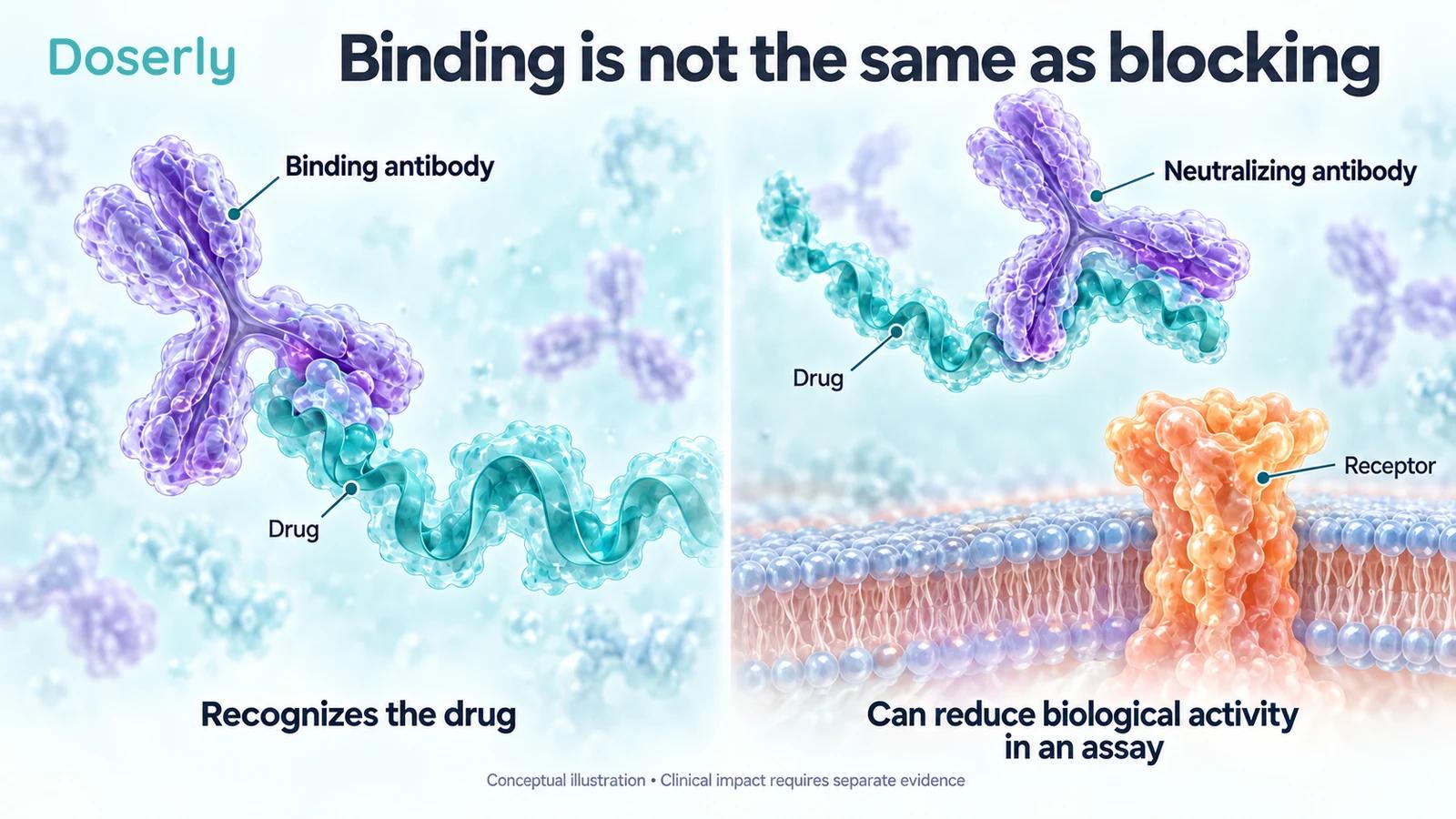
Binding and neutralization are different questions
A binding assay asks whether antibodies recognize the drug under the test conditions. A neutralization assay asks whether an antibody response can reduce the drug’s biological activity in a relevant experimental system. These are related tests, but they are not interchangeable.
FDA assay guidance describes a staged approach involving screening, confirmation, measurement of antibody levels or titers, and evaluation of neutralizing activity when appropriate. A screening signal is not automatically a confirmed result, and a confirmed binding result is not automatically a neutralizing result. FDA antibody-assay guidance
Even “neutralizing” needs its context. It concerns activity in a defined assay. Whether that translates into an important clinical effect depends on factors such as the response’s magnitude, persistence and relationship to drug concentrations and outcomes.
For example, a test may demonstrate that a sample can interfere with activity in the laboratory. That alone does not quantify how much a person’s weight response changed. A separate clinical analysis is needed to connect the laboratory measurement to that outcome.
An antibody titer adds another layer: it summarizes reactivity under the assay's dilution conditions. It is not automatically an absolute antibody concentration or a percentage of drug activity blocked. A higher titer may motivate closer investigation, but its meaning still depends on the assay and the clinical relationship.
Timing is equally important. A sample obtained while substantial drug remains in circulation can behave differently in an assay from one obtained later. Researchers must account for this interference rather than interpreting every negative or positive result as equally informative. FDA assay guidance
What the cagrilintide registry actually reports
The posted results for the phase 2 cagrilintide study include an endpoint counting participants with anti-drug antibodies from week 0 through week 32. Across the five cagrilintide groups, the counts were 51 of 101, 54 of 100, 52 of 102, 75 of 102 and 75 of 101. That is approximately 50–74%, depending on the group. Posted ClinicalTrials.gov results
The endpoint is occurrence of antibodies. It is not a count of participants whose treatment stopped working, whose antibodies neutralized the drug, or who had an allergic reaction. Those would require different measurements or analyses.
The follow-up window also matters. This was an “occurred during the interval” outcome, not necessarily a statement that all counted participants remained positive at the final visit. The registry specifies the in-trial observation period and notes that additional positive-antibody follow-up was not included in that period.
These details are why a large antibody percentage should not be copied into a headline as a failure rate. The number is meaningful, but only for the endpoint actually counted.
How antibodies and average efficacy can coexist
The same phase 2 program demonstrated greater average weight reduction with cagrilintide than with placebo. At 26 weeks, mean reductions across cagrilintide groups ranged from 6.0% to 10.8%, compared with 3.0% for placebo under the trial-product analysis. Primary phase 2 publication
That means antibody occurrence and an overall treatment effect can coexist in a study. It does not establish that the antibody-positive participants all responded equally well, or that their outcomes would have been identical without antibodies.
This is a problem of matching the level of evidence to the claim. Group-level weight results and group-level antibody counts do not reveal the relationship within each participant. To examine that relationship, researchers need linked observations: antibody status and timing, drug concentrations, treatment exposure and the relevant outcomes.
A hypothetical example makes the issue clear. Two groups could have the same average weight change even if a small subgroup experienced reduced response and other participants had larger responses. Conversely, antibody-positive and antibody-negative participants could have similar outcomes. Aggregate totals alone do not tell us which pattern occurred.
What would establish a clinically meaningful effect?
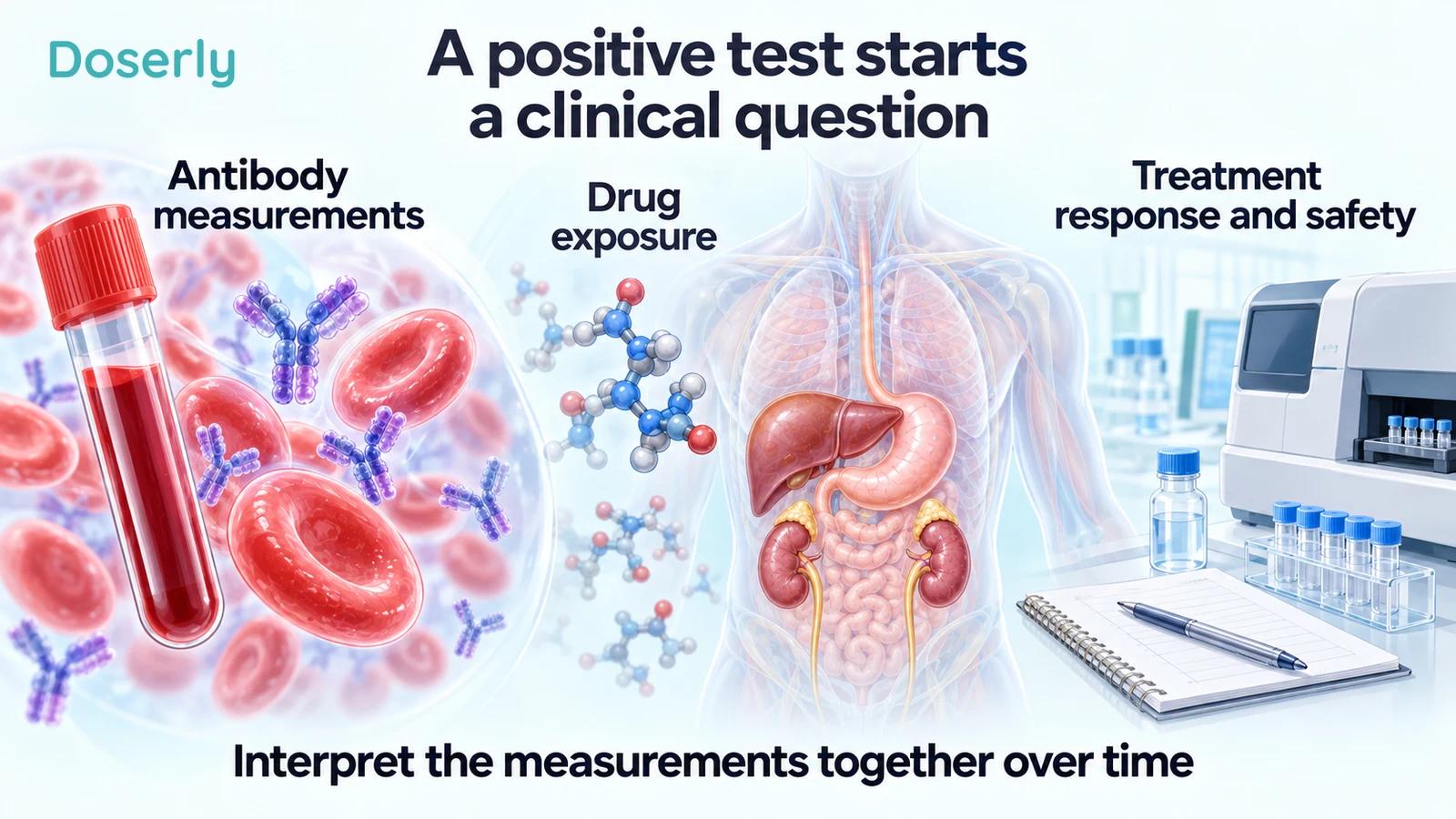
A convincing investigation follows the immune response over time and compares it with other measurements. Did the antibody response appear before a change in drug exposure or response? Was it persistent or temporary? Did higher antibody measurements correspond to a different pattern? Were safety events associated with the response?
The EMA guidance emphasizes integrated assessment of immunogenicity, including pharmacokinetics, efficacy and safety. Pharmacokinetics describes how the body handles a medicine and the concentrations achieved over time. It is one possible link between antibody formation and clinical effect, rather than a substitute for measuring benefit. EMA immunogenicity guideline
These analyses need care because antibody status is usually not randomly assigned. Participants who develop antibodies can differ from those who do not, and treatment exposure itself may affect both antibody detection and outcomes. A simple comparison can therefore be difficult to interpret.
A reassuring analysis should be described precisely: for example, no clinically important association was identified within the study’s duration and measurements. That is narrower than proving that no immune-related effect could ever occur, especially after longer exposure or in populations not adequately represented.
Why antibody percentages cannot rank different medicines
It may seem natural to compare a cagrilintide antibody percentage with a percentage for another peptide. That can be misleading because assays differ in sensitivity, specificity, drug tolerance, sampling schedules and definitions.
A more sensitive assay may detect responses that another method misses. Circulating drug can interfere with some tests. A study with more sampling opportunities or longer follow-up may identify more positive participants. Those differences can change the reported percentage without establishing a greater clinical problem.
The current Zepbound label makes this caution explicit for tirzepatide: assay-method differences prevent meaningful comparisons of antibody incidence across studies. It reports binding and neutralizing findings separately, illustrating why the categories should not be collapsed. Zepbound prescribing information, section 12.6
That label also states that no clinically significant effect of anti-tirzepatide antibodies on pharmacokinetics or effectiveness has been identified, while hypersensitivity and injection-site reactions were more frequent among antibody-positive participants. This is a tirzepatide-specific example of different outcomes needing separate assessment. It cannot be imported as a cagrilintide safety conclusion.
A plateau is not evidence of antibodies
Weight change is dynamic. As body weight and intake change, the relationship between energy intake and expenditure changes too. The NIDDK’s body-weight modeling work explicitly accounts for changing physiology over time rather than treating weight loss as a fixed linear process. NIDDK body-weight research
That provides a reason to avoid an immediate immune explanation for a slowing trajectory. A plateau does not identify a cause by itself. Neither does a return of hunger, an isolated higher scale measurement or a different feeling after treatment.
A clinician or study team would need to review the wider situation: the time course, actual treatment exposure, other changes, relevant symptoms and measurement consistency. Antibodies are one research consideration among several possible explanations, not a diagnosis that can be made from a graph in an app.
This also means there is no evidence-based basis here for a self-directed “antibody reset,” cycling strategy or switch to a different unapproved product. A plausible story about immunity is not a tested management plan.
Antibody tests are not interchangeable with allergy assessment
A research ADA result and a clinical assessment of a suspected allergic reaction answer different questions. An antibody count cannot diagnose every immune-mediated symptom, and a person with concerning symptoms should not wait for a research antibody result before seeking care.
The FDA assessment framework separates several potential consequences, including altered exposure, loss of efficacy and immune-related safety events. Which consequence matters must be established for the particular product and situation. “Antibody-positive” is too broad to serve as a complete clinical label.
For the same reason, absence of a detected antibody response does not guarantee that every symptom is unrelated to treatment. Assays have limits, and adverse effects can occur through other mechanisms. Clinical interpretation depends on the symptoms and circumstances, not only one laboratory category.
What to ask when reading a new report
A useful immunogenicity report should make its definitions visible. Were antibodies present before treatment, newly detected afterward or increased from baseline? Was the result confirmed? Did testing distinguish binding from neutralizing activity? What proportion of participants had evaluable samples?
Then look for the clinical connection. Did investigators examine drug concentrations, efficacy and safety by antibody status? Was there enough follow-up to assess persistence? Were small subgroups and missing samples acknowledged? A statement about incidence is not a substitute for these analyses.
The source also matters. A trial registry may provide dependable endpoint counts without the detailed integrated interpretation found in a full immunogenicity analysis. An abstract may summarize efficacy while omitting antibody methods. Neither omission licenses a reader to fill in the missing conclusion.
For someone discussing treatment response with a clinician, the most useful contribution is an accurate timeline of the observed change and associated symptoms. The clinician can decide which assessments are relevant; an internet antibody percentage should not become a self-ordered testing or treatment algorithm.
Our cagrilintide guide provides the broader trial context, and the tirzepatide guide covers the separate medicine used here as an assay-interpretation example. Antibodies deserve careful investigation. Their detection is the beginning of a clinical question, not an automatic verdict that treatment has failed.
Sources
- Cagrilintide phase 2 trial: posted anti-drug antibody outcome, 2023.
- Once-weekly cagrilintide for weight management in people with overweight and obesity: a multicentre, randomised, double-blind, placebo-controlled and active-controlled, dose-finding phase 2 trial, 2021.
- Immunogenicity Assessment for Therapeutic Protein Products, 2014.
- Immunogenicity Testing of Therapeutic Protein Products: Developing and Validating Assays for Anti-Drug Antibody Detection, 2019.
- Guideline on Immunogenicity Assessment of Therapeutic Proteins, Revision1, 2017.
- Zepbound US Prescribing Information, 2026.
- Research Behind the Body Weight Planner, 2025.