
TRT
October 16, 2026
Compounded testosterone cream: customization is not proof of superiority
On this page
A custom testosterone cream can sound reassuringly precise. The concentration is selected for you, the base may be chosen around your skin, and the prescription arrives with your name on it. Those features may solve a practical problem. They do not, by themselves, show that the cream is safer, more consistent, or more effective than an approved alternative.
The important question is why a custom preparation is needed and what evidence applies to the actual product supplied. Testosterone is the active hormone, but the container holds more than testosterone. Its concentration, cream base, dispenser, application site, and directions all contribute to the treatment.
This article concerns testosterone replacement in adult men. Evidence from that setting should not be used to invent dosing or benefit claims for other populations. It also focuses on US regulatory distinctions, with a Canadian laboratory study used for a clearly identified quality question.
What compounding changes
Compounding means preparing or altering a medicine to meet a particular need. FDA gives examples such as a patient who cannot use an ingredient in an available product or needs a different dosage form. It can have an important role when an approved medicine does not meet the patient's medical needs. FDA compounding questions and answers
That role is different from a general claim of superiority. A cream without an ingredient that irritates one person's skin might be a useful individualized choice. It does not follow that all men absorb it better, that it produces better sexual outcomes, or that it has fewer systemic adverse effects.
In the United States, compounded drugs are not FDA-approved. FDA does not review each compounded product for safety, effectiveness, and quality before marketing. This is not the same as saying that every compounded product is defective or that compounding has no oversight. It describes an important difference in the evidence and approval process. FDA explanation of compounded-drug risks
Ask the prescriber to name the problem the custom preparation is intended to solve. “You cannot tolerate this excipient in the available product” is a specific rationale. “Custom is more natural” is a marketing description that leaves the clinical question unanswered.
The cream base is part of the delivery system
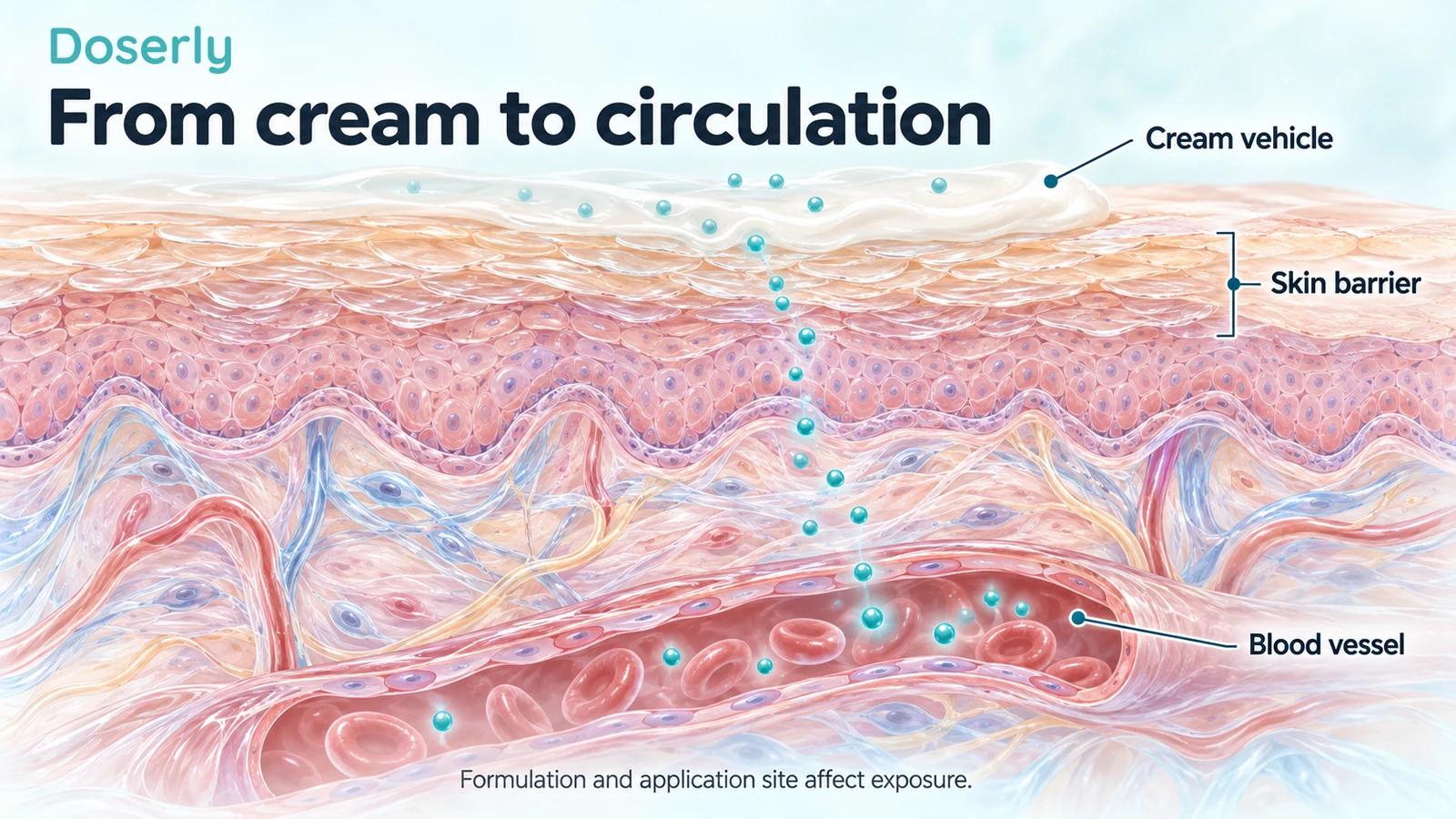
Skin is a barrier, not an open channel into the circulation. A topical medicine must leave its vehicle, move through skin, and reach the blood. The vehicle is the material carrying the active ingredient: its composition influences how the drug is presented to that barrier.
That is why knowing the hormone's name is not enough to make two products interchangeable. Even the approved AndroGel 1.62% label warns that topical testosterone products may have different strengths, application instructions, and systemic exposures. Its directions are specific to its formulation and designated sites. AndroGel 1.62% prescribing information
The amount dispensed is also different from the amount absorbed. A concentration describes how much testosterone is present per stated amount of cream. A dispenser describes how much preparation is delivered by a particular operation. Neither number, alone, tells you the resulting blood testosterone concentration.
This distinction becomes especially important when changing pharmacies or bases. The same-looking container or the same number of dispenser turns does not establish equivalence. Have the pharmacist confirm the concentration, the amount delivered, and the directions for that exact preparation. Do not translate instructions from another cream by eye.
What the concentration study actually measured
A 2015 study tested testosterone gels and creams from ten compounding pharmacies in the Toronto area. Researchers obtained two independently prepared batches from each pharmacy, one month apart, and used blinded laboratory measurements. Two commercial gels served as controls. Grober and colleagues
Only 50% of pharmacies in the first batch and 30% in the second supplied products whose measured concentration was within 20% of the prescribed amount. The commercial controls were consistent and accurate in that study. The investigators also reported a preparation with essentially no testosterone.
These findings matter because the prescription on a label and the measured contents are separate observations. However, this was a small local product-testing study, published in 2015. It was not a current audit of every pharmacy, a patient treatment trial, or a measurement of symptom improvement. It cannot tell you the present-day quality of a named pharmacy that was not evaluated.
Nor does the study show that 20% variation is a desirable treatment target. That was the comparison band used in the analysis. A reader should not turn the research threshold into permission to accept a particular discrepancy in their own medicine.
The useful response is to ask how the pharmacy verifies the preparation it supplies: how the formula is standardized, how active content is checked, and what happens if a quality concern arises. An attractive dispenser or a claim of personalization cannot answer those questions.
Absorption research answers another question
A 2017 pharmacokinetic study examined a testosterone cream applied to scrotal skin in healthy male volunteers whose own testosterone production had been suppressed for the experiment. Participants received different single doses in a crossover design. Blood measurements showed a rapid rise in testosterone, with peaks around two hours. Iyer and colleagues
This demonstrates absorption under those study conditions. It does not establish that any compounded cream used at any site will reproduce the same exposure. It also does not establish long-term symptom benefit, cardiovascular safety, fertility preservation, or superiority over approved gels or injections.
The study is sometimes relevant to discussions of application site because scrotal skin has different permeability. But it is not a self-treatment instruction. In particular, an approved gel whose label excludes genital application should not be moved there because someone has read a study of another cream.
A short pharmacokinetic experiment can be valuable without settling treatment choice. It helps explain why product, site, and blood-sampling time must be documented. To establish better clinical outcomes, researchers would need suitable treatment comparisons and follow-up, not simply a higher hormone concentration after application.

“Bioidentical” does not remove ordinary testosterone effects
The word “bioidentical” refers to chemical identity with a hormone made by the body. It does not tell you whether a finished preparation has undergone approval, how consistently it is made, or whether the exposure is appropriate for a particular patient.
The clinical task remains replacement for a supported diagnosis. The Endocrine Society recommends symptoms or signs together with consistently low testosterone and evaluation of the cause. It also recommends monitoring the response and adverse effects of treatment. A customized base does not replace those steps. Endocrine Society guideline
It is especially misleading to treat skin application as proof that testosterone acts only locally. The purpose of replacement cream is systemic delivery. Once absorbed, it can affect tissues beyond the application site, and reproductive planning remains relevant. The guideline recommends against starting testosterone in men planning fertility in the near term.
A concentration that looks satisfactory also cannot prove that every symptom comes from testosterone deficiency. Persistent fatigue, low mood, or sexual problems deserve assessment rather than automatic escalation. Raising exposure further is not a substitute for understanding why the original treatment goal has not been met.
Transfer precautions need product-specific instructions
Topical testosterone introduces a household consideration: another person may be exposed through contact with treated skin. The AndroGel 1.62% label carries a boxed warning about secondary exposure and reports virilization in children. It specifies measures such as hand washing and covering the treated area after drying. AndroGel label
Those findings establish that transfer is a real concern with topical testosterone. They do not quantify transfer from every custom cream. A thicker texture, different odor, or apparently dry surface should not be treated as proof of no remaining hormone.
Ask for written precautions for your exact preparation, including contact with partners or children, clothing, washing, and what to do after accidental exposure. The pharmacist should explain how those instructions relate to the formulation rather than simply borrowing a schedule from an unrelated product.
Tell the clinician if your living situation makes the routine difficult. For some people, preventing contact is straightforward; for others, caregiving or close household contact makes it more complicated. That practical fit belongs in formulation selection, alongside skin tolerance and clinical monitoring.
A changed result is a reason to investigate, not guess
If a testosterone result changes after a refill, several explanations may need consideration. The amount used, timing of use, timing of blood collection, application site, and changes in the preparation are all useful facts to bring to the review. The result alone does not identify which factor caused the change.
Keep the pharmacy name, concentration, base if listed, dispensing instructions, and refill dates with your medication record. Note any switch in product or dispenser. This gives the clinician and pharmacist something concrete to compare rather than relying on memory of whether the new cream felt different.
Doserly's compounded testosterone cream guide provides a broader formulation overview, while the TRT blood-work guide explains why consistent sampling context matters. Your clinician should specify the sampling plan for your product; there is no universal post-application hour that can be safely assumed for every cream.
Do not add extra applications or change the site to correct an unexpected result on your own. First establish whether the result is interpretable and whether the dispensed product matches the intended prescription.
If you suspect a dispensing problem, keep the container and its identifying information and contact the pharmacy and prescriber. Describe the observation precisely: an unfamiliar label, a changed dispenser, unexpected texture, or a new symptom. Those observations are useful starting points, but they do not establish the cause. The pharmacy can investigate the preparation while the clinician assesses whether the treatment or monitoring plan needs to change.
What a well-supported decision sounds like
A useful consultation ends with more than a claim that the cream is personalized. You should understand why it was selected, what alternative was considered, which pharmacy supplies it, how the directions are expressed, and how benefit and tolerability will be reviewed.
Ask what evidence supports the specific claims being made. Evidence that a cream raises blood testosterone supports delivery. Evidence that a batch contains the intended concentration supports one aspect of product quality. Neither automatically supports a promise of better mood, better sexual function, or fewer adverse effects than another option.
A compounded preparation may meet a real individual need. The strongest reason to use it is that clearly described need, supported by careful prescribing, pharmacy quality practices, and follow-up. Customization becomes useful when it solves a concrete problem; it is not a clinical outcome in itself.
Sources
- FDA: Compounding and the FDA—questions and answers
- FDA: Understanding the risks of compounded drugs
- Grober and colleagues: Accuracy of testosterone concentrations in compounded products, 2015
- Iyer and colleagues: Pharmacokinetics of testosterone cream applied to scrotal skin, 2017
- AndroGel 1.62%: Current US label
- Endocrine Society: Testosterone therapy guideline