
Peptides
October 16, 2026
CJC-1295 with DAC or no DAC: why the name changes the evidence
On this page
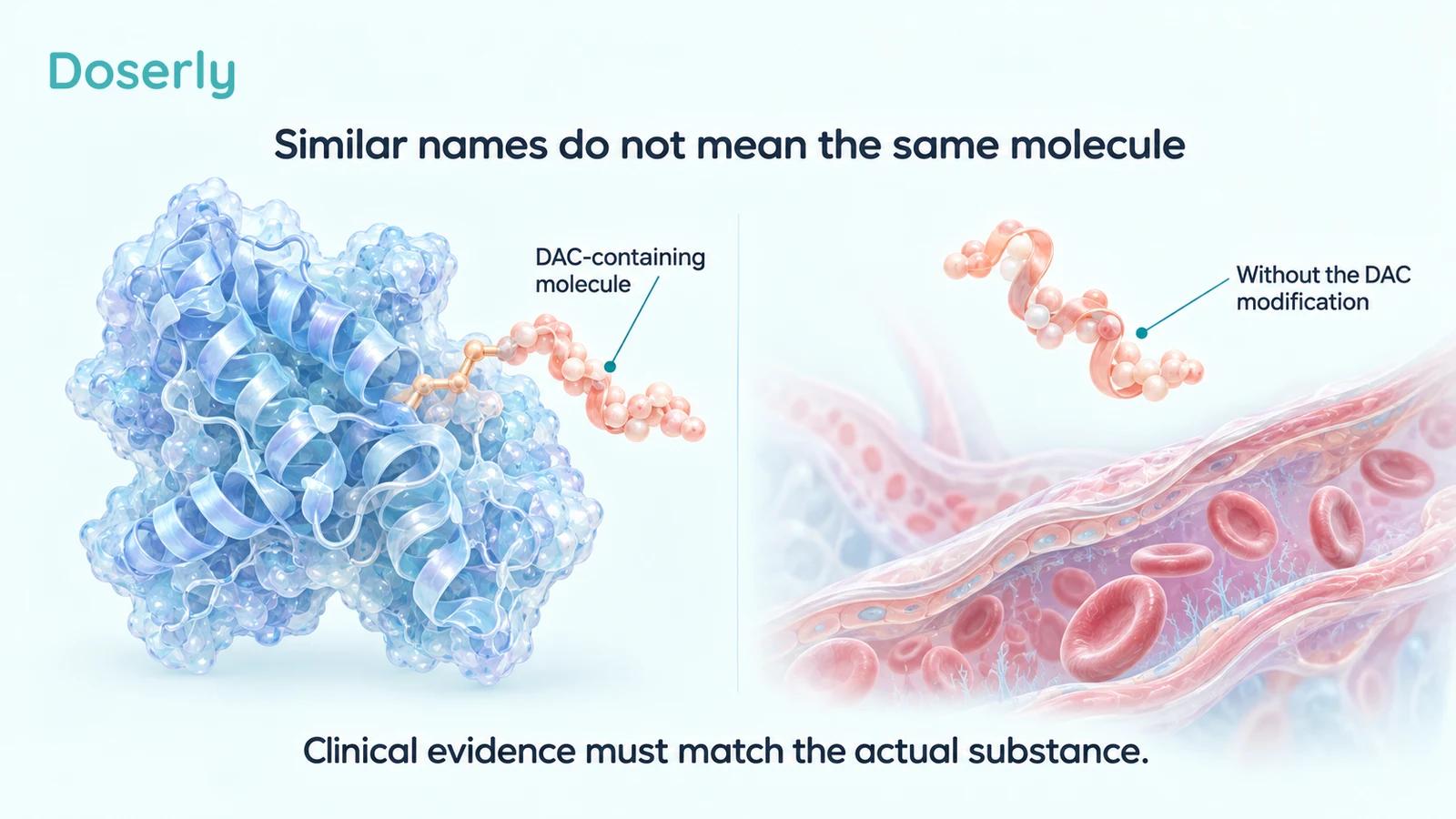
CJC-1295 is discussed as though it were one peptide available in a long and a short version. That shorthand can hide a consequential difference. The original investigational molecule was designed to bind to albumin in blood and remain active for an extended period. Products called “CJC-1295 no DAC” lack that modification and are often described using the name modified GRF(1–29).
For a reader comparing claims about effects, timing or safety, the first question is therefore not which version sounds more convenient. It is which molecule was actually studied, and does it match the product being discussed?
The published long-duration human results belong to the DAC-containing investigational molecule. They cannot simply be transferred to a product labeled no DAC. Understanding what changed in the chemistry makes this distinction easier to follow. Our CJC-1295 guide provides the broader clinical and safety background.
Start with GHRH, the signal the peptide imitates
Growth-hormone-releasing hormone, or GHRH, is a signal from the hypothalamus to the pituitary gland. It stimulates pituitary cells to release growth hormone. GHRH is also called growth-hormone-releasing factor in some older papers, which explains the abbreviation GRF.
The notation “1–29” refers to a segment containing the first 29 amino acids of the hormone. Scientists have investigated modifications to this segment to change its biological activity or how rapidly it disappears from blood. Different modifications create different investigational substances, even when their names share the same starting point.
This naming history is useful because a citation containing “GRF(1–29)” is not automatically a citation for every modern product using that phrase. The amino-acid substitutions, attached chemical groups and route of administration must still be checked.
An early human study illustrates the point. Researchers compared GHRH(1–29)-NH2 with a version containing a D-alanine substitution at position two in ten healthy men receiving intravenous infusions. Their measured disappearance half-times were 4.3 and 6.7 minutes, respectively. That experiment concerned those two specified molecules, not a marketed no-DAC product or the later albumin-binding CJC-1295. Human GHRH analogue study, 1994.
What does DAC add?
DAC is commonly expanded as drug affinity complex. In the CJC-1295 design, a reactive chemical feature allows the peptide to form a covalent attachment to albumin. A covalent attachment is a chemical bond, rather than simply two substances being mixed in the same container.
Albumin circulates in blood and has properties that make it useful in drug-design strategies intended to extend exposure. The purpose of the modification was to help a GHRH analogue persist longer while retaining biological activity. It was not merely a different brand name or a different amount of the same unmodified peptide.
Jetté and colleagues described the development work in 2005. They evaluated albumin-conjugated analogues in laboratory assays and administered candidates to rats. CJC-1295 showed GH-releasing activity, persisted in rat plasma beyond 72 hours, and produced an immunoreactive signal associated with albumin. The publication describes a tetrasubstituted GHRH fragment with an added reactive lysine derivative. Jetté and colleagues.
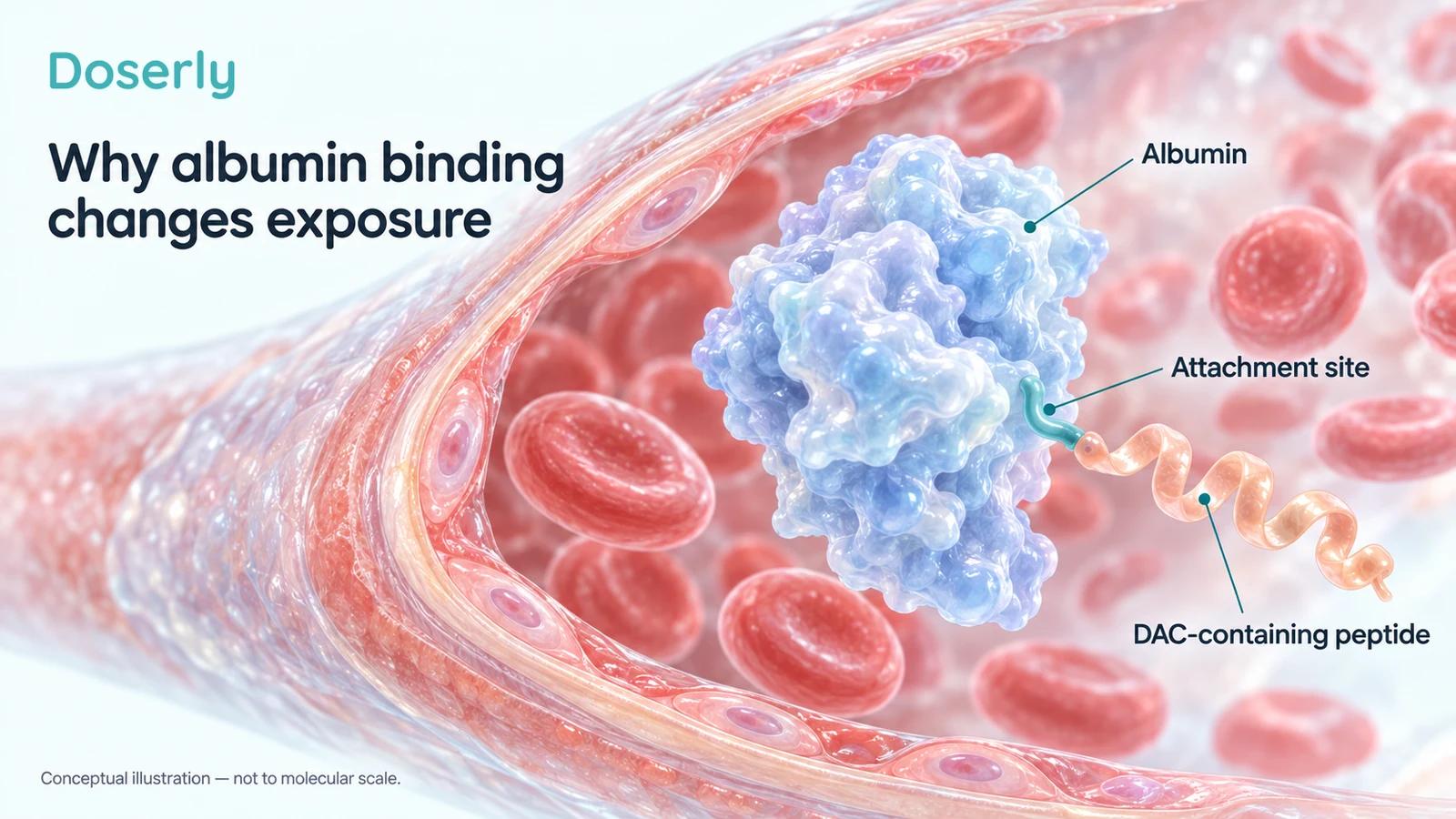
The study helps explain why researchers expected prolonged exposure. The rat time course itself is not a human half-life estimate, and neither result establishes that a longer exposure is better for a particular health goal.
Which version was given in the human trials?
The best-known human paper reported two randomized, blinded, placebo-controlled dose-escalation studies in healthy adults aged 21–61. It describes CJC-1295 as a long-acting GHRH analogue. Study periods were 28 and 49 days, with single or limited repeated subcutaneous administration. Teichman and colleagues, 2006.
The estimated half-life was 5.8–8.1 days. After one injection, mean GH rose approximately 2- to 10-fold for at least six days, and mean IGF-1 rose approximately 1.5- to 3-fold for nine to eleven days. Repeated exposure produced cumulative hormone effects.
These findings are frequently quoted without their identity context. They describe the long-acting investigational molecule. They do not establish that a no-DAC preparation lasts a similar time, produces the same hormone pattern or can be substituted using a mathematical adjustment to its amount.
The findings also concern pharmacology. The study did not demonstrate improved sleep, injury recovery, strength or healthy aging. Correctly identifying the molecule is necessary for interpreting a result, but it does not enlarge the outcome that the trial measured.
What does FDA distinguish?
FDA's 2024 review considered five related bulk substances: CJC-1295 free base and acetate, and DAC-containing free base, acetate and TFA forms. It described CJC-1295 and CJC-1295 DAC as distinct active moieties, not interchangeable versions of a single established medicine. The review also noted that the published human studies did not always make the exact salt form clear. FDA CJC-1295 briefing.
An active moiety refers to the part responsible for the substance's pharmacological action, with specified exclusions such as certain salt-associated portions. For a reader, the practical point is that removing the DAC modification is a different issue from describing the salt associated with a molecule.
“Acetate” does not mean “no DAC.” A substance can be DAC-containing and described as an acetate form. Likewise, writing only “CJC-1295 acetate” without an adequate chemical description may leave an important question unresolved. A suffix cannot be interpreted in isolation from the full identity.
FDA's discussion is especially relevant when a clinic, seller or paper uses a familiar short name. The label must be matched to a chemical description; it cannot be assumed to settle the identity simply because it looks precise.
Why “no DAC” does not provide its own evidence
No DAC is a statement about a missing feature. It does not, by itself, supply a complete characterization of the remaining material. People commonly use the term alongside modified GRF(1–29), but a market nickname cannot verify sequence, purity, strength or formulation.
The FDA review did not identify human studies of the evaluated non-DAC active moiety that would establish the popular clinical claims. Its discussion of available human pharmacology concerned the DAC-containing substance. That is a scoped finding from the review, rather than a claim that no unreported use has ever occurred anywhere. FDA CJC-1295 briefing.
This distinction protects against two opposite errors. It prevents borrowing the long-acting trial results to support no-DAC use. It also prevents assuming that every effect or adverse event reported with the long-acting molecule must occur identically with another substance.
The appropriate conclusion is that the evidence needs to match. Where it does not, the uncertainty should remain visible rather than being filled with a precise-looking duration or protocol from a product page.
Are DAC hormones flat and no-DAC hormones natural?
That is too simple. The original long-acting CJC-1295 pulse study collected blood every 20 minutes over 12 hours in healthy men, before and a week after exposure. GH pulses persisted. The study found a large increase in trough concentrations, the lower levels between pulses, rather than disappearance of the pulsatile pattern. Ionescu and Frohman, 2006.
Trough GH rose about 7.5-fold, while mean GH rose 46% and IGF-1 rose 45%. Those are different descriptions of the response. A retained pulse pattern does not mean the system was unchanged or that every consequence was beneficial.
Nor does the finding prove that another molecule produces a superior pattern. That would require a direct comparison with clearly identified products and a meaningful outcome. A label such as “physiological” is not enough unless the claim specifies what was measured and how close it was to the relevant untreated pattern.
Why exposure cannot be converted into a home schedule
A drug half-life describes a measured decline under particular conditions. Hormone release and downstream IGF-1 production may follow different time courses. Repeated administration adds another issue: exposure from an earlier administration may still be present when the next one occurs.
Consequently, replacing a long-acting product with a supposedly short-acting one is not simply a matter of dividing a weekly amount into smaller portions. The peak concentration, cumulative exposure, receptor response and formulation may all differ. The original studies do not provide a validated conversion between commercial DAC and no-DAC regimens.
The route matters too. The 1994 GHRH comparison used intravenous infusion; the CJC-1295 studies used subcutaneous administration of a specified investigational product. A number from one route and molecule cannot be treated as a universal timer for another.
This is why a clear article should preserve the complete study context rather than present a single duration next to a broad peptide name. The apparent convenience of a short summary can otherwise create false certainty.
What if ipamorelin is also in the product?
Adding ipamorelin creates a combination question on top of the identity question. Ipamorelin stimulates GH through a different receptor pathway. A product containing both is not the intervention studied in the original CJC-1295 pharmacology trials.
Even if each component has a plausible mechanism, that does not establish the combination's balance of benefit and harm. The amounts, actual chemical identities, administration route and comparison all matter. Our ipamorelin guide explains its separate human research, including the distinction between intravenous trial exposure and subcutaneous wellness claims.
For someone interpreting an existing record, “CJC/ipamorelin” is therefore an incomplete description. The record should preserve the exact stated ingredients and formulation, without pretending that a label alone verifies them. This helps a clinician reconstruct the history if an unexpected symptom or laboratory change occurs.
Does removing DAC establish safety?
It does not. A shorter expected exposure may change a drug-development question, but it does not supply safety data for a different product. A compound can have a brief presence in blood and still produce downstream effects, and product identity or quality problems are not resolved by a shorter-duration claim.
FDA's current risk information for CJC-1295 identifies limited clinical data, concerns about immunogenicity and peptide characterization, and serious adverse events associated with the substance, including increased heart rate and systemic vasodilatory reactions. That information should not be converted into an exact risk estimate for every named formulation. It also cannot be dismissed by assuming a no-DAC label makes the product safe. FDA safety information.
The practical next step is a discussion of the actual clinical need, the identified product and the relevant evidence. A mechanism-based preference is not the same thing as a demonstrated safety advantage.
Questions that resolve the naming problem
When a CJC-1295 claim is presented, ask which active molecule and salt were used, whether the study included DAC, and whether the route matches. Then ask what outcome the study measured. A hormone increase, a duration estimate and a clinical benefit should remain separate answers.
If the source cannot identify the product beyond a nickname, the evidence is not yet specific enough to support a confident comparison. That is a reason to clarify the underlying information, not to choose whichever label sounds more natural.
The DAC modification matters because it changes the molecule and its exposure. The human evidence belongs to the substance that researchers actually administered. Keeping that connection intact is the most useful way to read the literature without turning similar names into interchangeable treatments.
Explore the research
- GHRH and D-Ala2-GHRH comparison, 1994: ten men, intravenous exposure, different molecules from modern product nicknames.
- Jetté et al., 2005: albumin-binding design and preclinical experiments.
- Teichman et al., 2006: long-acting human pharmacology.
- Ionescu and Frohman, 2006: preserved GH pulsatility with increased trough levels.
- FDA CJC-1295 briefing, 2024: active-moiety and salt distinctions.
- FDA compounding-risk information: safety concerns and evidence limitations.