
Peptides
October 16, 2026
Tesamorelin versus GLP-1 trials: what the fat-loss numbers mean
On this page
Tesamorelin and medicines that activate the GLP-1 receptor both appear in discussions about abdominal fat. It is easy to find a percentage beside each name and assume the larger number identifies the stronger treatment. But the most familiar tesamorelin number describes visceral fat, while the best-known semaglutide number describes body weight. Those are different measurements.
The distinction matters if your main concern is abdominal fat, obesity, diabetes or future cardiovascular events. A medicine can have useful evidence for one goal without answering every other question. The most helpful comparison starts with the problem being treated, then looks at the people studied and what actually changed.
Here we use semaglutide as a specific example of a GLP-1 receptor agonist. Results for one medicine, formulation and trial should not be attributed automatically to the entire class. The tesamorelin and semaglutide guides explain the broader treatment background.
A percentage needs a denominator
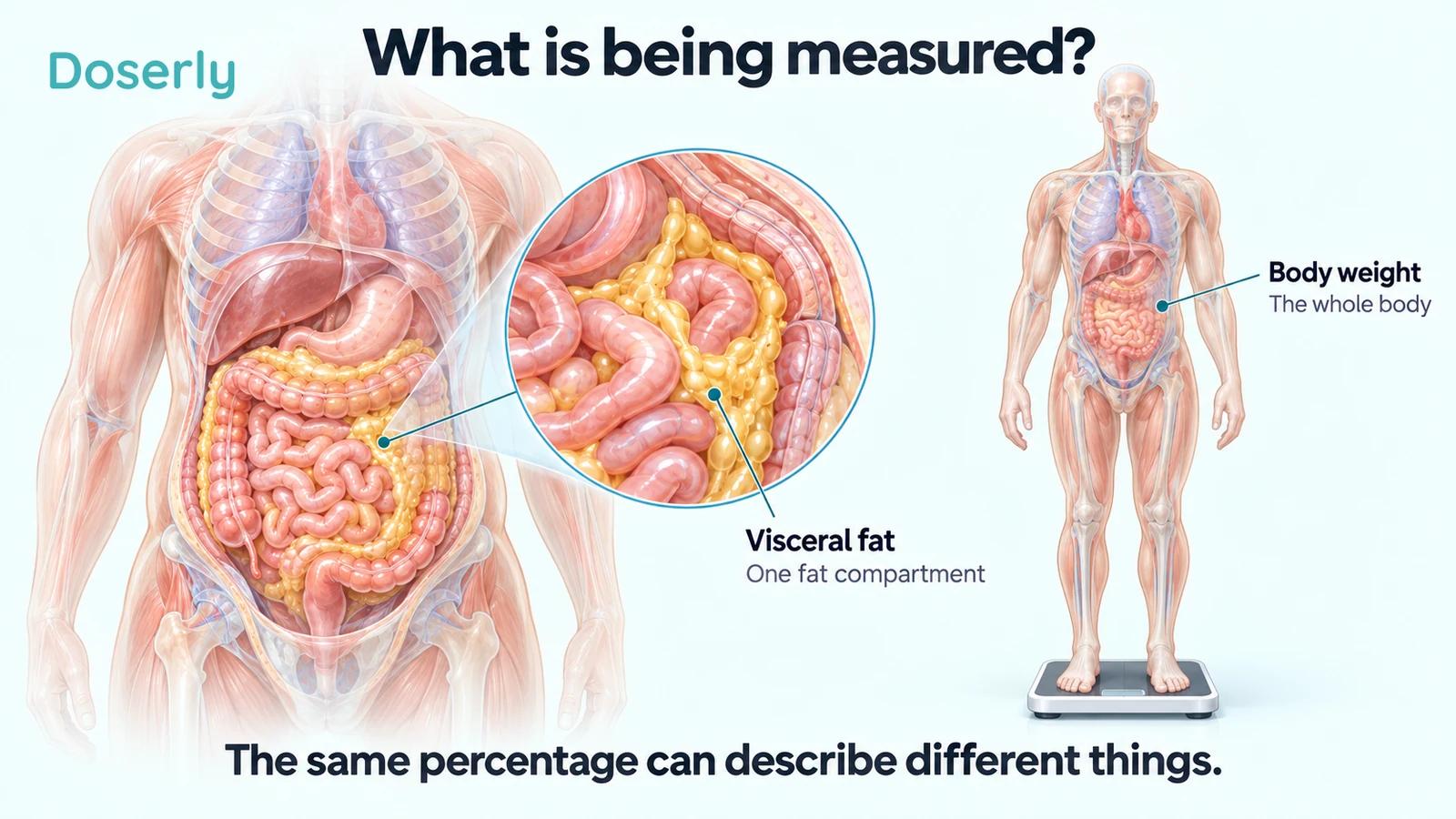
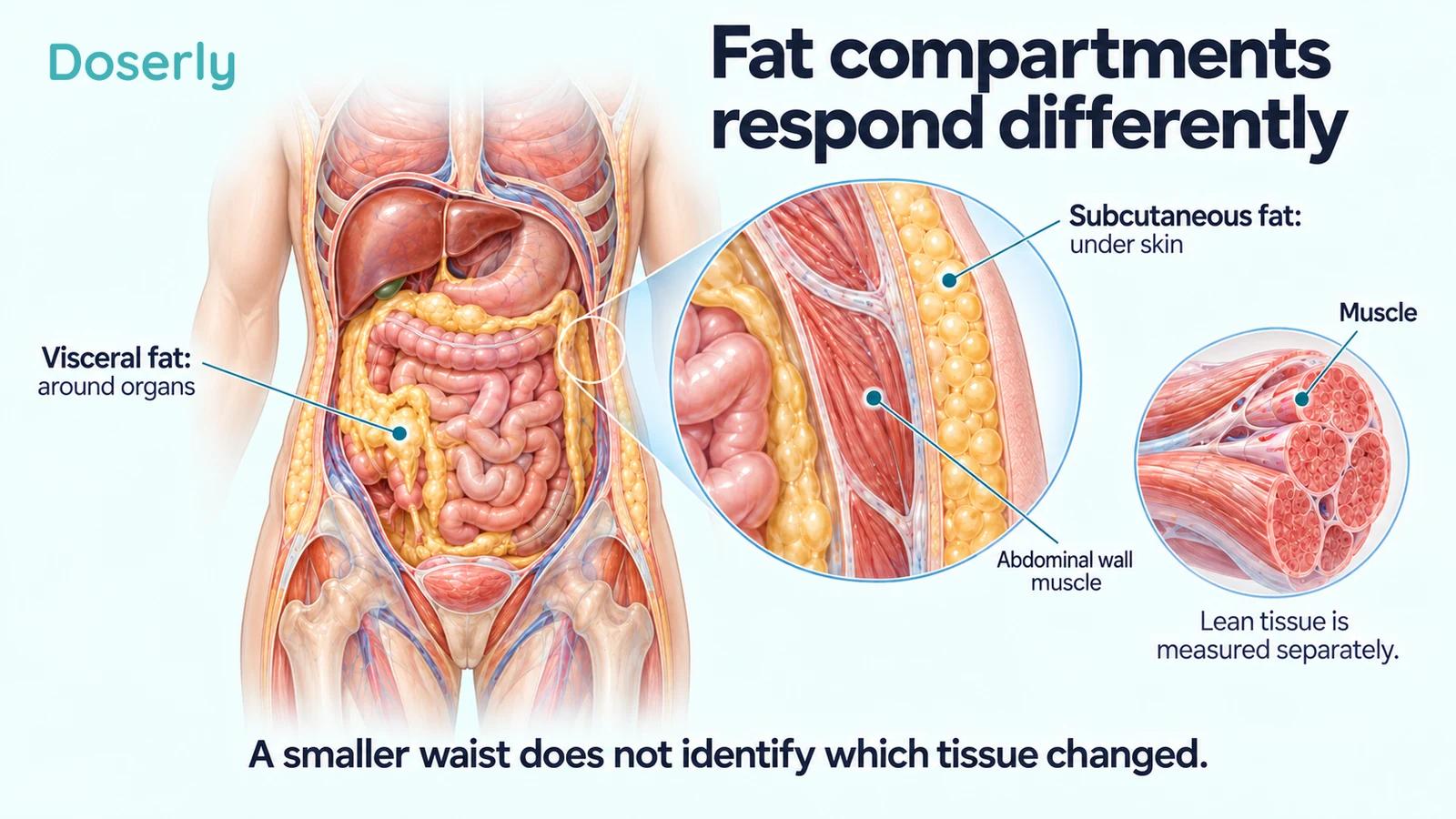
Visceral fat is the fat around internal organs inside the abdomen. Subcutaneous fat lies underneath the skin. Body weight includes both, together with muscle, other organs, bone, water and additional tissues. Imaging can quantify a particular compartment; a scale reports their combined mass.
Consider a purely hypothetical example. A 15% reduction in a visceral-fat measurement of 200 square centimeters would be a decrease of 30 square centimeters. A 15% reduction in a body weight of 100 kilograms would be a decrease of 15 kilograms. The percentages match, but the units and biological meaning do not. These are arithmetic examples, not expected treatment results.
There is another distinction within the percentage itself. An article may report the change from baseline in the treatment group, or the treatment effect relative to a control group. Those figures should not be placed side by side without identifying which calculation each uses.
What the main tesamorelin trials were designed to change
The pooled phase 3 publication included 806 adults with HIV, receiving antiretroviral therapy and experiencing excess abdominal fat. Participants received tesamorelin or placebo during a 26-week randomized phase, followed by an extension.
The main outcome was the percentage change in visceral adipose tissue measured by computed tomography. The reported placebo-relative treatment effect was −15.4%. Abdominal subcutaneous fat did not show a significant treatment effect. The program therefore provides evidence for a particular pattern of fat change, rather than the same overall weight-loss outcome commonly reported in obesity trials. Pooled tesamorelin trials
The population is part of the result. Adults with HIV-associated fat redistribution are not interchangeable with everyone who dislikes their waist size. The finding remains clinically relevant, but its meaning depends on why abdominal fat has accumulated and what outcome matters to the patient.
The current US EGRIFTA WR prescribing information describes treatment of excess abdominal fat in adults with HIV and lipodystrophy. It explicitly states that the product is not indicated for weight-loss management and that long-term cardiovascular safety has not been established. Current label
What the familiar semaglutide number describes
STEP 1 randomized 1,961 adults with overweight or obesity, without diabetes, to weekly semaglutide or placebo for 68 weeks. Both groups received lifestyle intervention. The study tested the 2.4 mg weekly regimen after escalation; that is the research exposure, not an instruction for selecting a dose.
Mean body-weight change was −14.9% with semaglutide and −2.4% with placebo. The estimated treatment difference was −12.4 percentage points. This model-based estimate should be quoted as reported; subtracting rounded headline values is not a substitute for the trial's analysis. STEP 1
Putting “15.4% tesamorelin” next to “14.9% semaglutide” therefore mixes at least three things: a visceral-fat result with a weight result, a placebo-relative effect with a treatment-arm change, and 26 weeks with 68 weeks. The near match between the numbers is coincidental.
Trial
Pooled tesamorelin phase 3
- Main population
- Adults with HIV and excess abdominal fat
- Measurement discussed here
- Visceral fat on CT
- Randomized comparison
- 26 weeks
Trial
STEP 1
- Main population
- Adults with overweight or obesity, without diabetes
- Measurement discussed here
- Body weight
- Randomized comparison
- 68 weeks
Trial
HIV semaglutide phase 2b
- Main population
- Adults with controlled HIV and lipohypertrophy, without diabetes
- Measurement discussed here
- Fat by body compartment
- Randomized comparison
- 32 weeks
The table helps identify the question each study answered. It is not a ranking, and it does not mean that the trials measured nothing else.
Semaglutide has also been studied in HIV-associated lipohypertrophy
A more relevant comparison comes from a 2024 trial in 108 adults with controlled HIV, a BMI of at least 25 and lipohypertrophy, without diabetes. Fifty-four participants were assigned to semaglutide and 54 to placebo. Treatment lasted 32 weeks, including eight weeks of escalation and 24 weeks at 1.0 mg weekly.
The investigators reported an adjusted visceral-fat effect of −30.6%, alongside reductions in abdominal subcutaneous fat and total body fat. The visceral-fat regression estimate was −30.82 square centimeters, with a 95% confidence interval from −50.13 to −11.51. Eight participants in each group withdrew early. HIV semaglutide trial
This is meaningful evidence that semaglutide can affect visceral fat in a population with HIV-associated lipohypertrophy. It also brings the research question closer to the tesamorelin program, because both measured an abdominal compartment.
It still does not establish that semaglutide is twice as effective as tesamorelin. The trial did not randomize participants between those two medicines. It used its own eligibility rules, baseline characteristics, duration, exposure and analysis. A comparison of two separate placebo-controlled studies cannot make those differences disappear.
Why a head-to-head comparison would be different
A direct comparative trial could recruit one defined population and randomly assign people to the treatments being compared. Researchers could use the same imaging methods, visit schedule, support and main outcome for both groups. That would address the practical question more directly than matching numbers from separate papers.
Even then, the result would need to specify the goal. A treatment might produce more total weight loss while another produces a different distribution of fat change. A patient seeking relief from abdominal enlargement may value that differently from someone prioritizing diabetes control or a reduction in cardiovascular events.
For someone with more than one concern, there may be no single “best percentage.” The decision has to include which benefit is most important, what the medicine is appropriate for, and how the person tolerates it. Research can inform that discussion without compressing every outcome into one score.
Why subcutaneous fat and lean tissue belong in the discussion
The HIV semaglutide trial reported changes in more than the visceral compartment, whereas the pooled tesamorelin report did not demonstrate a significant effect on abdominal subcutaneous fat. This difference in measured patterns is worth noticing. It is not a reason to assume that one drug produces an ideal body-composition result for everyone.
A waist circumference cannot identify the amount of each tissue that changed. Nor does a smaller waist demonstrate more muscle or better physical function. If preserving strength is an important treatment goal, strength and function need attention alongside weight and imaging.
HIV-associated lipodystrophy can involve both fat accumulation and loss of subcutaneous tissue in other areas. NIH guidance emphasizes the importance of the person's prior and current treatment history when considering fat distribution. That makes a blanket goal of losing as much fat as possible an incomplete description of care. NIH guidance
What about tesamorelin research outside HIV?
There is human research outside the approved HIV indication. A 12-month randomized study examined 60 adults with abdominal obesity and reduced growth-hormone secretion. Tesamorelin reduced visceral fat relative to placebo, with an estimated treatment effect of −35 square centimeters, and investigators reported changes in several cardiovascular risk markers. Selected obesity trial
That study is relevant to understanding biology, but its participants were selected for reduced growth-hormone secretion. It does not represent an unrestricted sample of adults with obesity. It also did not test tesamorelin against semaglutide or a combination of the two.
A change in carotid artery wall thickness, one measurement in that study, is different from observing fewer heart attacks. The distinction is not merely technical: a person considering treatment usually cares about health events and daily life, while a small mechanistic study may focus on an earlier biological measurement.
Fat loss and cardiovascular benefit are separate outcomes
SELECT directly examined cardiovascular events with semaglutide in 17,604 adults with established cardiovascular disease and overweight or obesity, but without diabetes. Its primary outcome combined cardiovascular death, nonfatal heart attack and nonfatal stroke.
An event occurred in 6.5% of semaglutide participants and 8.0% of placebo participants. The hazard ratio was 0.80, with a 95% confidence interval of 0.72–0.90, over mean follow-up of about 40 months. SELECT
This result is about event risk in a defined high-risk population. It is not a visceral-fat percentage and does not show that every person taking semaglutide gains the same protection. It also cannot be used as the missing cardiovascular outcome trial for tesamorelin.
If someone claims that reducing abdominal fat necessarily prevents cardiovascular events, ask which trial counted those events. Changes in tissue, laboratory markers and actual clinical outcomes can all be useful, but they answer different questions.
Can combining the treatments solve the comparison?
The studies discussed here do not establish the added benefit or safety of combining tesamorelin with semaglutide. Observing effects through different biological pathways is a reason researchers might study a combination, not evidence that the effects will add neatly together.
A useful combination study would need to compare the combination with appropriate individual-treatment groups. It would also need to examine tolerability and relevant metabolic measurements, not just photographs or a single waist measurement. Adding a medicine changes exposure and introduces another possible explanation for symptoms or laboratory changes.
The same limitation applies to claims that tesamorelin automatically prevents muscle loss during GLP-1 treatment. A favorable fat distribution result in another population is not a direct demonstration of that outcome. The question deserves a study with body composition, physical function and adequate safety follow-up.
Safety belongs beside efficacy, not after a ranking
Tesamorelin's label calls attention to glucose intolerance, elevated IGF-1, fluid retention and other risks. In the HIV semaglutide study, investigators observed one treatment-related severe lipase elevation and two possibly related gallstone cases. A nonsignificant overall difference in adverse events in a small trial does not eliminate those observations. Tesamorelin label, HIV trial
A larger fat-loss number is therefore not a complete benefit–risk assessment. The relevance of each risk depends on a person's medical history, concurrent treatment and the actual indication.
For people with HIV, NIH advises against interrupting antiretroviral therapy because of weight gain. Management should preserve effective HIV treatment while addressing weight and metabolic concerns. NIH guidance
Before comparing headline percentages, name the outcome you want to improve. Then ask which trial measured it in people like you, how long they were followed and what tradeoffs were observed. That approach makes the research useful without asking one percentage to answer every treatment question.
Sources
- Pooled tesamorelin phase 3 trials.
- EGRIFTA WR prescribing information.
- STEP 1.
- Semaglutide in HIV-associated lipohypertrophy.
- Tesamorelin in selected adults with obesity.
- SELECT cardiovascular outcomes.
- NIH HIV weight-gain guidance.