
Peptides
October 16, 2026
Can an IGF-1 increase validate a CJC-1295 recomposition claim?
On this page
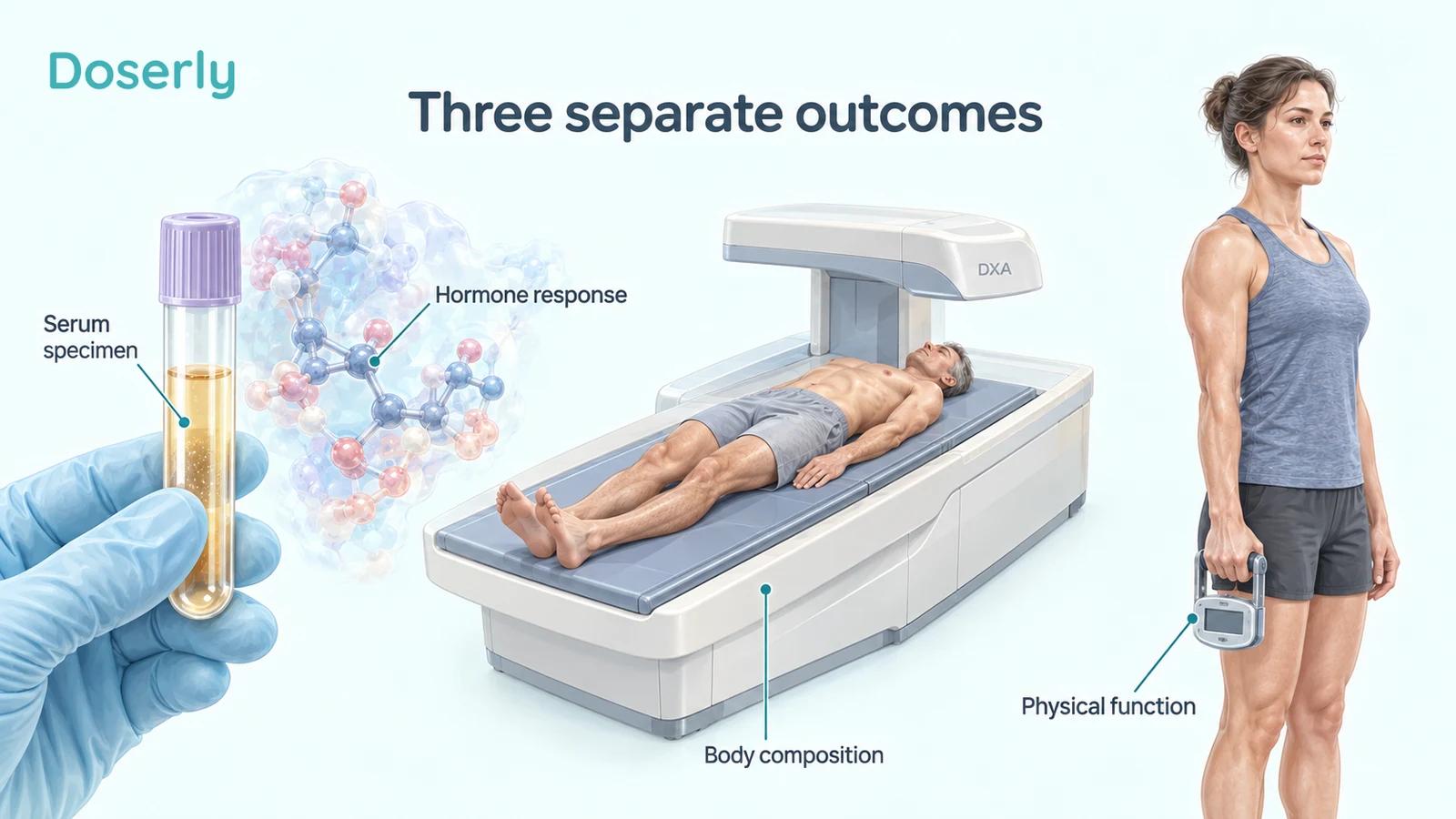
A higher IGF-1 result is evidence that the growth hormone system responded. It does not, by itself, show that someone gained muscle, lost body fat or became stronger. Those changes require their own measurements, and a drug can move a hormone marker without delivering the combination of outcomes implied by “recomposition.”
This is the central limitation of using CJC-1295's early human research to support physique claims. The published studies established prolonged hormonal activity. They did not establish a reliable program of fat loss and muscle gain in healthy adults.
Understanding the gap requires more than dismissing blood tests as irrelevant. IGF-1 is a useful biological measurement; it simply answers a different question. This article separates the hormone result, the tissue result and the practical outcome, then examines why evidence from tesamorelin or administered growth hormone cannot fill every missing step. Our CJC-1295 guide provides the broader compound overview.
What did CJC-1295 actually increase?
In two early randomized, placebo-controlled studies, the long-acting form of CJC-1295 increased growth hormone, or GH, and insulin-like growth factor 1, or IGF-1, in healthy adults. Following a single administration, the investigators reported mean GH increases of approximately twofold to tenfold for at least six days and IGF-1 increases of approximately 1.5-fold to threefold for nine to eleven days. The estimated drug half-life was 5.8–8.1 days. Teichman and colleagues, 2006.
Those are pharmacological results: a molecule designed to stimulate the GH system produced a sustained response. They are not percentages of muscle gained or fat lost. A threefold increase in a hormone does not imply three times the muscle growth, because the relationship between circulating signals and whole-body outcomes is not a simple conversion formula.
The study observation periods were 28 and 49 days, with single or limited repeated administrations. Neither duration should be presented as proof of successful long-term recomposition. The investigators' hormone measurements provide a reason to study downstream effects, rather than a substitute for measuring them.
Another human experiment examined overnight GH secretion before and one week after CJC-1295. Pulsatility remained detectable while mean and trough GH increased. That adds detail about the response pattern, but it still does not provide a body-composition outcome. Preserving a pulse pattern is not the same endpoint as gaining functional muscle. Ionescu and Frohman, 2006.
What does “recomposition” need to mean?
The word usually bundles two goals: reducing fat mass and increasing muscle. A useful assessment must specify both. Losing scale weight could reflect fat, lean tissue, fluid or a mixture. Maintaining weight could conceal meaningful tissue changes, or simply reflect no meaningful change at all.
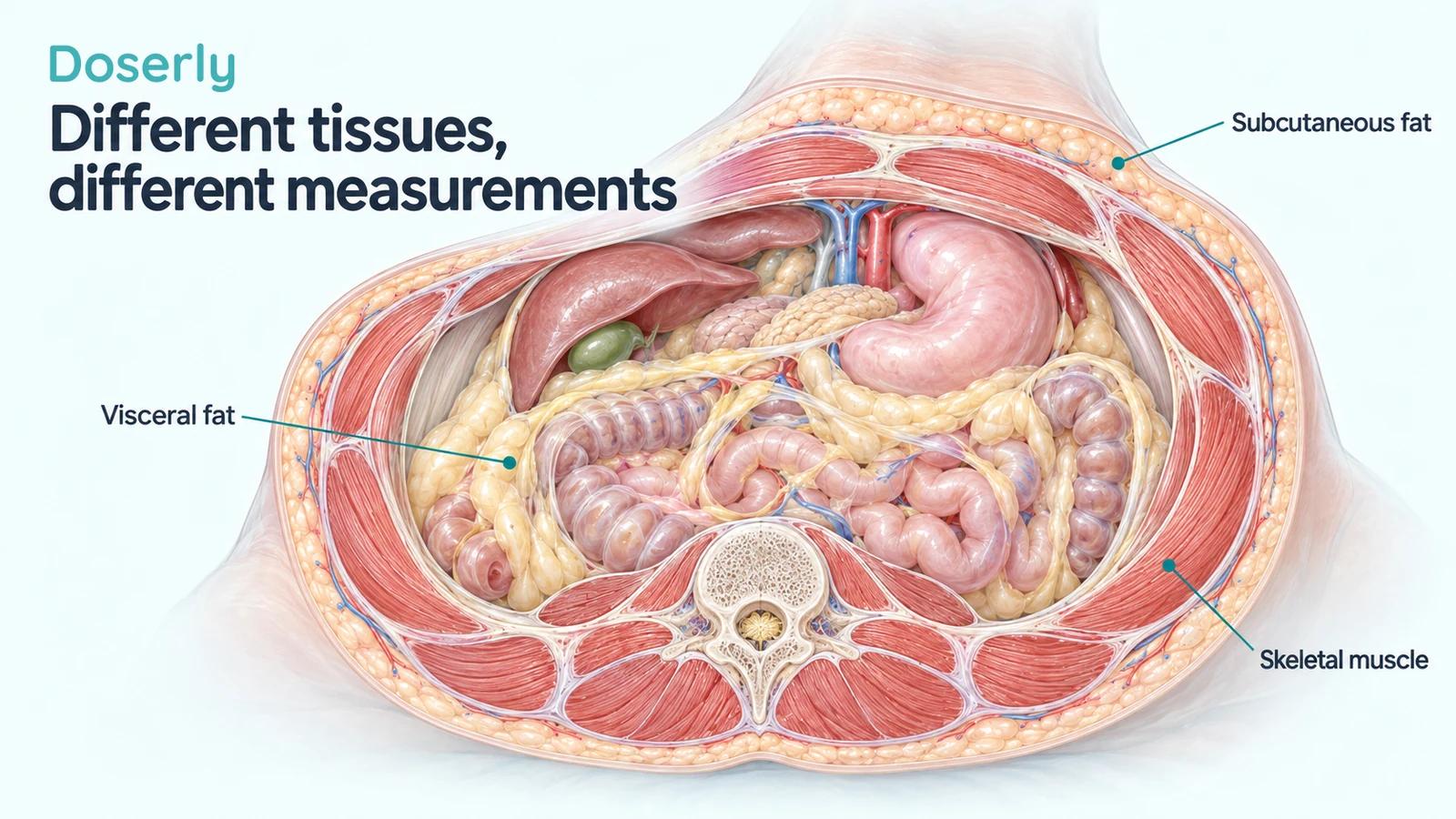
Even fat loss is not one interchangeable measurement. Subcutaneous fat lies beneath the skin, while visceral fat lies deeper around abdominal organs. A waist measurement, a photograph and an imaging estimate of visceral fat describe related but different things. Improvement in one does not automatically quantify the others.
Muscle claims also need precision. “Lean mass” is a broader measurement category than contractile skeletal muscle. A result reported as lean mass therefore needs interpretation alongside the measurement method, fluid changes and functional outcomes. Strength, power and endurance are distinct tests; one cannot stand in for all the others.
A convincing CJC-1295 recomposition study would define its target population, use a relevant comparison group, measure fat and muscle outcomes over a suitable period, and report adverse effects. If the claim includes better performance, the study should test that performance. The early hormone trials do not supply this package of evidence.
Why a blood test cannot serve as a body-composition scan
A circulating marker can help confirm biological exposure. It does not tell a reader where tissue changed, how much changed or whether the change improved function. The same limitation applies when a personal before-and-after laboratory result is genuine and the timing is clear.
Suppose someone reports higher IGF-1 and a lower waist measurement after several weeks. The two observations might coexist, but that alone does not show that the hormone change caused the waist change. Training, food intake, other products and measurement conditions can change at the same time. Without a suitable comparison, the contribution of CJC-1295 remains unresolved.
A laboratory value also cannot retrospectively establish the identity of a product sold under an ambiguous name. Published long-acting CJC-1295 research should not be transferred automatically to products labeled “no DAC.” FDA's assessment distinguishes DAC and non-DAC substances as different active moieties. A similar hormone response is not proof of identical pharmacology or clinical outcomes. FDA CJC-1295 review, 2024.
For an individual reviewing results with a clinician, the useful questions are concrete: what was measured, under what conditions, and what conclusion can that measurement support? A higher IGF-1 may belong in the exposure and safety discussion. It does not become a muscle measurement because muscle gain was the intended goal.
Lean mass can increase without equivalent muscle performance
A randomized trial of administered GH in recreational athletes illustrates why body-composition language matters. This was not a CJC-1295 trial, so its results cannot establish CJC-1295 efficacy. It does, however, show the danger of interpreting every lean-mass increase as new functional muscle.
The study included 96 recreational athletes and examined eight weeks of treatment, followed by a washout period. GH reduced fat mass and increased lean body mass, with the lean-mass increase attributed to extracellular water. Sprint capacity improved modestly, but the other measured performance outcomes did not show significant improvement. The sprint effect was no longer present after the six-week washout. Meinhardt and colleagues, 2010.
This result is more nuanced than either “GH builds muscle” or “GH does nothing.” Different outcomes moved differently. A body-composition category changed, one performance result improved temporarily, and other performance tests did not demonstrate benefit. The interpretation depends on the endpoint.
It also sets a limit on extrapolation. Directly administering GH and stimulating endogenous secretion with a GHRH analogue are different interventions. Differences in exposure, secretion pattern, population and duration prevent the athlete study from functioning as a missing CJC-1295 recomposition trial.
What a body-composition measurement can establish
A scan can bring the assessment closer to the tissue question, but measurement quality still matters. DXA is often used to estimate fat and lean soft tissue. It is more informative for those compartments than a hormone result, yet its outputs should be understood within the method's limitations.
The International Society for Clinical Densitometry emphasizes consistent preparation and positioning for body-composition measurements. Relevant preparation includes fasting status, clothing, time of day, physical activity and an empty bladder. These details matter when comparing measurements over time, especially when the apparent change is small. ISCD Official Adult Positions.
Consistency does not make a scan prove causation. It makes the measurement more interpretable. A well-standardized scan can document a change in an estimated compartment; it cannot independently determine which of several simultaneous interventions produced that change.
The same principle applies to strength testing. Repeating a test under comparable conditions helps distinguish a real performance change from differences in technique or procedure. But even a clear gain needs a comparison before it can be attributed confidently to one experimental compound. Good measurement and good causal evidence solve different parts of the problem.
Why tesamorelin is a useful comparison—and a limited one
Tesamorelin acts through the GHRH pathway and has an approved medical use involving abdominal fat. That makes it relevant to this discussion. It does not make its results interchangeable with CJC-1295 research.
In a randomized study, 412 adults with HIV and abdominal fat accumulation received tesamorelin or placebo for 26 weeks. The primary endpoint was the percentage change in visceral adipose tissue measured by computed tomography. Visceral fat decreased by 15.2% in the tesamorelin group and increased by 5.0% in the placebo group. IGF-1 also rose, but the fat-loss conclusion came from the imaging endpoint, not from assuming that the hormone increase guaranteed fat loss. Falutz and colleagues, 2007.
That is the important methodological contrast. The trial measured the tissue outcome it was designed to change. It also studied a specific population with a specific clinical problem, rather than healthy adults seeking general physique enhancement.
Current EGRIFTA WR prescribing information limits the indication to reducing excess abdominal fat in adults with HIV-associated lipodystrophy. It states that the medicine is not indicated for weight-loss management and describes a weight-neutral effect. Long-term cardiovascular safety has not been established. These qualifications belong alongside the benefit, rather than being erased by the phrase “fat-loss peptide.” EGRIFTA WR prescribing information.
The tesamorelin guide explains that clinical context in more detail. Its evidence demonstrates what a compound-specific body-composition program can look like. It does not grant another GHRH analogue the same indication, effect size or safety profile.
Did CJC-1295 reach a relevant clinical trial?
A registered phase 2 CJC-1295 study targeted HIV-associated visceral obesity, a population relevant to abdominal-fat research. The registry lists the study as terminated and does not provide posted results establishing a body-composition benefit. A planned twelve-week trial is therefore not equivalent to a positive twelve-week result. ClinicalTrials.gov, NCT00267527.
The existence of this study matters because it shows that investigators considered a clinical outcome beyond hormone stimulation. Its status also matters: a research question does not become answered simply because a trial was registered.
Nor should the terminated registry entry be converted into proof that CJC-1295 cannot affect body composition. The appropriate conclusion is narrower. The accessible evidence does not establish the claimed benefit, and the early hormone studies cannot supply the missing outcome data. Uncertainty about benefit remains uncertainty; it is not a reason to invent either success or failure.
How to read a recomposition claim without losing the useful detail
Start with the named outcome. If the supporting result is IGF-1, the claim is supported as a hormonal response. If it is lean mass, look for the method and whether fluid changes were considered. If it is muscle function, identify the actual test and whether the result lasted.
Next, match the intervention. CJC-1295, tesamorelin and administered GH belong in a related scientific conversation, but they are not the same study treatment. A result should retain its compound, population, comparison and duration when it is summarized.
Finally, keep benefit and tolerability together. A higher marker is not automatically a better result, and the absence of an obvious problem during a short observation does not establish safety during prolonged use. FDA identifies limited CJC-1295 safety information and concerns including immunogenicity, peptide impurities, increased heart rate and systemic vasodilatory reactions. Those concerns do not quantify every person's risk, but they rule out treating a laboratory increase as a complete benefit-risk assessment. FDA compounding safety information.
An accurate conclusion preserves what the research achieved: long-acting CJC-1295 can stimulate the GH–IGF-1 system. Whether it produces useful, durable recomposition in a defined population requires direct evidence about fat, muscle, function and safety. The blood test is one part of that investigation, not its final answer.
Explore the research
- CJC-1295 human hormone-response studies
- GH pulsatility after CJC-1295
- Growth hormone and performance in recreational athletes
- Tesamorelin trial in HIV-associated abdominal fat accumulation
- EGRIFTA WR prescribing information
- ISCD adult body-composition positions
- CJC-1295 visceral-obesity trial registry
- FDA CJC-1295 scientific assessment
- FDA peptide safety information