
Peptides
October 16, 2026
Can amylin research tell us who will respond best?
On this page
Amylin-based research can show that a treatment helps a study population and can reveal biological pathways worth investigating. It does not yet give the reader of these studies a validated shortcut for identifying, in advance, who will respond best to cagrilintide.
That is a narrower statement than saying personalized treatment is impossible. Trials, molecular studies and prediction models can all contribute to better selection over time. The difficulty is turning an interesting association into a reliable decision tool for a new patient.
A convincing claim needs to answer three questions: best response to which intervention, measured by which outcome, and compared with which alternative? Without those details, “amylin responder” can sound more precise than the evidence supports.
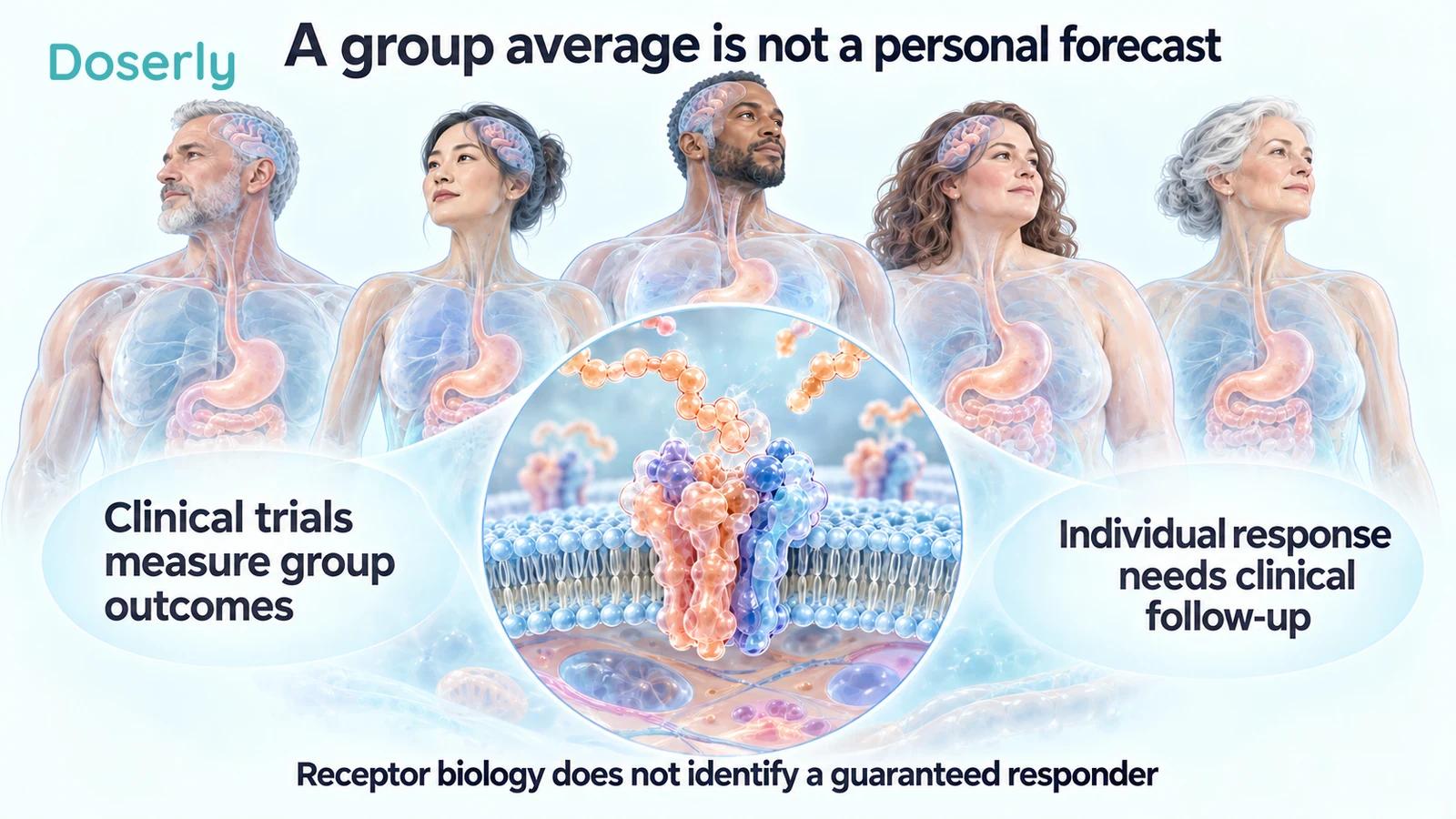
“Respond best” needs an outcome before it needs a biomarker
A person may care most about weight reduction, glucose control, daily function, relief from persistent food thoughts or a treatment they can tolerate consistently. These goals overlap, but they are not the same endpoint.
Even weight response can mean several things: percentage change at a fixed time, reaching a threshold, maintaining a reduction, or improving a related health problem. A prediction model built for one outcome does not automatically predict the others.
REDEFINE 1, for example, measured outcomes in adults with overweight or obesity without diabetes who were randomized to CagriSema, its individual components or placebo. Its mean weight estimates describe those interventions and that population. They do not establish a universal ranking of what matters most to each participant. REDEFINE 1 primary report
This matters before any molecular testing is considered. A test that accurately predicts a larger weight change might still be unhelpful if it overlooks a person’s tolerability, nutritional needs or priorities. Better treatment selection requires a useful decision, not merely an impressive prediction statistic.
An average is not an individual treatment effect
Randomization helps estimate how outcomes differ between groups assigned to different treatments. It does not allow researchers to observe the same person simultaneously receiving both treatments under otherwise identical conditions.
That missing comparison is the central challenge of personalized treatment-effect prediction. We can observe what happened to one person under one course of care. We cannot directly observe the alternative history in which that same person received a different intervention at the same time.
A study can still estimate which characteristics are associated with different treatment effects. But that requires appropriate comparisons and enough data, rather than taking the overall average and adjusting it informally for someone’s age or body size.
The analysis question matters too. An estimate assuming continued treatment differs from one incorporating discontinuation and other treatment changes. A personal forecast that silently uses the most favorable adherence assumption can overstate what the evidence says about a practical treatment strategy. ICH estimand guidance
For readers, a useful habit is to ask whether a number describes an observed outcome, an estimated average treatment effect or a prediction for a new person. Those are different claims.
A predictor of outcome is not necessarily a predictor of treatment choice
Suppose, hypothetically, that a baseline characteristic is associated with larger weight reduction in a treated group. That association alone does not show that people with the characteristic benefit more from that treatment than from an alternative.
The characteristic might be associated with better outcomes under several treatments, or even under the comparator. What matters for choosing between interventions is whether the treatment’s relative effect differs in a reproducible way.
The FDA-NIH BEST resource distinguishes prognostic information from predictive biomarkers. A prognostic marker provides information about the likely course of a condition. A predictive marker helps identify people more likely to experience a particular effect from an intervention. FDA-NIH biomarker definitions
For cagrilintide selection, a strong claim would therefore need more than “people with this feature lost more weight.” It would need evidence that the feature helps distinguish benefit or harm from a relevant treatment choice. The comparison could be cagrilintide versus placebo, CagriSema versus a component, or another clinically meaningful alternative—but the choice must be specified.
Receptor biology creates hypotheses, not a consumer test
Laboratory studies show how cagrilintide interacts with calcitonin-family receptors, including amylin receptors formed from a calcitonin receptor and receptor activity-modifying proteins. This helps explain why researchers investigate the pathway. It does not establish that a readily available blood test measures the relevant receptor response in a patient. Primary receptor pharmacology study
A 2026 cross-species brainstem atlas went further in identifying cell populations related to cagrilintide’s effects on energy balance. Causal experiments in rats examined the role of particular signaling populations. That is valuable mechanism research, but the causal animal experiment is not a human treatment-selection trial. Primary cross-species atlas
The translation requires several additional steps. A candidate measurement must be obtainable reliably in people, reflect something relevant to response, and improve prediction in new patients. It must also add information beyond what clinicians already know from the history, examination and routine assessments.
A gene or receptor name in a paper is not enough. Nor can a person infer an amylin-pathway defect from hunger, food preferences or a previous treatment’s disappointing result. Those experiences may motivate research questions, but they do not validate a molecular diagnosis.
Subgroup findings deserve attention without becoming destiny
Researchers often examine results by baseline characteristics such as age, sex, body size or metabolic status. These analyses can identify patterns worth following. They can also be unstable when the groups are small or many comparisons are made.
The relevant statistical question is whether the treatment effect differs between subgroups. A result being statistically significant in one subgroup and not in another does not, by itself, establish that the subgroups respond differently. The difference between the effects must be assessed directly.
Prespecification helps: an analysis planned before the results are known has a different evidential position from a pattern noticed afterward. Replication matters too. A promising subgroup result should be checked in additional data, especially before it is used to exclude someone from an otherwise appropriate option.
FDA guidance on enrichment strategies describes approaches for studying groups more likely to benefit and the design issues that follow. It does not turn every exploratory subgroup into a selection rule. FDA enrichment guidance
For an individual reader, subgroup evidence may help frame uncertainty. It should not be presented as a biological verdict based on demographic identity.
Synthetic prediction models are not prospective patient validation
A 2025 modeling paper used synthetic individual-level data reconstructed from published amylin-pathway trials and applied a target-trial emulation framework. It reported validation exercises including leaving individual trials out of model development. Original computational study
This type of work can help explore development questions and compare assumptions. But reconstructed data are not the original observed records of each participant. Matching published study summaries does not establish that the reconstructed relationships between individual characteristics and outcomes are uniquely correct.
Likewise, predicting a held-out trial’s aggregate result is different from predicting which treatment is best for a new patient. Those are different validation targets. A model can be useful for planning a study without being ready to guide a clinical decision.
When a headline uses the phrase “predictive modeling,” ask what was predicted and what data tested the prediction. A synthetic simulation, an internal cross-validation exercise and a prospective evaluation in new patients provide different kinds of evidence.
The conclusion here is not that modeling should be ignored. It is that the model’s intended use and validation should travel with any claim made from it.

A symptom questionnaire cannot choose a drug by itself
Food-related experience is another tempting basis for personalization. Someone who describes persistent food thoughts may wonder whether that identifies a particularly strong candidate for an amylin-based medicine.
The Food Noise Questionnaire has published evidence supporting its measurement properties. That means it can help study a reported experience. Its validation study does not establish a score that selects cagrilintide over semaglutide, tirzepatide or another intervention. FNQ development and validation
This is the distinction between measuring a problem and predicting a treatment effect. A measure can be useful for describing baseline burden and change over time without functioning as a companion diagnostic.
The same caution applies to appetite ratings and laboratory meal tests. A strong association with later weight change might be scientifically interesting. Before it becomes a selection tool, researchers need to show that it predicts a relevant difference between choices and remains useful outside the original study.
Early response is information, but it arrives after treatment begins
A person’s early experience can inform ongoing clinical care. It may reveal tolerability, practical barriers or an emerging outcome pattern. That is different from a validated pretreatment test telling someone which intervention to choose.
Early-response analyses can also mix several influences. Treatment exposure, adherence, symptoms, baseline differences and measurement timing may all relate to later outcomes. People who discontinue early may be missing from an analysis restricted to those who remain.
A decision rule based on early response would therefore need its own evaluation. What threshold is used? At what time? What happens to people just above or below it? Does acting on the rule improve outcomes compared with usual care? These are not answered merely by observing that early and later weight changes are correlated.
This article does not provide a stopping threshold or a dose-adjustment rule. Those decisions depend on the specific medicine, approved guidance where applicable, and the person’s clinical circumstances.
What would make a personalized amylin test convincing?
First, the measurement must be dependable. If the same sample or patient produces materially different results under routine conditions, a sophisticated prediction model cannot repair the underlying problem.
Second, the prediction needs evaluation in genuinely new people. The development dataset can make a model look better than it performs elsewhere, particularly when many candidate features were examined. Validation should consider the intended population and setting rather than assuming performance transfers automatically.
Third, the result must be calibrated: predicted probabilities or expected outcomes should correspond reasonably to what actually occurs. A tool that ranks people correctly but gives overly confident promises can still mislead a treatment decision.
Finally, using the test should help. Does it improve a meaningful outcome, reduce avoidable harm or make a decision more useful compared with the existing approach? A test can be statistically interesting while adding little practical value. This is the standard implied by the clinical purpose of predictive enrichment, not an accusation that every exploratory study must already meet it.
What can guide a useful conversation now?
Start with the goal and the evidence’s fit. Which outcome matters most? Does the person resemble the population studied? What other health conditions, treatments and practical constraints affect the choice? What follow-up would show whether the plan is helping?
A dated record of symptoms, relevant measurements and clinician-directed treatment changes can support this discussion. It does not identify a receptor profile or reveal the unobserved outcome under a different treatment. Its value is in making the real experience easier to assess.
Our cagrilintide guide and semaglutide guide explain the broader evidence behind the combination and its components. The current research supports asking better questions about individual response. It does not justify a guaranteed-responder label, a consumer amylin test inferred from mechanism alone, or a personalized promise borrowed from a trial average.
Sources
- Coadministered Cagrilintide and Semaglutide in Adults with Overweight or Obesity, 2025.
- A cross-species atlas of the dorsal vagal complex reveals neural mediators of the effects of cagrilintide on energy balance, 2026.
- AM833 Is a Novel Agonist of Calcitonin Family G Protein-Coupled Receptors: Pharmacological Comparison with Six Selective and Nonselective Agonists, 2021.
- Development and validation of the Food Noise Questionnaire, 2025.
- Understanding Prognostic versus Predictive Biomarkers: FDA-NIH BEST Resource, 2016.
- Enrichment Strategies for Clinical Trials to Support Determination of Effectiveness of Human Drugs and Biological Products, 2019.
- E9(R1) Statistical Principles for Clinical Trials: Addendum: Estimands and Sensitivity Analysis in Clinical Trials, 2021.
- Synthetic target trial emulation and predictive modeling of amylin-pathway therapies for obesity and type 2 diabetes, 2025.