
Peptides
October 16, 2026
CagriSema and REDEFINE 1: why one trial has two weight-loss numbers
On this page
CagriSema combines cagrilintide, a long-acting medicine based on the fullness hormone amylin, with semaglutide, a GLP-1 receptor agonist. Researchers are studying whether acting through these different appetite-related systems produces greater benefits than either medicine alone.
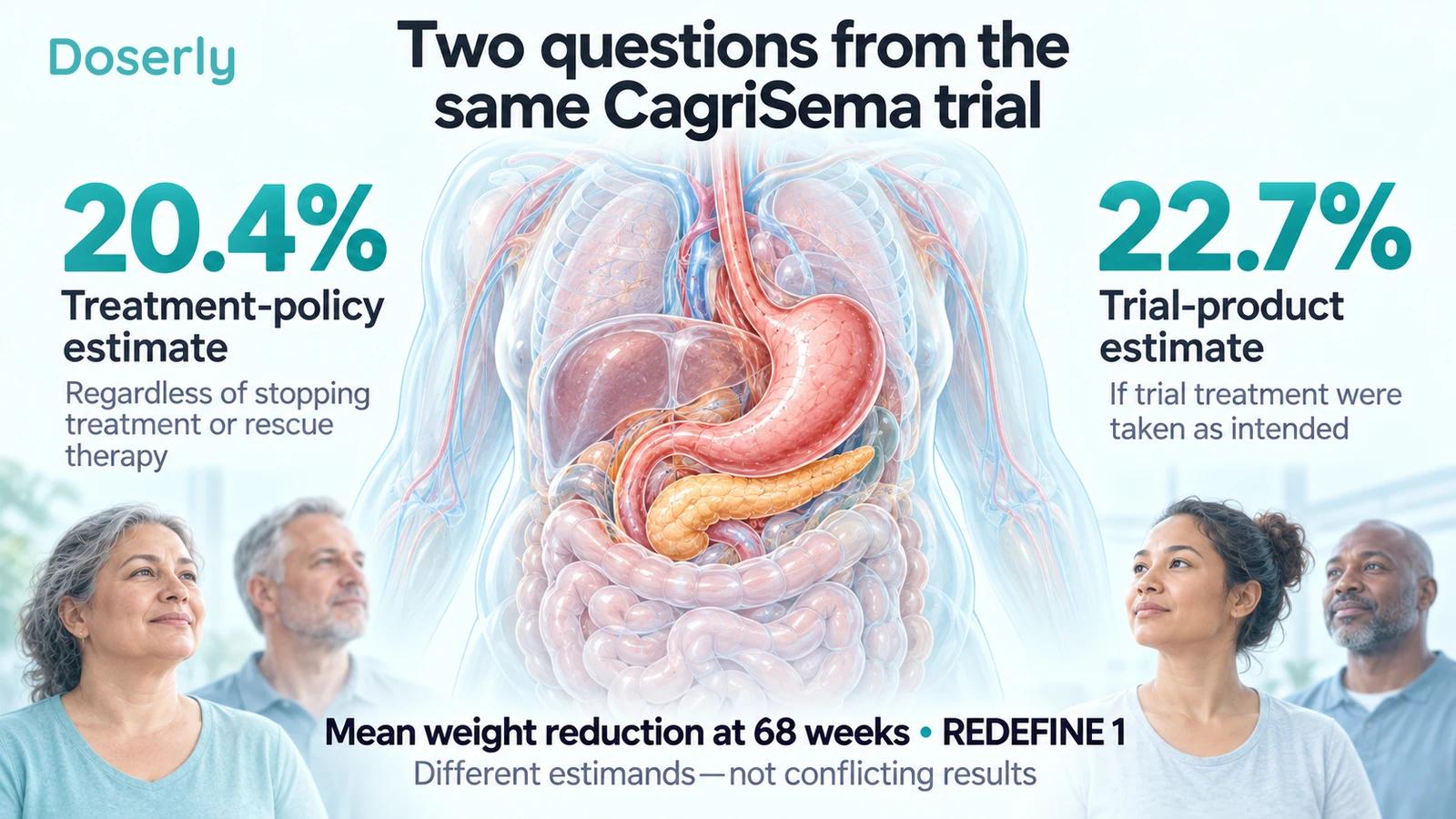
If you've read about its REDEFINE 1 trial, you may have encountered both 20.4% and 22.7% average weight reduction. Both appear in the published report. They are not conflicting measurements, and the larger number is not simply a corrected version of the smaller one. They answer different questions about the same treatment assignment. REDEFINE 1 primary report.
Understanding the difference helps you judge what a treatment might offer under trial conditions, how tolerability fits into the result and why comparing headline percentages across medicines can be misleading. You don't need advanced statistics; you need to know what happened to participants after randomization and which of those events the analysis includes.
First, what was REDEFINE 1?
REDEFINE 1 was a 68-week randomized trial in adults with obesity, or overweight plus an obesity-related complication, without diabetes. The 3,417 participants were assigned to CagriSema, semaglutide alone, cagrilintide alone or placebo. All groups received lifestyle intervention. The combination group was substantially larger than either single-medicine group.
The main weight outcomes compared the combination with placebo. Researchers also assessed its advantage over each component. That design is useful because it distinguishes “the combination works” from “the combination adds something to one ingredient.” It does not test every possible combination with cagrilintide. Trial design and results.
CagriSema's target was 2.4 mg of each component once weekly, reached through gradual escalation. Investigators could delay increases or reduce doses for specified clinical reasons. Those are features of the study intervention, not instructions for independently combining research products.
For background on the individual compounds, our cagrilintide guide and semaglutide guide explain their mechanisms and evidence.
What does the 20.4% result mean?
The treatment-policy estimand asks about the effect of assignment to the trial treatment regardless of whether someone subsequently stopped it or received rescue treatment. An estimand is the exact treatment effect researchers aim to estimate. Here, the question includes relevant events that occur after treatment begins.
Under that approach, estimated mean weight reduction was 20.4% with CagriSema and 3.0% with placebo at week 68. The published estimated treatment difference was 17.3 percentage points in favor of CagriSema. The difference comes from the statistical analysis using unrounded values; subtracting rounded headline numbers can produce a slightly different answer. REDEFINE 1.
A treatment-policy question is valuable because stopping a medicine is part of the experience of offering that treatment. People may stop because of symptoms, circumstances or other reasons. A useful treatment assessment needs to account for more than outcomes among those who can continue comfortably.
However, “regardless of stopping” does not mean every possible real-world condition was studied. Participants still received clinical-trial support, eligibility rules still applied, and missing outcomes still required statistical handling. Calling this a guaranteed “real-world result” would go beyond the design.
What does the 22.7% result mean?
The trial-product estimand asks what the effect would be if participants took the trial product as intended. In this trial, that included permitted dose levels rather than requiring everybody to remain on the maximum target dose. Under this question, estimated mean reductions were 22.7% with CagriSema and 2.3% with placebo. REDEFINE 1 statistical methods and results.
It is tempting to translate that into “people who stuck with it lost 22.7%.” That is too simple. The result estimates a defined hypothetical treatment effect using the trial's analysis methods. It is not merely the arithmetic average of a specially selected group of perfectly adherent people.
There is also no promise that persistence causes a particular personal outcome. Someone could take treatment consistently and lose much less than the mean, or experience adverse effects that require reassessment. The estimand defines a group-level question; it does not decide whether continuing treatment is right for one individual.
Why stopping treatment and missing data are different
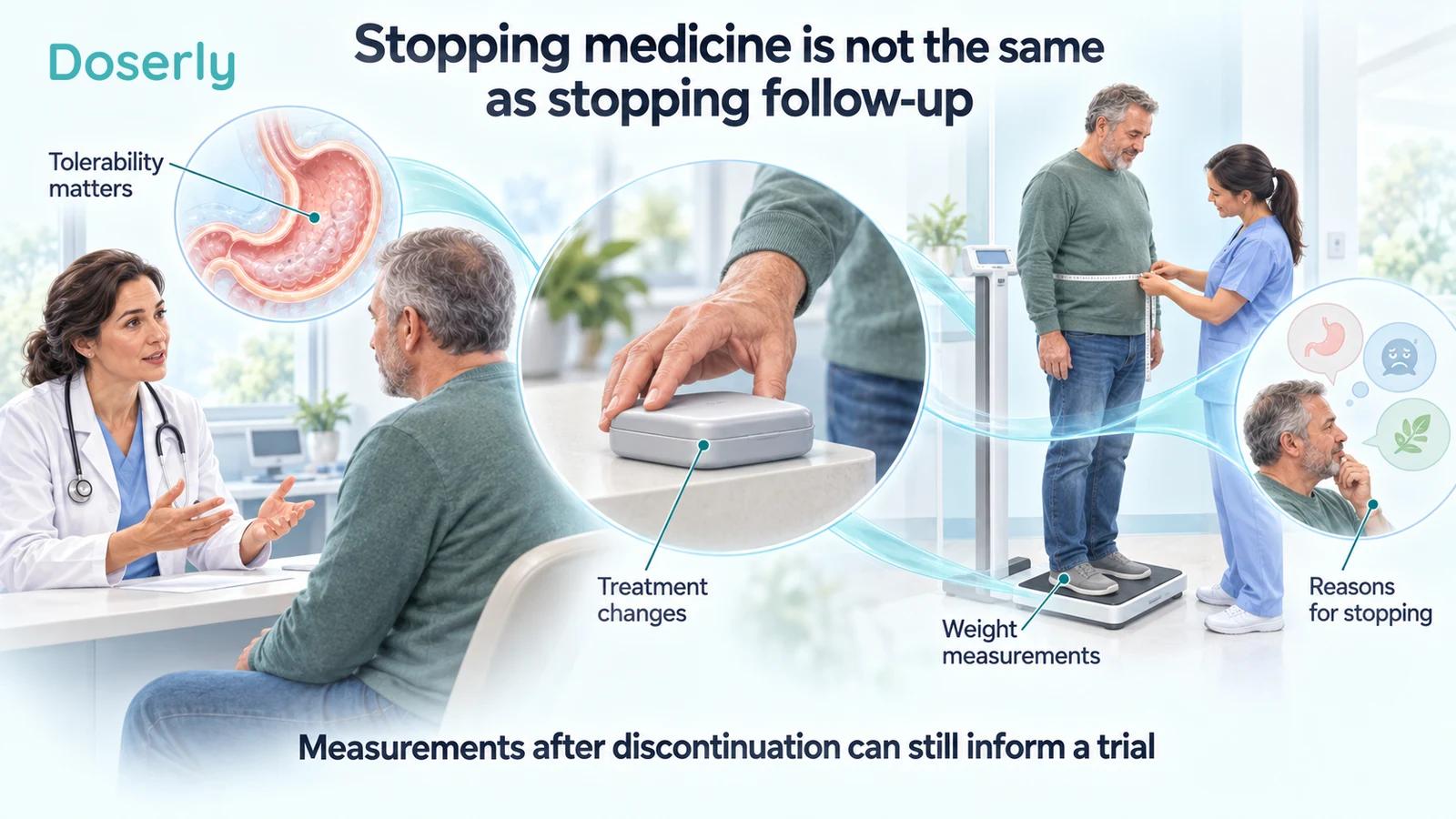
Suppose a hypothetical participant stops the study medicine at month six because of persistent nausea but returns for the final weight measurement. Their later weight is observed even though treatment stopped. Another participant may continue medicine but miss the final visit. That person's final outcome is missing even though treatment may have continued.
These situations need different handling. The first concerns an event after randomization that changes the treatment experience. The second concerns unavailable information. Confusing them can make a statistical result sound more complete than the data actually are.
The international estimand framework asks researchers to define these events before choosing how to analyze them. It distinguishes the clinical question from the statistical technique used to estimate the answer. Sensitivity analyses then examine whether conclusions are robust to important assumptions, especially those that cannot be fully checked from observed data. ICH E9(R1).
For a reader, the practical question is not “Did the researchers use statistics?” Every useful trial does. It is “Which question does this estimate answer, and what assumptions help bridge information the trial could not directly observe?”
Does the gap measure the cost of side effects?
No. The difference between 22.7% and 20.4% is not a direct estimate of weight loss prevented by nausea, nor the exact benefit of never missing an injection. Different estimands can differ because they handle several post-randomization events and missing observations differently.
To isolate the effect of a particular symptom, researchers would need an analysis designed for that question, with careful attention to factors associated with both symptoms and outcomes. Simply subtracting two headline estimates does not create that analysis.
Still, tolerability belongs in the treatment discussion. REDEFINE 1 reported gastrointestinal adverse events in 79.6% of the combination group and 39.9% of placebo participants; most were mild to moderate and transient. An adverse event being common does not tell us that every participant experienced it continuously or severely. Safety results.
An earlier cagrilintide-alone trial also reported gastrointestinal symptoms across its dose groups. That independent study helps establish that tolerability is relevant to the amylin component itself, while its shorter duration and different intervention prevent direct transfer of its rates to CagriSema. Cagrilintide phase 2 trial.
Why the maximum dose is not the whole story
Only 57.4% of participants assigned to CagriSema were receiving the maximum dose at week 68. This does not mean the trial-product analysis included only those participants. The published definition included permitted doses, and clinical dose adjustments were part of the trial. REDEFINE 1.
That detail changes how we should understand “taken as intended.” The intended treatment was a clinically managed strategy with some flexibility. It was not an instruction to endure every symptom to reach a fixed number.
The 57.4% figure also cannot tell us what would have happened if everyone had received the maximum dose. People remaining on lower doses may differ from those reaching the target. Comparing them after treatment begins is not equivalent to randomizing them to two fixed-dose strategies at baseline.
A treatment's eventual clinical value depends on the benefit achievable with tolerable exposure. The trial's flexibility is therefore part of the result, rather than an inconvenient detail to remove from a headline.
Why neither result belongs to cagrilintide alone
CagriSema contains two active components. Its 20.4% and 22.7% figures describe the combination, not cagrilintide by itself. REDEFINE 1's single-component arms help answer the separate question of what each medicine achieved.
Earlier research also tested cagrilintide alone. In a 706-participant, 26-week dose-finding trial, estimated mean reductions ranged from 6.0% to 10.8% across cagrilintide doses, compared with 3.0% for placebo under the trial-product estimand. These results established activity without semaglutide, but they are not another way of reporting the combination's outcome. Standalone trial.
This distinction becomes especially important when online discussions use “cagri” as shorthand for several different interventions. Ask whether the reported number describes cagrilintide alone, CagriSema, or an untested pairing. Similar names cannot make different treatments scientifically interchangeable.
Can these figures be compared with tirzepatide?
A fair comparison needs more than matching the largest percentage in each press release. Trials can differ in who enrolled, how long treatment lasted, whether diabetes was present, dose adjustment rules and how discontinuation was handled. Their published analyses may answer different questions even when both use the word “efficacy.”
Randomization creates comparable groups within a trial; it does not automatically make people in separate trials comparable. The statistical principles behind randomized studies are intended to control such differences in the comparison actually performed. ICH E9.
A direct head-to-head trial can address a medicine-versus-medicine question more convincingly, provided its population and analysis match what you want to know. Even then, comparing CagriSema with tirzepatide would not test adding cagrilintide to tirzepatide. Those are distinct treatment questions.
What if you have type 2 diabetes?
REDEFINE 1 excluded diabetes. REDEFINE 2 directly studied adults with overweight or obesity and type 2 diabetes: 1,206 participants were randomized to CagriSema or placebo for 68 weeks. Under its treatment-policy approach, estimated mean weight reductions were 13.7% and 3.4%, respectively. REDEFINE 2.
That trial supplies relevant evidence for a different population. It does not prove that diabetes alone explains every difference from REDEFINE 1; these were separate studies, not a randomized comparison of having versus not having diabetes. It does show why a treatment's headline should carry its population alongside its percentage.
For someone with diabetes, blood-glucose control, background medicines and hypoglycemia considerations also belong in the decision. Weight is an important outcome, but it is not the only reason a treatment strategy might be suitable or unsuitable.
What should you take from the two numbers?
Both analyses support substantial average weight reduction from the studied combination compared with placebo. The treatment-policy estimate includes the consequences of assignment despite later treatment changes. The trial-product estimate addresses treatment taken as intended under the protocol. Neither is an individual forecast.
A useful clinical conversation can start with three questions: Which study population resembles me? Which estimate matches the treatment strategy we are discussing? How would benefit, symptoms and treatment changes be assessed together?
As of the FDA page checked on October 15, 2026, cagrilintide is not a component of an FDA-approved drug and cannot be used in compounding under US federal law. Successful trials do not themselves create approval or establish the quality of independently sold products. FDA's current statement.
The two percentages are useful once their questions are visible. Reading them together provides a fuller view of the trial than choosing whichever number sounds more impressive.
Sources
- REDEFINE 1, 2025: both estimands, dose flexibility and safety.
- ICH E9(R1): defining treatment effects and sensitivity analyses.
- ICH E9: randomized comparisons.
- Cagrilintide dose-finding trial, 2021: standalone effects and tolerability.
- REDEFINE 2, 2025: the combination in type 2 diabetes.
- FDA, unapproved GLP-1 drugs: current US regulatory context.