
Peptides
October 16, 2026
Cagrilintide and food noise: meaningful experience, difficult measurement
On this page
For some people, the most striking change during weight-management treatment is not the number on a scale. It is having fewer repetitive thoughts about food, less negotiation over the next snack, or more attention available for the rest of life. “Food noise” gives that experience a useful everyday name.
Taking the experience seriously does not require pretending that every study measures it in the same way. Hunger, cravings, fullness, food-cue responses and intrusive food thoughts overlap, but they are not identical. A treatment can improve one without necessarily improving all of them.
Cagrilintide research is relevant to this discussion, especially through its combination with semaglutide, CagriSema. The evidence now includes newer conference findings about eating behavior and brain responses. The challenge is to describe what was actually measured, distinguish the combination from cagrilintide alone, and avoid turning a promising group result into a promise to silence everyone’s thoughts.
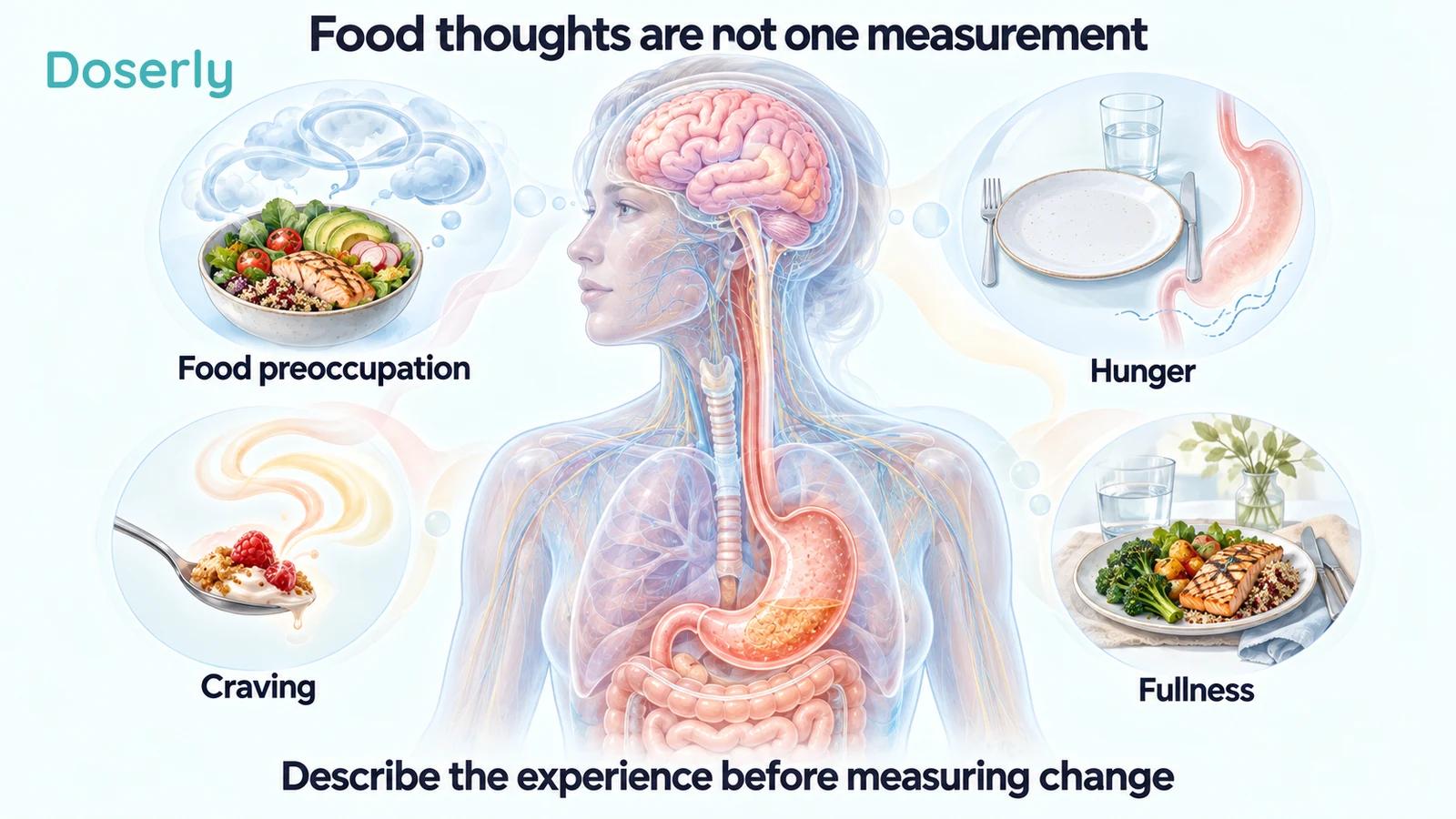
Start with the experience, not a guessed mechanism
Two people can use “food noise” to mean different things. One may describe thinking about food throughout a workday despite having eaten. Another may mean a strong desire for one particular food. A third may mean frequent physical hunger between meals. Those descriptions may lead to different questions even before any treatment is discussed.
Useful detail includes frequency, intrusiveness and effect on daily life. Is the thought easy to set aside, or does it repeatedly interrupt concentration? Is it mainly triggered by seeing food, or present across settings? Does it feel distressing? Does a change make eating more flexible, or simply make food unpleasant?
These are examples of clarifying the experience, not a diagnostic checklist. Food thoughts alone do not establish an amylin deficiency, a particular brain abnormality or the need for a specific medicine. The research question begins with a clearly described outcome, rather than a molecular explanation chosen after the fact.
That approach also respects an important distinction: a symptom can matter before a perfect instrument exists. Measurement is how researchers compare experiences fairly; it is not a test of whether a person is entitled to describe them. The FNQ study gives a formal example of investigating that experience.
Researchers now have tools beyond a casual phrase
The Food Noise Questionnaire, or FNQ, was developed and validated in a study published in 2025. Its five items were evaluated using data from 396 participants, including tests of consistency, repeatability and relationships with other measures. The authors found favorable psychometric properties while stating that further work was needed to establish clinical utility. FNQ validation study
That is a meaningful step forward. It makes an absolute statement that food noise has “no validated measure” outdated. It does not mean the questionnaire has automatically been validated for every population, language, treatment decision or clinical claim.
Reliability asks whether a measure behaves consistently under relevant conditions. Validity asks whether the evidence supports the interpretation being made from its scores. A questionnaire can perform well as a research measure without providing a cutoff that tells someone which drug to use.
A further question is whether a change is meaningful to the person. A statistically detectable average change is not automatically an improvement large enough to matter in daily life. Researchers also need to consider the recall period: a question about today and a question about the past month may capture different patterns. These are central issues in the FDA’s guidance on patient-reported outcomes. FDA measurement guidance
A questionnaire score is also not a literal count of thoughts. A lower score should not be translated into an equivalent percentage reduction in daily thoughts unless that interpretation has itself been established.
Weight loss does not measure food noise indirectly
The early randomized cagrilintide study demonstrated weight reduction without semaglutide. Its main endpoint concerned body-weight change over 26 weeks. That supports an effect on the measured clinical outcome. It does not supply a numerical estimate of how much intrusive thinking changed. Cagrilintide phase 2 trial
The same boundary applies to REDEFINE 1. Its substantial weight results for CagriSema cannot be relabeled as a food-noise score. A scale measures body mass. It cannot determine whether someone felt less preoccupied, had less hunger, experienced nausea, changed routines or combined several of those experiences. REDEFINE 1 primary report
This is not a reason to disregard weight outcomes. It is a reason to keep different outcomes visible. A person might value relief from persistent thoughts even when the scale changes slowly. Another might lose weight while still feeling troubled by food preoccupation. Neither pattern can be ruled out simply by citing a group’s mean weight reduction.
The distinction also prevents a harmful inference: no particular sensation is required to prove that a treatment is “working.” Feeling little hunger, feeling sick and feeling mentally freer are different experiences. A clinician needs the actual description rather than a single success-or-failure label.
What semaglutide research contributes
A controlled study of semaglutide in adults with obesity measured appetite, control of eating, cravings and intake at a test meal. It found improvements in several of those outcomes after 20 weeks. This provides evidence about semaglutide’s effects on eating-related measures under defined research conditions. Semaglutide appetite and intake study
It also complicates attribution in CagriSema. When a combination contains a component already associated with changes in appetite or cravings, an improvement with the combination cannot automatically be credited entirely to the other component.
To isolate an additional contribution, a study needs the relevant comparison and the relevant endpoint. A combination-versus-placebo result can demonstrate a combination effect. A combination-versus-semaglutide result can address an incremental effect under that study’s conditions. Neither is equivalent to a cagrilintide-alone estimate.
The test setting matters too. Eating less at a measured lunch provides a useful behavioral observation. It does not capture every food decision made during an ordinary week. A questionnaire can complement that observation by asking about experience, but it does not make the laboratory meal a complete record of daily life.
The 2026 CagriSema update deserves a careful reading
In September 2026, Novo Nordisk reported EASD conference findings from a 52-week CagriSema study examining appetite, eating behavior and functional MRI responses to food cues. The sponsor described improvements in food-related thoughts, cravings and eating behavior at 22 and 52 weeks, alongside changes in task-related brain responses. Sponsor report of the EASD findings
These findings are more directly relevant to the food-noise discussion than a weight-loss percentage alone. They should be included in a current account of the evidence. But the source available for this review was the sponsor’s report; the conference presentation landing page did not expose the detailed slides through the accessible text.
That limits the claims made here. The announcement does not provide the same detail as a full manuscript. It should not be expanded into an unreported FNQ result or a more precise claim about brain regions. The results concern CagriSema, not proof that cagrilintide alone produces the same effect.
A later full report should allow closer assessment of the questionnaires used, prespecified endpoints, sample size for each analysis, missing data and multiplicity of comparisons. Those details determine how much confidence to place in particular claims, especially when many eating-behavior and imaging outcomes are examined.
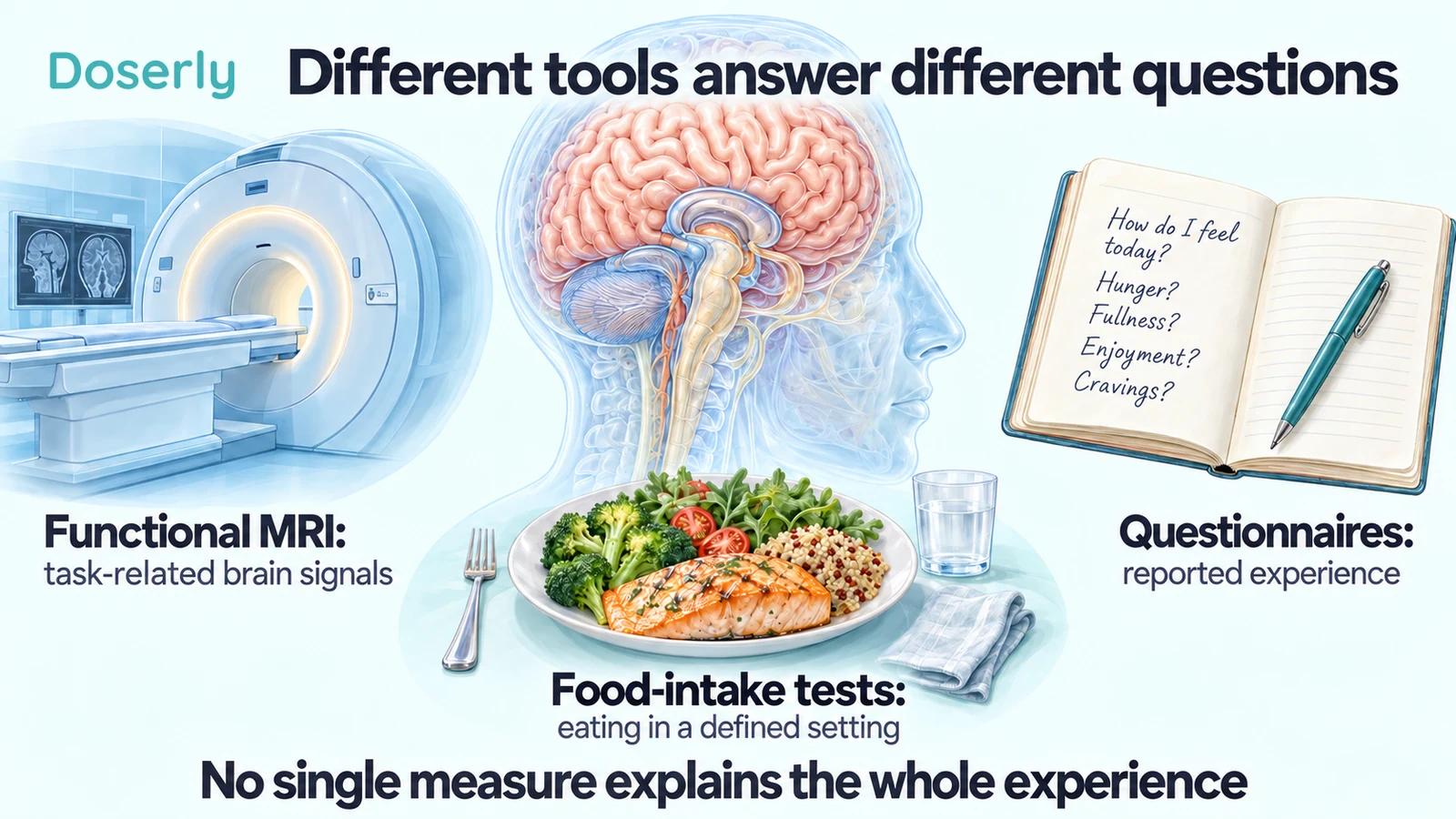
A brain image cannot read a person’s thoughts
Functional MRI examines signals related to brain activity during defined tasks. It can help investigate responses to food cues. It does not directly measure the full private experience of persistent food thoughts throughout a day, and a change in a task-related signal does not by itself establish why a person’s experience changed.
This is especially important when an image is described as showing a treatment “switching off” cravings. Brain responses are distributed, the task matters, and the interpretation depends on the comparison and analysis. A simplified illustration should not turn a research association into a literal on-off switch.
Mechanistic animal research adds another layer. A 2026 cross-species atlas identified relevant brainstem cell populations and included causal experiments in rats investigating cagrilintide’s effects on energy balance. That helps explain possible biological pathways. It does not measure human food noise, and rats cannot complete a questionnaire about intrusive thoughts. Primary brainstem atlas study
The strongest account keeps these layers together without merging them: laboratory mechanisms generate explanations, human experiments test outcomes, and patient reports describe experiences that anatomy alone cannot supply.
What a retrospective survey can add
The 2026 INFORM survey asked 550 US adults receiving injectable semaglutide about food noise. Respondents completed the FNQ and recalled their experience before starting treatment. The study reported lower current scores than recalled pretreatment scores. It was an opt-in opinion-panel survey, not a randomized comparison. INFORM primary report
The survey is useful because it documents how participants described their experience in a real-world setting. Its design also leaves room for recall bias, expectations and selection effects. People remembering a difficult period after experiencing improvement may describe that earlier period differently than they would have at the time.
It is semaglutide evidence, not cagrilintide evidence. It also cannot establish that every change was caused by the medicine. Prospective measurements collected before and after treatment, with a relevant comparator, would answer the causal question more convincingly.
This distinction is not a ranking of whose experiences deserve respect. It is a distinction between describing a reported experience and estimating a treatment effect.
What would make future claims more useful?
A strong food-noise study would name the instrument and the experience it intends to capture. It would collect baseline measurements before treatment, define follow-up times, report the comparator and explain what happens to missing responses when people discontinue.
It would also show more than a group average. How many participants improved by an amount they considered worthwhile? How many had little change or worsened? Did the improvement persist? Did people report better function or less distress alongside the score change? Those questions help connect a measurement to everyday benefit.
For combination research, single-agent comparators matter when the claim concerns cagrilintide’s specific contribution. For imaging research, the analysis plan and correction for multiple comparisons matter. For questionnaires, the suitability of the instrument and the meaning of the change matter. These are different checks because the evidence is answering different questions. FDA patient-reported outcome guidance explains the principles behind interpretable questionnaire results.
Bringing the experience into a clinical conversation
A brief dated description can be more informative than saying food noise is “high” or “gone.” You might note when thoughts interrupt an activity, how easy they are to redirect, whether hunger is present and whether eating still feels comfortable and adequate. These examples are for communication, not a substitute for a validated questionnaire.
Record nausea or difficulty eating separately from relief in preoccupation. If thoughts are distressing, eating feels difficult, or changes interfere with daily life, bring that directly to a qualified clinician. A lower desire to eat is not the only outcome that matters.
Our cagrilintide guide and semaglutide guide provide the wider treatment-research context. Food noise is a meaningful experience that research can study. The most helpful evidence will explain which experience changed, how it was measured and which intervention was actually tested.
Sources
- Development and validation of the Food Noise Questionnaire, 2025.
- Patient-Reported Outcome Measures: Use in Medical Product Development to Support Labeling Claims, 2009.
- Once-weekly cagrilintide for weight management in people with overweight and obesity: a multicentre, randomised, double-blind, placebo-controlled and active-controlled, dose-finding phase 2 trial, 2021.
- The effect of semaglutide 2.4 mg once weekly on energy intake, appetite, control of eating, and gastric emptying in adults with obesity, 2021.
- Coadministered Cagrilintide and Semaglutide in Adults with Overweight or Obesity, 2025.
- Retrospective Assessment of Food Noise Changes After Initiation of Injectable Semaglutide for Weight Management in the USA: The INFORM Survey, 2026.
- CagriSema food-noise and functional-MRI findings presented at EASD 2026, 2026.
- A cross-species atlas of the dorsal vagal complex reveals neural mediators of the effects of cagrilintide on energy balance, 2026.