
TRT
October 16, 2026
Breast tenderness on TRT: why one symptom has more than one explanation
On this page
Breast tenderness during testosterone replacement therapy can be unsettling, especially if it starts soon after a prescription change. Testosterone can be converted to estradiol, and breast tissue responds to hormones. That makes a treatment-related explanation possible. It does not make every tender nipple an estrogen diagnosis.
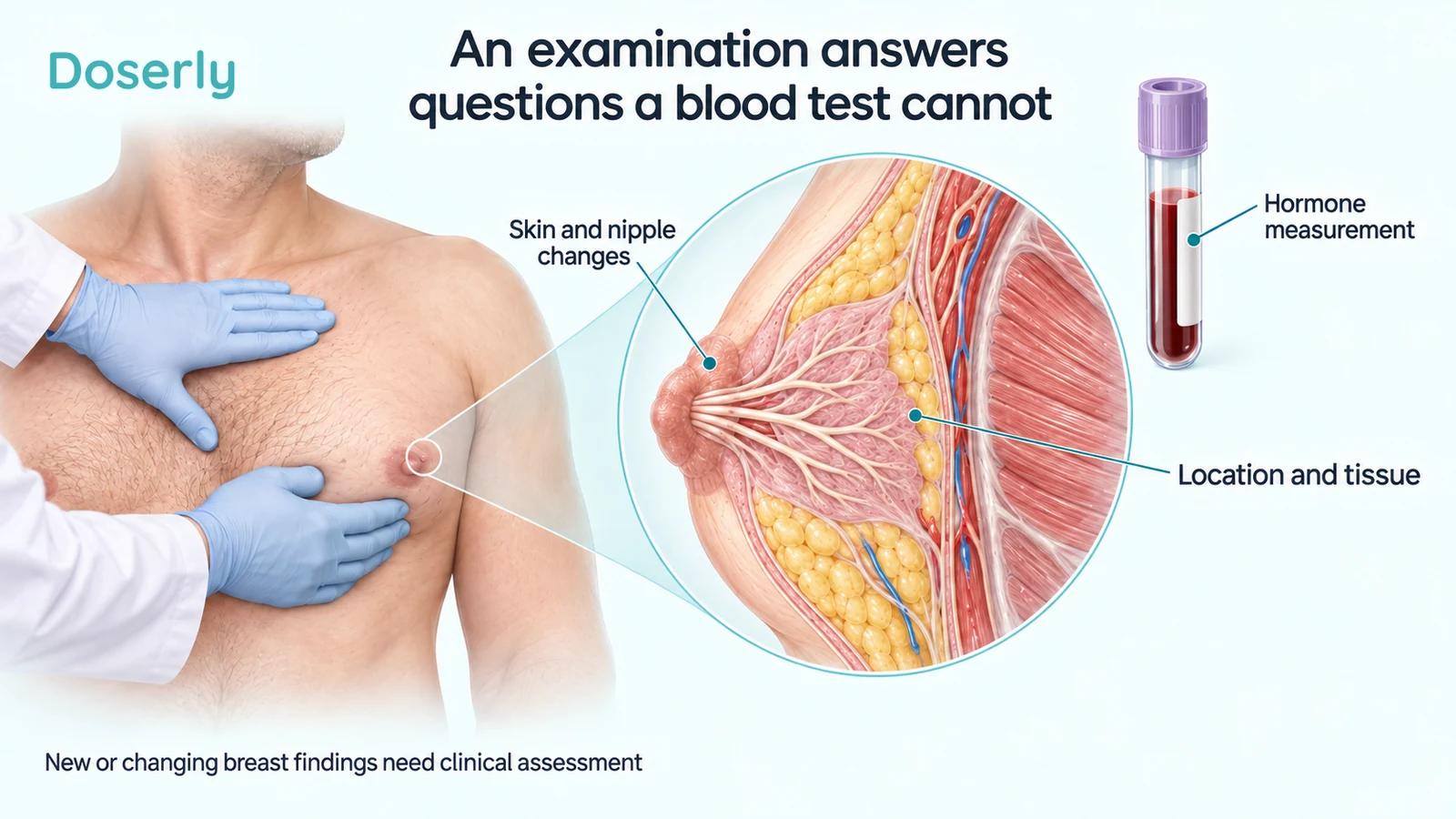
The useful first question is what has actually changed: pain, the skin, the amount of fatty tissue, a distinct lump or growth of glandular tissue. These are different findings. A clinician’s examination can help distinguish them and determine whether hormone testing, imaging or another assessment is appropriate. EAA gynecomastia guideline.
This article explains what the evaluation is trying to establish and why immediately adding an “estrogen blocker” can miss the point. Our estrogen management guide covers the wider relationship between testosterone, estradiol and monitoring.
Tenderness, enlargement and gynecomastia are different
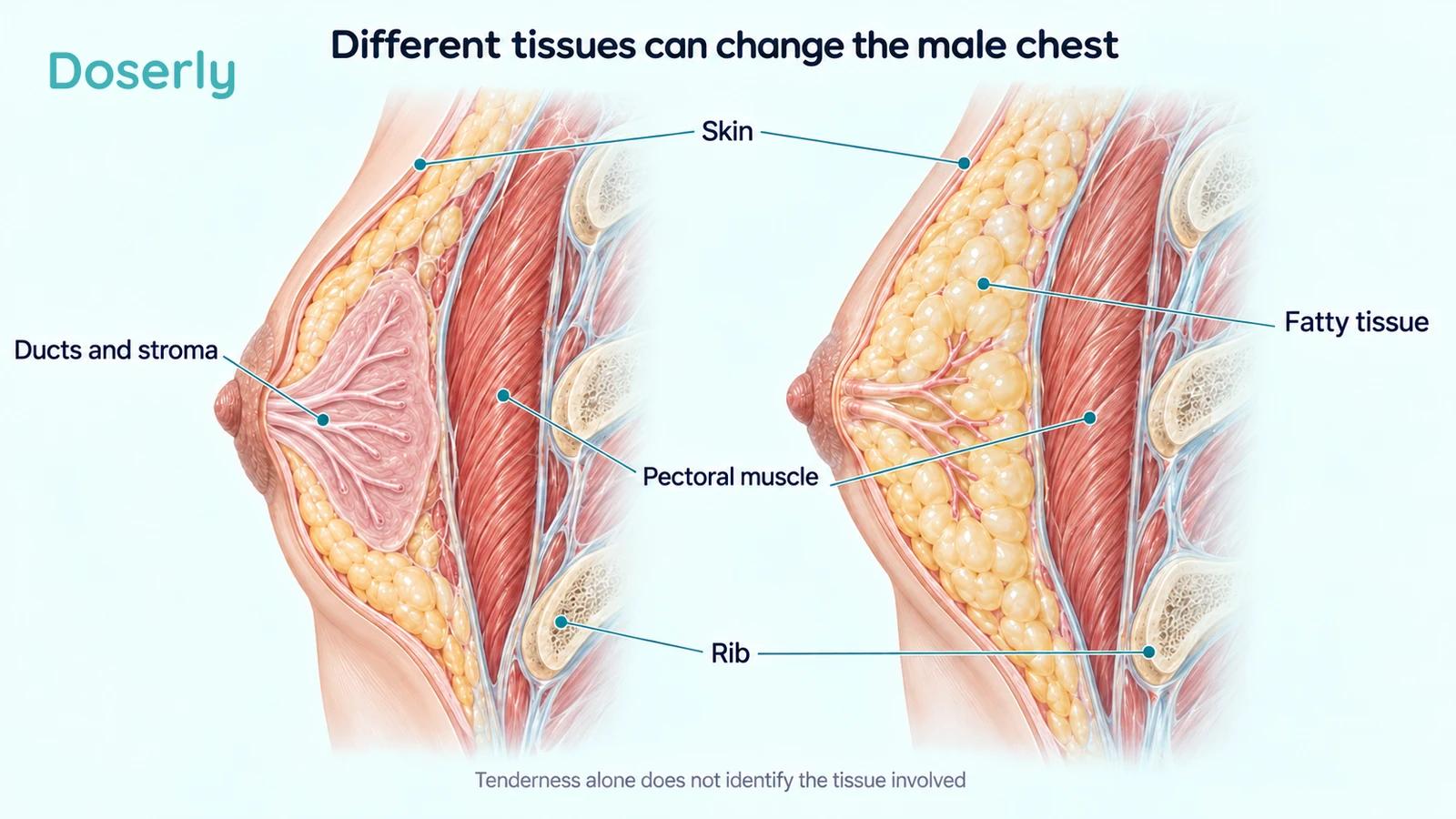
Tenderness describes a sensation. Gynecomastia describes enlargement of glandular breast tissue in a male body. Pseudogynecomastia refers to enlargement predominantly from fatty tissue. A change in chest appearance can involve more than one tissue, and pain does not reliably distinguish them.
Male breasts contain ducts and other tissues despite usually having much less glandular development than female breasts. The skin, subcutaneous fat and underlying chest structures can also be relevant to symptoms. An examination considers the location and character of a finding rather than assigning its cause from the word “tender.” NCI male breast anatomy.
For example, soreness associated with a visible skin change raises a different question from a new discrete lump. General fullness after weight change differs from a localized change behind the nipple. These examples are reasons to describe the symptom carefully, not a home diagnostic checklist.
Avoid repeatedly pressing the area to decide whether it “feels hormonal.” A description of what you first noticed, whether it is changing and whether it affects one or both sides is more useful to a clinician than a confident self-assigned label.
How could testosterone treatment be involved?
Some testosterone is converted into estradiol through aromatase. Changes in testosterone exposure can therefore change the hormonal environment of breast tissue. But the blood estradiol result is only one piece of information; it does not directly show which tissue has changed or why a particular area hurts.
The American Urological Association recognizes breast symptoms during TRT and discusses estradiol measurement in that setting. It also notes that symptoms sometimes abate during a period of monitoring chosen through clinical judgment. AUA guideline.
That observation supports a measured response after assessment. It does not mean every new symptom should be watched indefinitely, and it does not establish that every episode requires immediate medication. The appropriate response depends on the examination and the individual circumstances.
The timing is worth recording. Did tenderness start after beginning testosterone, changing the formulation, changing the prescribed amount or adding another drug? Did it exist beforehand? A temporal association helps frame the investigation, but it cannot exclude an unrelated cause.
What information helps at the appointment?
Describe the symptom in ordinary terms. Is the discomfort mainly in the nipple, behind it or elsewhere on the chest? Is there a visible change, a distinct lump or discharge? Has the area been stable, improving or enlarging? Mention whether symptoms interfere with clothing, sleep, exercise or daily activity.
Bring a medication list that includes prescribed testosterone, anastrozole or other hormone-active medicines, and supplements. Include recently stopped products as well as current ones. European guidance emphasizes identifying potentially aggravating substances and reversible causes when evaluating gynecomastia. EAA guideline.
A simple timeline is often enough. For instance: “I changed products three weeks ago, noticed left-sided tenderness last week, and have not noticed discharge.” This separates observations from interpretation. It leaves the clinician free to test the explanation instead of assuming that an elevated laboratory value is responsible.
You do not need to wait until you have a complete symptom log to arrange an assessment. The record is a communication aid. It should not become a reason to postpone evaluation of a persistent or changing finding.
Which breast changes should be assessed promptly?
A new lump, nipple discharge, nipple inversion, skin dimpling or other unusual changes should be brought to a clinician. The National Cancer Institute explains that many breast changes in men have benign causes, but that an examination is needed to determine the explanation. NCI guidance.
The purpose of mentioning these findings is not to suggest that tenderness usually means cancer. It is to avoid dismissing a new abnormality because TRT offers an easy explanation. Breast cancer is possible in men, and a hormone result cannot rule it out.
Whether a finding hurts is also insufficient to settle its significance. A person should not wait for a lump to become painful before mentioning it, or assume that pain proves a benign process. The relevant next step is assessment, not trying to infer a diagnosis from one feature.
If there is rapid change or the symptom is accompanied by feeling acutely unwell, contact a healthcare professional for advice about how quickly to be seen. Describe the actual findings when booking; “I have a new breast lump” conveys more useful information than “I think my estrogen is high.”
Does everyone need a scan?
No. Imaging decisions depend on the clinical findings. The American College of Radiology separates scenarios in which an examination is consistent with gynecomastia or fatty enlargement from those involving an indeterminate or suspicious mass. The appropriate investigation can therefore differ between two people who both initially describe breast discomfort. ACR symptomatic male breast criteria.
A clinician may be able to identify a typical benign pattern on examination. If the finding is uncertain or suspicious, imaging or tissue sampling may be needed. An ultrasound and a mammogram are not interchangeable in every clinical setting, and the choice is not something a testosterone level can determine.
It is reasonable to ask what question the proposed test will answer. Is it intended to characterize a lump, distinguish tissue types or evaluate a suspicious feature? Understanding the purpose helps make the result meaningful and avoids interpreting a normal hormone panel as though it were a normal breast examination.
What can estradiol testing add?
Estradiol testing can help characterize the hormonal setting, particularly when breast symptoms develop during testosterone treatment. It should be interpreted with testosterone exposure, the examination and the reason the test was ordered. A result above a laboratory interval does not by itself establish the cause of pain.
The test method matters, especially at low concentrations. An Endocrine Society position statement describes problems involving assay sensitivity, specificity and comparison between methods. If a surprising result would change treatment, a clinician may want confirmation or a better-suited assay. Estradiol measurement statement.
Keep the units and laboratory method with the result. A number copied into a message without that context can be misleading. Record the collection date and relevant recent medication changes as well.
Other investigations may be appropriate depending on history and examination. The clinician is not simply deciding whether estradiol is “high”; they are evaluating the person. That broader assessment is especially useful when the symptom predates TRT, does not fit the expected pattern or persists despite changes in the hormone result.
Does anastrozole reliably treat this problem?
Anastrozole lowers estrogen synthesis, but the evidence for treating breast symptoms has important limits. A 2004 report described successful treatment of testosterone-associated gynecomastia in two men. That is a case report, not a controlled trial capable of estimating how often treatment works or what would have happened without it. Rhoden and Morgentaler.
A separate randomized trial studied 80 boys aged 11–18 with pubertal gynecomastia. After six months, the proportion reaching the prespecified breast-volume response was 38.5% with anastrozole and 31.4% with placebo; the difference was not statistically significant. The endpoint was at least a 50% reduction in combined breast volume assessed by ultrasound. These were adolescents undergoing puberty, not adults receiving TRT. Pubertal trial.
Together, these studies show why enthusiasm based on individual responses should not become a universal promise. They also illustrate why population matters: a negative puberty trial cannot precisely quantify benefit in adult TRT users, while two adult cases cannot establish routine effectiveness.
For medication-specific background, our anastrozole guide explains how the drug works and why an individualized indication matters.
What if tenderness improves but enlargement remains?
Pain and tissue size are different outcomes. Improvement in discomfort does not necessarily mean that established tissue has disappeared. Conversely, a change in measured size does not describe every aspect of someone’s symptoms or distress.
Clarifying the goal before treatment helps. A person may primarily want relief from pain, reassurance about a lump or help with persistent enlargement. These goals can require different follow-up and should not be collapsed into a single “estrogen control” target.
If a treatment changes the hormone result without changing the original concern, bring that discrepancy back to the clinician. It may prompt reassessment of the diagnosis, the treatment goal or whether continued medication is worthwhile. It is not automatically evidence that a higher dose is needed.
For longstanding gynecomastia that remains troublesome, specialist assessment may include discussion of surgical management. European guidance distinguishes that situation from an early evaluation of a new symptom. Treatment depends on the established diagnosis and its persistence, not simply on whether testosterone is being prescribed. EAA guideline.
What does sensible monitoring look like?
Monitoring should have a purpose and a review point. Ask which changes should prompt an earlier call and what the clinician expects to reassess. “Keep an eye on it” is easier to follow when you know whether the concern is pain, growth, skin change or a new discrete finding.
Record meaningful changes rather than checking repeatedly throughout the day. Note whether the symptom is improving, stable or worsening and whether a new feature has appeared. If treatment changes, record the date so the next discussion can distinguish the period before and after it.
Do not use an estradiol result from someone else, a photograph or an online symptom list to select a medication. These cannot establish the tissue diagnosis or account for your treatment history. Similarly, do not make unplanned changes to prescribed hormones merely to see whether a lump responds.
Breast tenderness deserves a clear explanation, and the explanation may involve TRT. The safest useful conversation starts with the symptom and examination, then uses laboratory results and other investigations to answer the remaining questions. That approach makes room for a treatment-related cause without overlooking everything else.
Sources
- EAA Clinical Practice Guidelines—Gynecomastia Evaluation and Management
- Male Breast Cancer — National Cancer Institute
- Evaluation and Management of Testosterone Deficiency: AUA Guideline
- ACR Appropriateness Criteria: Evaluation of the Symptomatic Male Breast
- Challenges to the Measurement of Estradiol: An Endocrine Society Position Statement
- Treatment of Testosterone-Induced Gynecomastia with the Aromatase Inhibitor, Anastrozole
- Safety and Efficacy of Anastrozole for the Treatment of Pubertal Gynecomastia: A Randomized, Double-Blind, Placebo-Controlled Trial