
Longevity
October 17, 2026
Biological age tests: what a younger number really means
On this page
A report arrives with a striking result: your biological age is several years younger than your birthday suggests. It feels like a verdict on how well you have looked after yourself. A second report, taken after a new supplement or exercise routine, feels even more personal. If the number falls, surely something important has improved.
The science is interesting enough to take seriously, but the interpretation requires more than subtracting two ages. Biological age tests measure selected features of the body and translate them through a model. Different models were designed to answer different questions. Some recognize patterns associated with chronological age. Others emphasize future disease risk or the pace of physiological change.
Recent randomized trials have shown that some interventions change some of these measurements. That is a meaningful research development. It is not yet a reliable way to calculate how many healthy years a particular person has gained. Understanding the distinction makes the tests more useful, and their marketing easier to judge.
What is actually being measured?
Chronological age is elapsed time. Biological aging describes changes in function and vulnerability that do not progress identically in everyone. The difficulty is that there is no single instrument that directly reads all of those changes at once.
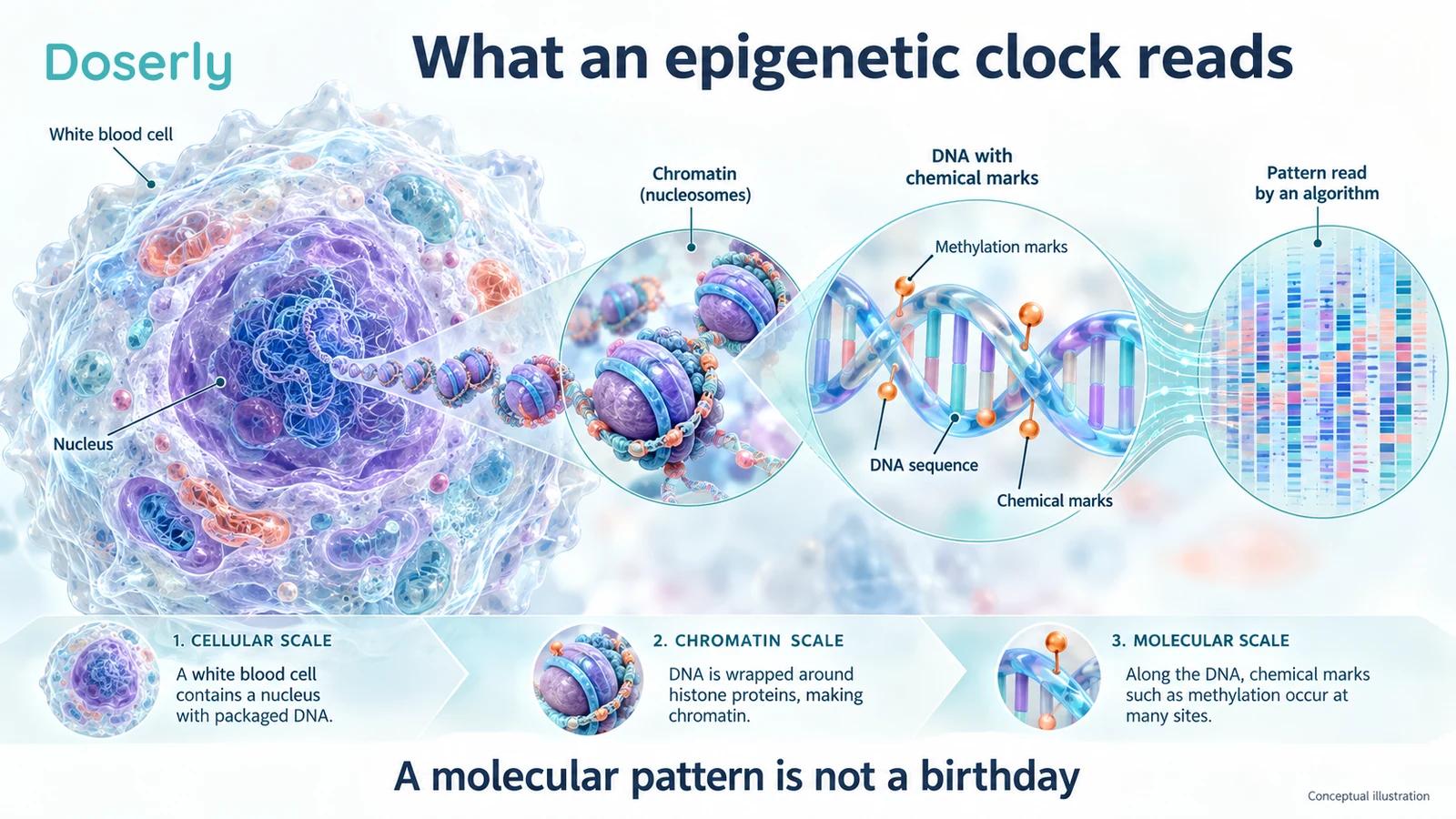
An epigenetic clock usually starts with DNA methylation. These are chemical marks associated with DNA, rather than changes to the sequence of its letters. A laboratory measures patterns at selected sites, and an algorithm combines those measurements into an estimate. The estimate depends on which sites the model uses, their weighting and the outcome the model originally learned to predict.
The foundational Horvath clock, published in 2013, was developed to estimate age across many human tissues and cell types. Its success showed that methylation contains a strong age-related signal. It did not establish that every departure from predicted age represents an equivalent amount of reversible damage. Horvath, Genome Biology
A useful comparison is a photograph-based age estimate. A model could become excellent at estimating birthdays from faces without measuring every process that determines health. This is an analogy about prediction, not a claim that methylation clocks are superficial. The key point is that accuracy for one task does not automatically establish accuracy for another.
Some products instead use ordinary blood tests, circulating proteins, physical measurements or combinations of data. The phrase “biological age” can therefore describe quite different tools. Before interpreting a score, it helps to know the material collected and the actual model used. A blood-based clinical algorithm and a saliva-based methylation test are not interchangeable simply because both print an age in years.
Age, risk and pace are different outputs
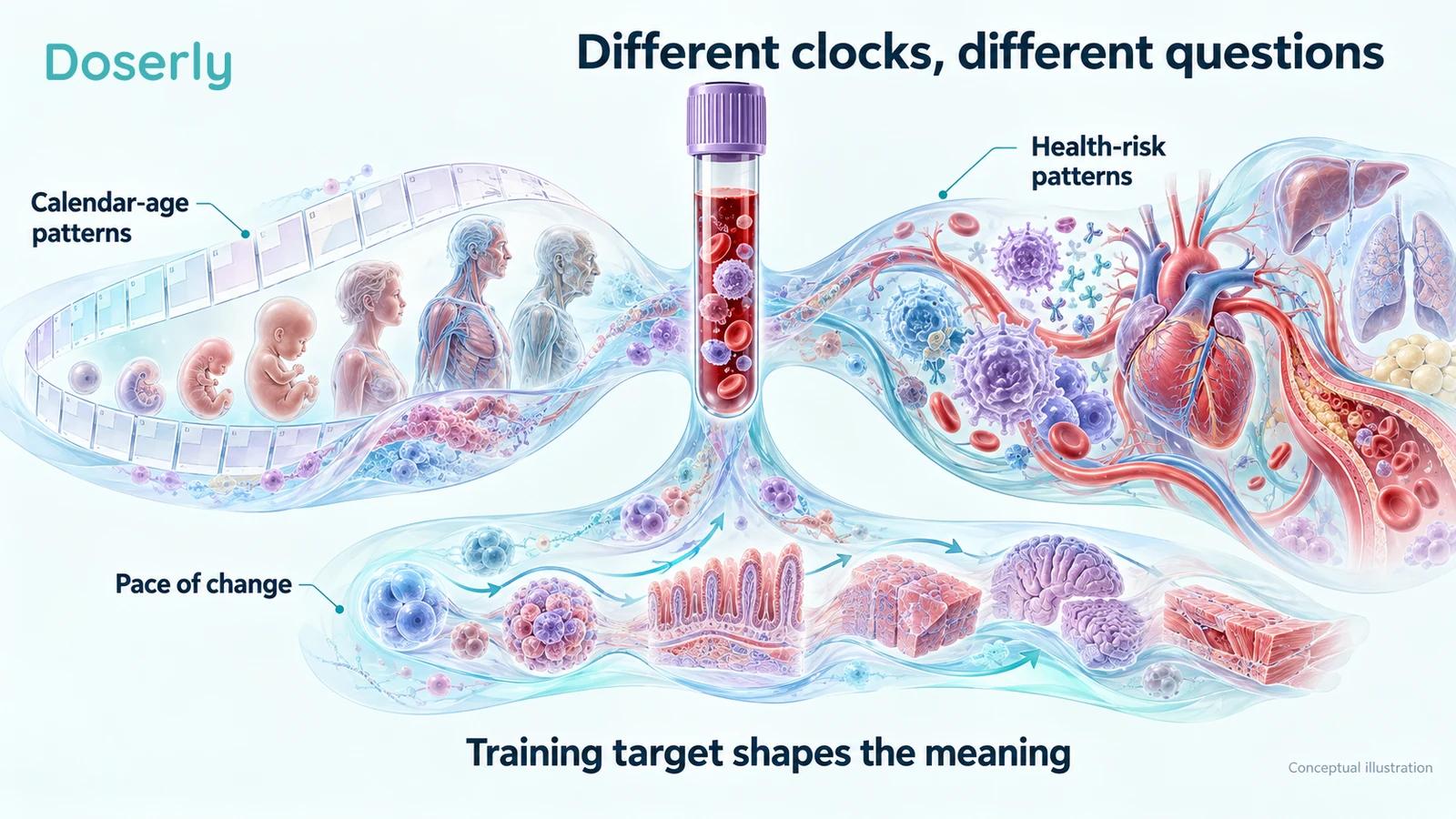
Later clocks were designed to capture more than calendar age. GrimAge, for example, combines methylation-based estimates related to selected plasma proteins and smoking exposure with other information to predict mortality-related outcomes. Its original development and validation associated the score with lifespan and healthspan measures in study populations. That makes it a risk-related biomarker, not a personal expiration date. Lu and colleagues, Aging
DunedinPACE takes another approach. It was developed using longitudinal physiological change over twenty years in a birth cohort, then trained a blood methylation measure to estimate that pace. Its output is a rate, rather than an age in years. A score around one refers to the model's reference rate of biological change per calendar year. Belsky and colleagues, eLife
This difference changes how a result should be described. A lower age estimate and a slower pace estimate are not the same claim. Neither tells you that every organ has become younger. A speedometer and an odometer describe different aspects of a journey, even when both respond to the same driving.
It also explains why a person can receive apparently conflicting results without one laboratory necessarily making an error. The models may emphasize different signals. Their reference populations may differ. One may respond more strongly to smoking-related patterns, another to metabolic changes, and another to features that track elapsed time.
When a report gives several scores, averaging them yourself does not create a more accurate biological age. The units and underlying targets may not support that calculation. The more useful question is what each score has been validated to predict, in whom, and with what uncertainty.
A changing score needs a reliable measurement
A before-and-after result contains at least two questions. Did the laboratory and algorithm measure a change reliably? If so, what does that change mean biologically?
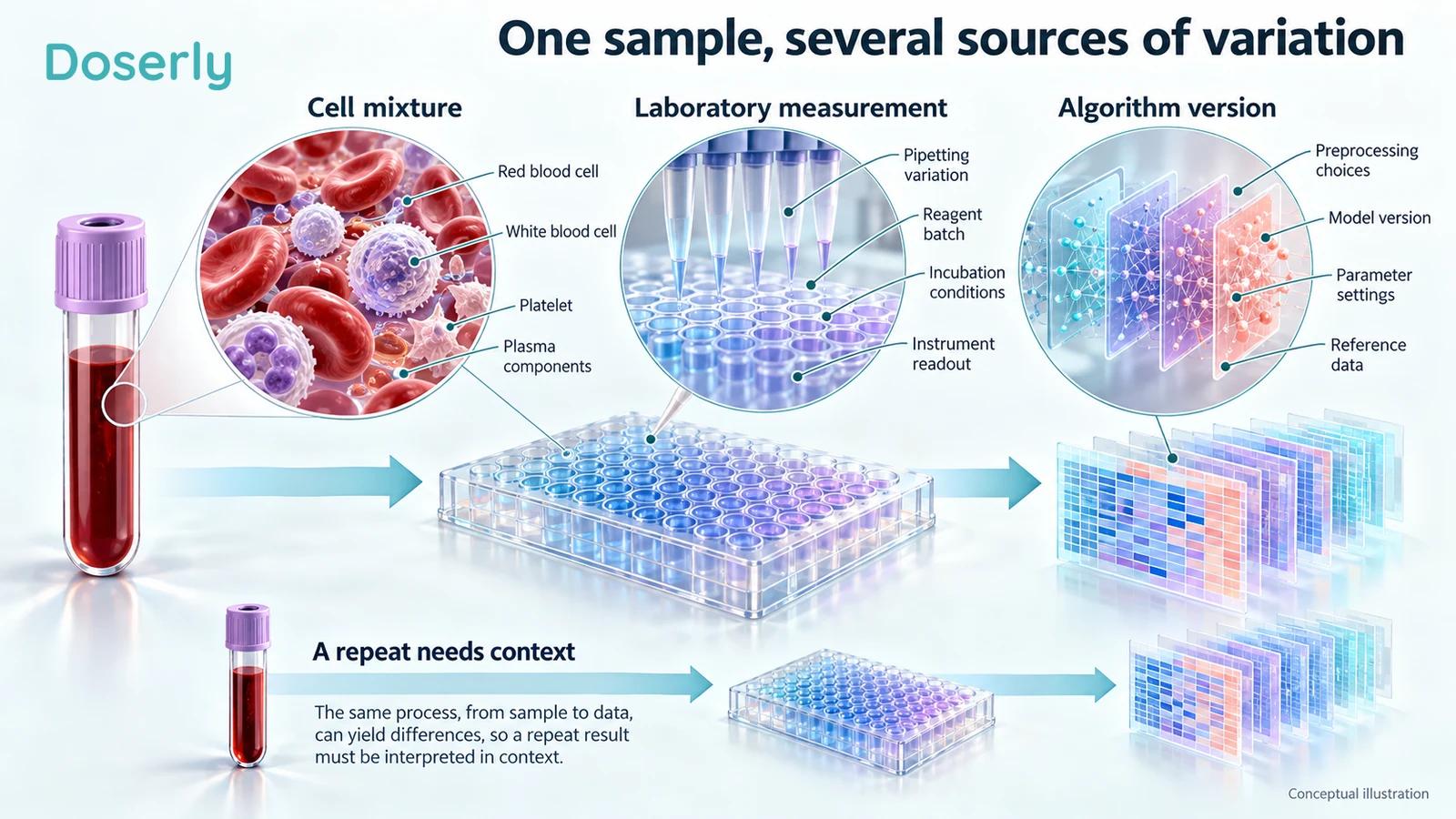
The first question is not trivial. A 2022 study examined technical reliability across six prominent epigenetic clocks. Some repeat measurements of the same biological sample differed by as much as nine years. Retrained versions using principal components improved agreement substantially, with most replicate differences within 1.5 years. Those findings concern the tested methods, not a universal error margin for every current product. Higgins-Chen and colleagues, Nature Aging
Technical replicates are particularly revealing because the person has not aged between them. The underlying sample is the same. Differences therefore expose variation in measurement and processing rather than a newly acquired biological benefit or harm.
For an individual following a commercial test, the relevant information is the repeatability of that exact assay and algorithm. A company's statement that its model correlates strongly with age is not a substitute. Correlation across people can look impressive while small changes within one person remain difficult to interpret.
Ask whether the same sample type, laboratory platform and algorithm version were used on both occasions. A revised model can change the reported number even if the underlying biology has not changed. If a company updates its method, it should explain whether older samples can be recalculated consistently and whether the new and old scores remain comparable.
Collection conditions also belong in the record. Recent illness, changes in treatment and changes in the mixture of cells sampled can matter to interpretation. Recording context does not mean you can mathematically correct a score at home. It helps prevent a laboratory result from being treated as an isolated judgment about your lifestyle.
Why an extreme first result often becomes less extreme
Imagine someone orders a test because they feel unwell and receives a surprisingly old estimate. They then start several changes at once and repeat the test when they feel better. The new number may improve. That observation is real, but it does not isolate the effect of any one change.
One explanation is regression toward the mean. Whenever a measurement contains variation, an unusually high first value is more likely to be followed by a less extreme value even without an effective intervention. This is a general statistical problem, not an accusation that the original result was fabricated.
Another explanation is that the person's health changed for reasons unrelated to the product being evaluated. Recovery from an illness, a change in prescribed treatment, or the passage of a stressful period could occur alongside a new supplement. A before-and-after testimonial cannot separate those influences.
Repeated measurements can help characterize a pattern, but more testing does not remove every source of bias. If someone tries enough interventions and highlights only the lowest result, the story becomes selective. The same problem occurs when a study measures many clocks but emphasizes only the favorable one.
For research, prespecified outcomes, appropriate comparison groups and consistent laboratory methods make a large difference. For a consumer, the practical lesson is simpler: a dramatic personal chart is not equivalent to a controlled experiment. It may generate a question worth studying without answering it.
What randomized trials have shown
The CALERIE trial provides a useful example of clocks disagreeing within a serious study. In a post hoc analysis of a two-year randomized calorie-restriction trial in adults without obesity, the intervention slowed DunedinPACE, but did not significantly change PhenoAge or GrimAge. The investigators reported an approximately 2–3% slowing on the pace measure. The trial did not establish a corresponding extension of human lifespan. Waziry and colleagues, Nature Aging
That result supports a specific statement: the intervention influenced one measured aspect of aging biology under trial conditions. It cannot tell an individual that eating less will reverse a fixed number of years. It also cannot establish that a clock which did not change is useless. Different instruments may detect different aspects of the response.
DO-HEALTH added another example in 2025. A post hoc analysis studied 777 generally healthy older adults from the Swiss subset of a larger randomized trial. Omega-3 supplementation was associated with small changes in three of four main methylation clocks over three years. The combination with vitamin D and exercise showed an additive effect on PhenoAge, but not consistently across all clocks. Long-term survival implications remained unknown. Bischoff-Ferrari and colleagues, Nature Aging
The distinction between a subgroup biomarker analysis and the full clinical trial matters. The people with suitable stored samples may not represent all participants, much less all older adults. The result is useful evidence about responsiveness. It is not a reason to select a supplement solely to improve a laboratory age. The fish oil guide discusses the separate nutritional and clinical questions around EPA and DHA.
In March 2026, the COSMOS ancillary study reported results from 958 participants. Over two years, daily multivitamin–multimineral supplementation modestly slowed change in PCGrimAge and PCPhenoAge compared with placebo. The yearly between-group differences were about 0.11 and 0.21 clock-years, respectively. Cocoa extract did not significantly affect the five clocks studied. Whether the changes translate into clinically meaningful benefits remains unresolved. COSMOS epigenetic aging study, Nature Medicine
These are small average differences between randomized groups, not promises of a detectable improvement in everyone taking a multivitamin. A group estimate can be statistically informative even when an individual change is smaller than the uncertainty surrounding their own test. For the broader nutrition decision, the seniors’ multivitamin guide puts supplementation in the context of nutritional needs.
The 2026 question: which clocks respond, and to what?
A broader analysis published in 2026 assembled TranslAGE, a database of 51 longitudinal human intervention studies. Researchers calculated a consistent panel of sixteen epigenetic clocks, alongside other methylation biomarkers, to compare responsiveness. Mortality-related and pace-related clocks generally showed stronger responses, while population characteristics and study duration influenced the findings. Sehgal and colleagues, Nature Medicine
The value of this work is methodological. Applying comparable calculations across studies helps distinguish a responsive measure from a literature in which different investigators happened to choose different clocks. The database includes varied interventions and study designs, so its findings should not be converted into a consumer ranking of treatments.
Responsiveness is necessary if a biomarker is going to help evaluate an intervention. But a responsive measure can still respond to changes that do not improve the outcome people care about. A drug might shift a blood marker directly while leaving disease risk unchanged, or while causing a separate harm.
The next step is therefore not merely to find interventions that produce larger score changes. It is to test whether those changes consistently accompany meaningful improvements in function, disease incidence or survival, and whether they explain the intervention's effect rather than simply traveling alongside it.
Prediction is not the same as a validated treatment target
A marker can predict an outcome without causing it. It can also reflect a mixture of causes, consequences and compensatory responses. Changing the marker is not automatically equivalent to changing every process it represents.
The biomarker-validation framework described by Moqri and colleagues emphasizes predictive validity, comparability and generalizability, as well as the work required before clinical translation. A proposed surrogate endpoint needs stronger evidence than an association with later illness. Moqri and colleagues, Nature Medicine
Consider a hypothetical trial in which a treatment improves a clock but does not improve walking ability, disease outcomes or quality of life. The clock finding could still reveal interesting biology. It would not justify telling participants that their overall health had improved. Conversely, an intervention with an established clinical benefit should not be discarded merely because one experimental clock remains unchanged.
This distinction becomes especially important when a test is used to sell the intervention that supposedly fixes it. The test, the suggested product and the interpretation may all come from the same commercial system. That arrangement does not invalidate the science, but it raises the value of independent replication and clearly disclosed conflicts of interest.
A persuasive study should make the comparison, outcome and analysis plan visible. A persuasive clinical service should also be able to explain what action follows from the result and what evidence supports that action. “Your number is older” is an observation. “This product will make you healthier” is a separate claim.
What about the age of individual organs?
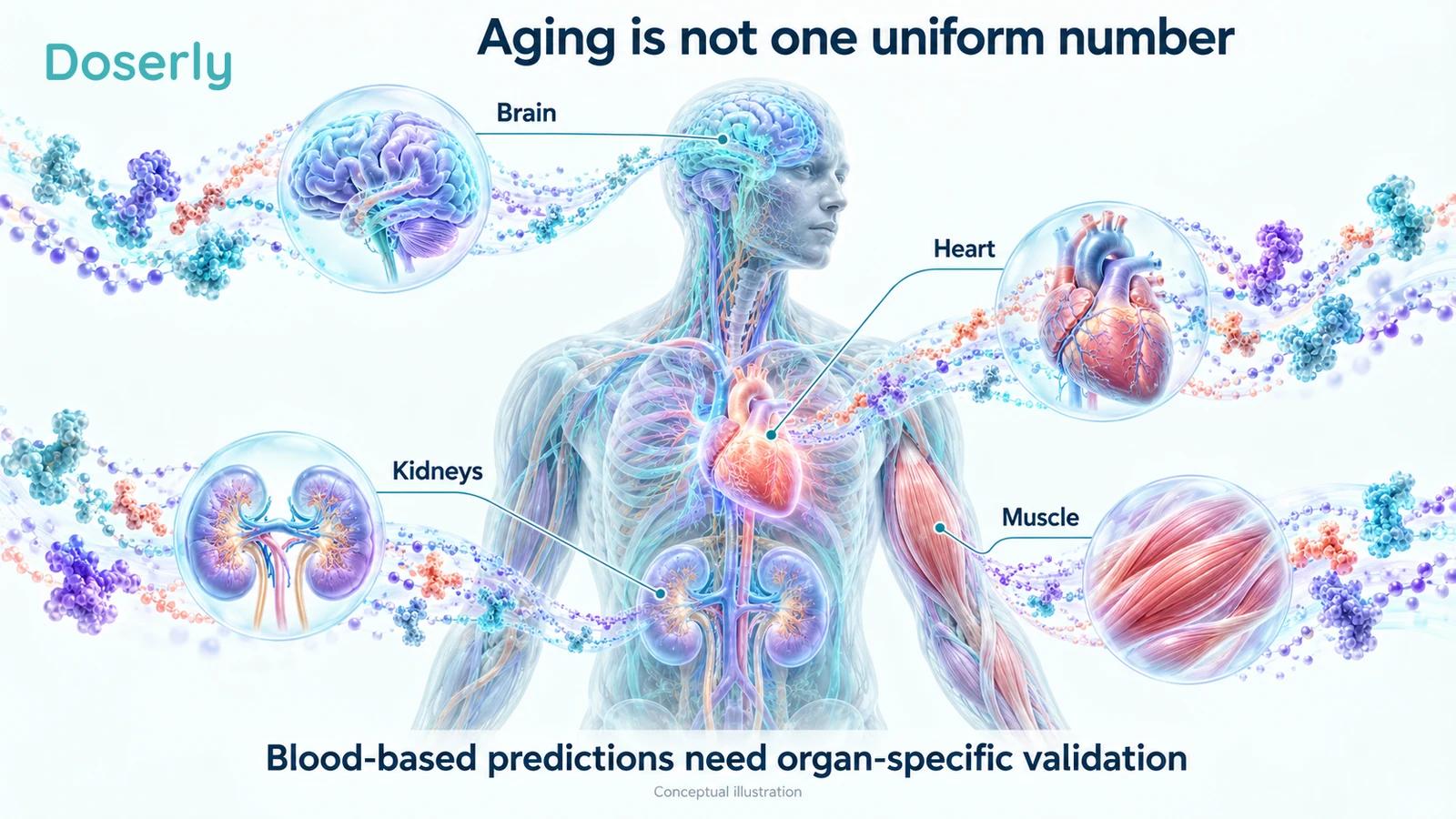
A single whole-body number can hide differences among systems. Research using circulating proteins is exploring organ-related aging patterns. A study published online in late 2025 and appearing in Nature Aging in 2026 developed and evaluated proteomic clocks across UK, Chinese and US cohorts. The models predicted disease and mortality-related outcomes, with partly distinct patterns across organs. These were observational prediction analyses, not trials showing that lowering an organ score prevents disease. Wang and colleagues, Nature Aging
The approach is promising because it asks a more specific question than whether the entire body is “young.” Yet an organ-labeled prediction from blood is not the same as directly examining that organ. A brain-related score is not a diagnosis of dementia. A kidney-related score does not replace standard assessment of kidney function.
For a reader, the important implication is that aging is multidimensional. Someone may have excellent exercise capacity and still need treatment for a separate risk factor. A favorable summary score cannot cancel a symptom, a family history or a conventional abnormal test.
Questions to ask before paying for a test
Start with purpose. Are you satisfying curiosity, contributing to research, or expecting the result to change a medical decision? Those are different uses, and they warrant different standards of evidence.
Ask for the exact test and algorithm name. Find out whether the score estimates age, age acceleration, disease risk or pace. Request the repeatability data for the method actually being sold, rather than a citation for a related academic clock. Ask whether its validation population resembles you in age, health status and sample type.
Next, ask what a change would mean. Does the service provide an uncertainty interval? Has it established a threshold for a meaningful within-person change? Was that threshold tested prospectively? If the answer is only that lower values are associated with better outcomes across a population, the individual treatment claim remains incomplete.
Finally, consider the practical consequences. Will a concerning result lead to an appropriate clinical assessment, or mainly to more products and more testing? Can you access and retain the underlying report? How are samples and data stored, shared or deleted? These questions are especially relevant when testing becomes a subscription rather than a one-time purchase.
Curiosity is a reasonable reason to engage with emerging science. It becomes more expensive, emotionally and financially, when a provisional measurement starts dictating decisions it has not been validated to support.
Reading the fine print of a report
The word “years” can conceal several calculations. An estimated age of fifty is not necessarily interpreted by simply subtracting a forty-five-year-old person's birthday. Some research uses age acceleration: the difference between the measured value and the value expected for someone of that chronological age in a reference population. That reference-based residual can differ from simple subtraction. Look for the definition before comparing your result with another person's screenshot.
Percentiles need similar care. Being in a favorable percentile means having a lower value than many people in the comparison group. It does not mean a corresponding percentage reduction in disease risk. The comparison group may include people with a different health profile, and a percentile can change if that group changes.
A report can also be precise in appearance without being precise in meaning. Two decimal places tell you how the software displays a result; they do not establish that changes of that size are biologically meaningful. The same principle applies to a graphic that colors every small downward movement green. A useful report makes uncertainty visible alongside the central estimate, explains the comparator and distinguishes observed measurements from interpretations generated by the model.
Keeping the number in proportion
If you already have a result, keep the report, method and collection context together. Treat it as one piece of information whose meaning depends on its validation. An unexpectedly high value deserves interpretation, not panic. An unexpectedly low value is not permission to ignore symptoms or established preventive care.
For tracking progress, consider what you hoped would improve before the test was ordered. Being able to walk farther, recover from activity, maintain strength or manage a recognized risk factor provides a different kind of information from a proprietary age score. Those observations do not need to be compressed into a younger birthday to matter.
Biological age research is moving quickly. Its strongest contribution may be helping researchers understand change and design better trials. For now, a younger number is best understood as a result from a particular model, not a certificate that aging has been reversed. The useful question is what the measurement adds to decisions that improve how you live.