
Supplements
October 16, 2026
Apigenin for sleep: why chamomile research does not settle the question
On this page
Apigenin is a plant compound found in chamomile, parsley and other foods. It belongs to the flavonoid family, a large group of substances that give plants some of their chemical properties. Interest in apigenin as a sleep supplement comes partly from chamomile's familiar bedtime use and partly from laboratory work on nerve-cell signaling.
Those are reasonable starting points for research. They do not yet establish that an isolated apigenin capsule improves sleep in people. The chamomile trials discussed below tested tea or whole extracts, rather than purified apigenin alone. A newer human trial tested a blend containing apigenin, which raises a different question from isolated-apigenin efficacy.
For someone considering a bedtime product, that distinction changes the question. The task isn't simply to decide whether chamomile is calming. It is to understand what was actually given, to whom, and whether the measured benefit matches the problem you want to address. Our apigenin guide introduces the compound; here we examine the sleep evidence behind its reputation.
A plant, an extract and a molecule are different products
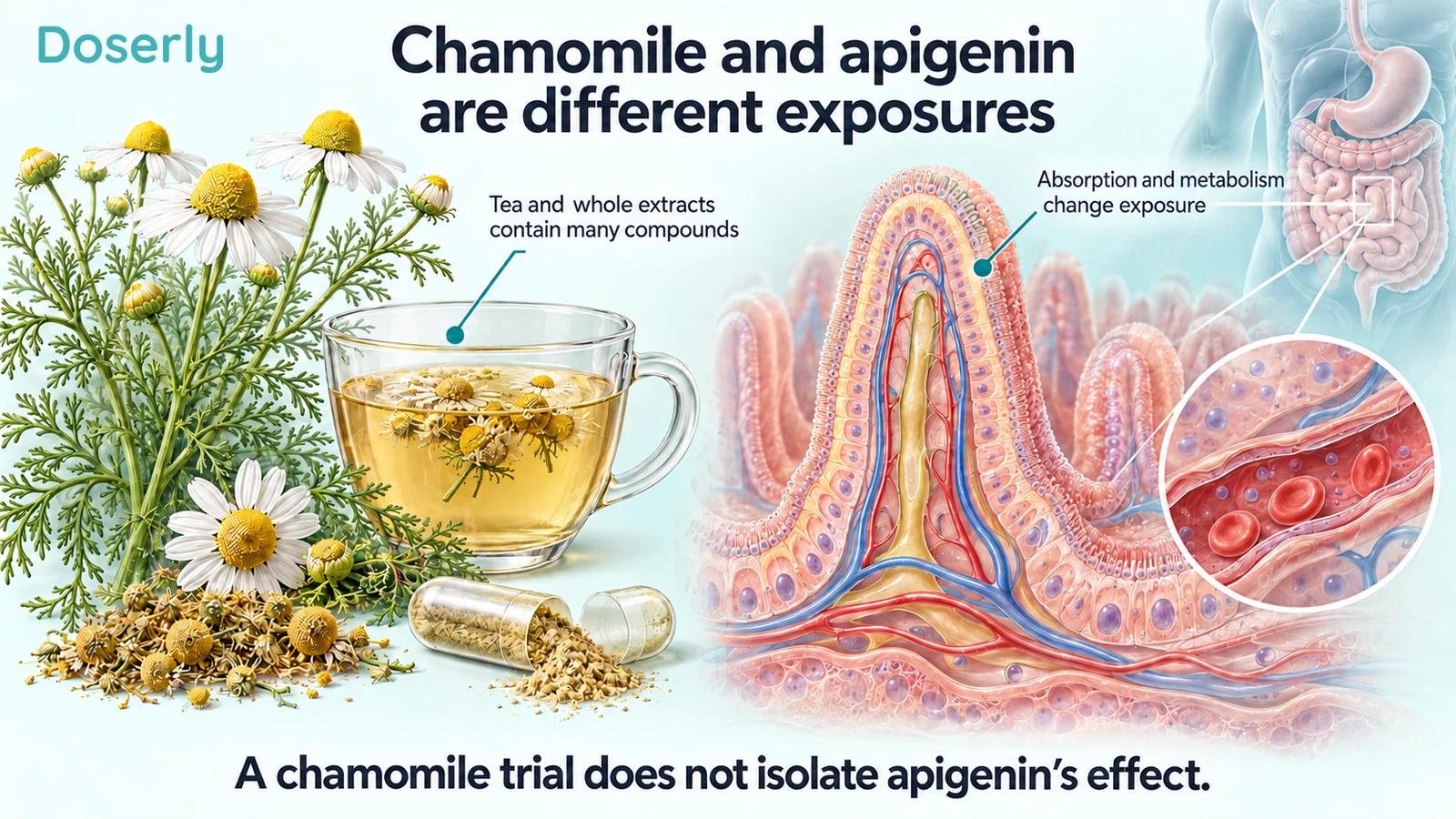
Chamomile contains multiple compounds. Tea extracts some of them into water; a concentrated extract may use a different manufacturing process and deliver a different mixture. An isolated apigenin product aims to supply one named constituent.
Even a standardized chamomile extract is not automatically an apigenin trial. Standardization means a manufacturer controls some aspect of composition, often a marker compound. Other constituents remain present and may contribute to the product's behavior. If the whole extract helps, the experiment cannot identify which ingredient caused the improvement.
This is why converting “milligrams of chamomile extract” into “milligrams of apigenin that improve sleep” is not a reliable shortcut. The former describes an administered mixture; the latter would require direct evidence about the isolated molecule. A product label should make clear which substance the quantity refers to.
The distinction also applies to safety. Ordinary food exposure provides useful context, but it doesn't establish the safety of a concentrated supplement taken nightly. Familiarity with tea is not the same as long-term clinical testing of a purified ingredient.
What the controlled insomnia trial actually tested
A 2011 pilot study enrolled 34 adults aged 18–65 with chronic primary insomnia lasting at least six months. Participants received 270 mg chamomile extract twice daily or placebo for 28 days in a randomized, double-blind comparison.
The primary outcomes came from sleep diaries: total sleep time, time to fall asleep, time awake after falling asleep, sleep efficiency, sleep quality and awakenings. There were no significant between-group improvements in these measures. Some estimates favored chamomile and others favored placebo, but the study did not establish a clear sleep benefit. Zick and colleagues
The pilot's size leaves uncertainty. A small study can miss a modest effect. But uncertainty is not a positive finding, and the results should not be described as demonstrating effective insomnia treatment. They also cannot validate a purified apigenin capsule, because that was not the intervention.
This trial is especially relevant because participants had a defined, persistent sleep problem and the comparison used a matching placebo. Those features make it more directly informative about insomnia than an uncontrolled report of people enjoying a calming drink.
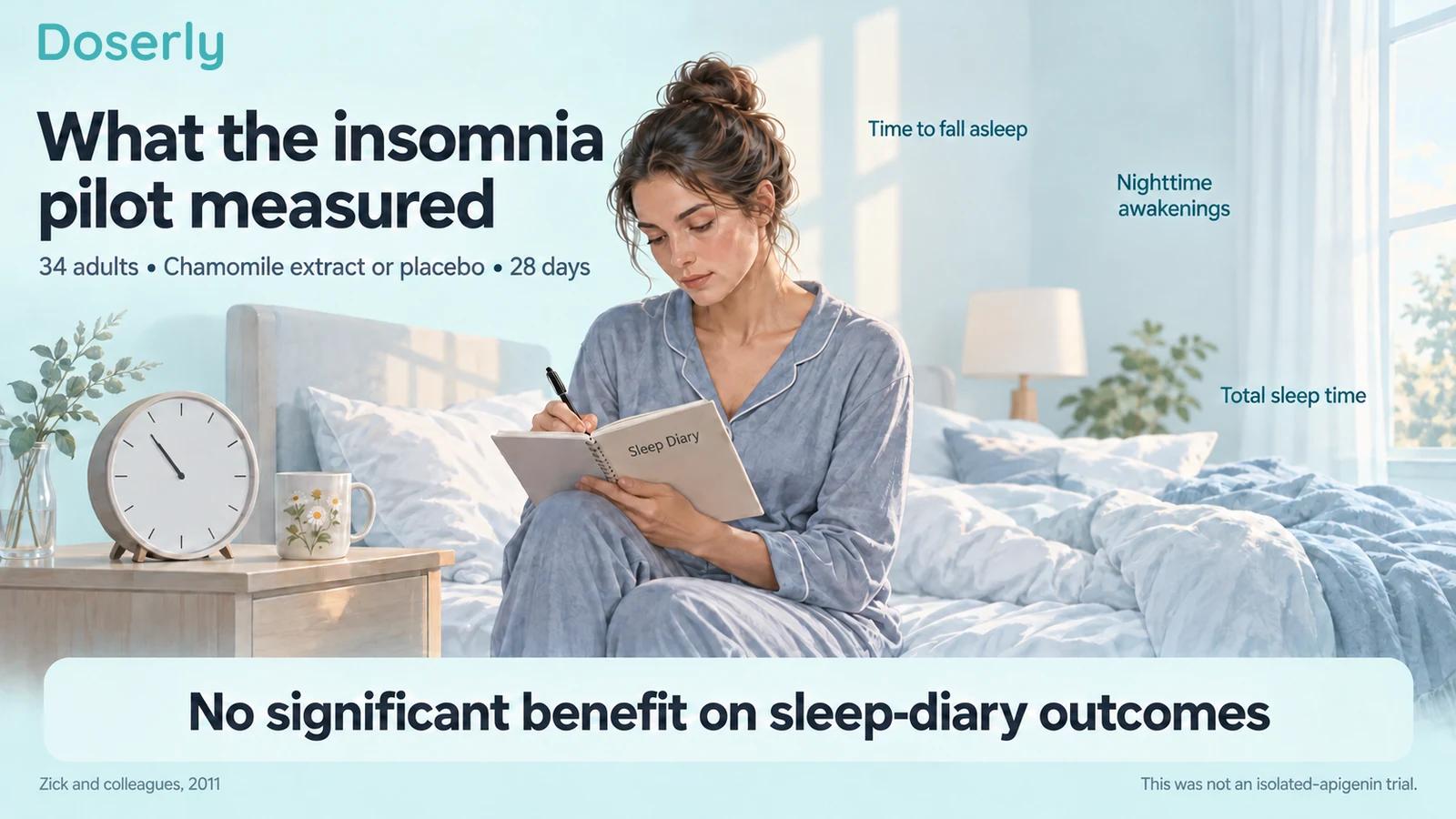
Image sources: Primary report
Why some chamomile headlines sound more positive
Other studies asked different questions. A trial in 80 Taiwanese postpartum women with poor sleep compared two weeks of chamomile tea with regular postpartum care. The tea group improved on a sleep-inefficiency subscale related to physical symptoms and on depressive symptoms immediately after the intervention. At the four-week assessment, scores on the study's three instruments were similar between groups. Chang and Chen
That is a potentially useful short-term signal in a specific setting. It wasn't a blinded comparison of apigenin with an identical placebo, and the control group did not receive a matching tea ritual. The tea, its many constituents and the experience of taking it were therefore not separated.
Postpartum sleep also has its own context, including infant care and changing routines. The finding cannot be transferred directly to an adult with longstanding insomnia, and participation in a tea study is not blanket evidence for supplement safety during breastfeeding.
A second study involved 77 older adults in nursing homes. Participants in the intervention group received 400 mg chamomile capsules twice daily for four weeks, while controls received no intervention. Questionnaire sleep scores improved. Although its title calls it a randomized trial, the abstract describes the design as quasi-experimental, and it did not use a placebo. Older-adult study
That design is more vulnerable to expectations and differences in care or reporting. It supports further investigation of that chamomile preparation in older adults; it does not establish isolated apigenin as a proven sleep aid.
What a sleep questionnaire can and cannot tell you
A sleep diary can record how long someone believes they lay awake, how often they woke and how refreshed they felt. These experiences matter. Insomnia is partly defined by difficulty sleeping and the resulting daytime burden, so dismissing personal reports would miss an important part of the problem.
However, a questionnaire improvement isn't a measurement of increased deep sleep, changed brain waves or a specific receptor effect. None of the chamomile findings above demonstrates that an apigenin capsule selectively increases a particular sleep stage.
For example, someone may rate sleep more favorably because the bedtime routine feels less stressful, even if total sleep time changes little. Another person may sleep longer but remain unrefreshed. Both patterns deserve attention, and neither is captured well by saying a product “optimizes sleep.”
A useful decision therefore begins with the desired outcome: falling asleep more easily, fewer long awakenings, better morning function or relief from persistent insomnia. The more precisely the goal is defined, the easier it becomes to see whether a cited study actually addresses it.
What about the GABA-receptor explanation?
GABA is a major inhibitory chemical messenger in the nervous system. Some medicines act at sites on GABA-related receptor complexes, and apigenin has been investigated in this context. The resulting diagrams can look persuasive because they describe a recognizable biological target.
In a 1995 study, researchers isolated apigenin from chamomile and examined receptor binding and behavior in mice. They reported anxiety-related effects in a maze test and mild sedation at a higher dose. This was not a human sleep experiment. Viola and colleagues
Later work complicated the explanation. A 2000 study found receptor-binding effects but also reduced GABA-activated chloride currents in cultured cells. In rats, reduced movement did not translate into the same pattern of anxiety-related effects, and the authors questioned whether the movement effect was explained by the proposed receptor mechanism. Avallone and colleagues
These findings show why “binds a receptor” should not be translated into “works like a gentle prescription sedative.” Binding, cellular activity, animal behavior and clinical sleep are different observations. Less movement in a rodent is not proof of restorative human sleep, and the animal work doesn't identify an effective bedtime dose for people.
Absorption is part of the unanswered question
A 2022 human study examined the absorption and metabolism of apigenin and its sugar-linked forms. Researchers measured metabolites after different exposures, including parsley and chamomile tea. The timing and amount of metabolites differed with the source, and isolated apigenin was poorly absorbed under the conditions studied. Human metabolism study
A metabolite is a substance produced as the body processes another compound. Finding one in blood or urine tells researchers something about exposure. It does not establish that enough active compound reached a relevant brain site to change sleep.
This is also why a claim of improved bioavailability is not, by itself, a claim of improved insomnia treatment. A formulation designed to increase absorption would still need a sleep trial and its own safety assessment. More exposure could change benefits, unwanted effects or both.
For readers comparing labels, the practical point is to identify the actual preparation. A tea, an ordinary extract and an absorption-enhanced capsule should not share a single clinical promise merely because all mention apigenin.
What safety information applies?
The US National Center for Complementary and Integrative Health says chamomile is likely safe in usual food and tea amounts, while medicinal use has a more limited short-term evidence base. Reported concerns include allergic reactions, particularly in people sensitive to related plants, and interactions involving warfarin or medicines processed by the liver. Interactions with sedatives are also a theoretical concern. NCCIH chamomile information
These are chamomile cautions, not a complete safety profile for isolated apigenin. They shouldn't be used to claim that purified apigenin has exactly the same risks, or that it avoids them. Direct safety information for a particular concentrated product may be limited.
If you take medicines, bring the exact label to a pharmacist or clinician. The same applies to pregnancy, breastfeeding or an ongoing health condition. “Natural” doesn't identify a safe combination, and adding several sleep ingredients can make it harder to recognize what caused dizziness, digestive symptoms or next-day impairment.
Does a sleep stack make the evidence stronger?
Combining apigenin with theanine, magnesium or another ingredient does not fill the gap in apigenin-specific evidence. A trial of one component cannot prove that the entire combination works, and a trial of a blend cannot necessarily identify the contribution of each component.
A randomized trial published online in October 2026 adds directly relevant blend evidence. It enrolled 103 healthy, physically active adults into four morning/evening treatment combinations. The evening product contained magnesium L-threonate, L-theanine and 50 mg apigenin; supplementation lasted two weeks within a four-week protocol. There was no isolated-apigenin arm, so the trial cannot identify whether apigenin itself helped sleep or how its contribution compared with the other ingredients. Detailed efficacy claims require the full report; the primary abstract alone does not justify treating this formulation as proof for a standalone capsule. Multi-compound trial, 2026
The same applies to personal experimentation. If several products are started together and sleep improves, the improvement is worth recording, but its cause remains uncertain. If a side effect develops, identifying the responsible ingredient may be equally difficult.
Our L-theanine guide covers a frequently paired ingredient. Its evidence should be considered on its own terms, including whether a study examined sleep, stress or attention. These outcomes are not interchangeable merely because the products appear together in a bedtime routine.
A more useful next step for ongoing insomnia
For persistent insomnia, a structured assessment can be more useful than escalating a supplement stack. The American Academy of Sleep Medicine strongly recommends multicomponent cognitive behavioral therapy for insomnia, or CBT-I. It addresses patterns of behavior and thinking that maintain insomnia and is more specific than general sleep-hygiene advice. AASM guideline
A short record of sleep timing, awakenings, daytime effects and products used can help that discussion. Describe whether the problem is inability to sleep despite adequate opportunity, a schedule that allows too little sleep, or sleep that remains unrefreshing. Those descriptions lead to different clinical questions.
Apigenin has an interesting laboratory rationale and a connection to a familiar plant. The human sleep evidence reviewed here does not yet provide a reliable efficacy estimate, a proven capsule dose or a demonstrated long-term benefit for isolated apigenin. Enjoying chamomile tea and regarding a concentrated supplement as an established insomnia treatment are different decisions.
Sources
- Zick et al., 2011: placebo-controlled chamomile insomnia pilot.
- Chang and Chen, 2016: chamomile tea in postpartum women.
- Adib-Hajbaghery and colleagues, 2017: nursing-home chamomile study.
- Viola et al., 1995: receptor binding and mouse behavior.
- Avallone et al., 2000: apigenin pharmacology in cells and rats.
- Human apigenin absorption and metabolism study, 2022.
- NCCIH: chamomile evidence and safety.
- AASM, 2021: behavioral treatment of chronic insomnia.
- Multi-compound stress and sleep trial (2026)