
Peptides
October 16, 2026
Amylin versus GLP-1: why cagrilintide brings a different appetite signal
On this page
Feeling satisfied after a meal involves communication between the digestive system, pancreas and brain. Several hormones participate, and they do not all act at the same receptor. That is why researchers are interested in cagrilintide even though effective GLP-1 medicines already exist.
Cagrilintide is a long-acting amylin analogue, not another GLP-1 agonist. It is designed around a different hormone system. Semaglutide acts at GLP-1 receptors; cagrilintide activates amylin-family receptors and also the calcitonin receptor. The distinction provides a biological reason to study the two together, but it does not automatically establish the benefit or safety of every possible combination. Receptor pharmacology study.
The practical question is what this different signal adds: a new way to influence appetite, a demonstrated treatment effect, or both? Let's follow the biology from hormone release to receptors and then compare it with what human trials actually measured.
What does the body's amylin do?
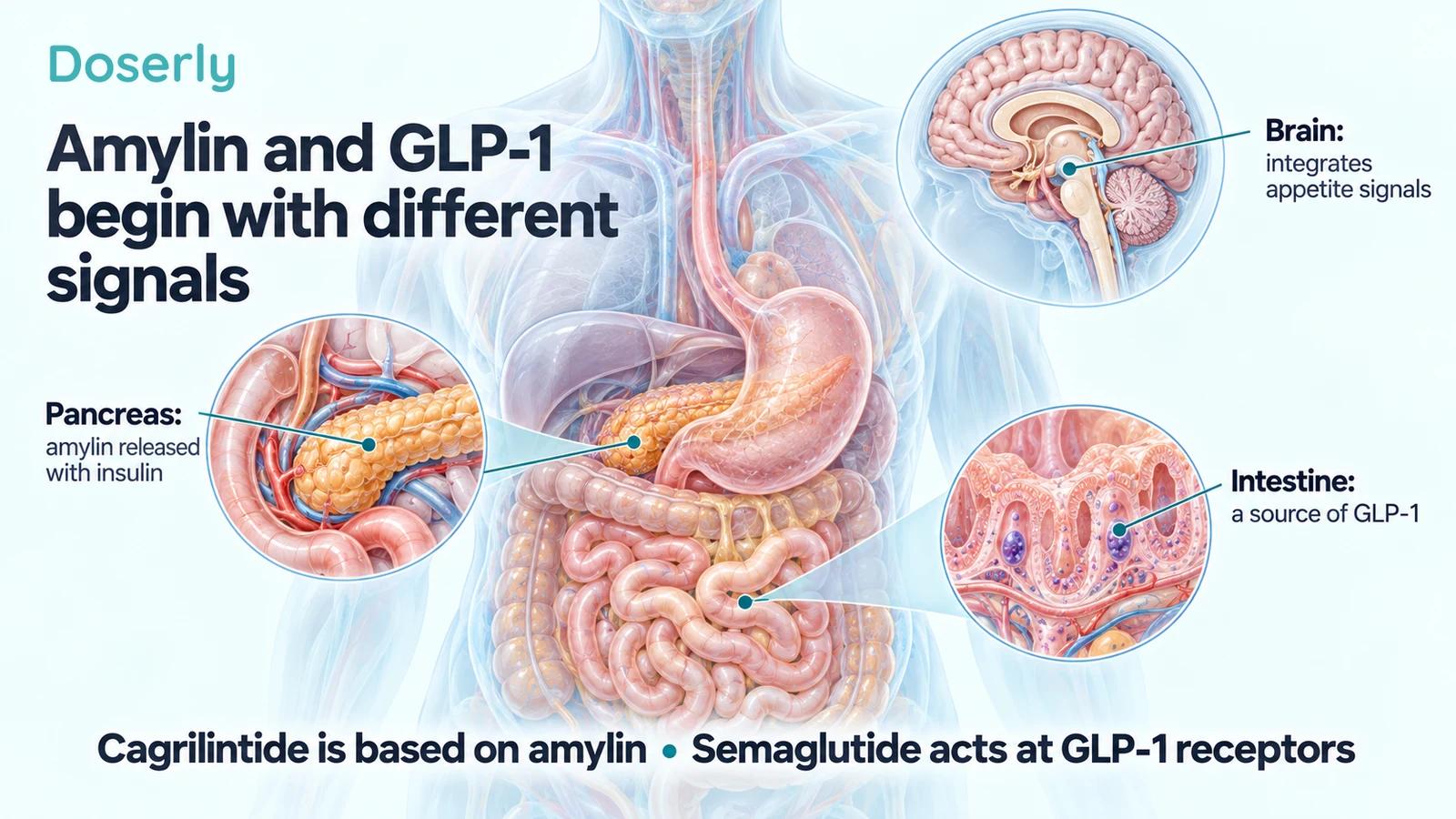
Amylin is a peptide hormone released from pancreatic beta cells alongside insulin. These cells sit in small clusters within the pancreas. Insulin is familiar for its role in glucose regulation; amylin contributes to the body's response to eating, including signals involved in limiting food intake.
This is a normal physiological system, not a discovery that people with obesity universally lack amylin. A medicine based on a hormone can produce an effect without proving that everyone who benefits had a deficiency of that hormone beforehand. The two propositions require different evidence.
The brainstem is an important site of amylin-related signaling. It receives and integrates information relevant to eating and internal bodily conditions. Researchers studying cagrilintide are investigating which cells and circuits contribute to short-term reductions in food intake and longer-term weight effects. Cross-species brainstem research.
GLP-1 belongs to a different signaling system. It is produced in the intestine and in specific brain cells, and medicines such as semaglutide activate its receptor. Both systems can influence appetite, but their overlap at the level of eating behavior does not make them the same molecular target. Our semaglutide guide covers that medicine's broader clinical uses.
What changes when amylin becomes a medicine?
Cagrilintide is an analogue: a modified molecule based on amylin. Drug development changes a molecule's properties so it can be studied as a practical treatment. In cagrilintide's case, modifications were designed to improve its pharmaceutical behavior and prolong its presence in the body.
The development report describes changes to the peptide and attachment of a fatty-acid component. Those are deliberate chemical modifications, not merely a larger amount of the body's native hormone. They help explain why conclusions about naturally released amylin cannot automatically supply every detail of cagrilintide's effects. Original development report.
“Long acting” also does not mean the body receives a natural meal-by-meal pulse. A weekly investigational treatment creates a different exposure pattern. Researchers must establish what that exposure does to appetite, weight, tolerability and other outcomes in people.
For someone considering the research, the relevant comparison is therefore between tested medicines and regimens. It is not between a “natural” and “unnatural” appetite signal, and it is not a reason to assume that a hormone-based treatment is free of adverse effects.
Why the amylin receptor has an unusual name
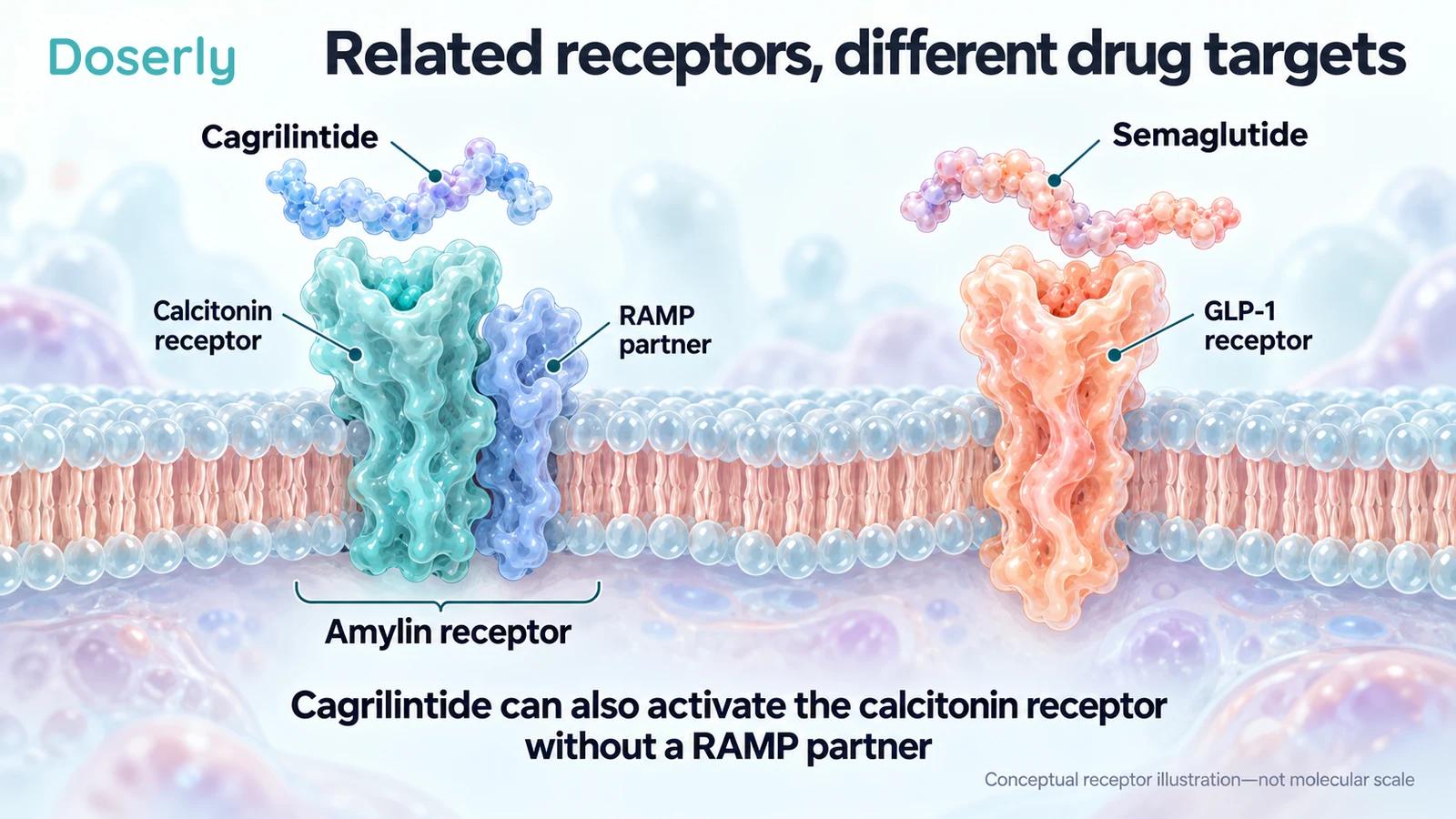
A receptor is a protein system through which a cell responds to a signal. Amylin receptors are built from the calcitonin receptor together with a partner called a receptor activity-modifying protein, abbreviated RAMP. The name describes what the partner does: it changes the receptor's functional properties.
There are three RAMP partners associated with the three commonly discussed amylin receptor forms, AMY1, AMY2 and AMY3. The calcitonin receptor can also exist without a RAMP partner. These related receptor arrangements respond differently to different peptides.
Cagrilintide is not perfectly selective for only one of these arrangements. Laboratory pharmacology shows activity at both amylin receptors and the calcitonin receptor. That is why some papers describe it as a dual amylin and calcitonin receptor agonist. Comparative receptor experiments.
A 2025 structural study examined cagrilintide bound to the three amylin receptors and the calcitonin receptor, using cryo-electron microscopy and related analyses. It helps explain how the drug engages its targets. It did not establish a personal weight-loss prediction or show that each receptor contributes an equal share of benefit. Structural study.
What have brainstem experiments added?
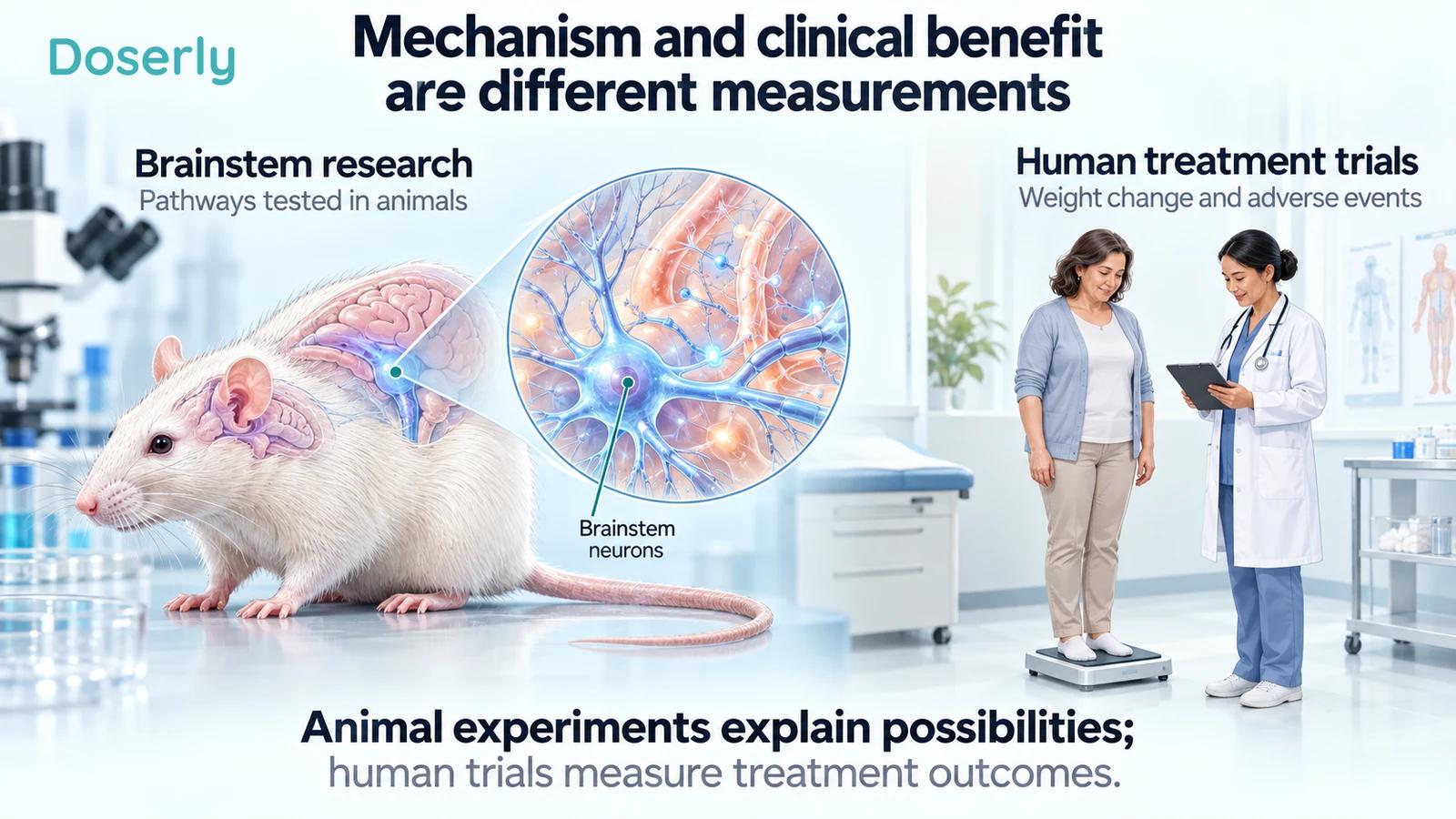
The 2026 cross-species atlas examined brainstem cell populations in rats, mice and macaques. It helped researchers identify conserved types of neurons, or nerve cells, relevant to amylin-related signaling. Finding related cell populations across species is valuable, but it is not itself a human treatment trial.
The causal experiments were particularly informative in rats. Reducing expression of prolactin-releasing hormone in a brainstem region disrupted cagrilintide's effects while leaving semaglutide's effects intact in that experimental setting. This supports a difference in the pathways required for the two drugs' actions in those animals. Primary brainstem study.
The study also distinguished acute effects from longer-term ones. Activating one population could affect feeding transiently without reproducing sustained weight effects. That finding is a useful reminder that an immediate appetite change and durable weight management are related but different outcomes.
These experiments give the combination rationale more detail. They do not show that a human with a particular appetite pattern needs an amylin medicine, nor provide a blood test that identifies a cagrilintide responder. Those would require separate clinical validation.
Has cagrilintide alone changed weight in people?
Yes. Unlike a purely theoretical appetite signal, cagrilintide has randomized human treatment evidence. A 2021 dose-finding trial randomized 706 adults with overweight or obesity and without diabetes. It tested several cagrilintide doses, placebo and the GLP-1 medicine liraglutide over 26 weeks.
Under the trial-product analysis—which estimates outcomes if treatment is taken as intended— estimated mean weight reductions ranged from 6.0% to 10.8% across cagrilintide groups, compared with 3.0% with placebo. The highest cagrilintide dose produced a larger average reduction than liraglutide in that study. Gastrointestinal symptoms and injection-site reactions were among the common adverse events. Cagrilintide phase 2 trial.
This demonstrates that the investigational molecule has clinically measurable activity without semaglutide. It does not prove superiority to all GLP-1 medicines: liraglutide, semaglutide and other compounds differ, and the trial tested a specific comparator.
It also does not tell us exactly how much of the weight effect came from each neural pathway. A successful weight trial can establish a treatment effect even while the detailed mechanism remains incompletely mapped.
What did combining the signals accomplish?
REDEFINE 1 tested cagrilintide plus semaglutide, known as CagriSema, against placebo and the individual components in 3,417 adults without diabetes. At 68 weeks, mean weight reduction under the treatment-policy analysis, which includes the effects of stopping treatment, was 20.4% with the combination and 3.0% with placebo. The combination also outperformed the single-component arms on the trial's weight comparison. REDEFINE 1.
This is stronger evidence for that particular pairing than receptor diagrams alone. Participants were actually assigned to the treatments, followed and measured. Both benefit and adverse events were part of the answer.
The result still does not establish that simply adding percentages from two standalone studies predicts a combination's effect. Biological pathways overlap, dose exposure differs, and tolerability can limit treatment. A combination must be tested rather than calculated by adding two headlines.
Similarly, evidence for cagrilintide plus semaglutide cannot be transferred to cagrilintide plus tirzepatide or retatrutide. These other medicines have different receptor profiles and treatment evidence. Mechanistic plausibility can justify research; it cannot replace the missing comparison.
Is appetite suppression just slower stomach emptying?
It is too simple to reduce these medicines' effects to food remaining in the stomach longer. Appetite involves brain signaling, sensations of hunger and fullness, food cues and behavior as well as digestive movement. Gastric emptying is the movement of stomach contents into the small intestine; it is one measurement, not a synonym for appetite.
A semaglutide study illustrates the distinction. In 72 adults with obesity treated for 20 weeks, semaglutide reduced intake at a test lunch and improved appetite-related ratings compared with placebo. The study did not find evidence of delayed gastric emptying at week 20 using its indirect paracetamol-absorption method. Semaglutide appetite trial.
That finding does not prove semaglutide never affects gastric emptying. The method, meal and timing of assessment matter. It does show why the statement “the drug works only by keeping the stomach full” is inadequate.
The same care is needed with cagrilintide. A finding about native amylin, a rat experiment or a combination does not automatically quantify gastric emptying during cagrilintide-alone treatment in humans. When discussing a proposed mechanism, keep the studied substance, species and measurement visible.
Does a different pathway mean fewer side effects?
Not necessarily. Acting at a different receptor creates the possibility of different benefits and risks, but it does not guarantee better tolerability. In the standalone cagrilintide phase 2 trial, nausea occurred across the active-dose groups. In REDEFINE 1, gastrointestinal adverse events were more common with the combination than with placebo. Standalone trial and combination trial.
A useful appetite effect should be considered alongside adequate nutrition, hydration and daily functioning. Feeling satisfied with a smaller meal and being unable to eat because of nausea are different experiences. The latter should not be treated as proof that the medicine is working especially well.
Nor does a different receptor guarantee success after another medicine has been ineffective. That is a question about treatment selection in a specific clinical population, not a conclusion that follows from receptor names.
What does the distinction mean for you?
Amylin research expands the biological approaches being investigated for weight management. Cagrilintide's different receptor activity is supported by laboratory work, and its weight effects are supported by human trials. The most useful interpretation combines those two kinds of evidence while keeping their roles clear.
If you are discussing future treatment options with a clinician, ask which outcome matters most: weight, glucose control, eating-related distress or another health problem. Then ask which study measured that outcome with the exact intervention being considered.
As checked on October 15, 2026, FDA identifies cagrilintide as unapproved and not eligible for compounding under US federal law. Research findings do not make independently sold vials equivalent to investigational trial products. FDA statement.
The cagrilintide guide provides a broader view of its clinical development. The central distinction is straightforward: cagrilintide offers a different biological target, while the value of any particular treatment or combination must come from measured human benefits and harms.
A receptor result also does not rank the strength of two medicines in people. Laboratory activity, exposure in the body and a clinically useful outcome must be connected by human evidence.
Sources
- Fletcher and colleagues, receptor pharmacology, 2021.
- Development of cagrilintide, 2021.
- Cao and colleagues, receptor structures, 2025.
- Ludwig and colleagues, cross-species brainstem atlas, 2026.
- Cagrilintide standalone phase 2 trial, 2021.
- REDEFINE 1 combination trial, 2025.
- Semaglutide appetite and gastric-emptying trial, 2021.
- FDA, unapproved GLP-1 drugs.