
TRT
October 16, 2026
Normal testosterone but still tired: what to review next
On this page
Testosterone contributes to sexual function, blood-cell production, muscle and bone health. When a person has symptoms and repeatedly low testosterone, treatment may address an important hormonal deficiency. But fatigue has many possible contributors, and restoring a laboratory result doesn't guarantee that every contributor has been treated.
If your testosterone level is now in range but you still feel exhausted, that is useful information. It doesn't mean the symptom is imaginary, and it doesn't automatically mean the target should be higher. The next step is to review what improved, what didn't, and whether the original explanation for fatigue still fits.
This article concerns persistent fatigue during treatment for male hypogonadism. It isn't a way to diagnose the cause from a single result. Our TRT results timeline guide provides broader context on response, while the research below explains why hormone normalization and feeling better can diverge.
First, describe what “tired” means
People use the same word for different experiences. You might feel sleepy enough to doze off, physically weak, mentally slowed, short of breath with activity, or depleted despite sleeping. These descriptions can lead a clinician toward different questions.
Try describing the limitation in ordinary terms. “I fall asleep during afternoon meetings” is different from “I can stay awake, but climbing stairs has become difficult.” “I have no motivation” may involve mood, sleep, physical illness or several factors together. The point is to make the symptom clearer, not to select your own diagnosis.
Timing helps too. Did fatigue begin before treatment? Has it changed gradually or abruptly? Does it follow a repeated pattern around administration, or is it present every day? Is it new fatigue after an earlier improvement?
A useful assessment compares the current problem with the original treatment goal. If libido improved but fatigue didn't, treatment may have helped one symptom while leaving another unexplained. Calling the entire response either a success or failure can hide that distinction.
What trials found when testosterone rose
The Testosterone Trials enrolled 790 men aged 65 or older with low testosterone and relevant symptoms. Participants received testosterone gel or placebo for one year and took part in one or more linked trials. The study raised testosterone into the intended range, yet different outcomes responded differently. Primary Testosterone Trials report
In the Vitality Trial, the main outcome was the proportion achieving at least a four-point improvement on a fatigue questionnaire. Testosterone did not significantly improve that outcome compared with placebo: the odds ratio was 1.23, with P=0.30. Some secondary measures of mood and vitality showed small changes.
That finding doesn't prove nobody felt more energetic. It shows that biochemical correction did not produce a clear benefit on the fatigue outcome chosen in advance in this older study population. It also doesn't answer every question about younger men or severe organic hormone deficiency.
For a patient, the implication is practical: persistent tiredness after normalization is a recognizable treatment situation. There is no scientific requirement to keep increasing exposure until every nonspecific symptom disappears.
Check what the “normal” result actually represents
A laboratory reference range describes how a measurement is interpreted using that laboratory's method and reference population. It isn't an individualized promise of symptom relief.
During treatment, timing relative to administration matters. A sample near a peak can tell a different story from one near the end of an interval. Recent changes, missed administrations and the formulation used also affect interpretation. Ask whether the sample was taken under the conditions intended for your prescription.
Total testosterone includes hormone bound to circulating proteins as well as free hormone. In selected diagnostic situations, altered sex hormone-binding globulin can make free testosterone assessment useful. That is a reason for careful interpretation, not a reason for everyone to order repeated panels or pursue an arbitrary free-testosterone target. Endocrine Society guideline
The clinician may confirm that exposure is appropriate, identify an issue with sampling or decide a different assessment is needed. Even if the result is entirely reassuring, it remains only one part of explaining fatigue.
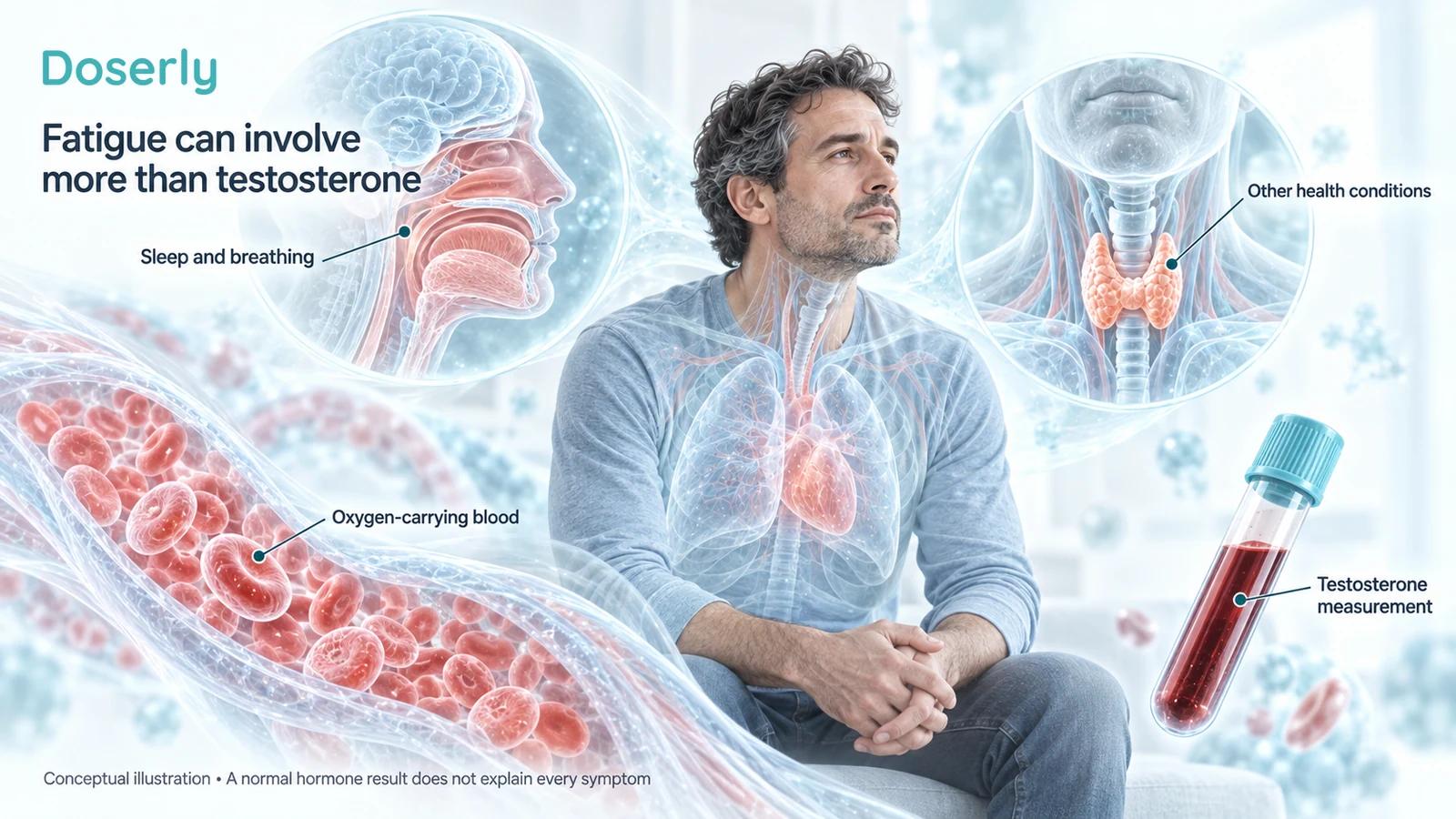
The illustrations show possible areas for clinical assessment. They do not diagnose sleep apnea, thyroid disease or anemia, and they are not a checklist of tests that every tired person needs.
Sleep deserves its own conversation
Obstructive sleep apnea involves repeated obstruction of breathing during sleep. Daytime sleepiness, fatigue, snoring or observed breathing pauses can be clues, although symptoms alone cannot confirm the diagnosis. A bed partner may notice events the person sleeping does not. NHLBI sleep apnea symptoms
A testosterone result cannot assess whether breathing is repeatedly disrupted overnight. Neither can the observation that someone spends eight hours in bed. Sleep duration and sleep quality answer different questions.
There is also a specific treatment interaction worth understanding. A randomized study in 67 men with obesity and severe obstructive sleep apnea compared injectable testosterone undecanoate with placebo over 18 weeks, alongside a dietary intervention. Breathing-related measurements worsened with testosterone at seven weeks; the between-group differences were not significant at 18 weeks. Hoyos and colleagues
This limited study doesn't establish that every person on TRT develops apnea or that a later nonsignificant result guarantees safety. It supports taking existing sleep-disordered breathing seriously. Persistent sleepiness, new snoring or observed pauses should be discussed directly rather than interpreted only as evidence that testosterone is insufficient.
If sleepiness is affecting driving or other safety-sensitive activities, address that promptly. Waiting for a future hormone adjustment does not resolve the immediate functional concern.
A blood count can tell a different story
Hemoglobin is the oxygen-carrying protein in red blood cells. Anemia means that the blood's hemoglobin concentration is below the relevant threshold. It can contribute to fatigue, but fatigue alone cannot establish that anemia is present or identify its cause.
Testosterone can affect red-cell production. In the TRAVERSE anemia study, 815 participants had anemia at baseline. Among those assessed at six months, anemia had corrected in 143 of 349 testosterone recipients, or 41.0%, compared with 103 of 375 placebo recipients, or 27.5%. TRAVERSE anemia report
Those are results in men with hypogonadism and cardiovascular disease or risk factors, using a study-specific anemia definition. They are not the percentage of all tired people who will benefit from testosterone. The denominators also describe participants assessed at that visit, not every person initially enrolled.
The same biological effect needs monitoring because an excessive rise in red-cell concentration is a different problem. More hemoglobin is not an unlimited route to more energy. A blood-count review can therefore address both inadequate correction and treatment-related excess, depending on the actual result.
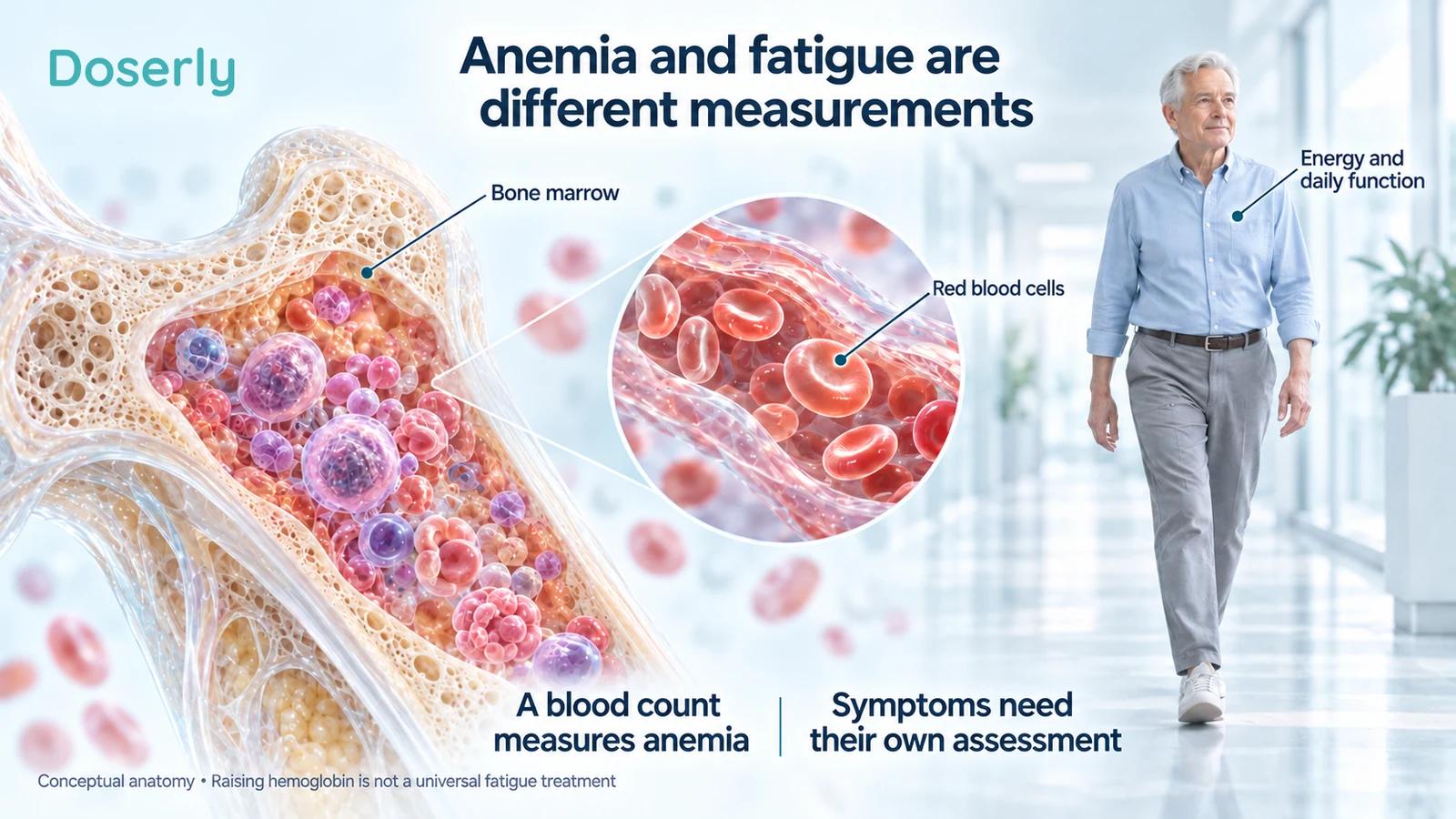
Bone marrow produces blood cells. This conceptual anatomy does not show a treatment effect. A blood-count improvement and a change in daily energy need to be assessed separately.
Revisit the original cause of low testosterone
Low testosterone can arise from problems in the testes, the brain's hormonal signaling system, or conditions that suppress that system. The underlying cause matters because replacing testosterone may not address everything associated with it.
For example, the Endocrine Society guideline distinguishes structural or destructive disorders from potentially reversible suppression associated with illness, obesity or certain medicines. It recommends investigating the cause rather than treating every low measurement as the same condition. Diagnostic guidance
If the original assessment was incomplete, persistent symptoms may be a reason to review it. This doesn't mean everyone needs imaging or an extensive endocrine investigation. The history, examination and earlier results should guide what is relevant.
It also helps to bring a complete medication list, including nonprescription products. A clinician needs to know what started, stopped or changed around the time fatigue developed. Reviewing those details is often more informative than repeatedly examining the same hormone number in isolation.
What else belongs in the clinical review?
A clinician may consider sleep, mood, nutritional problems, thyroid function, anemia, other chronic illness or medication effects according to the symptom pattern. These possibilities shouldn't become a self-directed list of diagnoses. The right next assessment depends on what else is happening.
Tell the clinician about changes in weight, appetite, exercise tolerance, sleep and everyday functioning. Mention recent illness and whether symptoms are improving or deteriorating. If fatigue is accompanied by a new significant symptom, make that clear instead of presenting everything as a routine TRT question.
An abrupt change with chest pain, severe breathlessness, fainting or other acute concerning symptoms needs urgent assessment. It should not be managed by waiting to see whether another administration changes how you feel.
For ongoing fatigue without acute warning features, a planned review can be more useful than frequent reactive adjustments. The goal is to identify a plausible explanation and a way to assess it, rather than add treatments until something seems to help.
When should the benefit of TRT itself be reconsidered?
The American Urological Association guideline advises discussing cessation three to six months after starting therapy when testosterone has normalized but symptoms or signs have not improved. This is a clinical review principle, not a direction to stop treatment independently. AUA guideline
The original indication matters. A person with established permanent hormone deficiency may have treatment goals beyond fatigue, including maintaining other aspects of health. Someone treated primarily for a nonspecific symptom needs a clear discussion of whether the anticipated benefit occurred.
That discussion should include adverse effects, practical burden and any improvements that did happen. It may lead to further assessment, a revised goal or a supervised treatment change. It should not be reduced to a single rule that everyone with persistent fatigue needs more testosterone or that everyone should stop.
Bring a short record that helps answer a question
Choose a few observations you can record reliably. Note when fatigue interfered with a specific activity, how sleep was, and whether medication or health circumstances changed. Keep treatment and blood-test dates together so the clinician can interpret the sequence.
Avoid changing several supplements or routines solely to create an experiment. Everyday life already contains enough variation to make causal interpretation difficult. The record's purpose is to improve the clinical conversation, not to prove the cause on your own.
At review, ask which goal TRT has met, what remains unexplained, and what the next assessment is intended to clarify. Agree on a follow-up point and what would prompt earlier contact. Our TRT side-effects guide can help you describe treatment-related concerns alongside the fatigue itself.
A normal testosterone result can be reassuring while still leaving important work to do. Persistent fatigue deserves an explanation that fits your actual symptoms and health history.
Sources
- Effects of Testosterone Treatment in Older Men, 2016.
- TRAVERSE anemia randomized substudy, 2023.
- Testosterone and breathing in severe obstructive sleep apnea, 2012.
- American Urological Association testosterone-deficiency guideline.
- Endocrine Society clinical practice guideline, 2018.
- NHLBI sleep apnea symptoms.