
In this guide
What is Bilberry Extract?
Bilberry is Vaccinium myrtillus, a European berry rich in anthocyanins. Whole fruit, juice, a standardized anthocyanin extract, purified anthocyanoside oligomers and mixed-berry formulas are different exposures. Blueberry and bog bilberry are different Vaccinium species. [1], [4]
Typical Bilberry Extract Protocols
| Source and question | Preparation | Amount each administration | Daily total | Frequency and duration | Main interpretation |
|---|---|---|---|---|---|
| Levy 1998 · crossover · 16 healthy volunteers | Anthocyanosides versus placebo | 12, 24 or 36 mg | Single exposure | One dose; tests at 4, 8 and 24 hours with 2-week washouts | No significant effect on scotopic threshold, dark adaptation or mesopic contrast |
| Kosehira 2020 · screen-task RCT · 109 | Standardized bilberry extract versus placebo | 240 mg | 240 mg/day | Once daily for 12 weeks | Selected accommodative microfluctuation findings favored extract; company-employed authors and healthy screen-task population |
| Szumny 2026 · presbyopia crossover · 23 | Mixed aronia, honeysuckle and bilberry extract | 400 mg | 800 mg/day | Twice daily for 6 weeks, 5-week washout | Exploratory selected outcomes changed; tiny mixed-product trial cannot isolate bilberry |
- Exact product
- Record species, form, lot and co-ingredients.
- Each administration
- Keep amount, timing and context.
- Real endpoint
- Separate biomarker, symptom and clinical outcome.
What is it commonly used for?
A systematic review found 12 placebo-controlled night-vision trials: the four most recent randomized studies were negative, and 11 of 12 studied people with normal or above-average sight. A 16-person crossover found no acute effect from 12, 24 or 36 mg anthocyanosides. A manufacturer-linked 109-person trial found selected accommodative microfluctuation improvements with 240 mg/day for 12 weeks after screen tasks; this does not establish treatment of retinal disease or impaired night vision. A 2026 mixed aronia, honeysuckle and bilberry trial cannot isolate bilberry. [1], [2], [4]
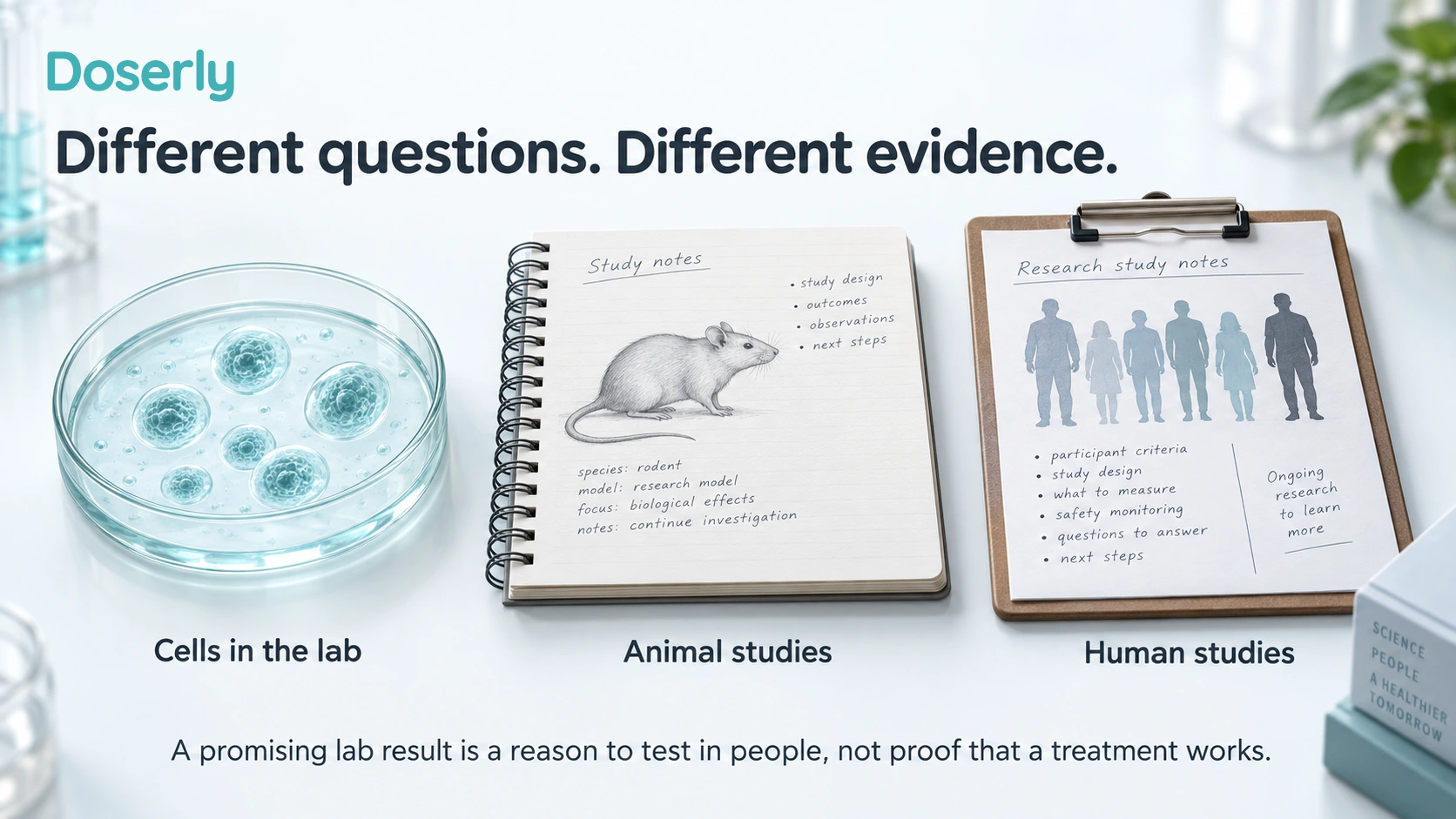
One result answers one question
How do forms and labels differ?
A useful label identifies V. myrtillus, plant part, extraction ratio, anthocyanin assay and amount per administration. Percent anthocyanins, anthocyanosides and purified oligomers are not automatically equivalent. Mixed berry products prevent attribution to bilberry. [4], [5]
How should the product be stored?
Follow the finished product’s label, keep it dry in its original container and away from children. Discard an expired, heat-damaged, broken-seal or untraceable product.
What does human research show?
| Question | Best direct evidence | Finding | Boundary |
|---|---|---|---|
| Efficacy | Levy 1998 · crossover · 16 healthy volunteers | No significant effect on scotopic threshold, dark adaptation or mesopic contrast | Specific product and population |
| Replication | Limited evidence | No universal effect established | Variable formulations |
| Universal dose? | None | Not established | Rows cannot be combined |
Keep the finished product reviewable
What are the risks and interactions?
Food amounts and concentrated extracts are different exposures. Gastrointestinal symptoms and allergy are possible. Bilberry may have antiplatelet or glucose-lowering effects in experimental or limited clinical contexts, so anticoagulants, antiplatelets and glucose-lowering medicines warrant pharmacist review. Sudden visual symptoms require eye care, not dose escalation. [2], [3], [5], [6]
Seek urgent eye care for sudden vision loss, a curtain or shadow, new flashes or many floaters, severe pain, new central distortion or a rapidly enlarging dark area.
What is the legal and regulatory status?
In the United States, it is sold as a dietary supplement; FDA does not approve it for safety and effectiveness before sale. In Canada, verify the exact product, NPN and authorized label. Legal sale does not prove efficacy or sport suitability. [6]
When should use stop?
Stop for any allergic reaction, persistent symptom worsening, unexpected laboratory result or doubt about product identity.
What should be monitored?
Record species, extract, anthocyanin specification, each amount, daily total, co-ingredients and the exact visual task or symptom. Use objective eye testing where clinically relevant. Screen fatigue, presbyopia, myopia and retinal disease should not be merged into one outcome.
What can community experience add?
Reports can compare taste, capsule color, screen comfort and stomach effects. They cannot verify anthocyanin identity or demonstrate better night vision. No systematic current community sample was assembled.
How do related options compare?
| Option | Main distinction |
|---|---|
| Whole bilberry | Food matrix with variable anthocyanins |
| Standardized extract | Species and anthocyanin assay should be declared |
| Mixed berry formula | Co-ingredients prevent bilberry attribution |
Common questions
Does bilberry improve normal night vision?
Rigorous randomized evidence does not support that claim.
What did 12–36 mg do?
Nothing significant on three night-vision tests in a small acute crossover.
What does 240 mg/day mean?
It belongs to one standardized extract and screen-task outcome, not a universal eye dose.
Can a mixed berry trial prove bilberry works?
No. Aronia and honeysuckle were also active ingredients.
Is blueberry equivalent?
No. Species and extract composition differ.
When is an eye exam needed?
For persistent fatigue, impaired night vision, distortion, flashes, floaters or vision loss.
Glossary
Terms for reading the evidence.
- Endpoint
- A defined result measured in a study.
- Anaphylaxis
- A potentially life-threatening systemic allergic reaction.
- Biomarker
- A biological measure that does not guarantee clinical benefit.
- Standardization
- A measured specification for a product component.
- Cross-reactivity
- Immune recognition of related proteins from different sources.
How this guide was researched
NCBI identities, publication notices, indexed abstracts and available open methods were checked. Null outcomes, mixed products, surrogate endpoints and missing details remain visible.
Research record · checked October 9, 2026
Identity: NCBI EFetch verified titles, authors, journals, DOI and descendant notices. PMID 14711439 links correspondence and an author reply, not a correction. No retraction or expression of concern appeared.
Attribution: the 2026 product contained aronia, honeysuckle and bilberry and is labelled mixed. The 2005 purified anthocyanoside study is not used as bilberry-only proof.
Conflict: the 240 mg study included company-employed authors; null outcomes and product limits remain visible.
Explore the sources
Primary human evidence and official context.
Showing 6 sources
- 01
Anthocyanosides of Vaccinium myrtillus (bilberry) for night vision--a systematic review of placebo-controlled trials. ↗
Systematic review
Twelve placebo-controlled trials were identified; the four newest randomized studies were negative, mostly in normal vision.
- 02
The effect of anthocyanosides on night vision. ↗
Randomized crossover trial
Sixteen healthy volunteers received single 12, 24 and 36 mg doses; three night-vision tests were null through 24 hours.
- 03
A 12-Week-Long Intake of Bilberry Extract (Vaccinium myrtillus L.) Improved Objective Findings of Ciliary Muscle Contraction of the Eye: A Randomized, Double-Blind, Placebo-Controlled, Parallel-Group Comparison Trial. ↗
Randomized controlled trial
One hundred nine healthy adults received 240 mg once daily; selected screen-task physiology favored extract and two authors worked for the product company.
- 04
Standardized Berry Extract Improves Selected Visual Function Outcomes in Presbyopia: A Randomized, Double-Blind, Placebo-Controlled Crossover Trial with Exploratory Biomarker Analysis. ↗
Randomized crossover trial
Twenty-three adults received a mixed aronia, honeysuckle and bilberry extract 400 mg twice daily; bilberry cannot be isolated.
- 05
Bilberry Fruit ↗
Institutional evidence overview
Summarizes limited clinical evidence and possible interaction concerns without endorsing night-vision treatment.
- 06
FDA 101: Dietary Supplements ↗
Official supplement overview
FDA does not approve dietary supplements for safety and effectiveness before sale.
No matching sources
Try a different term or show the full list.
Editorial note
This guide separates composition, biomarker, symptom and clinical outcome. It does not turn a narrow signal into a general promise.