
In this guide
What is PNC-27?
PNC-27 is a lab-made peptide designed as an experimental cancer drug. It joins a short piece of the body's p53 protein, a well-known tumour suppressor, to a tail that helps it stick to and cross cell membranes. It has been tested only in cells and animals, and it is not approved as a medicine in the United States or Canada. [1], [7]
A peptide is a short chain of amino acids, the building blocks of proteins. PNC-27 is a chain of 32 of them. The first 15 copy positions 12 to 26 of p53, the stretch p53 uses to grip a partner protein called HDM-2 (human MDM2). The other 17 form a cell-penetrating leader that the papers call "penetratin" or a membrane residency peptide. PNC-27 does not occur in nature; it is made by chemical synthesis. [1], [15], [8]
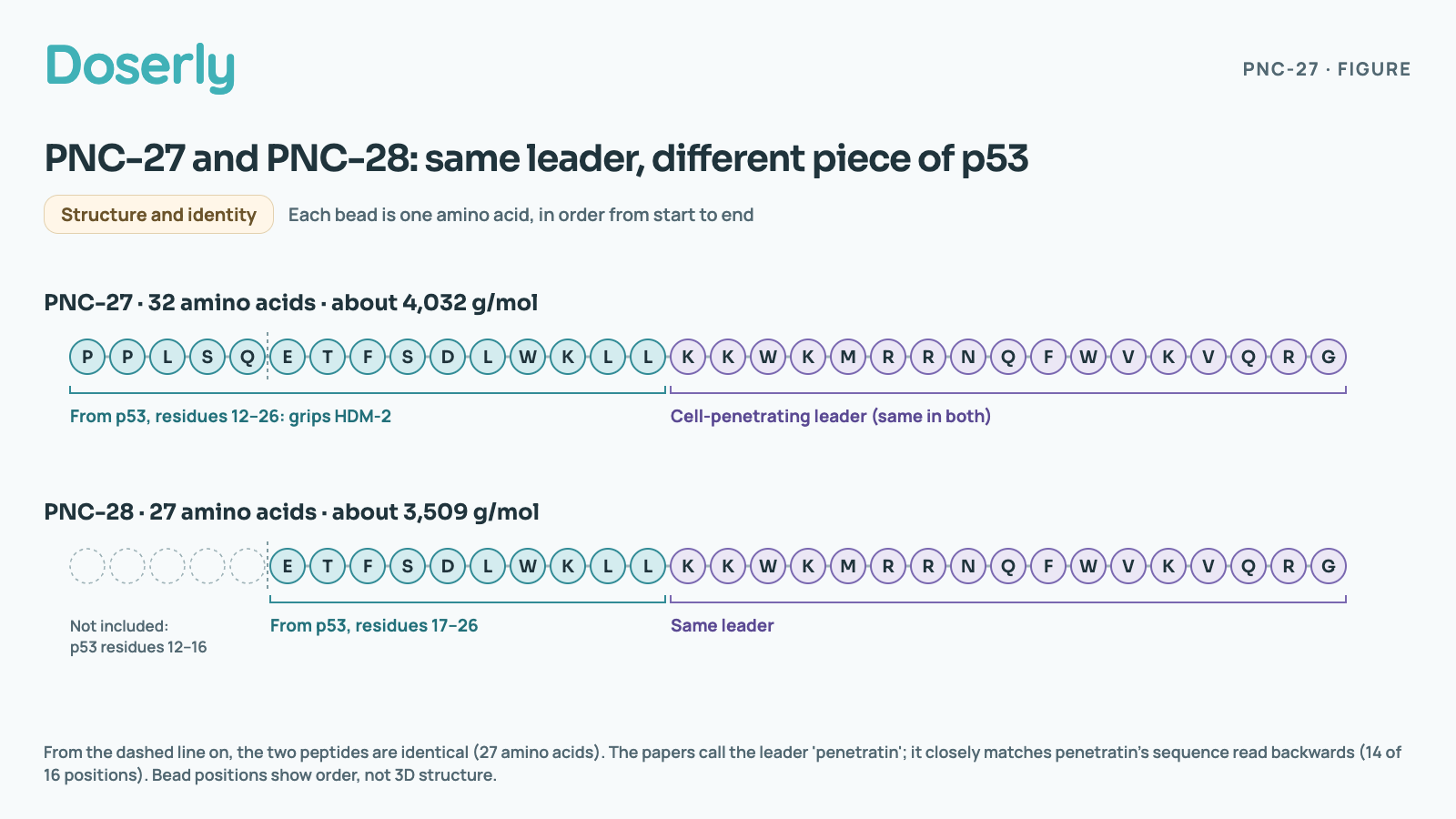
PNC-27 and PNC-28: same leader, different piece of p53
Each letter is one amino acid, in order. Structure and identity.
- PNC-27 (this guide) · 32 amino acids
- From p53, residues 12–26: grips HDM-2: PPLSQETFSDLWKLL. Then the cell-penetrating leader: KKWKMRRNQFWVKVQRG. About 4,032 g/mol.
- PNC-28 · 27 amino acids
- From p53, residues 17–26 only: ETFSDLWKLL. Then the same leader. About 3,509 g/mol.
PNC-28 has its own guide: PNC-28.
PNC-28 drops the first five p53 residues (PPLSQ); the p53 residues 17–26 and the leader are identical.
The design was first published in 2001 by a research group in New York, and early papers called it "p53(15)Ant". The group went on to produce most of the research on it, and several of its members are named inventors on patents covering the peptide. [1], [16], [8]
| Fact | Detail |
|---|---|
| Sequence (one-letter code) | PPLSQETFSDLWKLL + KKWKMRRNQFWVKVQRG [1] |
| Length | 32 amino acids [17] |
| Formula and weight | C188H293N53O44S, about 4,032 grams per mole [18] |
| Other names | PNC27, PNC 27, HDM2-binding peptide PNC-27, p53(15)Ant [2], [16] |
| Registry number | Listed in PubChem as CAS 1159861-00-3 (not confirmed in the CAS Registry itself) [18] |
| Status | Investigational; no registered human trial [7] |
The US National Cancer Institute's drug vocabulary lists it as "HDM2-binding peptide PNC-27" with "potential antineoplastic activity", meaning possible anticancer activity. That wording records that the peptide exists and is being studied; it is not a finding that it works. [2]
Is PNC-27 the same as PNC-28?
No, but they are close relatives from the same research group. PNC-28 uses a shorter piece of p53 (positions 17 to 26) on the same cell-penetrating leader, so it is 27 amino acids long instead of 32. The papers describe the same proposed way of killing cells for both, and no study has compared them head to head in animals. [1], [19], [20] See the comparison below, and Doserly's PNC-28 guide covers the shorter peptide.
Typical PNC-27 Protocols
| Example | Amount each time | Frequency | Total per day | Duration |
|---|---|---|---|---|
| Low | 100 mcg weeks 1–2, 200 mcg weeks 3–4, 300 mcg weeks 5–8, 400 mcg weeks 9–12, 500 mcg weeks 13–16 | Once a day | 100 → 400 mcg (500 mcg in optional weeks 13–16) | 8–12 weeks, optionally 16 The source page's own week table. An 8–12 week course ends at 300–400 mcg. The same page's text says "about every 2 weeks", and a copy says "every two to four weeks" [3], [21] |
| Mid | 1–2 mg | Once a day | 1–2 mg | 4–6 weeks One dosing page; no source given for the amount [4] |
| High | 5 mg | Twice a day (morning and evening) | 10 mg | 21–28 days A short course at a much higher amount, not a longer one [5] |
Read these cautions before the numbers. No amount of PNC-27 has ever been tested in a person, by any route. These schedules are what dosing websites publish, and several of those pages say themselves that their numbers are extrapolations with no human basis. [7], [21], [6]
- It is not a replacement for cancer treatment. In 2017 the FDA warned cancer patients not to buy or use PNC-27 as a treatment or cure, and recommended discussing treatment options with a licensed health professional. Tell your oncology team about anything you are considering, because they need to know to interpret scans, blood tests and side effects. [22]
- The only published human report ended in death. A woman with end-stage cervical cancer developed massive stomach bleeding two days after a PNC-27 infusion at a clinic abroad and died. The doctors who reported it said the timing "raises concern" but that it is "difficult to prove causation". [10]
- Products have been contaminated. The FDA's laboratory found two kinds of bacteria in PNC-27 inhalation solution sold online and warned of serious, possibly life-threatening infections, especially for people with weakened immune systems. [9]
- It has never been tested with chemotherapy in people. The combination studies were in mice and cells, and nobody knows how it interacts with any cancer medicine a person is taking. [23], [24]
- Amounts vary 200-fold between websites. Daily totals run from 0.1 mg to 20 mg, and at the common mixing strength a single syringe unit holds 100 mcg, so a one-unit slip doubles a starting dose. Check any amount with the reconstitution calculator (worked example below). [3], [5]
- Not studied in pregnancy, while breastfeeding, in under-18s, or in people with bleeding problems. It is also banned in sport at all times. [14]
The most common protocol in the reviewed sources is 100 mcg by subcutaneous injection once a day, stepped up to 300–400 mcg a day over an 8–12 week course, with 500 mcg reached only if the course is extended to weeks 13–16. Four pages publish this schedule and a fifth publishes a three-step variant that credits the same original; together they count as one origin. Several public accounts mention about 500 mcg a day, and in community education groups 500 mcg once a day is described as the figure most discussed online. [3], [21], [25], [26], [6], [27], [28], [29]
- Titration Changing the amount in steps
- The low schedule's week table gives 100 mcg a day in weeks 1–2, 200 mcg in weeks 3–4, 300 mcg in weeks 5–8, 400 mcg in weeks 9–12 and 500 mcg in weeks 13–16, so after week 4 the steps are four weeks apart. The same page's text says to add about 100 mcg "every 2 weeks as tolerated", and a copy says "every two to four weeks". One variant uses three steps instead: 100 mcg for weeks 1–4, 250 mcg for weeks 5–8 and 500 mcg for weeks 9–16. The high schedule starts at 5 mg once a day for 3–5 days as a "tolerance check" before moving to 10 mg a day. The mid schedule gives no titration. [3], [21], [6], [5]
- Breaks and cycles
- One page describes 16 weeks on and 4 weeks off, while another section of the same page says 8 weeks on and 4 weeks off; it calls the structure "theoretical" with "no clinical basis". The high-dose page describes 2–4 weeks off between 21–28-day courses. None of these breaks has been tested; they are conventions. [6], [5]
Read the units: 1 mg equals 1,000 mcg, so the low schedule's top step (500 mcg) is half of the mid schedule's lowest amount (1 mg), and the high schedule's daily total (10 mg) is 20 times the low schedule's top step. The amounts refer to PNC-27 alone. No blend products containing PNC-27 were found. [3], [4], [5]
Each row is a complete schedule from one published source, so its amount and duration belong together: the high example is a shorter course, not a longer one. Low, mid and high are alternatives, not steps to move through. These schedules come from protocol websites rather than any study in people; the cited references give the full details.
Where protocols differ: micrograms or milligrams, splitting and breaks ↓
Where these numbers come from
The low row comes from PeptideDosages' PNC-27 page for a 30 mg vial (published March 2026, updated September 2026), which lays out the step-up week by week and states that no authoritative human dosing exists. Dosage Peptide, PeptideDosage.org and Peptides.id publish the same ladder, and Peptide Schedule gives a tiered version that credits PeptideDosages by name. These five pages are one origin, not five confirmations. [3], [21], [25], [26], [6]
The mid row comes from Peptide Initiative's PNC-27 page, which lists 1–2 mg once daily with a 4–6 week cycle and cites no source for the amount. The high row comes from Biomogging's PNC-27 page, which gives 10 mg a day split into two 5 mg injections for 21–28 days, a 5 mg once-daily "beginner" course of 14–21 days, and an "aggressive" 15–20 mg a day. It justifies splitting the dose with a 30-minute half-life that has no published source. [4], [5]
Seven of the 14 dosing pages we could read give a human amount, from three independent origins. The other seven give no human dose, and several say plainly that none has been established. We excluded mouse doses in milligrams per kilogram from the table, because they come from a different species and route (see why mouse doses cannot be converted), and we excluded one page's claim that mice received 10 to 200 mg/kg, which the studies we checked do not support. Across the pages, single daily totals run from 0.1 mg to 20 mg; that spread describes websites, not safe or effective limits. [30], [31], [32], [25], [33]
What is PNC-27 commonly used for?
Almost everyone who discusses using PNC-27 has cancer, usually advanced, or is caring for someone who does. Public threads describe late-stage pancreatic, cervical and other cancers, often after standard treatment has run out, and PNC-27 is often combined with other unproven products. Some pet owners ask about it for dogs with cancer. [34], [35], [36], [37], [38]
The research points in the same direction but stays in the laboratory. Its developers tested it on cancer cells from the pancreas, breast, skin (melanoma), ovary, colon, cervix and blood (leukaemia), and in a few mouse models. The sections below describe what people hope for and what was studied. They do not establish that PNC-27 treats any cancer, because it has never been tested in a human trial. [19], [7]
Leukaemia and other blood cancers
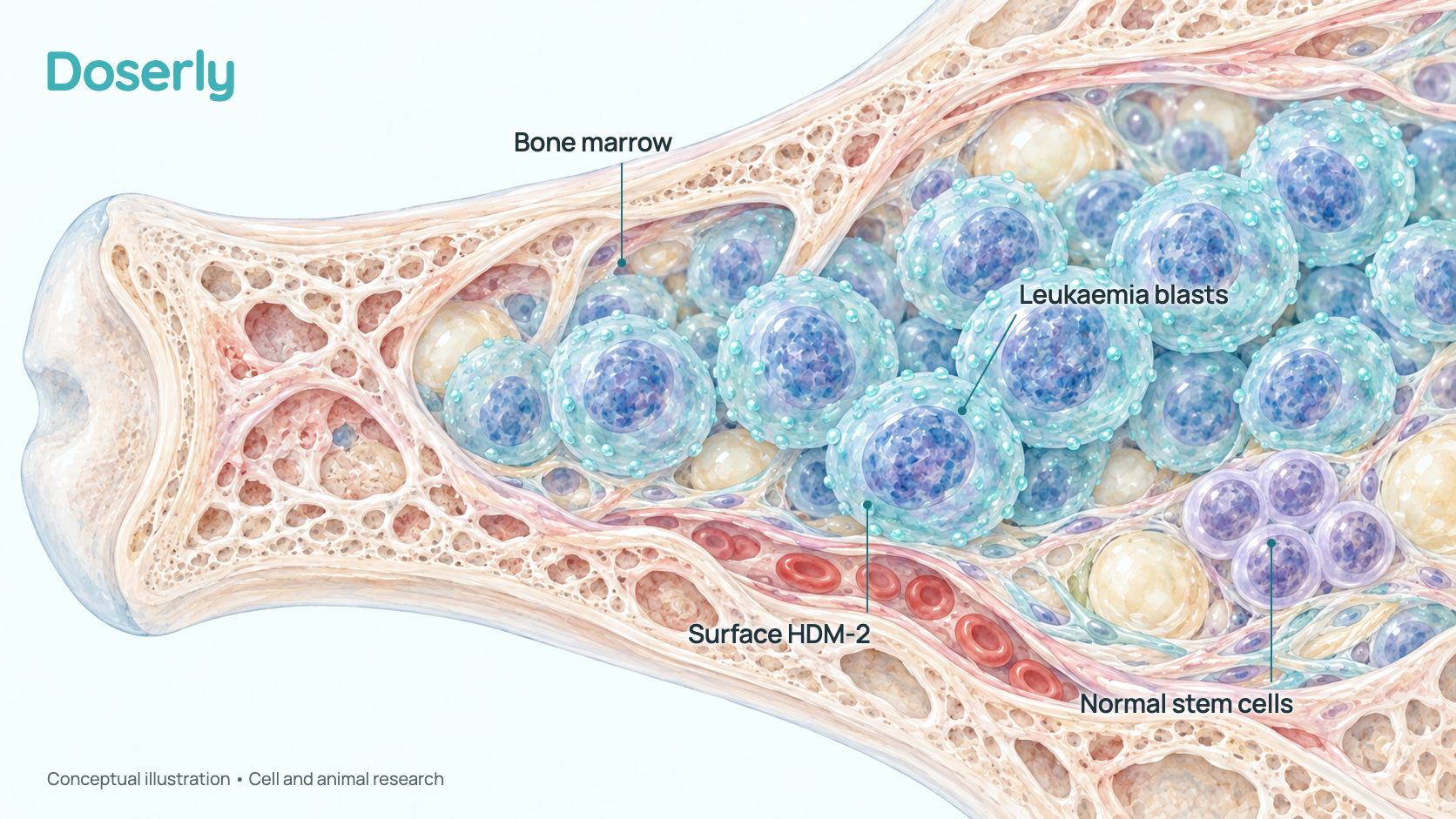
This is where the strongest animal evidence sits. In a 2020 study from a cancer centre outside the developer group, mice carrying acute myeloid leukaemia (AML), including leukaemia cells taken from patients, received PNC-27 injected into the abdominal cavity (intraperitoneal) at 40 mg per kg of body weight daily for two or three weeks. Treated mice had less leukaemia and lived longer: in one experiment, median survival was 136.5 days against 115 and 111 days for mice given a control peptide or no active treatment. [33]
The same study found HDM-2 on the surface of leukaemia cells but not on normal blood-forming stem cells, and PNC-27 did not measurably harm normal blood production in healthy mice. The peptide was supplied by a private company. Cell studies from the developer group also found that PNC-27 killed several leukaemia cell lines within hours. [33], [39], [15]
Pancreatic cancer
Pancreatic cancer is the cancer most discussed in public threads, and it was the first target in the developers' animal work, but with PNC-28, not PNC-27. When PNC-28 was infused into the abdomen of mice for two weeks, starting at the same time rat pancreatic cancer cells were implanted there, no tumours grew. Against tumours already growing elsewhere in the body, it shrank them for a while before they slowly regrew. For PNC-27 itself, the pancreatic evidence comes from cancer cells in a dish. [34], [36], [40], [19], [8]
Ovarian, breast, colon and cervical cancer
The developers report that PNC-27 killed ovarian, breast, colon and cervical cancer cell lines while leaving the normal comparison cells they tested alive. It also killed cancer cells taken fresh from two patients' ovarian tumours and grown in a dish, which is closer to real tumours than a long-established cell line but is still not a test in people. [41], [16], [42], [43], [44]
In mice, PNC-27 added to the chemotherapy drug paclitaxel slowed the growth of ovarian tumours more than paclitaxel alone, and in a colon cancer model it caused tumour nodules to die off without damaging nearby normal tissue. Both reports are available only as abstracts, which do not state the doses. [23], [42]
As a partner for chemotherapy or diet
Some people hope PNC-27 can make other treatments work better. The evidence for that is limited to the laboratory: the paclitaxel combination above (mice and cells), a cell study in which ketone bodies (compounds the body makes on very low-carbohydrate diets) lowered the amount of PNC-27 needed to kill cancer cells, and studies that attached PNC-27 to a chemotherapy-carrying particle as a targeting tag. None has been tested in people, and adding an untested peptide to chemotherapy can change what side effects mean. [23], [24], [45]
Does killing cancer cells in a dish mean it treats cancer?
No. Many substances kill cancer cells in a dish, and far fewer help people with cancer. A drug has to reach the tumour at a high enough level, avoid harming the rest of the body and work better than existing treatment, and only studies in people can show that. For PNC-27, those studies have not been done. [7] See what is actually known in people.
Where do PNC-27 protocols differ?
Sources disagree on almost every part of a PNC-27 schedule, and none of them can point to a human study. Here is what varies and why it matters.
Micrograms or milligrams: which scale is right?
Nobody knows. The copied step-up schedule tops out at 500 mcg a day, the mid page gives 1–2 mg, and the high page gives 10 mg, with an "aggressive" option of 15–20 mg. That is a 200-fold range from the lowest daily total to the highest, and none of the pages traces its amount to a measurement in people. [3], [4], [5]
Public accounts spread just as widely: 100 mcg a day rising to 750 mcg, 300–450 mcg, 500 mcg, 1 mg split into two doses, 0.5–0.7 mg three times a day, and a vendor catalogue's 1–2 mg three times a day. [35], [27], [34], [46], [47] In community education groups, an educator describes 500 mcg once a day as the figure most discussed online and raises 1–2 mg a day as a possibility because the animal doses were higher, while saying that the right amount cannot be judged. Across those groups, educators' figures run from 10 mcg to 3 mg a day, and one educator gave both ends of that range in different discussions. The patterns quoted most often are 200–300 mcg three times a week for 4–8 weeks, 100–200 mcg a day in 4–6 week cycles, and 500 mcg to 2 mg a day for 4–8 weeks. None of them comes with a source.
Why do some pages split the dose?
The high-dose page splits 10 mg into morning and evening injections because it says PNC-27 lasts only about 30 minutes in the blood. Other pages give half-lives of 2–4 hours or 3 hours and dose once a day. No study has measured PNC-27's half-life in any species, so none of these figures can settle the question. [5], [4], [6] See what is known about how long it lasts.
The high-dose page also points to the PNC-28 mouse study, which delivered the peptide continuously with a small implanted pump rather than by injections. That study used a different peptide and a different route, so it does not show whether splitting injections matters. [5], [40], [19]
Do sources start low, or at the full amount?
The low schedule builds up slowly over about 12 weeks. The high schedule uses a short "tolerance check" at 5 mg a day for 3–5 days before 10 mg a day. The mid schedule starts at its full amount. None of these approaches has been compared, and "as tolerated" means little when no one knows which side effects to watch for. [3], [5], [4]
How long, and what happens between courses?
Course length ranges from 21–28 days (high) to 8–16 weeks (low), and breaks range from none stated to 2–4 weeks or 4 weeks. One page gives two different on-and-off cycles in different sections. The breaks are conventions; none responds to a known effect of stopping. [5], [3], [6]
Why can't mouse doses be converted to a human dose?
The best-documented animal schedule is 40 mg per kg injected into the abdominal cavity of mice once a day for two to three weeks, with a 100 mg per kg group in some experiments. Mice clear drugs differently from people, the abdominal cavity is not the same as a subcutaneous injection, and no one has measured how PNC-27 moves through the body in either species. Converting these numbers to a human dose would produce a figure, not a tested dose, and this guide does not do it. [33]
Some dosing pages quote animal doses, such as 0.1–1 mg per kg, 10–200 mg per kg, or a mouse "maximum tolerated dose" of 2 mg a day, that we could not match to any study we checked. Several mouse papers do not state their doses in their abstracts, so we cannot rule every figure out. [48], [25], [6]
Is PNC-27 combined with other peptides?
In several public accounts, PNC-27 is combined with thymalin or thymosin alpha-1, and sometimes with non-peptide products such as ivermectin or fenbendazole. No study has tested PNC-27 with any of these, and combining several products makes it impossible to tell which one caused a change or a side effect. [46], [35], [29], [37]
How do micrograms convert to syringe units?
Many people meet "units" on an insulin syringe. A U-100 syringe holds 100 units per millilitre, so units measure volume, not an amount of PNC-27. How much each unit holds depends on how much liquid was added when the powder was mixed (reconstituted).
For example, the low schedule's page mixes a 30 mg vial with 3 mL, giving 10 mg per mL. At that strength, each unit holds 100 mcg, so 100 mcg is 1 unit (0.01 mL) and 500 mcg is 5 units (0.05 mL). The same page suggests smaller 30- or 50-unit syringes for doses of 10 units or less, because a single unit is hard to measure: at this strength, a one-unit error is the whole starting dose. At the same strength, the high schedule's 5 mg injection would be 50 units (0.5 mL). [3], [26]
Doserly's reconstitution calculator works this out for any vial and shows each step. It does arithmetic only; it does not make any amount safe.
Source-by-source comparison
Which pages give a human amount?
Unit key: 1 milligram (mg) = 1,000 micrograms (mcg).
- PeptideDosages (30 mg vial page): 100 mcg once daily for weeks 1–2, 200 mcg for weeks 3–4, 300 mcg for weeks 5–8, 400 mcg for weeks 9–12 and 500 mcg for weeks 13–16, subcutaneously; cycle 8–12 weeks with an optional extension to 16. Storage: powder frozen at −20 °C, mixed vials refrigerated at 2–8 °C. [3]
- Dosage Peptide, PeptideDosage.org and Peptides.id: the same 100–500 mcg ladder. PeptideDosage.org cites two PubMed numbers that belong to other papers. [21], [25], [26]
- Peptide Schedule: "Beginner 100 mcg, Moderate 250 mcg, Aggressive 500 mcg" daily, 16 weeks on and 4 weeks off in one section and 8 weeks on and 4 weeks off in another; it credits PeptideDosages for the ladder. [6]
- Peptide Initiative: 1–2 mg once daily, 4–6 week cycle. [4]
- Biomogging: 5 mg once daily for 14–21 days (beginner), 10 mg a day as 5 mg twice daily for 21–28 days (standard), 15–20 mg a day in two or three injections (aggressive), and a nebulized option of 5–10 mg once daily. [5]
Which pages give no human dose?
PeptideMind, CalcMyPeptide, Peptabase, PeptideX, Peptide-DB, PeptideDosageCharts and MyPeptideMatch give no human dose of their own (PeptideMind only mentions that supplier guides start around 100 mcg). Several state that no human dose has been established, and one advertises a directory of clinics offering PNC-27. [48], [30], [31], [32], [49], [50], [51]
Registered study plans
None. A search of ClinicalTrials.gov on September 26, 2026 found no registered study of PNC-27 or PNC-28. [7]
What happens when you stop PNC-27?
This has not been studied. No study has followed people after a course of PNC-27, and no animal study has looked for withdrawal or rebound effects. That is an absence of data, not proof that none exist.
- In mice given PNC-28, tumour growth stayed blocked during the two weeks of continuous delivery and for two weeks afterwards, then tumours began to grow again, although they stayed smaller than in mice given a control peptide (treatment started when the tumour cells were implanted at a site away from the infusion). That is a different peptide in an animal model, but it is the only evidence about what happens after treatment ends. [40]
- In a public account, a person who felt the effect "slowing" stopped for about five days, restarted alongside thymalin and described a renewed effect. There was no diagnosis, scan or blood test to check what was happening. [46]
The breaks that protocol pages describe are conventions, not a response to known effects of stopping.
Do injected, infused and inhaled forms of PNC-27 behave the same way?
Nobody knows, because none of them has been measured. How the body absorbs, moves and removes a substance is called pharmacokinetics, and no pharmacokinetic study of PNC-27 has been published in people or animals. [7], [33]
- Subcutaneous injection: the route dosing websites use. It has never been studied, so how much reaches the blood (the bioavailability) is unknown. [3], [32]
- Intraperitoneal injection (into the abdominal cavity): the route of the mouse studies, which people do not use. [33], [40]
- Intravenous infusion (IV, into a vein): given at clinics outside the United States, including in the only published human case. [10], [52]
- Inhaled (nebulized), vaginal and rectal forms: in 2017 the FDA said PNC-27 may be sold as a nebulized solution, an IV solution or vaginal or rectal suppositories; it tested only the inhalation solution, and found bacteria in it. None of these forms has been studied. [9]
- Oral (swallowed): no data. Peptides are generally broken down in the gut, and no study has tested PNC-27 by mouth.
How long does PNC-27 last in the body?
Not known. Half-life is the time it takes for the level in the blood to fall by half, and it has never been measured for PNC-27. Website figures of about 30 minutes, 2–4 hours and 3 hours have no published source, and a half-life would say nothing, by itself, about how long an effect lasts. [5], [4], [6], [32]
What the lab work shows is narrower. In a dish, the intact peptide stayed in the membranes of breast cancer cells, while in normal breast cells it was broken down, and cancer-cell membranes leaked a cell-damage marker within minutes to hours of exposure. [53], [39]
Should PNC-27 be injected into or near a tumour?
No study in people has compared injection sites. The PNC-28 mouse authors concluded that it "may be effective in treating cancers especially if delivered directly to the tumor", a suggestion from animal work. Injecting into a tumour is a medical procedure with its own risks of bleeding and infection, and no study has tested it for PNC-27. [40]
Which product is in the vial?
The research papers used peptide made to a checked purity of over 95%, and the leukaemia study used peptide supplied by a company. Products sold online are a different matter: the FDA found bacteria in one in 2017, and a public account describes a PNC-27 order that arrived with a paper insert for a clearly different product. [8], [33], [9], [54]
A first attempt to make PNC-27 in bacteria rather than by chemical synthesis failed at the step that cuts the peptide free; the same team later reported a bacterial method that worked. Either way, research-grade manufacture says nothing about what an online vial contains. A label saying "research use only" does not mean a product has been tested for identity, sterility or safety for people. [55], [56]
How should PNC-27 be stored, and how long does it last?
No one has published a stability study of PNC-27, so there is no tested shelf life or use-by date. Storage advice comes from dosing pages and suppliers, not from a medicine label, and the pages disagree.
- Powder, before mixing: pages say to keep the freeze-dried (lyophilized) powder in a freezer at −20 °C, and one says it is also stable in a fridge at 2–8 °C for up to two months. None cites a stability test. [3], [5], [6]
- After mixing: pages agree on a fridge (2–8 °C) and on avoiding freeze-thaw cycles, but disagree on how long a mixed vial lasts: 14–21 days on one page, and 7–10 days or "discard after 7 days" in two sections of another. [3], [5], [6]
- Why it might matter: PNC-27 contains one methionine, an amino acid that can react with oxygen. One page warns that this degrades the peptide over time, but no study has measured how quickly, or what that does to an injected product. [5]
This guide does not cover mixing, sterile technique or injection; the Academy note below covers practical handling basics.
What do we actually know about PNC-27 in people?
Almost nothing. No human trial of PNC-27 or PNC-28 has been registered, no study has measured how the body handles it, and no human dose has been tested. The only published human report is a single case abstract from 2017. Everything else is preclinical: cell studies and animal studies. [7], [10]
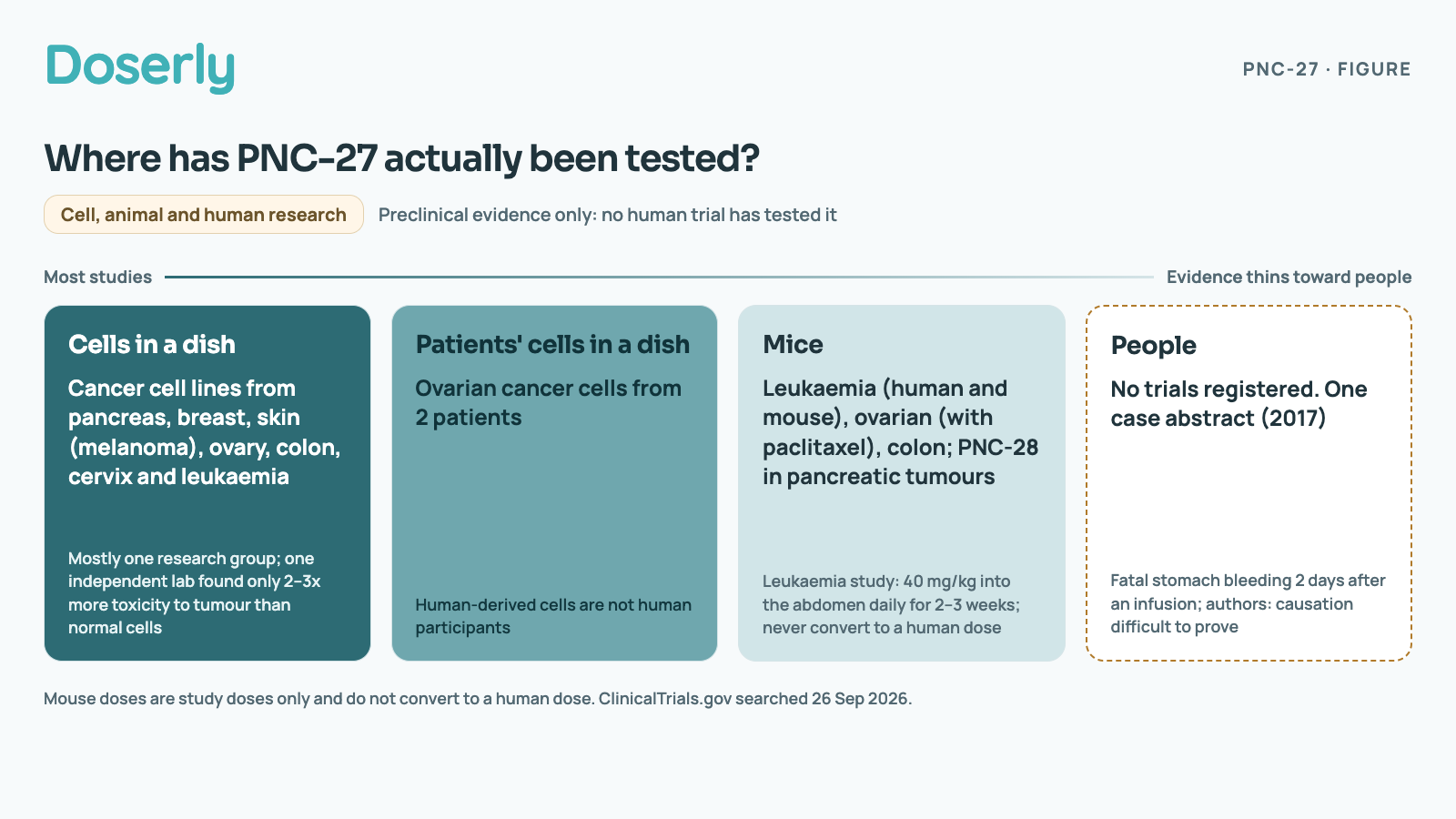
Where has PNC-27 actually been tested?
Cell, animal and human research, from most to least studied.
- Cells in a dish
- Cancer cell lines from pancreas, breast, skin (melanoma), ovary, colon, cervix and leukaemia. Mostly one research group; one independent lab found only 2–3x more toxicity to tumour than normal cells.
- Patients' cells in a dish
- Ovarian cancer cells from 2 patients. Human-derived cells are not human participants.
- Mice
- Leukaemia (human and mouse), ovarian (with paclitaxel), colon; PNC-28 in pancreatic tumours. Leukaemia study: 40 mg/kg into the abdomen daily for 2–3 weeks; never convert to a human dose.
- People
- No trials registered. One case abstract (2017). Fatal stomach bleeding 2 days after an infusion; authors: causation difficult to prove.
Mouse doses are study doses only and do not convert to a human dose.
Almost all of the evidence comes from cells and mice; no human trial has tested PNC-27.
The only published human case
In 2017, doctors in the United States described a 46-year-old woman with end-stage cervical cancer that had spread. She had been through several courses of chemotherapy and major pelvic surgery, had run out of treatment options in the US and received PNC-27 at a clinic in Mexico. Two days after an infusion, she began vomiting large amounts of blood, with bleeding from both of her surgical stomas (openings for urine and stool). [10]
A camera test found a 2 cm stomach ulcer, which was treated, but the bleeding continued; she needed repeated transfusions and died after moving to comfort care. The authors wrote that it is "difficult to prove causation" but that the timing "raises concern for potential adverse event". The dose and the exact product are unknown, and her cancer and earlier treatment could also have contributed. [10]
Some dosing pages describe this as a "documented human fatality" from PNC-27. That overstates it: it is one case in which the peptide could not be ruled in or out. It is also the only human safety information that exists. [6], [10]
What the FDA found in 2017
On January 10, 2017, the FDA warned consumers not to buy or use PNC-27 sold through a website as a treatment or cure for cancer. Its laboratory had found the bacterium Variovorax paradoxus in a PNC-27 solution for inhalation, and an update on March 27, 2017 added Ralstonia insidiosa in another sample. The FDA said people using a contaminated product risk serious, potentially life-threatening infections, especially young children, older people, pregnant women and people with weakened immune systems. [9], [22]
The same notice said the FDA had not evaluated or approved PNC-27 for any disease and had "not received reports of illnesses or serious adverse events related to PNC-27". Some summaries quote only that last line. Read in full, the notice is a warning, and its recommendation was for cancer patients to discuss treatment options with a licensed health professional. [9]
Who produced the research?
Most PNC-27 papers come from one research network, whose members are named inventors on patents covering the peptide or have worked with a related company, as the papers disclose. That does not make the results wrong, but it means few independent groups have checked them. [8], [19]
The independent work is small. A leukaemia study at a separate cancer centre reported effects in mice with leukaemia, using peptide supplied by a private company; the paper does not say whether that company is linked to the developer group. A laboratory in China found PNC-27 only partly selective for cancer cells (see how selective it is). Other groups used PNC-27 as a targeting tag on drug-carrying particles, and a few studies are computer models. [33], [57], [45], [58]

What would a useful result look like?
For a cancer drug, the questions are concrete: does the tumour shrink or stop growing on scans, do people live longer or better, and how does that compare with people who did not receive it? Feeling more energetic, eating better or having a lump seem smaller are real experiences, but on their own they cannot show that a tumour responded, especially when other treatments changed at the same time. [34], [46], [35]
That is why a clear record matters for anyone already using an unproven product: exact products, doses and dates, alongside scans, blood tests, symptoms and every other treatment, give an oncology team something to interpret.
How might PNC-27 work?
Everything in this section comes from cell and animal research, most of it from the group that designed the peptide. It describes a proposed explanation, not something shown in people. [19]
What are p53 and HDM-2?
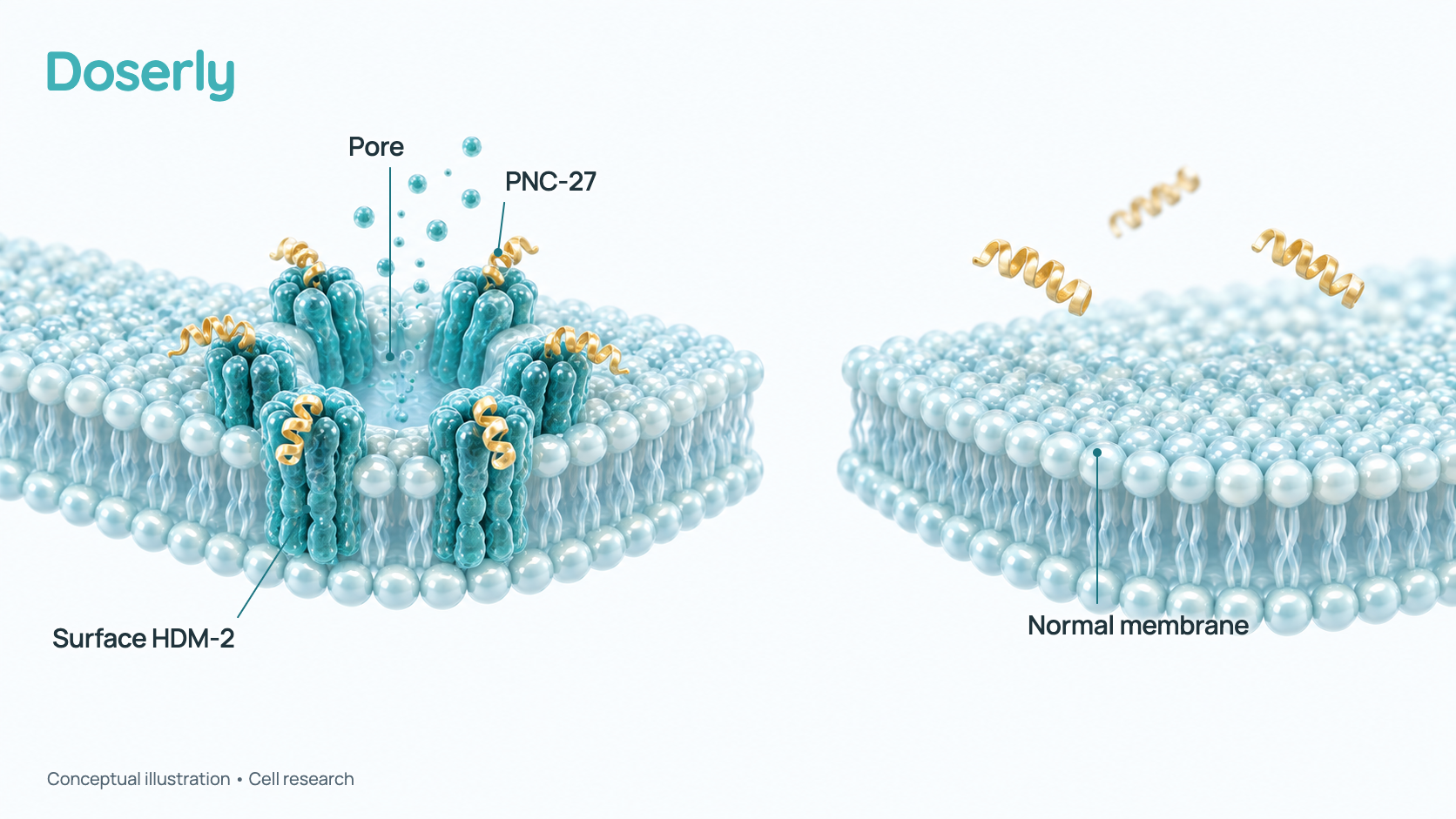
p53 is a protein that helps stop damaged cells from dividing, which is why it is called a tumour suppressor. HDM-2 (the human version of a protein called MDM2) normally keeps p53 in check, partly by gripping a stretch near the start of the p53 chain. Many types of cancer cell make more of it than normal cells do. PNC-27 copies positions 12 to 26 of that stretch, so it can grip HDM-2 in the same way. [1], [59], [17]
Punching holes: the pore model
HDM-2 usually works inside cells, but the developers report finding it in the outer membrane of many cancer cell lines and not in the normal cells they tested. Their model is that PNC-27 binds this surface HDM-2, and the pairs cluster into ring-shaped pores. The cell's contents leak out and the cell dies by necrosis, a fast, bursting form of cell death, rather than apoptosis, the tidy, programmed kind. [60], [8]
Several experiments support the model. Normal breast cells that were engineered to display HDM-2 on their surface became vulnerable to PNC-27. An antibody that blocks the p53-binding part of HDM-2 stopped the killing. Electron microscope images showed PNC-27 and HDM-2 together in the pores, in roughly one-to-one ratios. Pore formation depended strongly on temperature: at 17 °C, cancer cells were barely harmed. [60], [61], [8]
The team later reported that PNC-27 also enters cancer cells and damages their mitochondria (the cell's energy-producing structures). The cell-penetrating leader appears to change how the cells die: when the p53 piece of PNC-28 was made inside cancer cells without the leader, the cells died by apoptosis instead. [61], [62]
Why it may not need working p53
Many cancers have a broken p53 gene. The early papers found that PNC-27 and its relatives killed cancer cells with no p53 at all as readily as cells with normal or mutant p53, and they did not switch on the usual p53-driven cell-death proteins. [1], [15]
That contradicts a common online explanation, that PNC-27 works by "freeing" or raising p53 so the cell self-destructs. In the published model, killing did not depend on the cell's own p53; the peptide acts mainly on the membrane. [1], [38]
How selective is it for cancer cells?
The developer group reports that PNC-27 left normal cells unharmed in experiment after experiment, including blood-forming stem cells, breast, cervical and colon cells. In normal cells, the peptide was broken down in the membrane instead of forming pores. [1], [53], [43], [42] Normal heart-muscle cells have not been tested with PNC-27, and one independent study with its shorter relative PNC-28 found harm in them (see what could go wrong).
An independent laboratory found a smaller difference. It measured the concentration needed to kill half the cells (the IC50) and found PNC-27 only 2–3 times more potent against tumour cells than normal cells. When the researchers swapped PNC-27's leader for other cell-penetrating tails, the preference disappeared. They concluded that part of the selectivity comes from the leader binding a sugar-like molecule, chondroitin sulfate, a chain of sugar units that tumour cells carry in larger amounts, rather than from HDM-2 alone. [57]
A 2-to-3-fold margin in a dish is narrow. It does not show that a dose harming tumours would spare normal tissue in a person, and it is why claims that PNC-27 "cannot harm normal cells" go further than the evidence.
A different view from a leukaemia lab
The independent leukaemia study also found surface HDM-2 on leukaemia cells but described a different chain of events: PNC-27 strengthened HDM-2's link with a membrane protein called E-cadherin, which was then broken down, damaging the membrane. The exact mechanism is therefore still debated even among researchers who agree on the target. [33]
A note on the cell-penetrating leader
The papers call the leader "penetratin", a sequence from a fruit-fly protein used to carry molecules into cells. Its order of amino acids actually closely matches penetratin read backwards (14 of 16 positions), a point also made in a 2026 preprint. This does not change any experimental result, but it matters to anyone comparing sequences. [1], [63]
Where does the lab evidence fall short?
Cells in a dish are exposed to a measured concentration for minutes to hours; in a body, a peptide must survive the blood, reach the tumour and avoid being broken down, none of which has been measured. The mouse studies are few and short, one gave a different peptide (PNC-28), and several are available only as abstracts. There is no long-term animal safety study. [33], [40], [23]
What are the risks and unanswered questions?
Is PNC-27 safe?
Nobody knows, because it has never been studied for safety in people. There is no human safety study, no dose-finding study and no formal animal toxicology report. The evidence that exists is a single fatal case whose cause could not be established, an FDA warning about contaminated products, and mouse studies that looked mainly at whether it worked. [10], [9], [33]
What harms have been reported?
- Severe stomach bleeding and death: the single published case described above, two days after an IV infusion abroad, with causation unproven. [10]
- Bacterial contamination: two kinds of bacteria in PNC-27 inhalation solution, found by the FDA; the agency had received no reports of illness at the time. [9]
- Nosebleeds: one person in a public thread reported three nosebleeds while using PNC-27, which was unusual for them. A single report cannot show cause. [46]
In mice, 100 mg per kg a day for two weeks showed no significant differences from untreated mice in white cells, haemoglobin, platelets or bone marrow (7 mice per group), and the developers report that mice given PNC-28 kept gaining weight like untreated mice. Those are reassuring findings in mice, not evidence of safety in people. [33], [19]
What could go wrong that has not been measured?
These are concerns based on how PNC-27 is meant to work and how it is sold. None has been measured for PNC-27.
- Tumour lysis syndrome: when many cancer cells die quickly, they release potassium, phosphate and other contents into the blood, which can cause kidney failure, dangerous heart rhythms, seizures and death. It is a known emergency with effective cancer treatments, especially for blood cancers. If PNC-27 did kill tumour cells rapidly in a person, this would be a risk. [64]
- Damage at the injection site or to normal tissue: a peptide that bursts cell membranes, and is only 2–3 times more potent against tumour cells in one independent test, could harm normal cells at high local concentrations. [57]
- Harm to the heart: in an independent study of normal heart-muscle cells in a dish, a peptide that a 2019 review identifies as PNC-28 (the shorter relative) raised p53 and increased cell death, and the authors warned that such inhibitors might harm the heart. This has not been tested for PNC-27. [65], [66]
- Immune reactions: the body can make antibodies against a foreign peptide (immunogenicity), and this has never been checked for PNC-27.
- Infection: injecting or inhaling a non-sterile product can cause serious infections, a particular danger for people whose immune systems are weakened by cancer or chemotherapy. [9]
Could product quality change the risk?
Yes. The research used purified, tested peptide, but grey-market products are sold as "research chemicals" with no official quality control. The FDA's contamination finding and a public report of a mislabelled order show that what is in the vial may not match the label. Only a laboratory test of a specific batch can show what it contains, and even then it covers only the samples tested. [8], [9], [54]
Can PNC-27 replace cancer treatment?
No evidence supports that. PNC-27 has never been compared with any cancer treatment in people, and the FDA's 2017 advice was for cancer patients to discuss treatment options with a licensed health professional. Delaying treatment that works for one that has not been tested can cost time that matters. [22], [7]
Is PNC-27 legal? Is it FDA-approved?
Checked September 26, 2026. A "research use only" label does not make a product legal to sell or use as a medicine.
- United States. Not approved by the FDA for any use. On January 10, 2017 (updated March 27, 2017), the FDA warned consumers not to buy or use PNC-27 as a cancer treatment after finding bacterial contamination. It is not on the FDA's list of bulk substances nominated for pharmacy compounding (May 14, 2026 update), so there is no legal compounding route. The FDA's warning page has since been retired, and we cite an archived copy. [9], [22], [11]
- Canada. Health Canada's Drug Product Database lists no PNC-27 product. In April 2026 Health Canada warned that unauthorized injectable peptides bought online can seriously harm people; that advisory does not name PNC-27. [12], [67]
- Australia. PNC-27 is not named in the June 2026 Poisons Standard. We did not search the Australian Register of Therapeutic Goods (the list of medicines approved for supply) directly and found no report of an approved product. Not being named in the Poisons Standard does not make a substance approved or legal to sell as a medicine. [13]
- United Kingdom and European Union. Not checked for this guide; we found no report of an approval.
Is PNC-27 banned in sport?
Yes. PNC-27 is not named on the World Anti-Doping Agency (WADA) list, but it falls under class S0, "non-approved substances": any substance with no current approval by a government health authority for human use, including drugs still in preclinical development. S0 substances are banned at all times, in and out of competition. [14]
Who should be especially cautious?
None of the following groups has been studied. That is a reason for caution, not guidance on safe use.
- People with cancer on active treatment: interactions with chemotherapy, targeted drugs, immunotherapy and radiation are untested in people, and an unreported product can confuse the interpretation of side effects, scans and blood tests. Tell your oncology team. [23], [22]
- People with weakened immune systems: the FDA singled them out because of the contamination finding. [9]
- People with stomach ulcers, a bleeding tendency or low platelets, or who take blood thinners: the only human case involved severe stomach bleeding. Cause was not established, but no data rule it out. [10]
- People with kidney disease or a large tumour burden: these raise the stakes of tumour lysis syndrome, a concern that has not been measured for PNC-27. [64]
- Pregnancy, breastfeeding or trying to conceive: not studied in any species. The FDA named pregnant women among those at higher risk from contaminated products. [9]
- Under-18s: not studied.
- Drug-tested athletes: banned at all times under S0. [14]
- Pets: owners ask about dogs with cancer, but no veterinary study exists. Talk to a veterinarian. [38]
Has PNC-27 been tested alongside other medicines?
Only in the laboratory. PNC-27 and paclitaxel worked together against ovarian cancer cells and in mice; ketone bodies lowered the amount of PNC-27 needed to kill cancer cells in a dish; and PNC-27 has been attached to a liposomal doxorubicin particle as a targeting tag in mice. No combination has been tested in people, and no study has looked at interactions with blood thinners or any other everyday medicine. [23], [24], [45]
Public accounts combine PNC-27 with thymalin, thymosin alpha-1, ivermectin, fenbendazole and other products, often during cancer treatment. Bring a complete list of everything you take, including research peptides, to your oncologist or pharmacist. [35], [29], [37]
What should be monitored while using PNC-27?
There is no official monitoring guidance, because no regulator has approved PNC-27 and no human study has run. What can be described is what the animal studies measured and which checks follow from the concerns in this guide. It is information to discuss with a clinician, not a personal testing plan.
In the leukaemia study, researchers checked blood counts (white cells, haemoglobin and platelets) and bone marrow in healthy mice given PNC-27, and found no differences from untreated mice. The cell studies measured lactate dehydrogenase (LDH), an enzyme that leaks from damaged cells, as a sign of cell death. Neither has been measured in people taking PNC-27. [33], [39]
| Why it matters | What studies measured or flagged | Tracking category |
|---|---|---|
| Blood cells and bleeding | Blood counts and marrow in mice; the fatal bleeding case | Blood work (full blood count); watch for black stools, vomiting blood or unusual bruising |
| Rapid tumour breakdown | Tumour lysis syndrome with effective cancer treatments (not measured for PNC-27) | Blood work (potassium, phosphate, calcium, uric acid, kidney function) |
| Infection | Bacteria found in a PNC-27 product by the FDA | Immune Function; fever, redness or swelling at an injection site |
| Stomach and appetite | Stomach bleeding in the case report; appetite changes in public accounts | Nausea & GI Tolerance; Appetite & Satiety; Weight Management |
| How you feel day to day | Energy and appetite changes in public accounts | Energy Levels; Mood & Wellbeing; Pain Management |
| The cancer itself | Scans and tumour markers ordered by the oncology team | Discuss with your oncologist |
Sources for the table: [33], [10], [64], [9], [34]
None of these checks makes an untested product safe. They show what is changing, which is what a clinician needs to judge whether to continue.
What do people in public communities report?
Public discussion of PNC-27 is small and serious. The 38 relevant Reddit posts we found come mostly from people with late-stage cancer or their caregivers, asking whether anyone has tried it and what dose to use. Only five describe any outcome, and none of them can tell PNC-27's effect apart from other treatments or the natural course of the illness. [34], [35], [36]
What do the positive reports look like?
A caregiver gave PNC-27 at 1 mg a day, split morning and night, to a parent with very late-stage pancreatic cancer. After two weeks the parent "hasn't declined", with slightly better appetite and more energy. Four months later the caregiver reported that the parent had died, about 10 months after diagnosis compared with a predicted six, and believed PNC-27 had helped appetite and energy. No scans or blood tests were described. [34]
Another person used PNC-27 for a growth in the jaw bone that had never been biopsied or diagnosed, and reported that it "shrank". They later described using 0.5–0.7 mg three times a day for one to two weeks, once or twice a month, or 1–2.5 mg once a day for 10 days after a course of thymalin or thymosin alpha-1. A final outcome was never posted. [46]
Does everyone notice a difference?
No. A family member took 100 mcg a day, rising by 100 mcg a week to 750 mcg, with thymosin alpha-1 added; it "did not seem to do anything". Scans at three months were stable, but a new targeted cancer drug had started at the same time, so the result cannot be credited either way. In a pancreatic cancer group, one reply said there was "not much of a difference" and that the cancer "progressed by 10% in 4 weeks". [35], [36]
A third account describes a relative with a large pancreatic mass using daily PNC-27 injections alongside ivermectin, fenbendazole, IV DMSO and vitamins, with no scans since, so nothing can be attributed to any single product. [37]
What about unwanted effects?
Only one public account described a side effect: three nosebleeds while using PNC-27, unusual for that person. Other threads raised concerns rather than experiences: an order that arrived with the wrong product's insert, and the 2017 FDA warning, which some posters framed as "a contamination problem" rather than anything wrong with the peptide. The FDA did not test the peptide's own safety, so that notice cannot settle the question either way. [46], [54], [68], [9]
In community education groups, one person taking about 200 mcg a day as prevention, alongside several other compounds, described feeling light-headed in the first days and flu-like later, which they put down to their body clearing dying cells. That explanation has not been tested, and flu-like symptoms have other possible causes, including a contaminated product. Some members repeat summaries claiming PNC-27 has no known side effects, which ignores the published case of severe gut bleeding and the FDA warning. [10], [9]
What else comes up?
- Clinics abroad: posters mention cancer clinics in Mexico using PNC-27 as part of their protocols, which matches the setting of the one published case. [52], [10]
- Pets: several owners ask about dogs with leukaemia or oral cancer; none reported an outcome. [38]
- Pushback: in an evidence-focused pancreatic cancer group, a reply states there is "zero human evidence whatsoever" for PNC-27, and early discussions include sceptics who expect it to work only in dishes. [36], [47]
- Community education groups: educators describe the evidence as laboratory and animal only, with unknown human dosing and no safety data, which matches the published record. Four members there described their own or a relative's use, and none reported scans:
- A caregiver stepped a relative on chemotherapy and thymosin alpha-1 up from 100 mcg to 500 mcg a day over about 13 weeks, a schedule similar to the step-up schedule above, and reported more energy and shorter recovery after chemotherapy cycles.
- A person with melanoma injected PNC-27 as close to the skin lesions as possible, alongside several other peptides, and linked a long-swollen lymph node going down to it. They also had surgery, which removed the cancer with clear edges, so the peptide's part cannot be judged.
- A caregiver of someone with stage 4 cancer reported more energy after about two weeks, without giving the dose or saying whether the product had been tested.
- A person using it as prevention reported no measurable change.
- Stocking up and holding back: in the same groups, cancer survivors and people with inherited cancer risk describe buying PNC-27 to keep in reserve or to take as a preventive course, while others hold off because there is no human data. A claim that a US cancer centre has run PNC-27 trials does not match the trial registry, which lists none. [7]
- Supply: members describe PNC-27 as hard to find, with long waits for new batches, orders cancelled for lack of stock and no way to check quality without paying for independent testing.
How can you judge a cancer story?
Useful questions: What type and stage of cancer was it, and was it confirmed by biopsy? What exactly was used, how much, and was the product ever tested? What else changed, such as chemotherapy, a new targeted drug, surgery or diet? Were there scans or tumour markers before and after, and what happened months later?
Feeling better, eating more or a lump seeming smaller are worth recording, but they are not the same as a tumour responding on a scan. These selected discussions show what individual people experienced. They are not a survey of all users, a response rate or a substitute for controlled studies.
How does PNC-27 compare with PNC-28, FOXO4-DRI and thymosin alpha-1?
These are the peptides PNC-27 is most often confused or combined with. No study has compared any of them directly with PNC-27. The route column describes what studies or labels used, not tested human doses for the research peptides.
| Peptide | What it is | Route and schedule | Human evidence | Approval and sport status |
|---|---|---|---|---|
| PNC-27 (this guide) | 32 amino acids: p53 positions 12–26 plus a 17-amino-acid cell-penetrating leader [1] | Studies: into the abdominal cavity of mice daily for 2–3 weeks. Websites: subcutaneous, 100 → 400 mcg a day over 8–12 weeks (500 mcg only in optional weeks 13–16) [33], [3] | None; one case report [7], [10] | Not approved; FDA consumer warning in 2017; banned in sport (S0) [9], [14] |
| PNC-28 | 27 amino acids: p53 positions 17–26 on the same leader [20], [1] | Studies: continuous infusion into the abdominal cavity of mice for 2 weeks [40], [19] | None [7] | Not approved; banned in sport (S0) [14] |
| FOXO4-DRI | A lab-made mirror-image peptide built to break the grip of a protein called FOXO4 on p53, aimed at ageing (senescent) cells rather than cancer [69] | Studies: injections in mice [69] | None; no registered trial [70] | Not approved; banned in sport (S0) [14] |
| Thymosin alpha-1 | A 28-amino-acid peptide from the thymus, studied for the immune system [71] | Label: 1.6 mg subcutaneously twice a week, where approved [72] | Many human trials, for example in hepatitis B [71] | A prescription medicine in some countries, such as Singapore; not FDA-approved [73], [71] |
PNC-27 and PNC-28 are the closest pair. Both carry the same cell-penetrating leader and are proposed to kill cancer cells the same way, by binding HDM-2 in the cell membrane and forming pores. PNC-28 keeps a shorter piece of p53 (10 amino acids instead of 15). Their evidence comes from parallel lab work: most cell studies and the leukaemia mouse study used PNC-27, while the pancreatic tumour mouse study used PNC-28, which prevented tumour growth when infused from the time rat cancer cells were implanted and only temporarily shrank tumours that were already growing. [19], [62], [33], [40]
Early cell tests found them similarly active, but no animal study has compared them, so claims that one is "better" have no basis. The PNC-28 guide covers its own evidence, including a heart-cell finding summarised in the risks section. [1], [65]
FOXO4-DRI also involves p53 and is sometimes mentioned alongside PNC-27, but it works on a different protein partner and a different kind of cell, so the comparison is loose. Thymosin alpha-1 is one of the peptides combined with PNC-27 in several public accounts; it is a different molecule with a different job, and it is the only one in this table with an approved medicine anywhere. [69], [35], [73]
Common questions about PNC-27
Has PNC-27 been tested in people?
No. No human trial of PNC-27 has ever been registered, and no study has measured a human dose, how long it lasts in the body or its side effects. The only published human report is a single 2017 case abstract describing fatal stomach bleeding after an infusion abroad, in which the authors could not establish cause. Everything else comes from cells and mice. [7], [10] See what is known in people.
Is PNC-27 the same as PNC-28?
No. Both come from the same research group and use the same cell-penetrating leader, but PNC-27 carries 15 amino acids from p53 (positions 12 to 26) and PNC-28 carries 10 (positions 17 to 26), making them 32 and 27 amino acids long. Early cell tests found them similarly active, and no animal study has compared them. [1], [20] See the comparison and the PNC-28 guide.
Does PNC-27 harm normal cells?
The developers report that it leaves normal cells alone, but an independent laboratory found it only 2–3 times more potent against tumour cells than normal cells in a dish. That margin is narrow, and nobody has measured what happens to normal tissue in a person. In mice, two weeks at a high dose did not change blood counts or bone marrow. [1], [57], [33] See how selective it is.
Can PNC-27 be taken with chemotherapy?
That has never been tested in people. In mice and cells, PNC-27 added to paclitaxel worked better against ovarian cancer than paclitaxel alone, but no study has checked safety or interactions with any cancer medicine in a person. Anyone on cancer treatment should tell their oncology team about any product they are considering. [23], [22] See interactions.
Did PNC-27 kill someone?
One published case describes a woman with end-stage cervical cancer who died after massive stomach bleeding that began two days after a PNC-27 infusion at a clinic in Mexico. Her doctors said causation was difficult to prove, but that the timing raised concern for a possible side effect. Her advanced cancer and past treatment are other possible explanations. It is a warning sign that has never been followed up, not proof either way. [10] See the case.
How long does PNC-27 take to work?
Nobody knows, because it has never been tested in people. Public accounts range from a caregiver who saw better appetite within two weeks to people who noticed no difference, and all involved other treatments. In mouse studies, treatment lasted two to three weeks, and effects were judged by tumour burden and survival, not by how anyone felt. [34], [35], [33] See what people reported.
Is PNC-27 a pill, an injection or an inhaler?
Dosing websites describe subcutaneous injections, clinics abroad have given it by IV infusion, and the FDA said it may be sold as a nebulized solution, an IV solution or vaginal or rectal suppositories (it tested only the inhalation solution). None of these forms has been studied, and there is no data for swallowing it. [3], [10], [9] See routes and forms.
Is PNC-27 legal to buy?
It is not approved as a medicine in the United States or Canada, and we found no approved Australian product (we checked the Poisons Standard, not the Australian register of approved medicines). There is no legal pharmacy compounding route in the US. The FDA has warned consumers not to buy or use it as a cancer treatment. A "research use only" label does not make a product legal to use as a medicine or safe to inject. [9], [11], [12], [13] See the dated legal-status summary.
Glossary
Plain explanations of the route, dosing, research and regulatory terms used in this guide. Underlined terms in the text link here.
- Adverse event
- A harmful or unwanted medical event reported after someone used a treatment. A report alone does not prove the treatment caused it.
- Amino acid
- A small chemical building block. Chains of amino acids make up peptides and proteins.
- Animal study
- Research in animals such as mice. It shows what a substance does in a living body, but results in people can differ.
- Apoptosis
- A tidy, programmed form of cell death in which a cell dismantles itself from the inside. Many cancer treatments work this way.
- Bioavailability
- How much of a dose reaches the bloodstream in a usable form. It depends heavily on the route. It has never been measured for PNC-27.
- Case report
- A description of what happened to one patient. It can raise a warning but cannot prove what caused an event.
- Cell study (in vitro)
- Research on cells grown in a dish. It gives early clues about biology, but it is far from proof of benefit in people.
- Cell-penetrating peptide
- A short, usually positively charged chain of amino acids that helps a molecule stick to or cross cell membranes. PNC-27's 17-amino-acid leader is one.
- Compounding
- When a pharmacy prepares a customized medicine from individual ingredients. In the US, federal lists control which bulk ingredients pharmacies may use.
- Controlled trial
- A study that compares people who receive a treatment with a similar group who do not. No controlled trial of PNC-27 exists.
- Course and cycle
- A course is the period of repeated use, such as eight weeks. A cycle is a course plus a planned break before any further use.
- Daily total
- All the amounts given in one day, added together. For example, 5 mg twice a day is a 10 mg daily total.
- Dose (amount each time)
- The amount given on one occasion. A protocol lists both the dose and how often it is given.
- Freeze-dried (lyophilized)
- Dried by freezing and removing the water, leaving a powder. Research peptides are sold this way and mixed with liquid before use.
- Half-life
- The time it takes for the measured level of a substance in the blood to fall by half. It is not the same as how long an effect lasts.
- HDM-2 (MDM2)
- A protein that keeps the tumour suppressor p53 in check. MDM2 is the protein's official name; HDM-2 is an older name for the human form, used in most PNC-27 papers. PNC-27 is designed to bind it.
- IC50
- The concentration of a substance that kills or blocks half of the cells in a test. A lower IC50 means a stronger effect in that test.
- Immunogenicity
- The tendency of a substance to provoke an immune response, such as antibodies or an allergic reaction. Not studied for PNC-27.
- Intraperitoneal (IP)
- Injected into the abdominal cavity, the space around the gut. The mouse studies of PNC-27 used this route; people using it do not.
- Intravenous (IV)
- Given directly into a vein, so it enters the bloodstream immediately. The one published human case involved an IV infusion.
- Investigational
- Still being studied and not approved by a regulator, such as the FDA, to treat any condition.
- Leukaemia (AML)
- A cancer of blood-forming cells. Acute myeloid leukaemia (AML) is a fast-growing type that starts in the bone marrow.
- mcg and mg
- Micrograms and milligrams. 1 mg equals 1,000 mcg, so 500 mcg is half a milligram.
- Necrosis
- A fast, uncontrolled form of cell death in which the cell's outer membrane fails and its contents leak out.
- Oral
- Taken by mouth, as a capsule, tablet or liquid. There are no data on PNC-27 taken this way.
- p53
- A protein that helps stop damaged cells from dividing, often called a tumour suppressor. Its gene is changed in many cancers.
- Peptide
- A short chain of amino acids. PNC-27 is a chain of 32.
- Pharmacokinetics
- How the body absorbs, moves, breaks down and removes a substance. No pharmacokinetic study of PNC-27 has been published.
- Preclinical research
- Studies done before research in people: cell studies and animal studies.
- Reconstitution
- Mixing a freeze-dried powder with a liquid so it can be measured. The amount of liquid sets how much peptide each unit holds.
- Research use only
- A label on products sold for laboratory research. It does not mean a product is approved, tested for human use or legal to sell as a medicine.
- Subcutaneous (SC)
- Injected into the fatty layer just under the skin. This is the route dosing websites describe for PNC-27, although it has never been studied.
- Syringe units
- Markings on an insulin syringe that measure volume. On a U-100 syringe, 100 units equal 1 mL. The amount of drug per unit depends on the vial's concentration.
- Titration
- Adjusting a dose in steps, usually starting lower and increasing.
- Trial registry
- A public database, such as ClinicalTrials.gov, where studies are recorded before they run. No PNC-27 study is registered.
- Tumour lysis syndrome
- A medical emergency in which many cancer cells break down quickly and flood the blood with potassium, phosphate and other contents, which can damage the kidneys and heart.
- WADA
- The World Anti-Doping Agency, which publishes the list of substances banned in sport. Its class S0 covers substances with no human approval.
- Withdrawal and rebound
- Withdrawal effects are symptoms caused by stopping a substance. A rebound is a problem returning worse than before. Neither has been studied for PNC-27.
Explore more of the research
Go deeper into the experiments behind the claims. Each entry says which peptide was used; almost all studied PNC-27 in cells or mice.
Across this guide, the citations include 29 original scientific papers and reports (28 cell, animal, laboratory and computer-modelling papers and 1 human case report), plus 1 preprint. The optional library below explores 26 of them, grouped by question. Paper counts are not counts of independent research teams: most come from the group that designed the peptide. Reviews, registry searches, regulatory documents, websites and personal accounts are counted separately.
In the route details, intraperitoneal means into the abdominal cavity, and IC50 is the concentration that kills half the cells.
Design and structure · 7 papers
How was the peptide designed?
Model: Three p53 pieces (positions 12–26, 12–20 and 17–26) attached to the same cell-penetrating leader, tested on human cancer cells and normal cells, including stem cells from cord blood.
Finding: All three killed cancer cells, including cells with no p53, and did not affect normal cells; the usual p53 cell-death proteins were not switched on.
Limit: Cells in a dish; the developer group.
What shape does it take?
Model: Nuclear magnetic resonance (NMR) study of the peptide in solution.
Finding: PNC-27 was described as a 32-residue peptide that forms helix-loop-helix shapes; a later review linked this helical shape to whether cells die by necrosis or apoptosis.
Limit: Structure studies, not tests of effect.
What do computer models add?
Model: Quantum-chemistry and docking calculations on the p53 12–26 segment and related peptides.
Finding: They described the electronic properties of the segment and the role of specific amino acids in stabilising the bond with MDM2.
Limit: Computer models only.
Can bacteria make it?
Model: Recombinant production systems designed to make peptides in bacteria, tested with PNC-27.
Finding: In the first study, the final step that cuts the peptide free did not work for PNC-27. A follow-up from the same team reported bacterial production of PNC-27 with a different cutting step that allowed the peptide to be recovered.
Limit: Manufacturing studies; they say nothing about products sold online.
How it kills cells · 6 papers
Does it target HDM-2 in the cell membrane?
Model: Several cancer cell lines and normal breast cells, including normal cells engineered to show HDM-2 on their surface.
Finding: HDM-2 was found in the membranes of cancer cells but not normal cells, PNC-27 bound it there, and engineered normal cells became vulnerable.
Limit: Cells in a dish; the developer group.
Does the whole peptide act, or pieces of it?
Model: PNC-27 labelled with two colours, one at each end, on breast cancer cells and normal breast cells.
Finding: The intact peptide gathered in cancer-cell membranes within 30 minutes as the cells broke apart; in normal cells it was broken down and the cells survived.
Limit: Cells in a dish.
What do the pores look like?
Model: Pancreatic cancer cells and normal skin fibroblasts, with electron microscopy and temperature experiments.
Finding: PNC-27 and HDM-2 appeared together in ring-shaped pore structures in roughly one-to-one ratios; no pores formed in normal cells, and there was almost no killing at 17 °C.
Limit: Cells in a dish; the authors are inventors on patents covering the peptide.
Does it hit mitochondria too?
Model: Pancreatic cancer cells with an antibody against HDM-2's p53-binding site and dyes for cell structures.
Finding: The antibody blocked killing, and PNC-27 bound to and disrupted mitochondrial membranes.
Limit: Cells in a dish; abstract only.
Why necrosis instead of apoptosis?
Model: Pancreatic cancer cells treated with PNC-28, or made to produce its p53 piece without the leader.
Finding: PNC-28 caused rapid necrosis with pore formation; without the leader, cells died by apoptosis instead.
Limit: PNC-28, not PNC-27; cells in a dish.
Is it truly selective?
Model: Tumour and normal cell lines in an independent laboratory, with PNC-27's leader swapped for other cell-penetrating tails.
Finding: PNC-27 was only 2–3 times more potent against tumour cells; with other tails, the preference vanished, and chondroitin sulfate on tumour cells helped explain it.
Limit: Cells in a dish.
Cancer cells in the lab · 7 papers
Breast cancer cells
Model: Three breast cancer cell lines with different p53 status, and two normal breast cell lines; the peptide was then called p53(15)Ant.
Finding: Rapid, non-apoptotic cell death in all three cancer lines, with minimal effect on normal cells.
Limit: Cells in a dish.
Leukaemia cells
Model: A p53-null chronic myeloid leukaemia cell line (K562) and three acute myeloid leukaemia lines, with normal white blood cells as controls.
Finding: Nearly 100% killing of K562 cells and necrosis of the AML lines within 4 hours, with no effect on control cells.
Limit: Cells in a dish; mouse white cells as the K562 control.
Ovarian cancer cells, including patients' cells
Model: Two ovarian cancer cell lines against a normal blood-vessel cell line, and cancer cells freshly taken from two patients' ovarian tumours.
Finding: High surface HDM-2 and rapid necrosis in the cancer lines; dose-dependent killing of the patients' cells and of chemotherapy-resistant lines.
Limit: Cells in a dish; only two patients' tumours.
Cervical cancer cells
Model: A cervical cancer cell line and a normal cervical cell line.
Finding: IC50 of 12.4 micromolar in the cancer cells, with no killing of the normal cells.
Limit: Cells in a dish; abstract only.
Does diet chemistry change the effect?
Model: Several cancer cell lines treated with ketone bodies plus anticancer agents.
Finding: Ketone bodies slowed cell growth and substantially lowered the concentration of PNC-27 needed to kill cancer cells.
Limit: Cells in a dish; no animal or human test.
Animal studies · 5 papers
Leukaemia in mice
Model: Mice carrying human leukaemia cells from patients, or mouse leukaemia, and healthy mice.
Finding: 40 mg/kg into the abdominal cavity daily for 2–3 weeks reduced leukaemia and leukaemia stem cells and extended survival (for example, a median of 156.5 against 93 days in mice that received marrow from treated animals); 100 mg/kg daily for 2 weeks did not change blood counts or marrow in healthy mice.
Limit: Mice; peptide supplied by a company; no pharmacokinetics.
Pancreatic tumours in mice (PNC-28)
Model: Nude mice with transplanted rat pancreatic cancer cells, given PNC-28 continuously into the abdominal cavity by a small pump for 2 weeks.
Finding: When infusion into the abdomen started at the same time the tumour cells were implanted there, no tumours grew. When treatment started at implantation at a remote site, growth was blocked during treatment and for two weeks after, then resumed slowly. Tumours already growing at a remote site shrank for a while, then slowly regrew.
Limit: PNC-28, not PNC-27; a rat tumour line in mice; dose not stated in the abstract.
Ovarian cancer with paclitaxel
Model: Mouse ovarian cancer cells, in a dish and in an abdominal mouse model.
Finding: Cells surviving paclitaxel carried more surface MDM-2 and were more sensitive to PNC-27; adding PNC-27 to weekly paclitaxel reduced tumour growth.
Limit: Mice; abstract only; dose not stated.
Colon cancer
Model: Six colon cancer cell lines, a normal colon cell line and a mouse model tracked by light-emitting tumour cells.
Finding: PNC-27 killed colon cancer stem-like cells, and in mice caused necrosis of tumour nodules but not of normal tissue.
Limit: Abstract only; dose not stated.
As a targeting tag on a chemotherapy particle
Model: Mice with colon tumours that carry HDM-2, or melanoma tumours that do not, treated with liposomal doxorubicin with or without PNC-27 attached.
Finding: PNC-27 on the particle improved the effect against the HDM-2-positive tumours only.
Limit: PNC-27 as a tag, not a standalone treatment; mice.
PNC-27 as a delivery tag · 2 papers
Carrying genes into cancer cells
Model: p53-derived peptides, including PNC-27, attached to a gene-carrying polymer (PEI) and tested on cells.
Finding: The peptides improved delivery into cancer cells.
Limit: Cells in a dish; a delivery tool, not a treatment.
Tagging iron-oxide particles for imaging
Model: PNC-27 attached to magnetic iron-oxide nanoparticles, tested on cells for early cancer detection.
Finding: The tagged particles were proposed as a double-targeting imaging agent.
Limit: Cells in a dish; an imaging tool.
How this guide was researched
This guide is built from a thorough review of the sources cited throughout it: published scientific studies, trial-registry searches, regulatory and anti-doping documents, identity databases and published protocol descriptions. We also reviewed public online forums and community education groups where people describe their own experiences with PNC-27.
The guide cites 79 sources, including 29 original scientific papers. Each type of source answers a different question. Studies show what researchers measured. Protocol descriptions show how PNC-27 is typically used. Personal accounts show what individual people experienced. Every numbered citation links to its entry below, labeled by source type. Reviews from the developer group, including a 2024 overview of the pore mechanism, helped locate studies but are not counted as independent confirmation. [19], [78], [79]
How this guide was made
Research and drafting were AI-assisted. Every cited source was checked against the original, and the guide was reviewed and edited by Doserly before publication. It has not had an independent clinical review, and Doserly does not currently have medical reviewers. Doserly makes a medication and health-tracking app and runs Doserly Academy, both of which are promoted in this guide. Read our editorial policy for how guides are researched, updated and corrected.
This guide is for educational purposes. It summarizes what the reviewed sources report so the research is easier to understand; it is not medical advice. For a deeper dive, or to check any point for yourself, go straight to the cited sources.
Explore the sources
These are the documents cited in this guide. Studies, website advice and personal accounts answer different questions. A source being listed does not mean every statement on its page is endorsed. Almost every study listed here was done in cells or mice; the only human entry is a single case report.
Showing 79 sources
- 01
Peptides from the amino terminal mdm-2-binding domain of p53, designed from conformational analysis, are selectively cytotoxic to transformed cells ↗
Cell study
Original abstract reviewed.
Disclosure: from the research group that designed the peptide.
- 02
NCI Thesaurus C136515: HDM2-binding Peptide PNC-27 ↗
Reference database
Definition and synonyms reviewed. Its description places the p53 segment at the opposite end of the chain from the published papers.
- 03
PNC-27 Dosage Chart: 30 mg Vial Protocol ↗
Protocol source
Page reviewed 26 Sep 2026. Describes practice; not clinical validation. Earliest dated version of the 100–500 mcg step-up schedule.
- 04
PNC-27 Dosage, Safety & Stacks ↗
Protocol source
Page reviewed 26 Sep 2026. Describes practice; not clinical validation. No source for the 1–2 mg amount or the 2–4 hour half-life.
- 05
PNC-27 Protocol: Dosage, Mechanism & Side Effects ↗
Protocol source
Page reviewed 26 Sep 2026. Describes practice; not clinical validation. Its 30-minute half-life has no published source.
- 06
PNC-27 Dosage Guide & Calculator ↗
Protocol source
Page reviewed 26 Sep 2026. Describes practice; not clinical validation. Credits PeptideDosages for the schedule; its half-life, mouse maximum-dose and 'documented fatality' statements are unsourced or overstated.
- 07
ClinicalTrials.gov search for PNC-27, PNC27 and PNC-28 ↗
Registry search
Zero registered studies of PNC-27 or PNC-28.
- 08
PNC-27, a Chimeric p53-Penetratin Peptide Binds to HDM-2 in a p53 Peptide-like Structure, Induces Selective Membrane-Pore Formation and Leads to Cancer Cell Lysis ↗
Cell study
Original full text reviewed.
Disclosure: several authors are inventors on intellectual property covering the peptide.
- 09
FDA warns cancer patients not to use PNC-27 products for treatment ↗
Regulatory source
Archived page reviewed in full. The live FDA page no longer loads (checked 26 Sep 2026).
- 10
Experimental PNC-27 Therapy and Massive GI Hemorrhage: A Complication or Coincidence? (abstract 1879) ↗
Human report (conference case abstract)
Full abstract reviewed. A single case; the authors state that causation is difficult to prove, and the dose and product are unknown.
- 11
Bulk Drug Substances Nominated for Use in Compounding Under Section 503A of the FD&C Act ↗
Regulatory source
List text searched: no PNC-27, p53 or HDM-2 entry. Absence from a list is not permission.
- 12
Health Canada Drug Product Database search for PNC products ↗
Regulatory source
Database searched by brand name: no product found.
- 13
Therapeutic Goods (Poisons Standard - June 2026) Instrument 2026 ↗
Regulatory instrument
Text searched 26 Sep 2026: PNC-27, p53 and HDM-2 are not named.
- 14
World Anti-Doping Code International Standard: Prohibited List 2026 ↗
Regulatory source
Class S0 (non-approved substances) reviewed. PNC-27 is not named but falls under S0 as a substance without human approval.
- 15
The anti-cancer peptide, PNC-27, induces tumor cell necrosis of a poorly differentiated non-solid tissue human leukemia cell line that depends on expression of HDM-2 in the plasma membrane of these cells ↗
Cell study
Original abstract reviewed.
Disclosure: from the research group that designed the peptide.
- 16
Preferential induction of necrosis in human breast cancer cells by a p53 peptide derived from the MDM2 binding site ↗
Cell study
Original abstract reviewed.
Disclosure: from the research group that designed the peptide.
- 17
NMR solution structure of a peptide from the mdm-2 binding domain of the p53 protein that is selectively cytotoxic to cancer cells ↗
Laboratory study (structure)
Original abstract reviewed.
Disclosure: from the research group that designed the peptide.
- 18
PubChem CID 16201774: PNC-27 ↗
Reference database
Formula C188H293N53O44S, molecular weight about 4,032; lists CAS 1159861-00-3 as a synonym, which we could not confirm in the CAS Registry.
- 19
Poptosis or Peptide-Induced Transmembrane Pore Formation: A Novel Way to Kill Cancer Cells without Affecting Normal Cells ↗
Review
Original full text reviewed.
Disclosure: a review by the research group that designed the peptide; authors report ties to a related company.
- 20
PubChem CID 16158363: PNC-28 ↗
Reference database
Formula C164H255N47O37S, molecular weight about 3,509; FDA ingredient identifier (UNII) 5237P710BP; CAS 392661-17-5.
- 21
PNC-27 Peptide 30mg Dosage Chart & Injection Protocol ↗
Protocol source
Page reviewed 26 Sep 2026. Describes practice; not clinical validation. Same step-up schedule; calls it an educational extrapolation.
- 22
PNC-27 Products: FDA Warning, Do Not Use For Treatment or Cure for Cancer ↗
Regulatory source
Archived alert reviewed in full, including the recommendation to discuss treatment options with a licensed health care professional.
- 23
Synergy between Paclitaxel and Anti-Cancer Peptide PNC-27 in the Treatment of Ovarian Cancer ↗
Animal study
Original abstract reviewed. The abstract does not state the dose.
Disclosure: from the research group that designed the peptide.
- 24
Ketone Bodies Induce Unique Inhibition of Tumor Cell Proliferation and Enhance the Efficacy of Anti-Cancer Agents ↗
Cell study
Original abstract reviewed.
Disclosure: from the research group that designed the peptide.
- 25
PNC-27 Dosage Chart, Schedule & Reconstitution Protocol ↗
Protocol source
Page reviewed 26 Sep 2026. Describes practice; not clinical validation. Same schedule; two cited PubMed numbers belong to other papers, and its 10–200 mg/kg mouse range is not supported by the studies we checked.
- 26
PNC-27 Research, Dosing & Protocols ↗
Protocol source
Page reviewed 26 Sep 2026. Describes practice; not clinical validation. Same schedule with a 30 mg vial mixed in 3 mL.
- 27
Has anyone used PNC-27? What the dosage and your experience? ↗
Community account
Public thread and replies reviewed. A personal account, not a study.
- 28
Is there a standard dose and schedule for pnc-27? ↗
Community account
Public thread and replies reviewed. A personal account, not a study.
- 29
Anti cancer peptide stack ↗
Community account
Public thread and replies reviewed. A personal account, not a study.
- 30
PNC-27 Dosing Guide: Half-Life, Reconstitution & Protocol ↗
Protocol source
Page reviewed 26 Sep 2026. Describes practice; not clinical validation. States that no human dose has been established.
- 31
PNC-27 Protocol: Dosing & Research ↗
Protocol source
Page reviewed 26 Sep 2026. Describes practice; not clinical validation. Gives no human dose.
- 32
PNC-27 ↗
Protocol source
Page reviewed 26 Sep 2026. Describes practice; not clinical validation. Gives no human dose and states that no pharmacokinetics have been published.
- 33
Targeting cell membrane HDM2: A novel therapeutic approach for acute myeloid leukemia ↗
Animal study
Original full text reviewed: doses, routes, survival results and blood-count checks.
Disclosure: the peptides were supplied by a private company (Oncolyze, Inc).
- 34
PNC-27 Has anyone cured the C word? ↗
Community account
Public thread and replies reviewed. A personal account, not a study. Caregiver updates at two weeks and four months.
- 35
PNC-27 Dosing Protocol? ↗
Community account
Public thread and replies reviewed. A personal account, not a study.
- 36
PNC 27 Does anybody have try it ? ↗
Community account
Public thread and replies reviewed. A personal account, not a study.
- 37
Personality wildness ↗
Community account
Public thread and replies reviewed. A personal account, not a study.
- 38
Dog with Leukemia - PNC-27 ↗
Community account
Public thread and replies reviewed. A personal account, not a study. Similar pet questions appear in other threads; none reported an outcome.
- 39
Targeting Membrane HDM-2 by PNC-27 Induces Necrosis in Leukemia Cells But Not in Normal Hematopoietic Cells ↗
Cell study
Original abstract reviewed.
Disclosure: from the research group that designed the peptide.
- 40
PNC-28, a p53-derived peptide that is cytotoxic to cancer cells, blocks pancreatic cancer cell growth in vivo ↗
Animal study (PNC-28)
Original abstract reviewed. The abstract does not state the dose.
Disclosure: from the research group that designed the peptide.
- 41
Anti-Cancer Tumor Cell Necrosis of Epithelial Ovarian Cancer Cell Lines Depends on High Expression of HDM-2 Protein in Their Membranes ↗
Cell study
Original abstract reviewed.
Disclosure: from the research group that designed the peptide.
- 42
Molecular Targeting of H/MDM-2 Oncoprotein in Human Colon Cancer Cells and Stem-like Colonic Epithelial-derived Progenitor Cells ↗
Animal study
Original abstract reviewed. The abstract does not state the dose.
Disclosure: from the research group that designed the peptide.
- 43
HDM-2-Targeting Peptide PNC-27 Kills Cervical Cancer Cells but not Normal Cervical Cells ↗
Cell study
Original abstract reviewed.
Disclosure: from the research group that designed the peptide.
- 44
Ex vivo Efficacy of Anti-Cancer Drug PNC-27 in the Treatment of Patient-Derived Epithelial Ovarian Cancer ↗
Cell study (patient-derived cells)
Original abstract reviewed.
Disclosure: from the research group that designed the peptide.
- 45
PNC27 anticancer peptide as targeting ligand significantly improved antitumor efficacy of Doxil in HDM2-expressing cells ↗
Animal study
Original abstract reviewed.
- 46
pnc-27 cycle ↗
Community account
Public thread and replies reviewed. A personal account, not a study. Includes the only reported side effect (nosebleeds).
- 47
Pnc-27 - links to dosing for cancer? Reliable sourcing? ↗
Community account
Public thread and replies reviewed. A personal account, not a study.
- 48
PNC-27 Peptide Dosage Guide, Benefits & Side Effects ↗
Protocol source
Page reviewed 26 Sep 2026. Describes practice; not clinical validation. Its 0.1–1 mg/kg animal range is not supported by the studies we checked.
- 49
PNC-27 Overview, Dosing & Safety ↗
Protocol source
Page reviewed 26 Sep 2026. Describes practice; not clinical validation. Gives no dose.
- 50
PNC-27 Dosage Chart, Doses, Protocols & Calculator ↗
Protocol source
Page reviewed 26 Sep 2026. Describes practice; not clinical validation. Mixing table only; no dose.
- 51
PNC-27: Dosage, Benefits, FDA Status & Clinics (2026) ↗
Protocol source
Page reviewed 26 Sep 2026. Describes practice; not clinical validation. No dose; advertises a directory of clinics.
- 52
- 53
The anti-cancer peptide, PNC-27, induces tumor cell lysis as the intact peptide ↗
Cell study
Original abstract reviewed.
Disclosure: from the research group that designed the peptide.
- 54
- 55
Design and implementation of a high yield production system for recombinant expression of peptides ↗
Laboratory study (manufacturing)
Original abstract reviewed.
- 56
Production of cell-penetrating peptides in Escherichia coli using an intein-mediated system ↗
Laboratory study (manufacturing)
Original abstract reviewed.
- 57
Chondroitin sulfate as a molecular portal that preferentially mediates the apoptotic killing of tumor cells by penetratin-directed mitochondria-disrupting peptides ↗
Cell study (independent laboratory)
Original abstract reviewed: PNC-27's IC50 was 2–3 times lower in tumour cells than in normal cells.
- 58
The role of ETFS amino acids on the stability and inhibition of p53-MDM2 complex of anticancer p53-derivatives peptides: DFT and molecular docking studies ↗
Computer modelling study
Original abstract reviewed.
- 59
Emerging Role of MDM2 as Target for Anti-Cancer Therapy: A Review ↗
Review
Original abstract reviewed.
- 60
Anticancer peptide PNC-27 adopts an HDM-2-binding conformation and kills cancer cells by binding to HDM-2 in their membranes ↗
Cell study
Original abstract reviewed.
Disclosure: from the research group that designed the peptide.
- 61
Anti-Cancer Peptide PNC-27 Kills Cancer Cells by Unique Interactions with Plasma Membrane-Bound hdm-2 and with Mitochondrial Membranes Causing Mitochondrial Disruption ↗
Cell study
Original abstract reviewed.
Disclosure: from the research group that designed the peptide.
- 62
The penetratin sequence in the anticancer PNC-28 peptide causes tumor cell necrosis rather than apoptosis of human pancreatic cancer cells ↗
Cell study (PNC-28)
Original abstract reviewed.
Disclosure: from the research group that designed the peptide.
- 63
Structural and physicochemical dissection of the anticancer peptide PNC-27: a computational reassessment of its design logic (preprint) ↗
Preprint (not peer reviewed)
Abstract reviewed. Used only for the observation that the leader resembles penetratin read backwards, which we checked against the published sequences.
- 64
The tumor lysis syndrome ↗
Review
Full text reviewed for the definition and complications. General cancer-care context; it does not mention PNC-27.
- 65
Differential regulation of cardiomyocyte survival and hypertrophy by MDM2, an E3 ubiquitin ligase ↗
Cell study (independent laboratory; peptide identified as PNC-28 by a later review)
Original abstract reviewed. The abstract does not name the peptide; the 2019 review below identifies it as PNC-28.
- 66
Considering the Role of Murine Double Minute 2 in the Cardiovascular System? ↗
Review
Original full text reviewed: states that inhibition of MDM2 by PNC-28 raised p53 and increased cardiomyocyte apoptosis in culture.
- 67
Think twice before injecting peptides bought online: unauthorized products can seriously harm you ↗
Regulatory source
Advisory reviewed: a general warning about unauthorized injectable peptides. PNC-27 is not named.
- 68
Pnc-27 the cancer killer ↗
Community account
Public thread and replies reviewed. A personal account, not a study.
- 69
Targeted Apoptosis of Senescent Cells Restores Tissue Homeostasis in Response to Chemotoxicity and Aging ↗
Cell and animal study (FOXO4-DRI)
Context for the comparison table; about FOXO4-DRI, not PNC-27.
- 70
ClinicalTrials.gov searches for FOXO4-DRI and its aliases ↗
Registry search
Zero studies for FOXO4-DRI and its aliases. About FOXO4-DRI, not PNC-27.
- 71
FDA Evaluation of Thymosin Alpha-1 (Ta1)-Related Bulk Drug Substances for Inclusion on the 503A Bulks List ↗
Regulatory source
Briefing reviewed for identity (28 amino acids), clinical studies and regulatory status. About thymosin alpha-1, not PNC-27.
- 72
ZADAXIN Thymosin Alpha 1 Injection (thymalfasin) package insert, Indonesian registration file ↗
Product label
Label checked: 1.6 mg subcutaneously twice weekly for hepatitis B. About thymosin alpha-1, not PNC-27.
- 73
ZADAXIN INJECTION [SIN07483P], National Drug Formulary (Singapore) ↗
Regulatory source
Official entry checked: thymosin alpha-1 (thymalfasin) as a prescription-only medicine.
- 74
The role of alpha-helical structure in p53 peptides as a determinant for their mechanism of cell death: necrosis versus apoptosis ↗
Review
Original abstract reviewed.
Disclosure: from the research group that designed the peptide.
- 75
Electronic structure and physicochemical properties characterization of the amino acids 12-26 of TP53: a theoretical study ↗
Computer modelling study
Original abstract reviewed.
- 76
P53-Derived peptides conjugation to PEI: an approach to producing versatile and highly efficient targeted gene delivery carriers into cancer cells ↗
Cell study
Original abstract reviewed.
- 77
Conjugated PNC-27 peptide/PEI-SPIONs as a double targeting agent for early cancer diagnosis: In vitro study ↗
Cell study
Original abstract reviewed.
- 78
Anti-cancer peptides from ras-p21 and p53 proteins ↗
Review
Original abstract reviewed.
Disclosure: from the research group that designed the peptide.
- 79
Novel peptides from the RAS-p21 and p53 proteins for the treatment of cancer ↗
Review
Original abstract reviewed.
Disclosure: from the research group that designed the peptide.
No matching sources
Try a different term or show the full list.
Updates and corrections
Published September 26, 2026. This is the first version of this guide. It had no earlier Doserly page to replace. The date describes this version, not a fresh check of every source.
Found an error or a relevant study we missed? Report a correction with the guide title, the specific passage and a supporting source if available. Please leave out personal health records. See our editorial policy for how we handle attribution, evidence limits and corrections.