
Peptides
October 16, 2026
Zenagamtide tablets and injections: what changes with the formulation?
On this page
Zenagamtide is an experimental medicine designed to activate hormone receptors involved in blood sugar and appetite. Earlier studies call it amycretin. Researchers are developing both a daily tablet and a weekly injection, which creates an appealing possibility: people might eventually have more than one way to receive this type of treatment. The oral and injectable programs are real, but their results need to be read separately. Sponsor's description of the program
If you have seen a headline about large weight loss with amycretin and assumed it described a pill, the missing detail may be the route. The widely discussed 24.3% estimated weight reduction at 36 weeks came from a particular group receiving a weekly injection in an early trial. It is not a tablet result, and it is not the expected result for everyone using the molecule. Subcutaneous phase 1b/2a trial
The useful question is therefore more specific than whether a pill exists. What has each formulation demonstrated, how does it reach the bloodstream, and what practical questions still need answers? Our zenagamtide guide introduces the wider research program; here we focus on why the formulation is part of the evidence.
The same molecule still has to reach its target
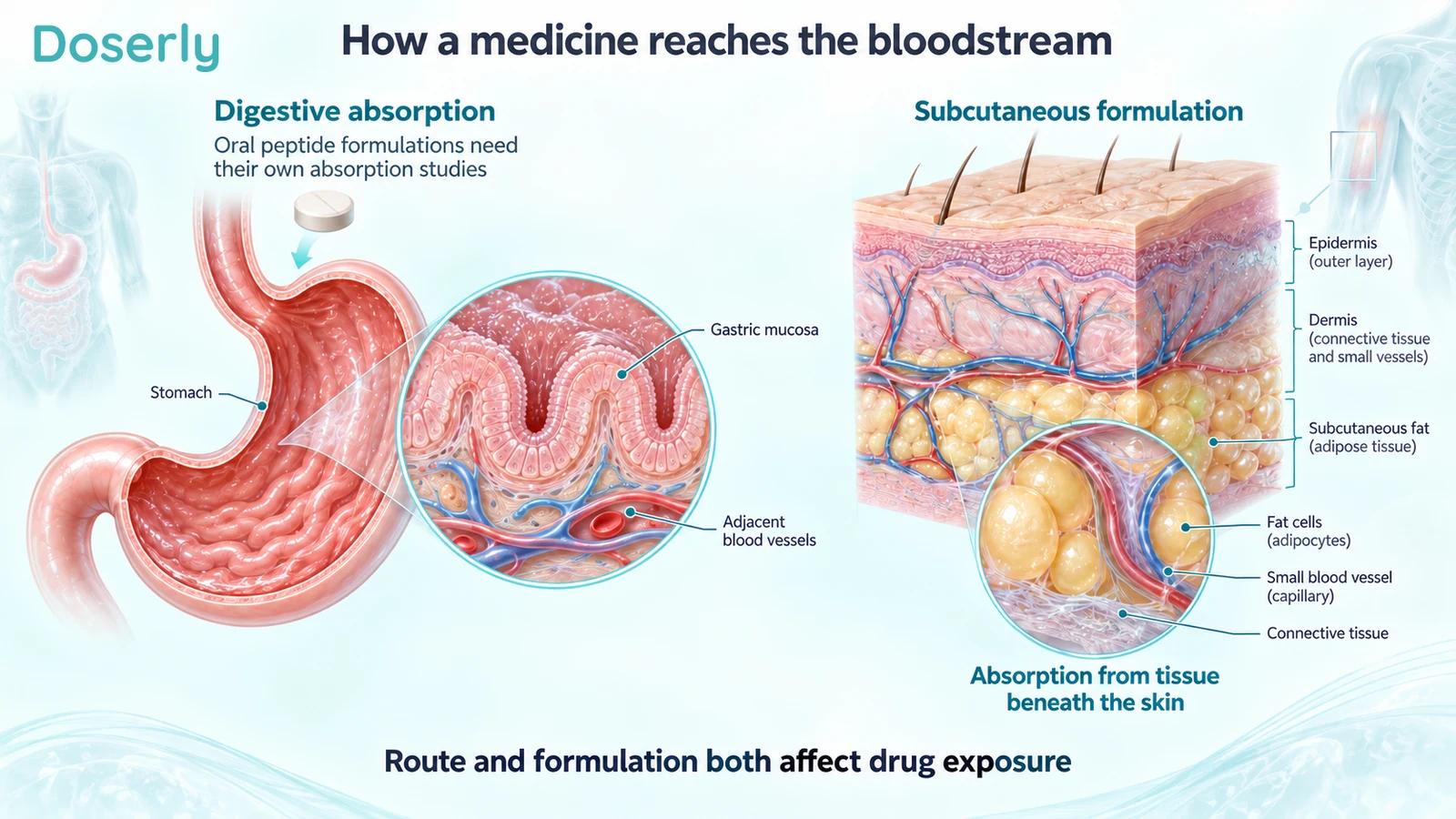
A medicine's active molecule is only one part of the product. Its formulation includes the way that molecule is prepared and delivered. A tablet has to release its contents within the digestive tract. An injection under the skin deposits medicine into tissue from which it can be absorbed. Neither route can be understood simply by reading the amount printed beside the molecule's name.
This is particularly relevant to peptides, chains of amino acids. Digestive enzymes can break peptides down, and the lining of the digestive tract can restrict how much crosses into the body. Research on oral semaglutide illustrates the challenge: investigators studied a tablet containing an absorption enhancer and found evidence of stomach absorption. That work concerns semaglutide, not a measured absorption rate for zenagamtide. It explains why researchers study the complete oral formulation instead of assuming a peptide can simply be swallowed. Buckley and colleagues' absorption research
Exposure describes how much medicine is present in the body over time. Two products containing the same number of milligrams can produce different exposure. A larger tablet amount does not automatically mean a stronger effect than a smaller injected amount. The route, formulation, absorption and elimination all contribute.
What the early oral trial actually tested
The first-in-human oral study was a multipart trial involving 144 participants overall. Its longer weight assessment belonged to the 12-week portion, with 60 participants, rather than all 144 people receiving the same treatment for three months. Participants had overweight or obesity. Safety was the main objective; weight change was an exploratory outcome. Original oral phase 1 report
That distinction matters because an early formulation study has several jobs. Researchers need to see whether the tablet produces measurable exposure, how exposure changes with different amounts, and whether people tolerate the regimen. Weight change can be encouraging while still being one part of a study designed primarily to learn how to develop the medicine.
A person considering future treatment may reasonably care about avoiding injections. The oral study supports the scientific feasibility of investigating that option. It does not settle the practical question of how well an eventual marketed tablet would work over years, with ordinary meals, other medicines and missed doses. Those questions require their own measurements rather than an extension of a 12-week result.
What the diabetes tablet study adds
A later phase 2 trial studied oral zenagamtide in adults with type 2 diabetes taking stable metformin, with or without an SGLT2 inhibitor. The oral report included 186 people assigned to three tablet dose groups or placebo over 36 weeks. Its main outcome was change in HbA1c, a measure reflecting blood sugar over the preceding months.
Estimated HbA1c reductions were approximately 0.9, 1.3 and 1.4 percentage points across the three active groups. The estimated differences from placebo were 0.5, 0.99 and 1.09 percentage points, respectively. These are changes in a diabetes measurement, not percentages of body weight lost. The analysis used on-treatment observations without rescue medication. Oral phase 2 primary report
“Percentage points” is worth spelling out. As an arithmetic illustration, a fall from 8% to 7% is one percentage point; it is not a 1% relative reduction. The starting value and the comparison with placebo help interpret the result. A change from baseline includes everything that happened during follow-up, whereas the difference between randomized groups is more informative about treatment's effect under the study conditions.
This oral study addresses a different reader question from a trial in people without diabetes. Someone hoping to improve blood sugar wants evidence in people with diabetes and on relevant background treatment. Someone primarily interested in obesity treatment needs studies designed around that population and goal. One study can inform the other without replacing it.
What the injection studies add
The early injection trial randomized 125 adults aged 18–55 with overweight or obesity, with follow-up varying between study parts. In the group escalating to the highest studied target, estimated weight change at week 36 was −24.3%, compared with −1.1% for its placebo comparison. The paper explicitly reported substantial withdrawal, including many departures for reasons unrelated to treatment-emergent adverse events. Injection phase 1b/2a report
That finding is a reason to investigate the medicine further. It is also a result from one route, one regimen and one early study population. It cannot be transferred onto an image of a tablet or used as a promise about the oral formulation. Even the time spent receiving treatment differs from the earlier 12-week oral investigation.
The later injection report in type 2 diabetes included 262 randomized participants and six dose groups. Over 36 weeks, estimated HbA1c reductions ranged from approximately 0.9 to 1.7 percentage points; each active dose improved HbA1c compared with placebo. The main analysis again used on-treatment data without rescue medication. Subcutaneous phase 2 report
There are therefore real human findings for both formulations. But setting the largest oral HbA1c change beside the largest injection change is not enough to identify the best future choice. A meaningful formulation comparison needs appropriate exposure, uncertainty around the difference, tolerability and the practical burden of taking treatment. The published reports primarily compared dose groups with placebo; they do not establish a universal conversion or switching rule.
Why daily tablet amounts cannot be converted into weekly injections
A daily amount and a weekly amount describe different schedules before absorption is even considered. Multiplying a tablet amount by seven only calculates how much was swallowed in a week. It does not calculate how much reached circulation, the highest concentration after a dose or the concentration before the next one.
The distinction also runs in the other direction. Dividing a weekly injected amount by seven does not create a tested oral regimen. A tablet is a manufactured formulation with its own behavior, not an injectable product in a different container. The relevant evidence is generated from the product actually administered to participants.
This is why a study's dose list should be read as a description of research, not as instructions for translating between routes. A future approved product, if developed, would need its own labeling and evidence for use. The current trials should not be used to design a home conversion between experimental formulations.
Why meal timing and water volume are being studied
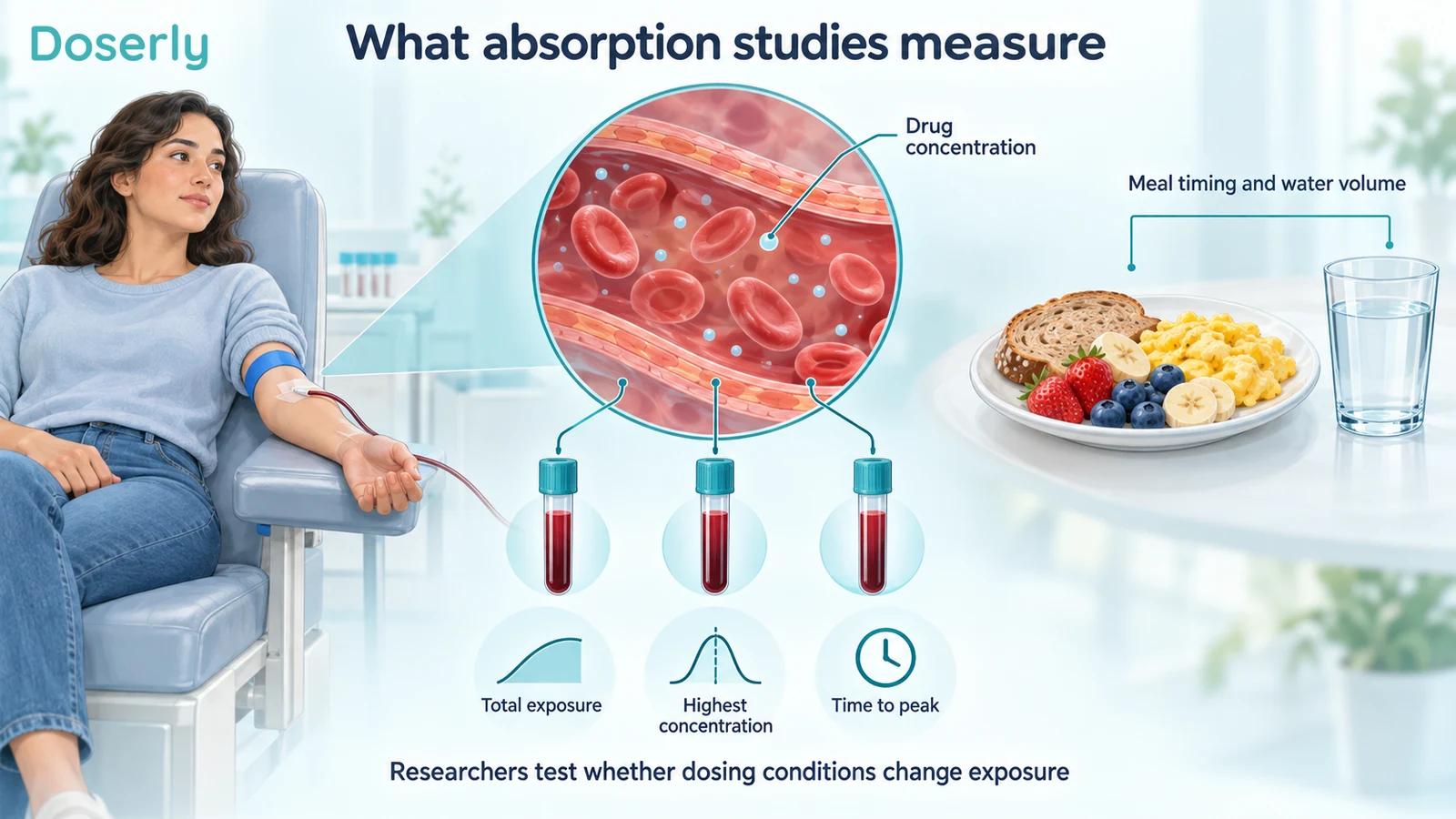
A current registry record asks a very practical question: do different meal timings after dosing and different water volumes change zenagamtide exposure? NCT07815067 is a pharmacokinetic study, meaning it examines how the medicine enters and behaves in the body. On October 15, 2026, the record listed it as recruiting, with planned enrollment of 320 and no results posted. Current primary registry record
Its planned measurements include total exposure during a dosing interval, peak concentration and time to that peak. These measures answer different questions. Total exposure describes the overall amount circulating across time. Peak concentration describes the highest measured level. Time to peak describes when that level occurs. A product could change one without changing the others in the same proportion.
The presence of this study does not tell us which meal or water condition is best. It tells us that the question is being investigated. Specific fasting intervals or water instructions from a different oral medicine should not be borrowed and presented as established zenagamtide directions.
Is a tablet automatically easier to tolerate?
Avoiding a needle and avoiding systemic side effects are different things. Once an oral medicine reaches the bloodstream, it can still produce effects throughout the body. In the oral diabetes trial, gastrointestinal adverse events were reported in 26%, 41% and 47% of the three active groups, compared with 23% on placebo. These figures describe any reported gastrointestinal event, not the proportion who stopped treatment. Oral phase 2 report
The injection diabetes report also described gastrointestinal events as the most common adverse events, mostly mild or moderate. Neither report makes “tablet” a synonym for gentler treatment. Nor should the frequency of an event in different trials be treated as a direct comparison of routes. People, dose exposure and study rules need to be comparable before drawing that conclusion. Injection phase 2 report
Convenience can still matter. For one person, taking a daily tablet may fit an established routine. Another may prefer remembering treatment once a week. Research ultimately needs to connect these preferences with actual adherence: whether people can use the product consistently over time. That is a different outcome from whether they like the idea of a tablet when asked before treatment begins.
What the larger oral trial should clarify
AMAZE 9 is a phase 3 oral obesity study with planned enrollment of 950 and a primary weight-change assessment at 76 weeks. Its registry listed recruiting status and no posted results when checked on October 15, 2026. This is a development plan, not evidence that the tablet has already delivered a particular long-term weight reduction. AMAZE 9 registry
Longer follow-up can help show whether the initial effect persists and how many people remain on treatment. It also gives more opportunity to observe adverse events than a short formulation experiment. Even a successful weight trial would need to be interpreted according to its eligibility rules and outcome; it would not automatically establish every possible cardiovascular or kidney benefit.
For now, the most useful way to read a zenagamtide result is to keep four details together: route, population, duration and outcome. A daily tablet result in diabetes answers one question. A weekly injection result in an early obesity trial answers another. Both contribute to the development program, and neither should be relabeled as the other.
Sources
- Oral amycretin phase 1 trial, 2025
- Subcutaneous amycretin phase 1b/2a trial, 2025
- Oral zenagamtide phase 2 diabetes trial, 2026
- Subcutaneous zenagamtide phase 2 diabetes trial, 2026
- Novo Nordisk's June 2026 program and results statement
- Buckley and colleagues, oral semaglutide absorption research, 2018
- Zenagamtide meal timing and water study
- AMAZE 9 oral obesity trial