
Peptides
October 16, 2026
Zenagamtide tolerability: how many people could stay on treatment?
On this page
Zenagamtide is being studied for its effects on blood sugar and body weight through hormone pathways involving GLP-1 and amylin receptors. Its early results have attracted attention because some participants experienced substantial weight reduction. But a medicine's usefulness also depends on whether people can continue taking it. An impressive average effect and a difficult treatment experience can coexist within the same trial.
That makes discontinuation an important result in its own right. It means stopping something, but the object matters: stopping the medicine is different from stopping all study visits. Likewise, stopping because of an adverse event is different from leaving for another reason. The zenagamtide reports illustrate all of these distinctions. Early injection trial
The practical question is not simply whether nausea appeared on a list. It is how frequently symptoms occurred, how disruptive they were, what the trial allowed researchers to do about them, and how many people remained on the assigned regimen. Our zenagamtide guide provides broader background; here we look closely at what the tolerability findings mean.
What an adverse-event count tells you
An adverse event is an unfavorable medical occurrence recorded during research. Its appearance after treatment does not, by itself, prove that treatment caused it. Trials collect events systematically so researchers can compare patterns, timing and frequency across groups.
A serious adverse event has a specific regulatory meaning, including outcomes such as hospitalization, a life-threatening event or death. It is not simply another word for an intense symptom. A severe headache may be highly unpleasant without meeting the definition of serious; a medically serious event may begin with symptoms that seem relatively modest. FDA explanation of serious adverse events
For someone deciding whether a treatment is workable, another distinction matters: even a symptom graded mild can interfere with meals, work or willingness to continue. A report saying most events were mild or moderate does not tell us that everyone found the regimen acceptable. The discontinuation data help answer that separate question.

The early injection trial had small treatment groups
The phase 1b/2a amycretin study, using the earlier name for zenagamtide, randomized 125 participants across several study parts. It involved adults with overweight or obesity and assessed safety, tolerability and weight change over periods up to 36 weeks. Gastrointestinal events were the most common, generally mild or moderate. The main report also explicitly noted substantial withdrawal. Primary publication
The highest-target group contained 17 participants, not all 125. The original research poster reported adverse events leading to withdrawal in six of those 17, approximately 35%. That is a meaningful observation, but its denominator is small. One participant represents nearly six percentage points in a group of 17, so the percentage should be read with the count beside it. Original investigator poster
The supplement adds an especially useful detail: those six participants stopped at different points during escalation. Their last doses were below the final 60 mg target. Calling this “35% stopped while taking 60 mg” would therefore misdescribe the exposure. It is a withdrawal figure for people assigned to that escalation group. Early trial supplementary withdrawal tables
This is more than a technical correction. A target dose is where a regimen aims to end; it is not necessarily the dose every participant received. To understand tolerability, we need to know when difficulties arose and what exposure preceded them.
Not every withdrawal was a side effect
The same early trial also had withdrawals for reasons other than treatment-emergent adverse events. The investigator poster suggested that frequent visits and inpatient stays may have contributed to participant burden. That is an interpretation offered by the researchers, not proof of the reason behind every departure. Investigator poster
Two opposite shortcuts are unhelpful. Counting every departure as drug intolerance overstates what the trial recorded. Dismissing every non-adverse-event departure as irrelevant understates the effect on available follow-up. A person who stops attending may leave unanswered questions about later weight change and safety even if an adverse event was not the recorded reason.
The distinction should remain visible in a report: how many stopped for adverse events, how many stopped for other reasons, and how much information was collected afterward. We should also avoid assigning motives that the trial did not establish. Withdrawal of consent, for example, is a recorded category, not a complete account of someone's experience.
The diabetes trial used a fixed escalation design
The later injection study enrolled 262 adults with type 2 diabetes and compared six zenagamtide dose groups with placebo for 36 weeks. Participants were receiving metformin, with or without an SGLT2 inhibitor. The primary outcome was HbA1c change, and the report described gastrointestinal events as the most common adverse events. Phase 2 diabetes trial
Its protocol is essential to interpreting stopping rates. It used a fixed escalation design: participants were assigned a planned regimen, and routine modification to a different randomized dose was not allowed. Investigators could provide symptom support and certain brief interruptions under the protocol, but persistent inability to tolerate the planned dose led to permanent discontinuation of the investigational product. Protocol, dose modification section
This does not make the trial unfair. Fixed regimens help researchers learn what specific dosing strategies do. It does mean that its discontinuation experience cannot simply be substituted for a future flexible clinical regimen. A study allowing people to remain at a lower dose would be asking a different question about treatment use.
The converse is equally important: we cannot assume flexibility will solve every tolerability problem or preserve the same effect. Those possibilities need data. A proposed slower escalation schedule is not validated merely because a fixed schedule was difficult for some participants. The protocol describes research conditions, not instructions for modifying experimental treatment outside a trial.
Stopping treatment did not necessarily mean leaving the study
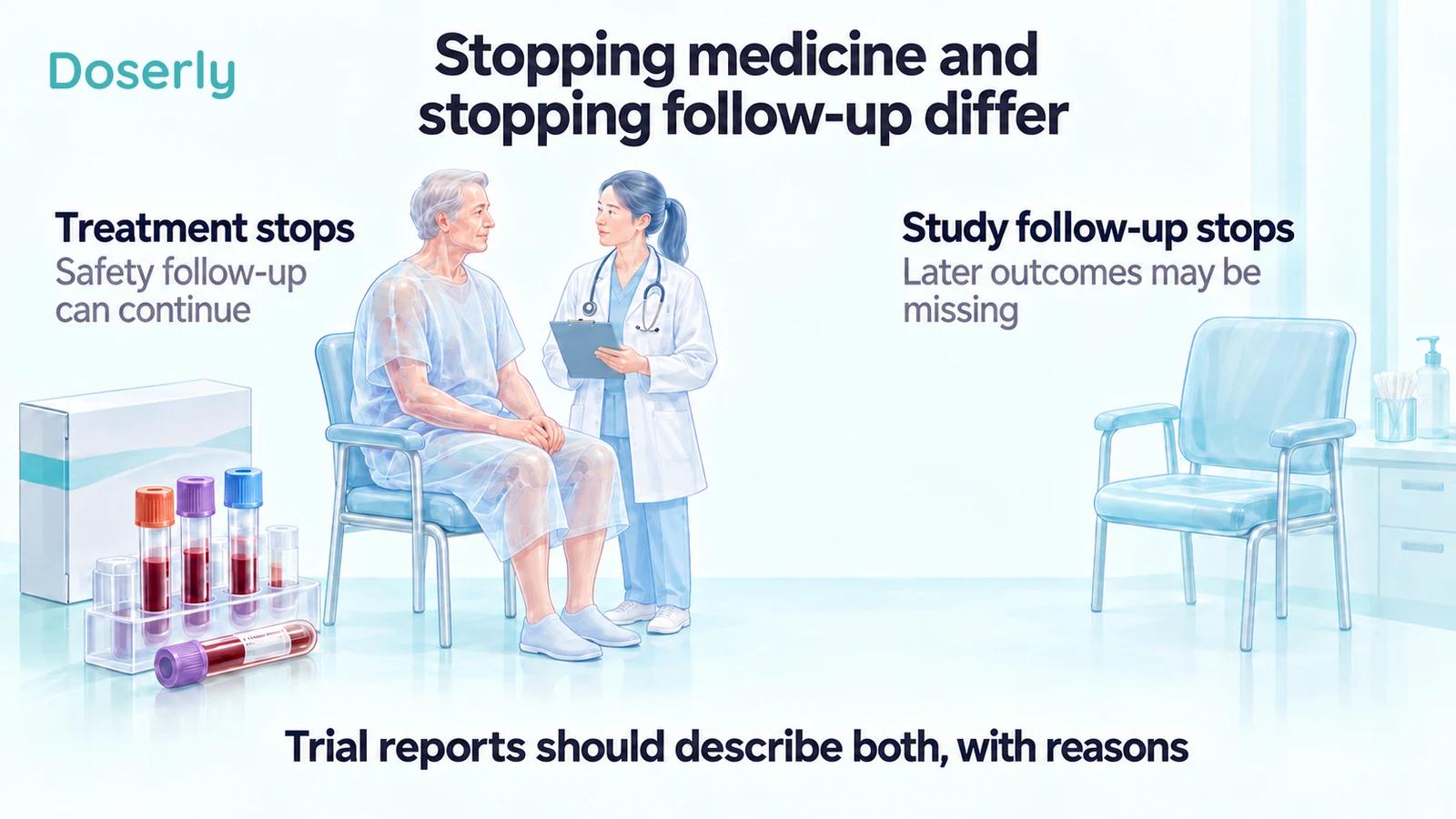
The diabetes protocol asked that people who permanently discontinued the investigational medicine remain in the study where possible for safety assessment. This separates two events that are often collapsed into one word: treatment discontinuation and study withdrawal. Protocol, discontinuation section
Continuing follow-up after stopping is valuable. Researchers can learn whether symptoms resolve, whether new events occur and what happens to the clinical outcome. If a participant leaves all follow-up, those later observations may be unavailable. A trial's ability to answer questions about starting treatment therefore depends partly on retaining contact even when the medication itself is stopped.
The participant flow diagram and the adverse-event tables serve different purposes. A flow diagram shows where people went through the study. An adverse-event table describes medical occurrences and sometimes which led to stopping. Reading only one can leave an incomplete picture of the experience.
Why discontinuation also changes the efficacy question
The diabetes supplement describes an efficacy estimand asking what would happen if participants remained on planned treatment without starting rescue medication. An estimand is the precise effect a study aims to estimate. Here, discontinuation and rescue treatment were handled through a hypothetical strategy. Supplementary Table 3
That estimate is useful for studying the medicine under continued use. It is not identical to asking what happens to everyone who begins the regimen, including people who cannot continue. International methodology explicitly distinguishes hypothetical scenarios from questions that follow outcomes regardless of treatment changes. ICH estimand guidance materials
For a patient, both perspectives matter. “How much could it help if I tolerate it?” and “What is the experience among people who start?” are legitimate questions. A strong result for the first does not remove the need to answer the second.
Missing observations add another layer. Researchers may use statistical models to estimate unavailable outcomes, but models require assumptions. Transparent reporting should explain those assumptions and whether the conclusions change under alternative reasonable analyses. The presence of modeling is not a reason to reject a study; it is a reason to understand which question its headline number answers.
What would a more useful future tolerability report include?
The next studies can make the picture clearer by presenting counts and denominators for adverse-event discontinuation at each assigned regimen, alongside the time of stopping and actual exposure. They can distinguish temporary interruption, permanent cessation and withdrawal from all follow-up. They can also show how much time participants spent at a maintenance dose.
A useful report would describe the symptoms themselves: whether they appeared during escalation, whether they recurred, and whether they resolved. A single “any gastrointestinal event” percentage groups together experiences that may differ considerably in duration and burden.
It would also make comparisons within the trial. Placebo participants can report nausea or stop study treatment too. The difference between appropriately comparable groups is more informative about treatment than an isolated percentage from the active arm. Comparing a small early study with a different medicine's late-stage trial requires still more caution because the rules may differ.
Finally, larger and longer studies need to evaluate uncommon harms. A tolerability problem that appears frequently in a small trial and a rare serious event are different research challenges. The former may be evident early; the latter may require substantially more exposure to characterize.
What this means for a treatment conversation
Zenagamtide's early research gives reasons to study its benefits and clear reasons to examine how people experience treatment. The available reports do not support treating the largest weight estimate as the experience of every participant. They also do not support describing every person who withdrew as unable to tolerate the medicine.
The most useful questions are concrete: How many people stopped because of adverse events? At what stage? Could they change the regimen? Did they continue follow-up? Was the reported benefit estimated under continued treatment, or did it include outcomes after stopping?
If a future treatment is proposed, the relevant discussion should connect expected benefit with the person's symptoms, other medicines and ability to sustain use. A dated symptom record can help describe what happened and when, but it cannot determine causation on its own. For the present research program, the key is to keep efficacy, tolerability and retention together when interpreting the results.
Sources
- Early injection trial, 2025
- Original investigator poster with withdrawal counts
- Early trial supplementary withdrawal tables
- Injection diabetes trial, 2026
- Diabetes trial supplement and protocol
- FDA: serious adverse events
- ICH E9(R1) methodology materials