
Peptides
October 16, 2026
Thymosin alpha-1 and vaccine response: does it mean fewer infections?
On this page
Thymosin alpha-1 has been investigated as an addition to vaccination because some people develop weaker immune responses to vaccines. The idea is straightforward: if an intervention helps the body respond to a vaccine, it might improve protection against the infection that vaccine targets. Researchers have tested parts of that idea in older adults and people receiving dialysis.
But the next claim often grows much larger than the experiment. An increase in vaccine-related antibodies is sometimes presented as evidence that thymosin alpha-1 prevents ordinary colds, reduces every kind of infection or generally “strengthens immunity.” The studies do not support that expansion.
The distinction is not that antibodies are unimportant. They are central to understanding vaccine responses. It is that a laboratory response and a reduction in illness answer different questions. Looking at the original trials makes this clearer—and gives you more useful questions to ask if an extra injection is proposed around vaccination.
What an antibody test measures
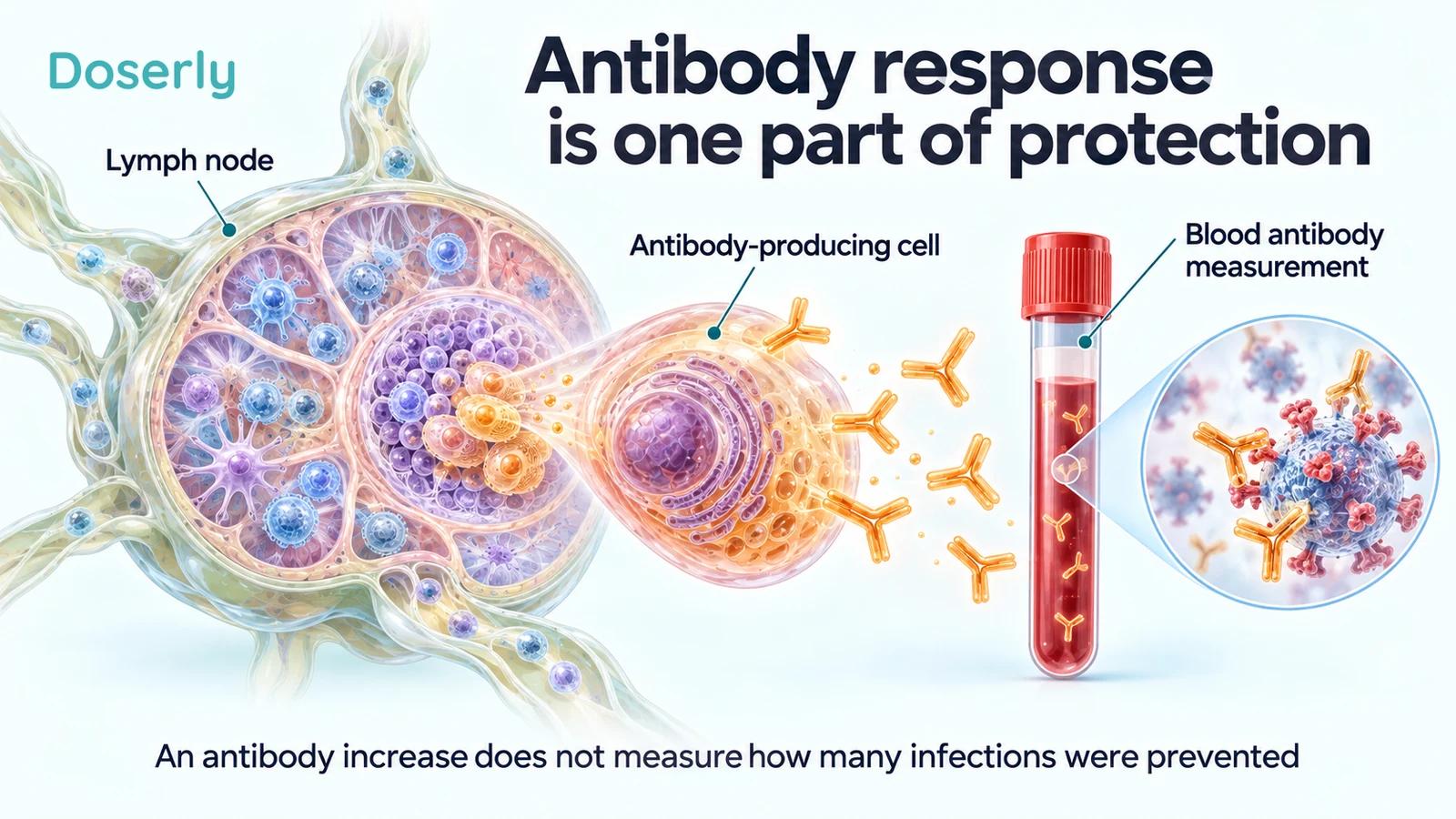
Antibodies are proteins that recognize particular targets. Vaccine studies may measure how much antibody appears after vaccination or how well those antibodies act in a laboratory assay. Immunogenicity describes a treatment's ability to provoke an immune response; it is not itself the number of infections prevented.
For influenza, one common method is the hemagglutination inhibition, or HI, test. It examines how antibodies interfere with a virus's interaction with red blood cells under laboratory conditions. Other tests evaluate neutralization or different aspects of the response. CDC uses human serology research to understand vaccine responses and breakthrough infections. CDC human serology explanation
An antibody titer is a way to express antibody activity through serial dilution. A fourfold rise means the measured value increased four times relative to the starting value. It does not mean the person became four times less likely to get sick. The starting level, assay, timing and target virus all matter when interpreting the result.
Similarly, “seroconversion” and “seroprotection” are study terms defined by specified laboratory criteria. A person meeting a threshold has met that criterion; the word does not guarantee that they cannot become infected. This is why clinical protection must be evaluated in the appropriate setting rather than inferred from a term alone.
The older-men influenza study
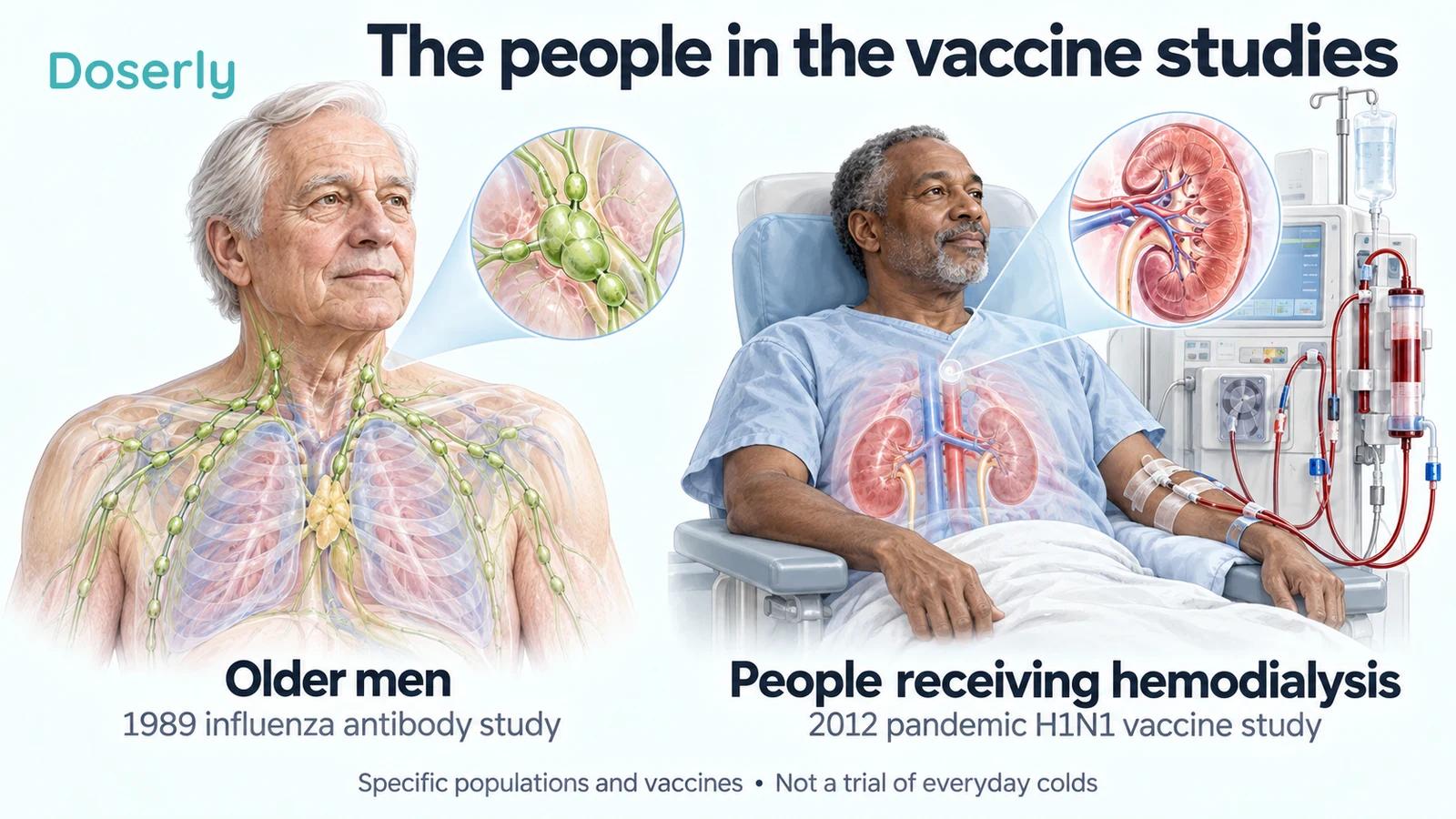
A double-blind placebo-controlled study published in 1989 randomized 90 men aged 65–99 to thymosin alpha-1 or placebo alongside the 1986 trivalent influenza vaccine. Samples from 85 men were suitable for analysis. The researchers assessed antibody responses over the weeks after vaccination. Gravenstein and colleagues
At six weeks, the thymosin group had a greater antibody response, with P=0.023. The difference was attributed to a stronger response in the older subgroup, aged 77 and above; no corresponding difference appeared between the younger treatment groups. The trial reported no observed toxicity.
This was a real human randomized study. Its direct finding was an antibody response to a particular influenza vaccine in older men. It was not a trial showing that young, healthy adults caught fewer colds, and the absence of observed toxicity in a small study cannot exclude uncommon harms.
The subgroup result also deserves restraint. It suggests that age or the starting immune response might influence the effect. It does not establish a universal age threshold at which thymosin alpha-1 should be added to vaccination. A useful follow-up would test a clearly defined population and confirm that the immune change translates into worthwhile protection.
What the dialysis pilot tested
A later pilot examined an MF59-adjuvanted pandemic H1N1 influenza vaccine, Focetria, with or without thymosin alpha-1 in people receiving hemodialysis. It was randomized and open-label, meaning treatment assignment was known. The report distinguished 94 participants in the intention-to-treat analysis, 82 in the per-protocol analysis and 99 in the safety population. Carraro and colleagues, 2012
Blood samples were assessed on days 0, 21, 42, 84 and 168. On day 21, the thymosin-containing groups had better HI antibody measurements than the vaccine-only group. By day 42, however, HI geometric mean titers had declined more in the peptide groups. The original abstract also reported no adverse events attributed to the peptide or vaccine. Original pilot report
The later findings need equal attention. FDA's review of the original paper reports that, on days 84 and 168, HI seroconversion, seroprotection, geometric mean titers and geometric mean ratios were higher with vaccine alone. These HI results do not demonstrate a sustained advantage from adding thymosin alpha-1. FDA review of the vaccine studies
A different assay, microneutralization, gave a different pattern: titers were highest in the higher-exposure peptide group at each follow-up, while vaccine alone outperformed the lower-exposure peptide group. The assays should therefore not be collapsed into a single claim that every immune response improved or worsened. These laboratory findings establish neither clinical harm nor fewer infections. They leave durable patient benefit unresolved in this specific dialysis population and vaccine setting. FDA assay-specific assessment
The different analysis populations are not three separate trials. They represent different sets of participants included for different analyses. When reading a summary, it helps to retain the denominator appropriate to the claim: the people included in an immune-response analysis may differ from everyone who received at least one treatment and was assessed for safety.
Why these findings do not answer the common-cold question
The studies administered a vaccine against a defined target and then examined the response to that vaccination. A claim about preventing everyday infections changes several parts of the question at once: the pathogen, the population, the intervention's purpose and the clinical outcome.
Even the phrase “fewer infections” needs definition. Does it mean fewer symptomatic episodes, fewer laboratory-confirmed infections, fewer antibiotic prescriptions, fewer hospital visits or fewer severe complications? These outcomes may move differently. Counting all days with a runny nose is not equivalent to confirming influenza with a test.
CDC describes vaccine effectiveness research using clinical outcomes, including laboratory-confirmed influenza. That approach addresses whether people actually experienced the illness being studied. Antibody measurements can complement that work, but they cannot substitute for every clinical endpoint. CDC explanation of effectiveness studies
For an add-on treatment, the relevant comparison would generally keep vaccination comparable in both groups and vary the add-on. Otherwise, a benefit from vaccination could be mistakenly attributed to the peptide. The trial would also need enough participants and follow-up for infections to occur; a short study optimized for blood sampling may be unable to answer that question.
Does HIV immune-recovery research fill the gap?
It addresses another important but different clinical problem. A 2003 open-label randomized pilot studied 20 people with HIV whose viral loads were controlled on antiretroviral treatment but whose CD4 counts remained low. Thymosin alpha-1 was compared with no injections over 12 weeks. Chadwick and colleagues
At week 12, changes in CD4, CD8 and selected lymphocyte subsets did not differ significantly between groups. A laboratory measure called signal-joint T-cell receptor excision circles increased in treated participants. These DNA circles are used in research related to T-cell development, but the authors stated that clinical benefits and long-term consequences remained undetermined.
This does not supply the missing evidence for preventing ordinary infections in otherwise healthy people. It concerns a specific immune-recovery problem in patients already receiving effective HIV therapy. The peptide was not a replacement for antiretroviral treatment, and a change in that specialized assay is not a count of prevented infections.
It is also a reminder that different immune measurements can disagree. One may change while another does not. That is a reason to describe the actual assay and clinical question, rather than combining every favorable laboratory finding into one general promise of immune improvement.
What is being studied with COVID vaccination?
The official record for NCT06821100 describes a randomized open-label phase I study of thymalfasin before a COVID-19 vaccine in older adults. When checked on October 15, 2026, the record listed recruitment, an estimated enrollment of 75 and no posted results. Its primary outcome concerns adverse events and tolerability; secondary outcomes include antibody and T-cell measurements. ClinicalTrials.gov record
The record specifies descriptive summaries for the secondary immune outcomes, with no formal hypothesis testing planned. It is therefore especially important not to advertise the registration as a completed demonstration of improved vaccine protection. Planned enrollment is not the same as the number who have completed follow-up.
A registry is useful because it tells us what investigators intend to evaluate and whether results have been reported. It does not establish success in advance. Future findings from this study may clarify safety and immune responses, but their relevance will still depend on the participants, product, vaccine and outcomes actually analyzed.
The vaccine and the added product are separate decisions
Someone can reasonably choose a recommended vaccine while declining an unproven add-on. Conversely, interest in a trial of an add-on does not mean the vaccine itself lacks clinical evidence. Keeping those decisions separate prevents uncertainty about the peptide from being misread as uncertainty about all vaccination.
The safety of an established vaccine also does not automatically establish the safety of combining it with a separate injected peptide. FDA's 2024 thymosin alpha-1 evaluation identified limitations in vaccine-adjuvant evidence and concerns involving formulation, peptide aggregation and impurities. FDA scientific evaluation
The proposed product matters. A medicine used under a trial protocol is not interchangeable with every vial sold online under the same peptide name. Product identity and clinical efficacy are different questions, and both need answers before a treatment recommendation can be justified.
For the wider evidence and product distinctions, our thymosin alpha-1 guide provides additional background. The guide is not a reason to improvise an injection schedule around a vaccine appointment.
What to ask if an extra injection is suggested
Ask what problem the clinician is trying to address. A documented concern about vaccine response in a particular medical condition is more specific than a general desire to avoid getting sick. Then ask whether the supporting trial measured antibody levels or actual infections, and whether its vaccine and population resemble your situation.
Clarify the expected benefit in terms that matter to you. If the claim is fewer hospitalizations, an antibody study alone cannot estimate that benefit. If the aim is a stronger laboratory response, ask why that measurement is informative for your particular condition and what would be done with the result.
Finally, discuss how the added treatment would affect monitoring, costs and the timing of ordinary care. The evidence reviewed here does not identify a proven thymosin alpha-1 schedule for general infection prevention. It would be inappropriate to delay indicated vaccination or prescribed treatment while trying to reproduce an old experimental regimen.
The research supports a narrower, worthwhile question: can thymosin alpha-1 improve selected vaccine responses, and do those changes help the people receiving it? Some antibody findings are encouraging. The broader promise of fewer everyday infections still needs direct clinical confirmation.
Explore the research
- Gravenstein and colleagues, 1989: randomized influenza-antibody study in older men.
- Carraro and colleagues, 2012: pandemic H1N1 vaccine-response pilot in hemodialysis patients.
- Chadwick and colleagues, 2003: immune-reconstitution pilot in treated HIV.
- NCT06821100: ongoing phase I vaccine-response study; record checked October 2026.
- CDC human serology: how antibody responses are studied.
- CDC vaccine effectiveness methods: clinical protection outcomes.
- FDA thymosin alpha-1 briefing, 2024: evidence and formulation limitations.