
TRT
October 16, 2026
Why TRT's blood-pressure warning deserves its own headline
On this page
Testosterone replacement can improve symptoms in people with an established deficiency, but a good symptom response does not tell you what is happening to blood pressure. That is a separate measurement, and it deserves a place in follow-up even when a testosterone result looks reassuring.
In February 2025, FDA announced two changes that can sound contradictory when reduced to a headline. It called for removal of boxed-warning language concerning increased major cardiovascular outcomes, informed by TRAVERSE. It also required information warning that testosterone products can raise blood pressure, informed by separate monitoring studies. Both conclusions can be true. FDA communication
For a person using TRT, the practical lesson is to measure blood pressure directly, understand what the product-specific evidence says, and agree on a response to a sustained change. It is not a reason to assume treatment is dangerous for everyone or to dismiss a rising reading because you feel better.
What blood pressure measures
Blood pressure describes the pressure of circulating blood against artery walls. The upper, systolic, number reflects pressure as the heart contracts; the lower, diastolic, number reflects pressure between beats. These are expressed in millimeters of mercury, written mm Hg. Heart rate, testosterone concentration and hematocrit are different measurements. American Heart Association explanation
A hormone test measures an exposure related to treatment. A pressure reading measures an aspect of circulation. Neither can substitute for the other. Someone can have a testosterone concentration within the intended range and still need attention to blood pressure, just as someone with a satisfactory pressure reading can still have symptoms requiring evaluation.
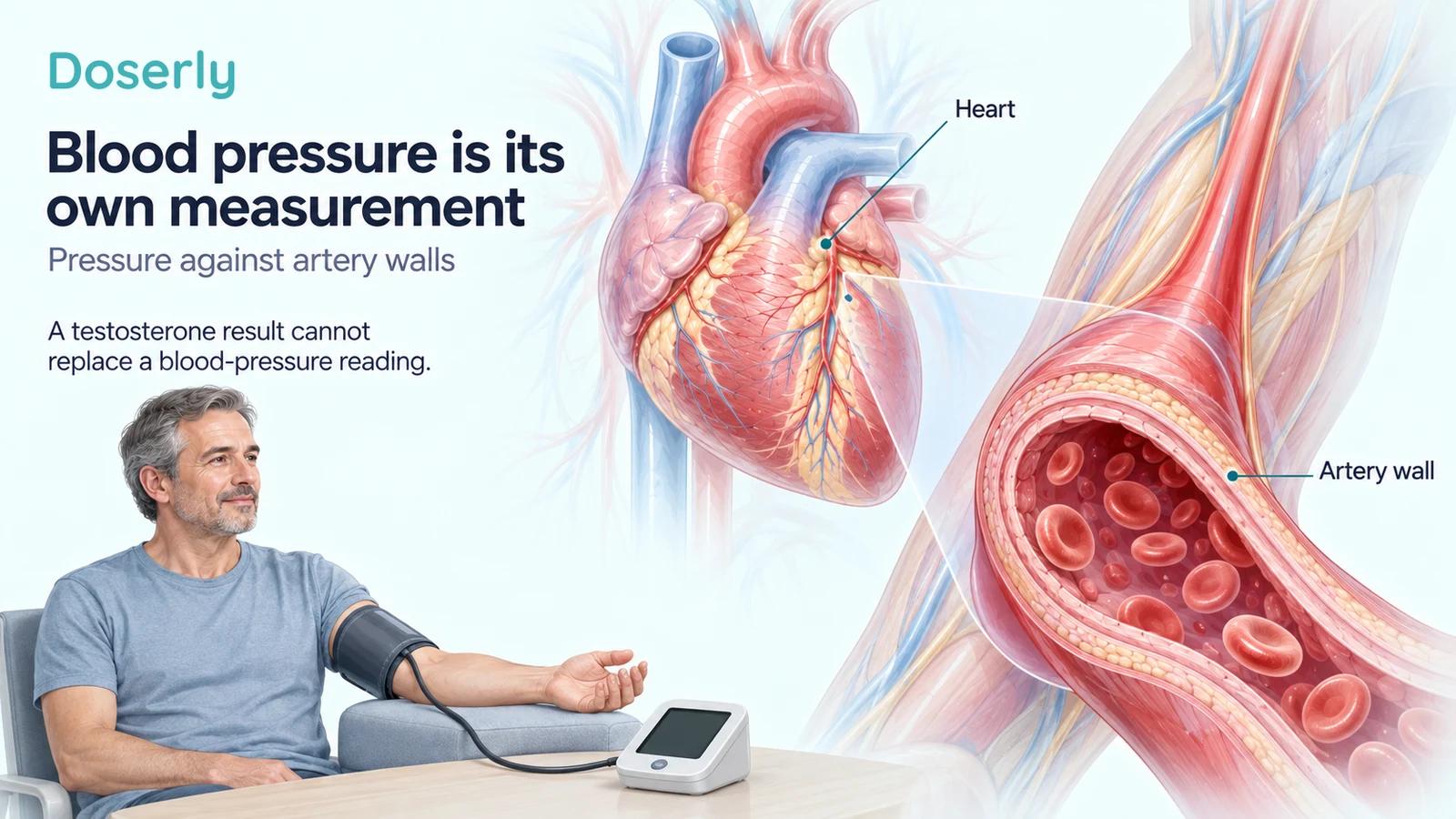
This distinction also explains why safety follow-up includes several measures. A blood count does not answer the same question as a cuff, and a cuff cannot tell whether a medication is delivering the intended hormone exposure. Our TRT blood-work guide explains the laboratory portion of that broader assessment.
Why TRAVERSE does not cancel the blood-pressure warning
TRAVERSE compared testosterone gel with placebo in 5,246 men with symptoms, repeated low testosterone and established or increased cardiovascular risk. Over mean follow-up of 33 months, the primary combination of cardiovascular death, nonfatal heart attack or nonfatal stroke occurred in 7.0% and 7.3%, respectively. The trial met its noninferiority criterion for this outcome. Primary TRAVERSE report
That result addresses serious events over the observed period. It does not mean every cardiovascular measurement was unchanged. A trial can observe similar event rates while a smaller average pressure difference is present, particularly when people receive other medical care and follow-up is finite.
Nor does a warning about blood pressure mean a particular patient will have a heart attack. A pressure increase is a risk-related change that clinicians can identify and manage. The warning is useful precisely because it directs attention to something measurable before a serious event occurs.
FDA reviewed ambulatory blood-pressure monitoring, or ABPM, studies across testosterone products. ABPM uses a wearable cuff to collect readings across ordinary daytime activity and sleep. The agency concluded that increases were a class-wide concern and requested product-specific information where monitoring studies had been completed. FDA's explanation of the ABPM findings
What the individual product numbers actually mean
The retrieved AndroGel 1.62% label reports an average increase from baseline of 1.9 mm Hg systolic and 1.3 mm Hg diastolic after 16 weeks in its ABPM study. Among participants with hypertension who were receiving antihypertensive treatment, the reported average increase was 3.0/2.2 mm Hg. The label recommends periodic pressure monitoring and says the product is not recommended for uncontrolled hypertension. AndroGel prescribing information
These are group averages. They are not the increase every user should expect, a target change, or a threshold below which individual monitoring is unnecessary. An average can include people whose readings barely move and people with a larger change.
The XYOSTED label, for a subcutaneous testosterone enanthate product, reports a 3.9/1.5 mm Hg average increase from baseline after 12 weeks in its clinical studies. It also calls for periodic monitoring, particularly in men with hypertension, and advises against use in uncontrolled hypertension. XYOSTED prescribing information
It would be tempting to place those two figures side by side and declare one product twice as risky. That would go beyond the comparison. The studies had different participants, schedules and settings; they were not a randomized head-to-head test of those two products. A prescriber can consider the evidence for each formulation without pretending that cross-study averages provide a precise ranking.
The route also matters to interpretation. Evidence about one named injection product is not a measurement of every injectable preparation, dose or interval. The relevant question is what is known about the actual product and exposure being considered.
A transdermal study shows why the analysis population matters
A 2024 study examined a testosterone transdermal system over 16 weeks using 24-hour monitoring. It enrolled 168 men who received at least one dose. Only 62 met the reported adherence requirement and had a valid week-16 monitoring session for the principal analysis described in the abstract. Their average 24-hour systolic pressure rose by 3.5 mm Hg, with a 95% confidence interval of 1.2–5.8. Efros and colleagues
The study did not have a concurrent placebo group. It could not rule out a pressure effect under its prespecified noninferiority criterion, which required the upper confidence limit to remain below 3 mm Hg. The limited analyzed sample and absence of a comparison arm matter when interpreting the size and cause of the change. Primary study report
A measurement before treatment and another afterward can identify a pattern, but other things may change during those weeks. A randomized comparator makes it easier to separate treatment effects from those changes. This does not make monitoring studies useless; it explains why their findings are used alongside larger trials, labeling and individual follow-up.
It also helps explain why a personal reading cannot be predicted from a published mean. Your starting pressure, concurrent treatment, measurement conditions and course over time are part of the clinical interpretation.
How to collect readings that help your clinician
An accurate home record starts with a validated upper-arm monitor and a cuff that fits. The American Heart Association recommends quiet rest for at least five minutes, a bare upper arm supported at heart level, and two readings one minute apart. Avoid smoking, caffeine and exercise in the preceding 30 minutes; empty your bladder and remain quiet during measurement. Bring the device to a visit so its use and readings can be checked. AHA home-monitoring guidance

The aim is a representative record, not a competition to produce the lowest number. Repeatedly testing until an appealing value appears can give a misleading account of what happened. Save the readings you were instructed to collect, with their dates and times, and note unusual circumstances.
Useful context might include a missed blood-pressure medicine, an acute illness, a recent formulation change or a reading taken immediately after activity. These notes do not establish why pressure changed. They help a clinician decide whether to repeat measurements under standard conditions, review treatment or investigate further.
Ask how often to measure before and after a treatment change, how the record should be shared, and which values require contact. The answer may differ between a person with stable normal readings and someone already being treated for hypertension. A monitoring plan should be specific enough that you do not have to improvise when a number surprises you.
What if the home and office readings disagree?
A clinic reading captures a short period in an unfamiliar setting. Home readings describe another setting, while ABPM samples across a longer day and night. Disagreement should prompt interpretation, not automatic dismissal of whichever result is less convenient.
The AHA describes both white-coat hypertension, with higher office readings, and masked hypertension, with higher readings outside the office. Checking technique and reviewing multiple measurements can help clarify the pattern; a clinician may use ambulatory monitoring when appropriate. AHA discussion of out-of-office measurement
For example, a reassuring reading at a scheduled TRT visit does not explain a repeatedly higher home average. Equally, a single high result after rushing to an appointment should not be treated as a complete diagnosis. Bring the full record and the device rather than only the highest or lowest result.
Keep averages and isolated readings separate
A label reporting a mean systolic increase of a few millimeters of mercury is describing an average across a study group. A single home reading that differs from yesterday by a few points is a different kind of observation. It cannot show that you have reproduced the study effect, and it should not be subtracted from the trial average to estimate how susceptible you are.
For follow-up, the useful comparison is the pattern collected according to the agreed schedule, with comparable technique. If a clinician summarizes that pattern as an average, retain the underlying readings too. They show whether the summary reflects consistently similar values or a mix of ordinary readings and occasional much higher ones.
A rising reading does not identify its own cause
If pressure rises after TRT begins, the timing is clinically relevant. It is not proof that testosterone is the only contributor. Other medicines, changes in health and the conditions under which pressure was measured may also matter. Your clinician needs the medication list and the pattern over time, not just the fact that one event followed another.
This is a reason to avoid changing several treatments yourself at once. Doing so can make both safety and interpretation harder. The purpose of a record is to support a supervised decision about the whole treatment plan, including whether the intended benefits are occurring.
A useful conversation might sound like this: “These are my readings before the change, these are the readings afterward, and this is what changed in my symptoms and medicines.” That is more informative than “My testosterone is normal, so the pressure must be unrelated,” or “The pressure rose once, so the treatment must be unsafe.”
The blood-pressure warning does not specify that every increase should lead to the same action. A sustained pattern, starting cardiovascular risk, other treatment and the clinical reason for TRT all affect the decision. The label for the exact product remains an important reference.
Know when a reading needs urgent attention
AHA guidance says that a pressure above 180 systolic and/or 120 diastolic should be rechecked after at least one minute. If it remains very high, contact a healthcare professional immediately. With symptoms such as chest pain, shortness of breath, weakness, vision change or difficulty speaking, call emergency services rather than waiting for it to settle. AHA urgent-reading guidance
Serious symptoms also deserve urgent assessment even if a home monitor is unavailable. Do not wait for the next scheduled hormone appointment to address them.
For ordinary follow-up, the central question is simpler: is treatment helping the problem it was prescribed for, and are the relevant safety measurements remaining acceptable? Blood pressure belongs in that conversation in its own right. A helpful symptom response and a reassuring testosterone level are useful information; a well-collected pressure record adds something neither can supply.
Sources
- FDA, class-wide testosterone labeling changes, 2025.
- AHA, Blood Pressure Explained.
- Lincoff and colleagues, TRAVERSE, 2023.
- AndroGel 1.62% prescribing information.
- XYOSTED prescribing information.
- Efros and colleagues, transdermal testosterone ABPM study, 2024.
- AHA, Home Blood Pressure Monitoring.
- AHA, interpreting home and office measurements, 2022.