
Peptides
October 16, 2026
Why small ARA-290 trials leave large safety questions
On this page
ARA-290, or cibinetide, was designed to explore some of erythropoietin's tissue-protective effects without stimulating red blood cell production. That design helps explain the interest in it for nerve disorders. It does not mean that the resulting peptide has no other effects or that its safety can be assumed from its intended mechanism. Original preclinical development study
The human trials provide useful early observations: investigators asked about symptoms, checked blood tests and recorded medical events. Most exposures were short, however, and the groups were small. A reassuring description such as “well tolerated” has to be read alongside those limits and the actual adverse-event details.
For someone considering an experimental treatment, the practical question is broader than whether a study found an obvious problem in a few weeks. It includes uncommon reactions, longer exposure, existing illnesses, other medicines and the quality of the product being used. The available ARA-290 studies answer only parts of that question.
What early monitoring can tell us
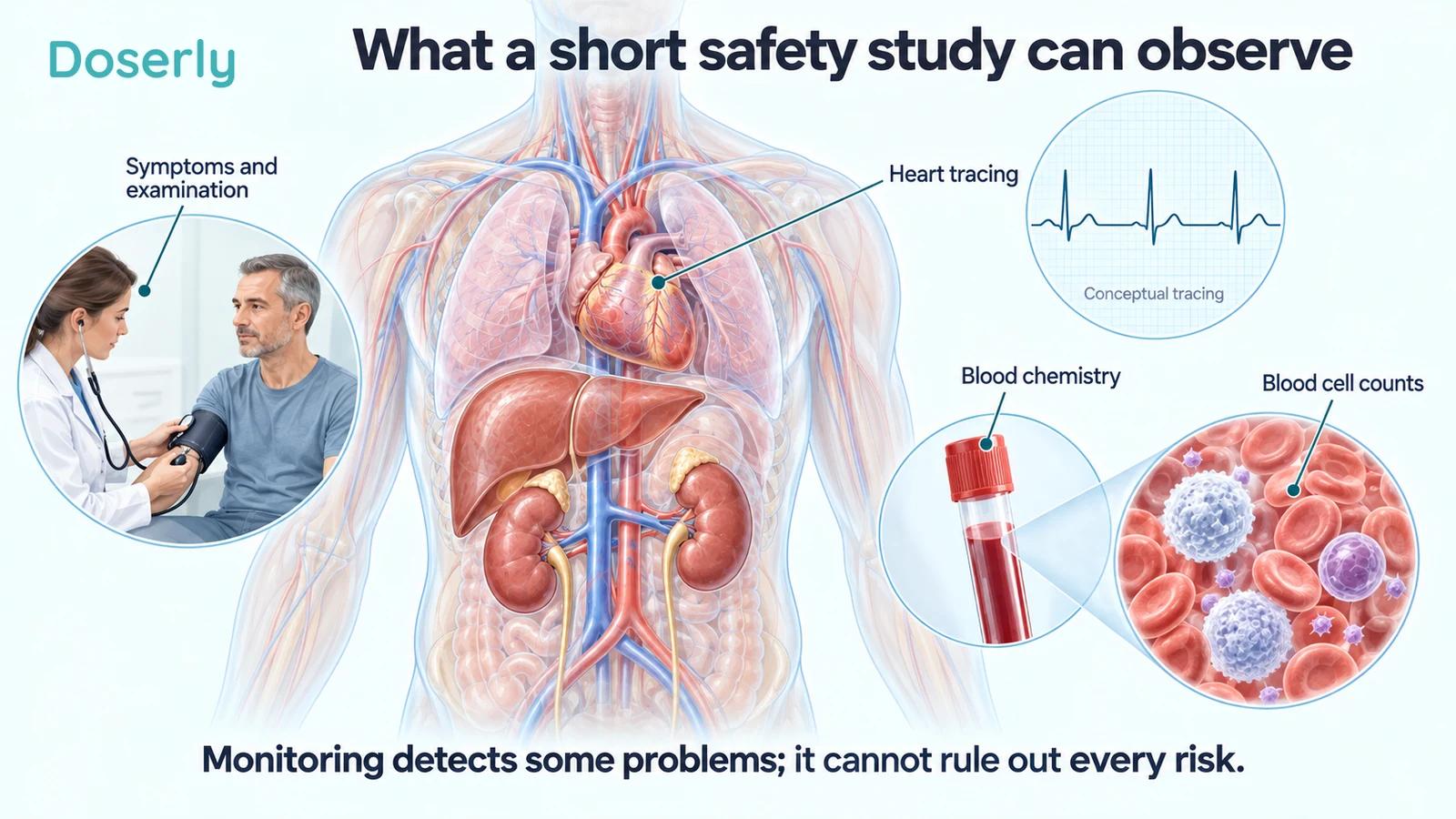
In the diabetes trial, participants had clinical chemistry, blood-cell measurements and vital signs checked at baseline and during follow-up. Researchers also obtained a short electrocardiogram recording around the first administration and tested for antibodies against ARA-290. Participants were questioned about adverse events at regular intervals. Diabetes trial methods
Those are meaningful safeguards. They can reveal some changes that a person may not notice, and structured questioning is more informative than relying only on spontaneous reports. A study can also show whether participants find a treatment burdensome enough to stop it.
Yet a normal set of scheduled measurements does not test every possible harm. A transient event might occur between visits. An uncommon reaction might not happen in a small sample. A problem associated with repeated exposure might not appear during a first short course. What was measured and how long people were observed define the information the study can provide.
An adverse event is not automatically a drug reaction
An adverse event is an unfavorable medical occurrence during a study. It can happen because of the investigational treatment, the underlying disease, another medicine or an unrelated cause. Investigators then assess whether the treatment may have contributed.
A serious adverse event is classified by consequences such as death, a life-threatening event, hospitalization or significant disability. “Serious” is not simply another word for an intensely unpleasant symptom. A severe headache and a medically serious event are overlapping but different descriptions. FDA's reporting explanation makes that distinction important when reading safety tables. FDA definition
Causality assessments are judgments made with the information available. “Possibly related” is not proof that the medicine caused the event, but it is also not a reason to leave the event out. “Unrelated” should be reported as the investigators' assessment rather than treated as an experimentally proven explanation.
This language allows a fair account of early studies: describe what happened, how investigators assessed it and what uncertainty remains. Neither counting every event as caused by the peptide nor excluding all uncertain events gives an accurate safety picture.
What happened in the larger sarcoidosis trial?
The 2017 study randomized 64 adults with sarcoidosis-associated small nerve fiber loss and neuropathic pain to placebo or three cibinetide amounts for 28 days. Two participants assigned to the highest amount had unconfirmed treatment assignment because of a pharmacy error, which is relevant when reading the analyzed safety denominators. Primary trial report
The EU results record reports serious events in two of 16 participants in the 1 mg group and one of 14 in the 8 mg group, compared with none of 16 in the placebo group and none of 16 in the 4 mg group. Multiple events can occur in one person, so counting events and counting affected participants are not the same calculation. EU trial results
The paper describes the events in the lower-amount group as unrelated to study drug. It describes suicidal ideation in one participant in the highest-amount group as possibly related. The registry marks the suicidal-ideation occurrence as treatment-related in its causality field. Both sources therefore require that this event be taken into account, while neither can establish a reliable population frequency from one case. Published report; registry
There were also nonserious events, including headache, nausea, fatigue, diarrhea and injection-site pain. Some occurred in placebo participants as well. The headache totals are not identical between the published report and the registry's nonserious-event rows, so a single pooled headache percentage would imply more consistency than these records provide. The central observation is that symptoms were recorded; a blanket “no side effects” description is inaccurate.
The diabetes study needs more than its abstract
The diabetes paper's abstract offers a reassuring overall safety conclusion. Its detailed results contain a more complicated account. Forty-nine people enrolled, and one participant stopped treatment after kidney function deteriorated; that participant was excluded from the main analysis. The paper reports four serious adverse events in the ARA-290 arm, two judged possibly related and two judged unlikely to be related. Full diabetes report
In the kidney case, the participant already had borderline renal impairment and a diuretic dose had been increased. Those circumstances make attribution difficult. The safety committee stopped ARA-290, while the increased diuretic continued; kidney function did not improve over the reported follow-up. The appropriate conclusion is that the event and its competing explanations matter, not that the peptide was conclusively responsible or conclusively cleared.
The report also describes a fatal heart attack after a severe skin infection, occurring after dosing had ended, which the safety committee judged unrelated to treatment. That assessment should remain attached to the account. A death during follow-up cannot be silently omitted from a safety description, but neither should it be recast as a proven drug-related death.
The difference between the abstract and the detailed section is a useful reason to read beyond a favorable sentence. An overall interpretation does not replace participant flow, withdrawals, event descriptions and causality assessments.
What do the reassuring smaller studies add?
The 2013 sarcoidosis study reported no serious adverse events during dosing or its 12-week follow-up. It also reported no detected antibodies against ARA-290 in the post-exposure samples. Those observations are encouraging within a 38-person trial. They cannot establish that serious reactions or antibodies never occur. 2013 trial
A separate diabetic macular edema study enrolled nine people, eight of whom completed 12 weeks. Its abstract reported no serious adverse events or anti-cibinetide antibodies. It did not show improvement in mean visual acuity or retinal thickness. This is additional short-term experience in another selected population, but the study was uncontrolled and too small to define uncommon risks. 2020 eye study
These reports can coexist with serious events in other trials. Small samples vary, and participants differ in their underlying illnesses. The correct synthesis is not to choose whichever study gives the most comforting or alarming impression. It is to recognize a limited database with some reassuring monitoring results and some events that require attention.
How easily can a small study miss a rare problem?
Consider a mathematical example, not an estimate of ARA-290 risk. Suppose a particular reaction truly occurs in one out of every 100 exposed people over a defined period, and suppose risks are independent and the same for everyone. In a group of 50 people, the probability of seeing no cases is 0.99 raised to the 50th power, or about 61%.
In other words, even under those simplified assumptions, a small study would more often miss that reaction than observe it. Seeing zero cases is compatible with a risk that could matter when many people use a treatment. This is why “none observed” and “cannot happen” are very different statements.
Real safety studies are more complicated than that example. Exposure time varies, participants may stop early, and risk may be concentrated in particular subgroups. The arithmetic is only an illustration of sample-size limits; it does not imply that ARA-290 has a one-percent risk of any named event.
Four weeks cannot answer every repeated-use question
A 28-day exposure is not interchangeable with several months or repeated courses separated by breaks. The amount given, route, formulation and follow-up all matter. Simply adding up people from different small studies does not create a large trial of one consistent regimen.
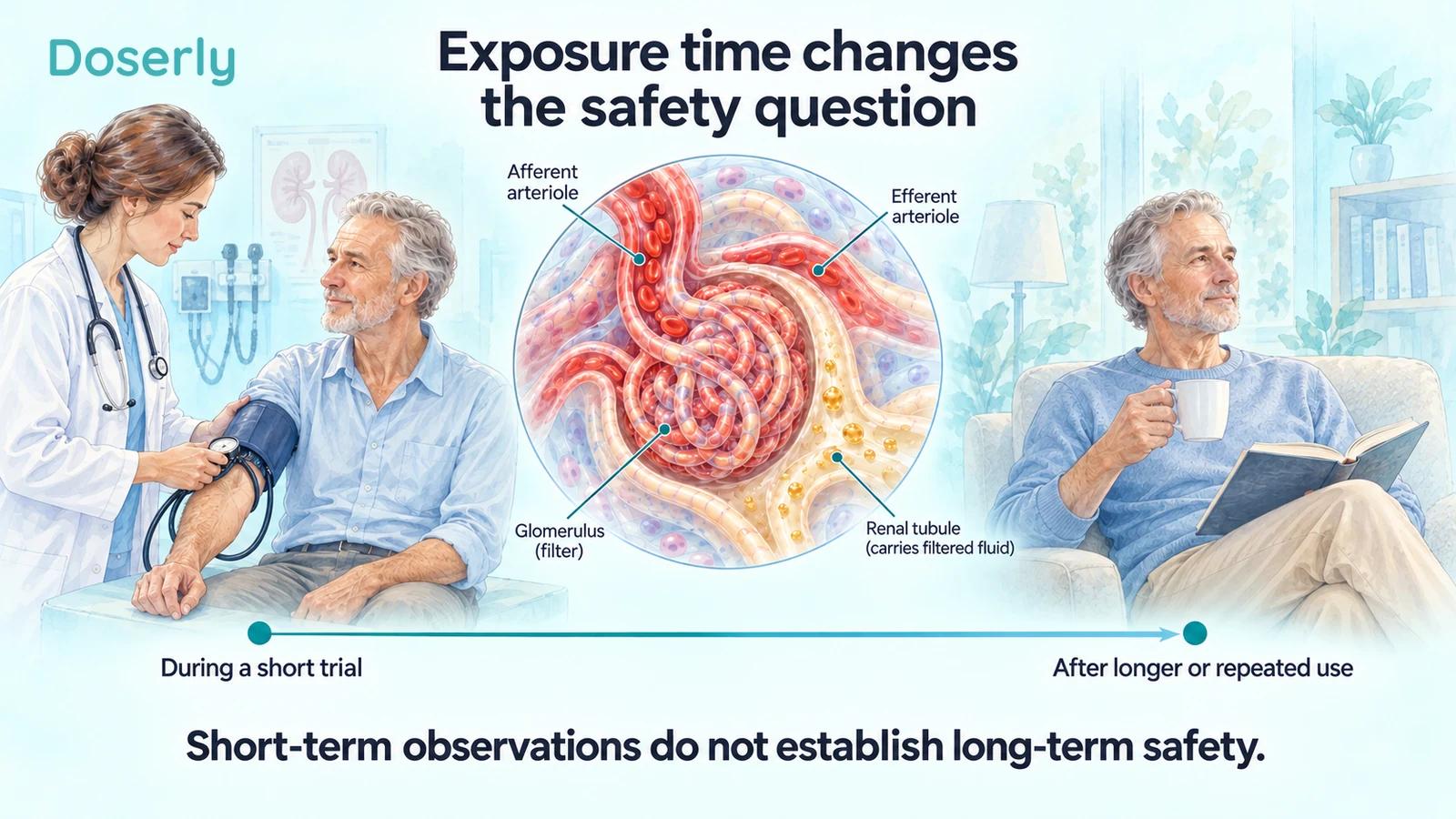
The absence of detected antibodies in short trials is also time- and assay-specific. It does not establish that all formulations are nonimmunogenic or that a person cannot develop a later reaction. Similarly, the lack of red-blood-cell stimulation in the peptide's development studies addresses one intended distinction from erythropoietin, not every possible biological effect. Preclinical design study
Who was represented in the safety sample?
The larger sarcoidosis trial was an adult study. Its registry lists 59 participants aged 18–64 and only five aged 65–84, with no children or adults aged 85 and over. A result from that population cannot establish the same risk profile in children, pregnancy or much older people. Eligibility rules also select participants who can complete the study and meet its medical criteria. EU trial population
That does not mean an excluded group is known to be harmed. It means the study cannot supply a reliable estimate for that group. When someone says a treatment was safe “in humans,” the relevant follow-up is which humans and under what conditions.
Can trial safety be transferred to an online product?
The diabetes trial specified the study material, its preparation and the matching placebo. A product offered elsewhere may share the name ARA-290 without having demonstrated equivalent identity, purity, concentration or sterility. A clinical paper cannot establish the quality of an unrelated vial. Study material and methods
This is a separate uncertainty from the molecule's pharmacology. Even if a future trial establishes an acceptable benefit-risk balance for a defined medicine, that result will concern the tested product and conditions. It will not retrospectively validate every preparation or combination sold under the same peptide name.
Likewise, stable background medication use in a small trial is not a systematic interaction study. It does not establish safety alongside every pain medicine, immune treatment, hormone or other peptide. The number of possible combinations is much larger than the experience these trials provide.
What a useful safety conversation sounds like
Start with your specific health problem and the expected benefit, because tolerating a risk only makes sense in relation to what treatment might achieve. Ask which study most closely matches your diagnosis, existing illnesses and proposed exposure. Ask about withdrawals and serious events, not only average laboratory results.
A clinician should also know about kidney problems, mood symptoms and other medicines when discussing these reports. New severe symptoms or suicidal thoughts require prompt medical attention regardless of whether a treatment caused them. A research uncertainty is not a reason to delay care.
Our ARA-290 safety discussion provides wider context, and the human evidence section connects potential benefits with the populations studied. The available trials support continued investigation under appropriate supervision. They do not support a promise of harmlessness, a proven safe repeat-course schedule or certainty about long-term use.
Explore the research
- Original peptide-development study: preclinical nonerythropoietic design.
- FDA: serious adverse-event definition.
- Culver et al., 2017 trial: published safety narrative.
- EU trial results, APCP-112: complementary event counts and causality fields for the same trial.
- Diabetes trial full text: monitoring, withdrawal and serious-event details.
- 2013 sarcoidosis trial: short-term monitoring and antibody observations.
- 2020 diabetic macular edema study: small uncontrolled 12-week exposure.