
Peptides
October 16, 2026
Semaglutide and heart risk: what the SELECT trial changed
On this page
Semaglutide affects appetite and blood-sugar regulation by activating the receptor for glucagon-like peptide-1, or GLP-1. Those effects made it an important diabetes and weight-management medicine. A different question followed: could treatment help people avoid a heart attack or stroke, rather than simply improve measurements associated with those events?
The SELECT trial gave a clear answer for a particular group: adults with established cardiovascular disease and overweight or obesity, without diabetes. Adding weekly semaglutide to usual care reduced a combined outcome of cardiovascular death, nonfatal heart attack and nonfatal stroke. It was an important change in what clinicians could discuss with patients, because the benefit was measured directly rather than inferred from weight loss. SELECT primary report
The details matter when you apply that finding to your own treatment decisions. The familiar “20% reduction” describes a relative hazard, the participants already had cardiovascular disease, and the three events in the main outcome did not all show the same result individually. Here's how the findings fit together.
Why weight loss and heart protection are different questions
The number on a scale is one measurement of treatment response. A cardiovascular trial asks whether serious events become less common over years of follow-up. A medicine can improve a risk factor without necessarily improving every clinical outcome, so researchers need to count the events themselves.
Many cardiovascular events involve atherosclerosis: a buildup of cholesterol, fat and other material within artery walls. Plaque can narrow a vessel, and a plaque disruption can lead to a clot that interrupts blood supply. The consequences depend on which circulation is affected. Coronary arteries supply the heart; vessels leading to and within the brain supply brain tissue. This is why an article about “heart risk” may also discuss stroke. NHLBI explanation of atherosclerosis
SELECT did not scan every participant's arteries to demonstrate plaque removal. It counted predefined clinical events. The distinction is useful: the trial can support a claim about fewer events without establishing that semaglutide repaired an artery or identifying the exact biological route to benefit.
For background on appetite, glucose regulation and the medicine's different formulations, our semaglutide guide explains the wider treatment picture.

Who was studied?
SELECT enrolled 17,604 adults aged 45 or older with a body mass index of at least 27 and established cardiovascular disease. Qualifying disease included a previous heart attack, previous stroke or symptomatic peripheral arterial disease, which affects circulation outside the heart, commonly in the legs. People with diabetes were excluded. The trial therefore addressed people already at substantial cardiovascular risk, rather than a general population seeking weight loss. Current Wegovy prescribing information, cardiovascular outcomes study
Participants were randomly assigned to semaglutide or a matching placebo injection. The study targeted semaglutide 2.4 mg weekly, introduced gradually. Both groups received standard cardiovascular care and lifestyle counseling. That included treatment of other cardiovascular risk factors; semaglutide was being added to care, not used to replace it. FDA's account of the approval trial
Random assignment helps make the comparison fair. Blinding means participants and investigators did not know which injection was assigned. Those features reduce the chance that differences in expectations or treatment selection explain the outcome. They don't make the participants representative of every person who might receive semaglutide.
Someone with obesity but no previous cardiovascular disease may still have a reason to discuss weight treatment. SELECT alone cannot tell that person how much their first-event risk would fall. Preventing another event in someone with established disease and preventing a first event in a lower-risk person are separate clinical questions.
What did the main result show?
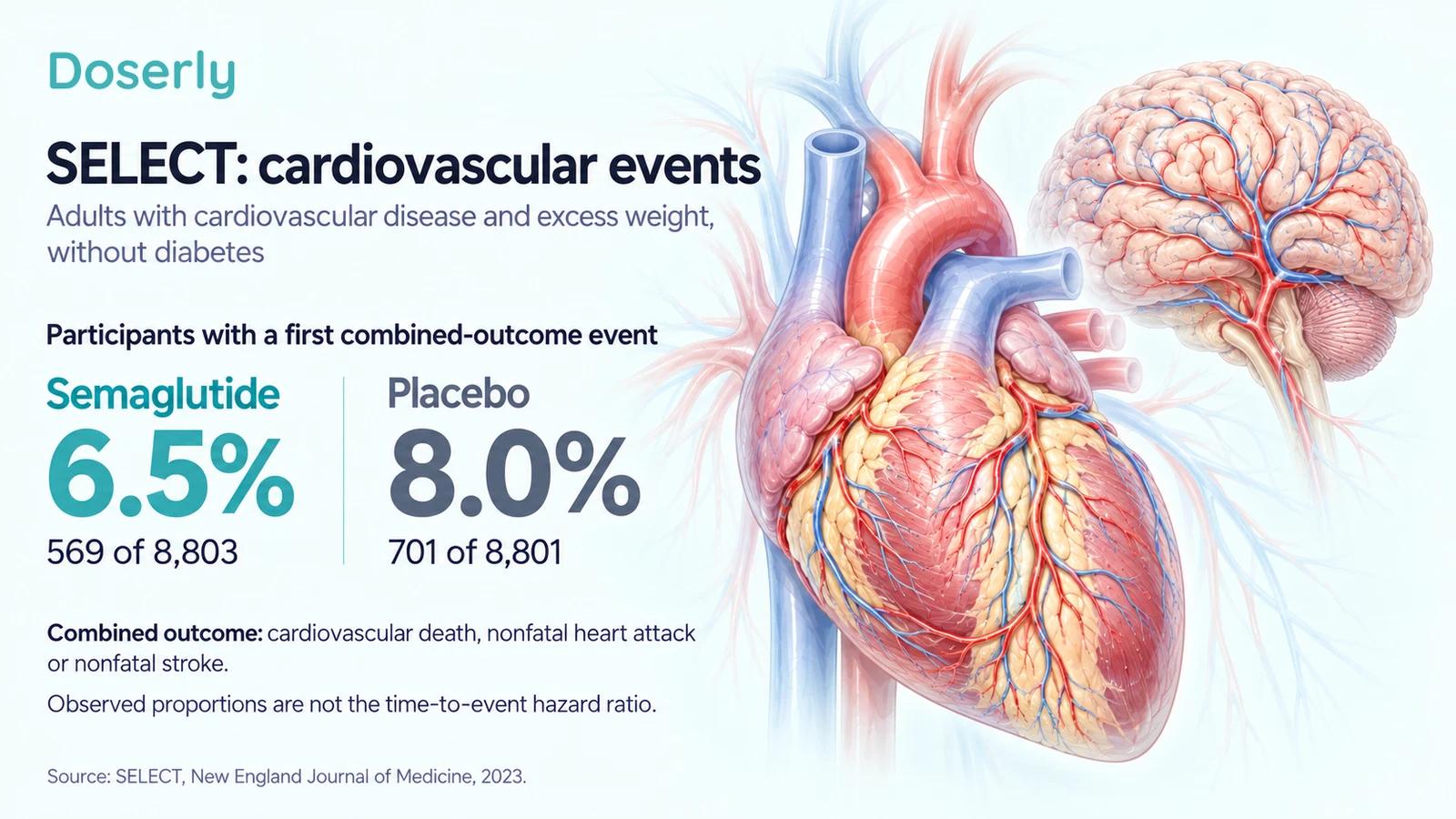
A first primary-outcome event occurred in 569 of 8,803 participants assigned semaglutide and 701 of 8,801 assigned placebo. These correspond to approximately 6.5% and 8.0%. The hazard ratio was 0.80, with a 95% confidence interval of 0.72–0.90. SELECT results
A hazard ratio uses the timing of events during follow-up. A value of 0.80 is commonly described as a 20% lower relative hazard. It doesn't mean 20 of every 100 participants avoided an event, or that every participant's cardiovascular health improved by 20%.
Subtracting the rounded event proportions gives an absolute difference of about 1.5 percentage points. Expressed on a scale of 1,000 people with the study's characteristics, the observed proportions correspond to roughly 65 people with an event versus 80. This is a translation of the trial counts, not a personalized prediction and not a calculation of the risk at one identical follow-up time for everyone.
Both descriptions are useful. Relative effects help characterize the comparison between treatments. Absolute differences show how many events occurred in the population studied. A large relative improvement can correspond to a small absolute difference when baseline risk is low. The same relative improvement could correspond to a larger absolute difference in a higher-risk population, but assuming that the relative effect transfers unchanged is itself an assumption.
For an individual, the decision also involves treatment burden, side effects, access, other illnesses and preferences. A trial average cannot decide that balance on its own. It gives a better starting point for a conversation than either an impressive headline percentage or a weight-loss photograph.
Did heart attacks, strokes and cardiovascular deaths all fall by 20%?
No. The 20% figure belongs to the combined primary outcome. A composite endpoint counts several defined types of event together. Combining them gives researchers more events to analyze, but it does not make each component equally common or equally responsive.
Cardiovascular death was the first confirmatory secondary outcome in SELECT. Its hazard ratio was 0.85, with a confidence interval of 0.71–1.01; this did not meet the trial's significance requirement. Consequently, the trial's planned hierarchy did not continue formal superiority testing for subsequent confirmatory secondary outcomes. A successful primary endpoint should not be rewritten as a separately proven survival benefit. SELECT endpoint results and testing hierarchy
This doesn't erase the main finding. It explains its scope. “Reduced the combined risk of cardiovascular death, nonfatal heart attack or nonfatal stroke” accurately describes what was established. “Reduced every one of those outcomes by 20%” would describe something different.
It also means that fewer cardiovascular events and fewer hospital visits for heart failure should not automatically be treated as the same claim. Heart failure concerns the heart's ability to fill or pump effectively. A heart attack concerns interrupted blood supply damaging heart muscle. They can be related in a person, but their trial endpoints remain distinct.
Was the benefit just a consequence of losing weight?
SELECT demonstrated a treatment effect on events; it did not fully separate the pathways responsible. Weight, blood pressure, glucose regulation and inflammatory processes may be relevant, but a credible biological explanation is not the same as a demonstrated explanation for the event reduction.
The trial also produced useful long-term weight information. In a prespecified analysis, mean weight change at 208 weeks was −10.2% with semaglutide and −1.5% with placebo. Weight loss in the semaglutide group continued for about 65 weeks and was then sustained through the observation period. These are group averages, with substantial individual variation. SELECT weight analysis
That analysis helps show what happened alongside the cardiovascular result. It does not prove that a particular amount of weight loss caused a particular amount of protection. Participants were assigned a medicine, not randomly assigned to lose an exact number of kilograms while everything else remained the same.
Nor does SELECT establish that another way of losing the same weight produces the same event reduction. Diet, exercise, surgery and different medicines have their own evidence. The practical message is that weight response and cardiovascular goals can both matter when evaluating treatment; neither can completely stand in for the other.
How does this relate to diabetes trials?
Semaglutide's cardiovascular evidence did not begin with SELECT. SUSTAIN-6 studied injectable semaglutide in people with type 2 diabetes at high cardiovascular risk. Its main purpose was to establish cardiovascular noninferiority: to rule out an unacceptable increase in risk against a prespecified margin. The reported composite event result favored semaglutide, but superiority testing was not prespecified or adjusted for multiple comparisons. SUSTAIN-6 primary report
Later, SOUL tested oral semaglutide in 9,650 people with type 2 diabetes and atherosclerotic cardiovascular disease, chronic kidney disease or both. Primary events occurred in 12.0% assigned oral semaglutide and 13.8% assigned placebo; the hazard ratio was 0.86, with a confidence interval of 0.77–0.96. SOUL primary report, 2025
These trials broaden the clinical picture while answering different questions. They do not provide a head-to-head comparison of tablets against injections, nor do their percentages rank one formulation as better. The populations, background risks, exposure and follow-up differ. SELECT's particular contribution was direct outcome evidence in people with established cardiovascular disease who did not have diabetes.
What about tolerability and longer-term use?
The possibility of avoiding a future cardiovascular event must be considered alongside what treatment is like now. SELECT reported adverse events leading to permanent treatment discontinuation in 16.6% of semaglutide participants and 8.2% of placebo participants. Gastrointestinal problems contributed substantially. Serious adverse events overall were less frequent with semaglutide, illustrating why “serious event” and “side effect that makes someone stop” are different measures. SELECT safety results
The current prescribing information includes warnings about pancreatitis, gallbladder disease, severe gastrointestinal reactions and kidney injury associated with fluid depletion. It contraindicates use with a personal or family history of medullary thyroid carcinoma or multiple endocrine neoplasia syndrome type 2. The thyroid warning is based on rodent findings; whether semaglutide causes these tumors in humans is unknown. Wegovy prescribing information
A clinician can review these issues in the context of your history and other medicines. Persistent vomiting or inability to maintain fluids deserves attention, rather than being accepted as evidence that the medicine is “working.” If a treatment is difficult to tolerate or obtain consistently, that belongs in the discussion of its expected benefit.
What should you take to a treatment appointment?
Start with your actual diagnosis and goal. A previous heart attack, stroke or symptomatic peripheral artery disease makes SELECT more directly relevant than a family history alone. Ask how your other risk factors are being managed and what adding semaglutide is intended to achieve.
It can help to bring a current medicine list, recent measurements your clinician requested and a dated symptom record. If you're already taking semaglutide, note tolerability and interruptions as well as weight change. Those observations help describe your experience, although they cannot tell you whether a future cardiovascular event has been prevented.
The main questions are practical: How closely do I resemble the population studied? What benefit is realistic over the years ahead? How will we manage adverse effects? What alternatives fit my other health needs and circumstances? These questions connect the trial result to a plan that can be reviewed over time.
SELECT changed the conversation because it showed that semaglutide could improve an important cardiovascular outcome in a defined group, beyond its established role in weight management. It supports a specific, worthwhile treatment discussion without turning every weight-loss response into a promise of heart protection. Our semaglutide guide's research section places these findings alongside the medicine's other clinical uses.
Sources
- SELECT primary report, 2023: randomized cardiovascular outcomes; funded by Novo Nordisk.
- SELECT long-term weight analysis, 2024: prespecified secondary analysis, not a separate randomized weight-loss mechanism experiment.
- Wegovy US prescribing information, June 2026: current indications, trial population and safety.
- FDA cardiovascular indication announcement, March 2024: regulatory context for the injection approval.
- SUSTAIN-6, 2016: injectable treatment in high-risk type 2 diabetes.
- SOUL, 2025: oral treatment in high-risk type 2 diabetes.
- NHLBI: atherosclerosis: artery biology and clinical consequences.