
Peptides
October 16, 2026
Why Selank dependence claims need longer follow-up
On this page
Selank is sometimes presented as an anxiety treatment without dependence or withdrawal. That claim is appealing, particularly to people who have had difficulty stopping another medicine. But it asks a different question from whether a short treatment course reduced anxiety or caused few reported side effects.
The small human reports reviewed here do not establish a well-characterized dependence syndrome for Selank. They also do not provide enough evidence to guarantee that prolonged or repeated use is free of dependence, withdrawal or other problems after stopping.
Understanding the distinction requires clear definitions and attention to the period after treatment ends. The Selank guide covers the broader evidence; this article focuses on what the dependence claim would actually require.
Dependence, tolerance and addiction are different concepts
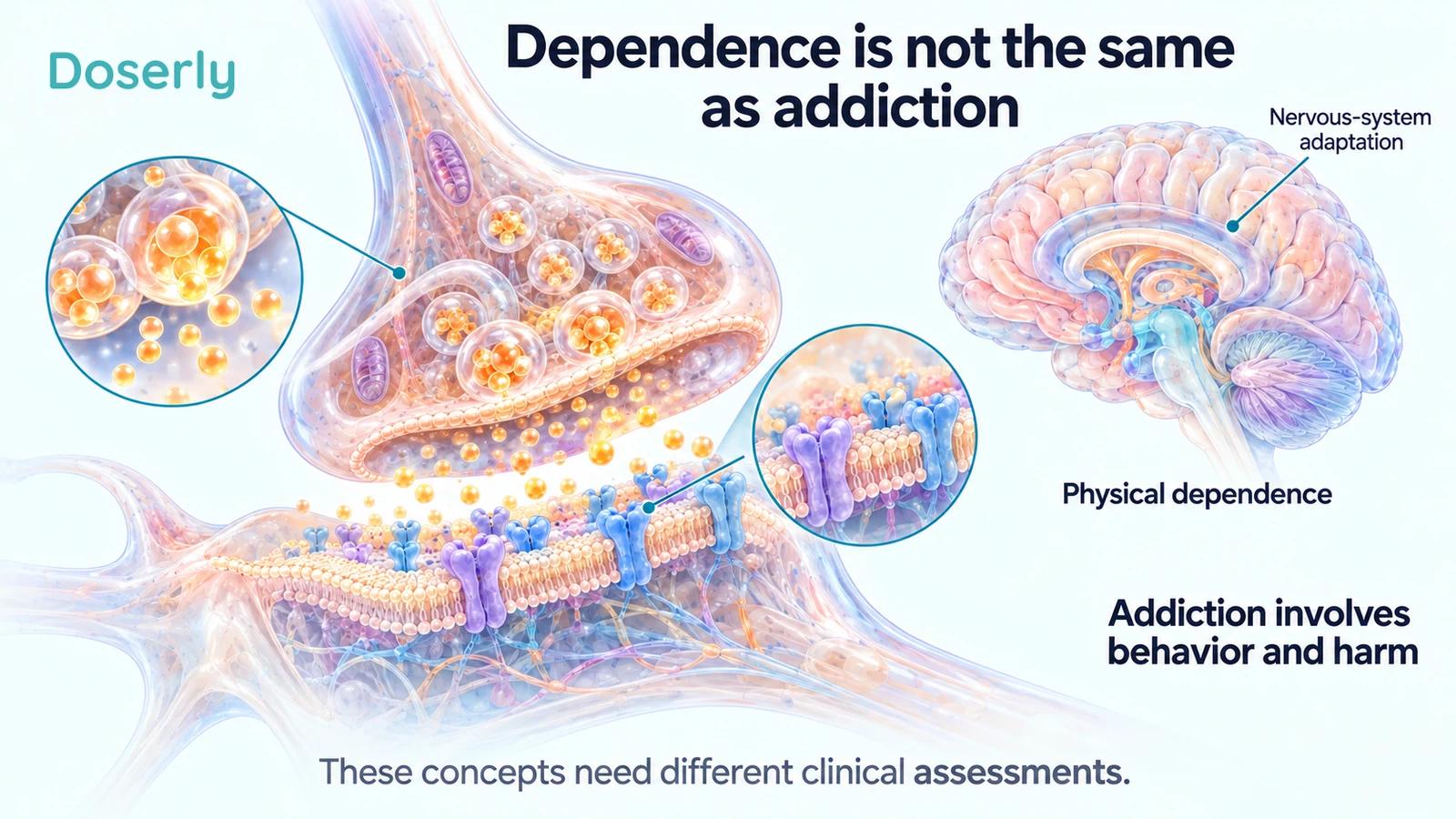
Physical dependence refers to adaptation to a substance such that reducing or stopping it can produce withdrawal symptoms. It can occur during medically supervised treatment and is not, by itself, a diagnosis of addiction.
Tolerance means that the response to a given exposure diminishes over time. A person may describe something as “not working anymore,” but that experience can have other explanations, including a change in illness, circumstances or product.
Addiction involves a pattern of impaired control and continued use despite harm, among other features. It is a behavioral and clinical assessment, not simply the presence of withdrawal.
The joint benzodiazepine-tapering guideline explicitly distinguishes physical dependence from benzodiazepine use disorder. That distinction helps explain the terminology; it does not classify Selank as having the same risk profile. Joint clinical guideline.
Calling a product “non-addictive” therefore does not automatically establish that it produces no tolerance or withdrawal. Each claim needs appropriate evidence.
What did the post-treatment Selank report show?
A 2014 comparison of Selank and phenazepam in 60 patients reported that the anxiety-relieving effect persisted for one week after the last peptide administration. Original comparison.
That is a limited observation of benefit after a treatment course. It is not the same as a systematic study designed to detect withdrawal after prolonged exposure.
To assess withdrawal, a report would need to describe symptoms sought after stopping, when assessments occurred, how symptoms compared with baseline and what happened to everyone who discontinued. A general statement that the benefit persisted does not supply all of that information.
The accessible abstract does not establish a long-term dependence rate or a guarantee that symptoms cannot occur after other patterns of use. The precise conclusion should stay with the reported week of follow-up.
What does the phenazepam add-on study add?
A 2015 report compared phenazepam alone in 30 patients with phenazepam plus Selank in 40. The authors described fewer unwanted effects during treatment and after tranquilizer withdrawal in the combination group. Original add-on report.
The substance being withdrawn in that part of the report was the tranquilizer. This is not the same question as whether stopping Selank after long-term use produces symptoms.
It also does not establish that Selank prevents serious benzodiazepine withdrawal. The accessible abstract lacks the detailed design and outcome information needed to support such a claim.
The finding is best understood as a preliminary observation in a combination-treatment study. It can motivate more research, but it cannot become a replacement for an individualized benzodiazepine discontinuation plan.
Why a short course cannot settle prolonged use
The duration and pattern of exposure determine what a study can observe. A short course followed by a short assessment does not reproduce months of continuous use or many repeated courses.
The study population matters too. Participants selected for an anxiety trial may differ from people using multiple products, people with other neurological or psychiatric conditions or people receiving treatment for a different reason.
A study that reports few problems among completers also needs to explain why others stopped. Missing participants can be especially important when the question concerns unwanted effects or difficulty discontinuing.
General drug-development guidance treats the amount and duration of exposure as central to assessing medicines intended for long-term use. That principle explains why evidence must match the intended pattern, rather than be inferred from the age of a compound's name. FDA/ICH E1A guidance.
Symptoms after stopping can have several explanations
If anxiety returns after a treatment ends, that may reflect recurrence of the original problem. If symptoms briefly become more intense than before treatment, researchers may consider rebound. Withdrawal concerns symptoms associated with reducing or stopping a substance to which the body has adapted.
These categories can overlap in experience, and timing alone does not always separate them. A person may also have a new illness, disrupted sleep or a change in another medicine.
A useful study would document the baseline pattern before treatment, changes during exposure and symptoms afterward. It would consider whether post-treatment symptoms are new, resemble the original condition or follow another plausible explanation.
For Selank, the available short reports do not provide a sufficiently detailed map of these possibilities after prolonged use. That limits both reassurance and claims of a specific withdrawal syndrome.
The practical point is to describe symptoms carefully and seek assessment, rather than assume that every change is withdrawal or that withdrawal is impossible.
What would a convincing dependence assessment include?
Researchers would need a clearly defined preparation and exposure period. They would collect symptoms systematically, including after discontinuation, rather than rely only on spontaneous reports.
Follow-up should include people who stop early. The reason for stopping, the subsequent course and any additional treatment are all relevant. Otherwise, the study may miss the very participants whose experience most matters.
Assessments should distinguish anxiety, sleep changes, cognitive symptoms and other complaints. They should also examine behavior relevant to misuse where appropriate, rather than treat physical symptoms as the whole addiction question.
An appropriate comparison can help interpret natural fluctuations and background symptoms. The design must also protect participants; testing a dependence hypothesis is not a reason to expose people to unsafe discontinuation.
These are requirements for research, not a home experiment. Deliberately stopping and restarting products to see what happens cannot establish safety and may create avoidable problems.

Do breaks or cycles prevent dependence?
The reports reviewed here do not establish a validated Selank cycling schedule that prevents tolerance or withdrawal. A break changes exposure, but its protective value is a separate claim that needs testing.
An online schedule can look medically precise while having no comparative evidence behind the interval. Repeating the same schedule across websites does not make it a clinical standard.
The same applies to the claim that a short detectable lifetime in an animal experiment guarantees no lasting adaptation. The time a molecule remains measurable and the time a biological response persists are different questions.
Without direct evidence, neither continuous use nor a particular cycling pattern can be described as proven dependence-free. This is a limit of knowledge, not an estimate of how likely any individual problem is.
Product differences complicate personal reports
A story about “Selank” may involve a different chemical form, derivative, route or combination from the clinical literature. The exact exposure is often unclear.
That matters when interpreting a report of symptoms after stopping. A clinician needs to know what was actually used, other medicines and substances, and whether the product changed. A common name alone is insufficient.
FDA notes important missing human safety information for Selank acetate and potential immunogenicity concerns associated with peptide aggregation and impurities. These concerns do not establish dependence, but they show why overall safety cannot be summarized by one reassuring label. FDA Selank acetate entry.
A product's uncertain quality and a drug's possible withdrawal effects are distinct issues. Both should remain visible rather than being folded into a single explanation.
If your concern is stopping a benzodiazepine
This is a separate, established safety issue. FDA warns that abrupt discontinuation or reducing a benzodiazepine too quickly can cause serious withdrawal reactions, including seizures. It recommends a patient-specific gradual reduction plan with clinical monitoring. FDA benzodiazepine warning.
The joint guideline likewise emphasizes individualized decisions and supervised tapering for people at risk of physical dependence. It should not be interpreted as a universal schedule that everyone can copy. Joint tapering guideline.
The Selank add-on report does not remove those precautions. Do not stop a prescribed benzodiazepine abruptly because a peptide is described as preventing withdrawal.
If you have already developed concerning symptoms during a medication change, contact the prescribing clinician. Severe symptoms such as seizures or trouble breathing require urgent medical attention.
What to record and discuss
A clear account includes the product, timing, duration, other medicines and symptoms before, during and after use. Note whether symptoms are new or resemble the original anxiety problem.
A record can help a clinician identify possible explanations and decide what evaluation is needed. It does not prove causation, and it should not be used to justify repeated exposure to test a theory.
Ask what evidence supports the specific claim being made: no physical dependence, no misuse potential, no withdrawal after a defined course, or no problems after prolonged use. Those statements require different studies.
The current Selank reports do not establish a long-term dependence risk estimate or a dependable no-withdrawal guarantee. The most accurate conclusion is that the relevant follow-up remains inadequate. The Selank guide provides the broader clinical context for that discussion.
Sources
- Selank versus phenazepam, 2014.
- Selank added to phenazepam, 2015.
- Joint Clinical Practice Guideline on Benzodiazepine Tapering, 2025.
- FDA benzodiazepine safety communication, 2020.
- FDA/ICH E1A long-term safety exposure guidance.
- FDA Selank acetate safety-information entry.