
Peptides
October 16, 2026
Why research-labelled SS-31 cannot borrow Forzinity’s label
On this page
SS-31 is a research name for elamipretide, a peptide studied for its effects on mitochondria. Forzinity is a prescription medicine containing elamipretide. Since FDA approved Forzinity in September 2025, it has become easier to encounter a misleading shortcut: if a vial says SS-31, surely it has the same approval and supporting evidence.
It doesn't. An approval concerns a defined medicine, manufactured and supplied under a reviewed application, for specified uses. A matching ingredient name is only part of that description. The formulation, concentration, route, quality controls and conditions of use also matter. This distinction is especially relevant when a product sold for research is discussed as though it were an interchangeable prescription medicine. FDA: Forzinity
This article explains the US approval and the practical questions it leaves for someone comparing products. It is not a verdict about the contents of an individual vial: that cannot be established from its website description. Our SS-31 guide covers the peptide's biology and clinical research in more depth.
What exactly was approved?
Forzinity received accelerated approval to improve muscle strength in adults and children with Barth syndrome weighing at least 30 kg. Barth syndrome is a rare inherited disorder. This is a defined patient group and treatment goal, not a general approval for tiredness, healthy aging, exercise performance or eye disease.
FDA's account describes 12 participants in the pivotal trial. The initial randomized period did not show superiority on its main walking and fatigue outcomes. Improvements in knee-extensor strength were observed during the longer open-label extension. Under accelerated approval, further studies are needed to confirm clinical benefit. FDA trial snapshot
There are therefore two separate questions when you hear that SS-31 is “approved.” Is the product actually the approved medicine? And is the proposed use supported by the approved indication? Answering yes to the first does not automatically answer yes to the second. Even a genuine prescription product does not acquire evidence for every mitochondrial theory associated with its active ingredient.
The distinction helps avoid dismissing the real achievement, too. A medicine for a rare disease can be valuable to its intended patients without establishing a broad anti-aging claim. Precision about the approval makes the evidence more useful, not less.
The finished medicine contains more than a peptide name
The prescribing information describes Forzinity as an aqueous solution for subcutaneous injection, meaning injection under the skin. It lists elamipretide hydrochloride, the concentration and formulation ingredients, including the preservative benzyl alcohol. It is supplied in single-patient-use vials. Those details describe the finished product studied and supplied under the approval. Prescribing information
A container of powder with “SS-31” on the front does not communicate all of that information. Nor does a stated mass on a vial establish how the material will behave after someone adds a liquid. The concentration in the resulting solution depends on more than the ingredient name, and instructions for an approved solution cannot simply be copied onto a different preparation.
Consider a pharmacist checking a medicine before dispensing it. Knowing the active ingredient would not eliminate the need to know its strength, dosage form, intended route and storage instructions. The same questions remain relevant when the name on the container is a peptide that has become familiar through research discussions.
This is not an argument that changing any ingredient must make a product ineffective. It is an explanation of what has to be established. Equivalence is a scientific and regulatory conclusion, rather than something demonstrated by using a familiar synonym.
What does a purity certificate actually answer?
A certificate of analysis may report the result of a particular test on a particular sample. It can be useful information when the test, laboratory, batch and methods are clear. But a percentage described as purity is not a complete account of an injectable medicine's quality.
Several questions need separate answers. Identity asks whether the intended substance is present. Amount or strength asks how much is present. An impurity test looks for specified unwanted components within the test's capabilities. Microbial quality concerns contamination relevant to the preparation. Stability asks how the material changes during its proposed storage and use. One favorable result doesn't logically answer all the others.
FDA explains that current good manufacturing practice, or CGMP, includes systems for controlling manufacturing processes, materials, facilities and testing. Testing a small sample at the end is insufficient on its own; quality must also be built into the process. FDA: CGMP
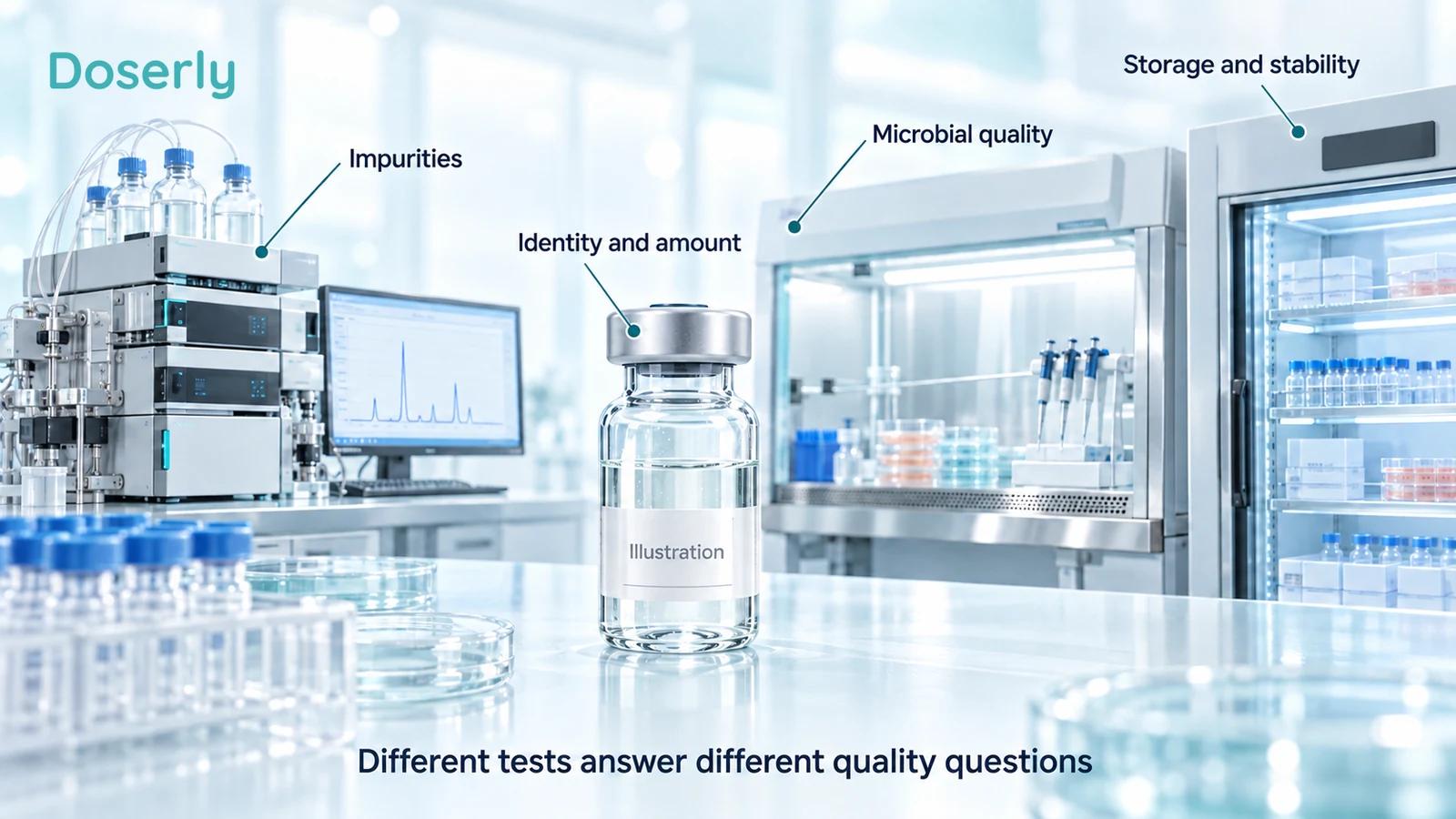
It would be equally inappropriate to claim that every research-labelled vial is contaminated without testing it. The narrower, defensible point is that a purity claim does not establish the full product-quality evidence associated with an approved medicine. “Not demonstrated equivalent” and “proven contaminated” are different statements.
Why storage and handling belong to the product
Storage instructions are part of the conditions under which a product is expected to retain its quality. They concern a specific formulation in a specific container, including what happens after the container is opened. That is why a shelf-life claim for one preparation should not be transferred casually to another.
The Forzinity label supplies product-specific handling instructions and an after-opening discard interval. It also instructs users not to mix other products in the same syringe. These details are not a general reconstitution manual for online SS-31 powders. Forzinity label
For a patient, a useful question is whether the pharmacist's instructions apply to the exact dispensed preparation. If the name, concentration or form differs from a product discussed online, that difference should be resolved before instructions are borrowed. A screenshot of another product's label can't establish the missing information.
The same applies to delivery history. Knowing that a substance can be stored under particular conditions doesn't tell you whether an individual package remained under those conditions. Traceability and the ability to contact a responsible dispenser matter when something about a medicine is unclear.
Why route and exposure matter
How a substance enters the body affects the questions researchers need to answer. Absorption concerns movement from the administration site into circulation. Clearance concerns how the body removes the drug. Together with distribution and metabolism, these processes help determine exposure over time.
A shared ingredient name doesn't establish matching exposure from an unstudied formulation or route. Forzinity's label also addresses impaired kidney function, illustrating that the person receiving the medicine matters as well as the material in the vial. These are reasons to involve a clinician and pharmacist, rather than treating an online amount as an interchangeable measure of effect. Clinical pharmacology and renal impairment sections

The approved product also has risks. Injection-site reactions are common, and serious hypersensitivity reactions have been reported. Approval therefore isn't a declaration that a medicine is harmless. It establishes a regulated product with a defined benefit-risk assessment and instructions that can be updated as evidence develops. Forzinity safety information
Is a research product like an approved generic?
An FDA-approved generic is not merely a product that prints the same ingredient name on its package. FDA describes requirements involving the active ingredient, strength, dosage form, route, manufacturing standards and bioequivalence. Bioequivalence addresses whether a product performs comparably in the body under the required assessment. FDA: generic drug facts
This is why “the molecule is the same” is an incomplete comparison. Chemical identity is relevant, but there is an established process for demonstrating that a finished product can substitute for another. A seller's assertion is not that process.
This explanation does not imply that a particular generic elamipretide product is available. It explains what the word generic means in an approval context. If someone describes a research vial as a generic version of Forzinity, the useful follow-up is to identify the actual approved application and product, rather than debate the terminology alone.
What about compounded medicines?
Compounding is a separate category from both an FDA-approved finished product and an online research reagent. FDA acknowledges that compounded medicines can meet important individual medical needs. It also states that compounded drugs are not FDA-approved and that the agency does not review their safety, effectiveness and quality before marketing in the same way as approved medicines. FDA: compounded-drug risks
That does not make every compounded medicine inappropriate, and it does not make every research seller a legitimate compounder. The categories should not be collapsed into one. A patient-specific prescription, the identity of the dispensing pharmacy and the reason for the preparation are concrete matters to discuss with the prescriber and pharmacist.
This article does not determine whether a particular proposed elamipretide preparation satisfies current compounding requirements. That depends on details beyond the active ingredient's name. The central point remains that Forzinity's approval cannot serve as a substitute for answering those product-specific questions.
What FDA said about research-only wording in 2026
In an August 24, 2026 warning letter, FDA identified a product advertised as SS-31 (elamipretide) among unapproved new drugs sold by TXP Innovations, doing business as Tex Peptides. The agency considered the website's drug claims and marketing context despite research-only and nonhuman-use disclaimers. FDA warning letter
That letter documents a specific regulatory action. It is not a laboratory analysis of every vial sold by that company, and it should not be described as one. Its relevance here is that wording such as research use only does not confer approval or neutralize claims that indicate human drug use.
The same distinction helps readers interpret marketing. A webpage may quote genuine elamipretide research while selling something whose own equivalence has not been established. The paper's authenticity and the product's status are two separate questions.
A useful conversation with your clinician or pharmacist
Start with the health problem you want to address. If it is fatigue or reduced exercise tolerance, discuss the condition and what evidence supports the proposed treatment in people like you. Then identify the exact product: its manufacturer or dispensing pharmacy, formulation, concentration and route.
Ask which instructions apply to that preparation, what adverse effects require attention and who to contact about a quality concern. If an online claim relies on Forzinity's approval, ask whether it describes the approved product and its actual indication. These questions do not require you to become a pharmaceutical analyst; they help the responsible professionals make the comparison explicit.
A genuine connection between SS-31 and elamipretide explains why the names appear together. It does not allow an unrelated vial to inherit Forzinity's manufacturing review, clinical evidence or label. Keeping the medicine, the molecule and the proposed use distinct is the most practical way to understand what the approval does—and does not—tell you.
Sources
- FDA: Forzinity trial snapshot.
- Forzinity prescribing information.
- FDA: current good manufacturing practice.
- FDA: generic drug facts.
- FDA: risks of compounded drugs.
- FDA warning letter to TXP Innovations, August 24, 2026.