
Peptides
October 16, 2026
Why reproductive peptides need outcome-specific monitoring
On this page
A reproductive hormone can change without the outcome a person cares about changing with it. LH can rise without proving sperm production. A follicle can grow without establishing a live birth. A laboratory measure of sexual arousal can change without showing sustained improvement in everyday sexual wellbeing.
This is why monitoring should begin with the goal. The right question is not simply whether a peptide has an effect, but whether the measurements can show the intended benefit, over an appropriate period, while also detecting problems. A collection of impressive laboratory values is not automatically a useful monitoring plan.
Gonadorelin and kisspeptin illustrate the point particularly well. They influence the reproductive hormone pathway at different levels and have been studied in different populations. Their findings should remain attached to the actual treatment, delivery pattern and endpoint. The Doserly gonadorelin guide and kisspeptin guide provide background on those distinctions.
Name the outcome before choosing the measurement
“Reproductive health” is too broad to serve as a measurable treatment goal. A clinician or researcher may instead be trying to establish pituitary responsiveness, support hormone production, induce sperm production, restore ovulation or improve distressing low sexual desire. Each question requires different evidence.
The goal also has a time dimension. A diagnostic challenge may be assessed over minutes or hours. Sperm production during treatment for a hormone-deficiency disorder may be followed for months. A claim about sustained sexual wellbeing requires observations beyond a brief research visit.
These goals can overlap, but they should not be collapsed into one score. A blood test can be helpful without being the decisive outcome. Likewise, a symptom record can be valuable without proving the mechanism responsible for a change.
A useful plan states what success would look like, how it will be measured and what uncertainty will remain afterward. This is a framework for discussing clinical monitoring, not a universal test panel or a self-treatment protocol.
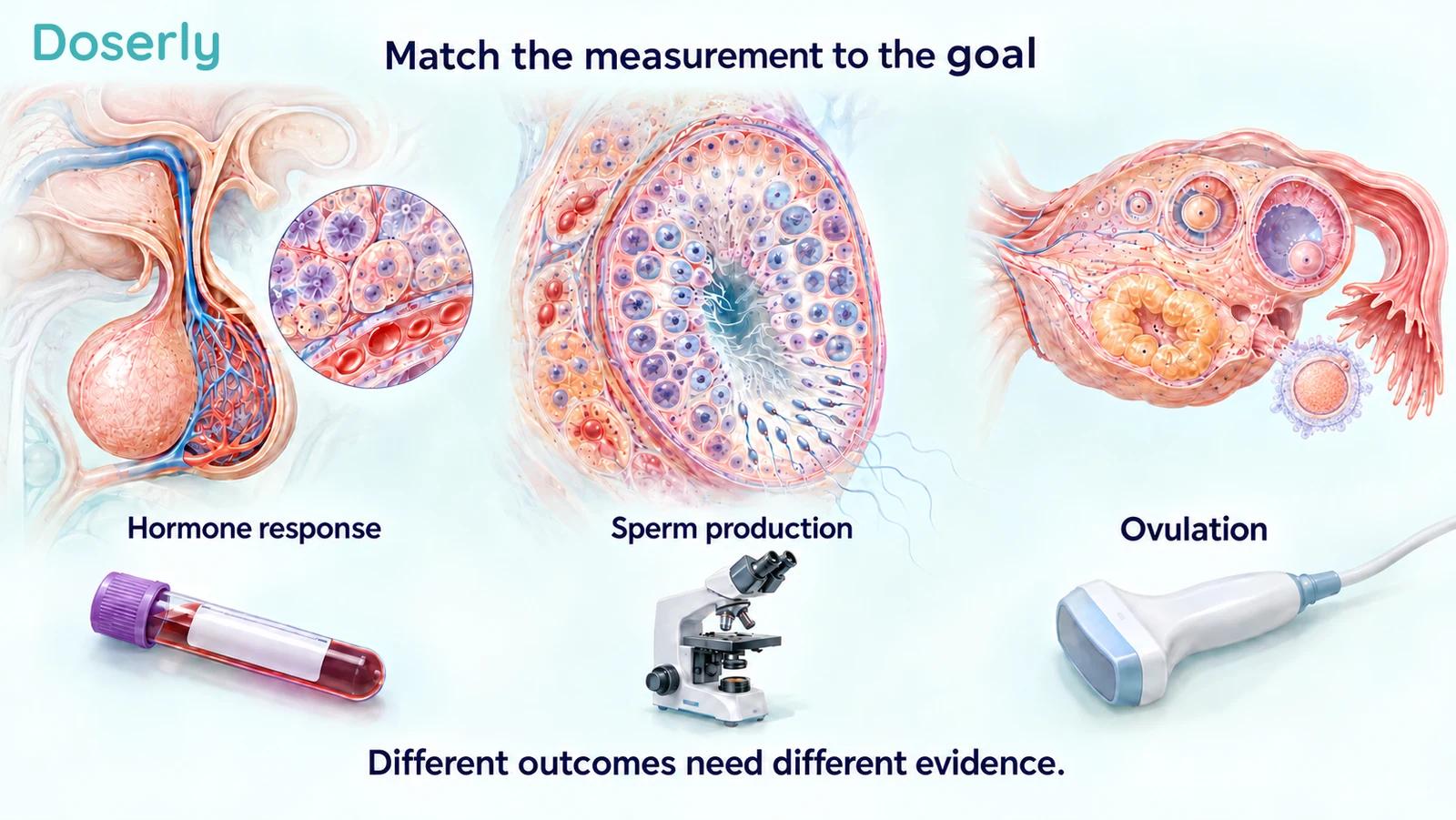
Hormone responses show one level of activity
Gonadorelin stimulates pituitary gonadotropes to release LH and FSH. A diagnostic response can therefore help describe pituitary function under the test conditions. The product information explicitly limits what a single challenge can establish about the cause of a subnormal response and pituitary reserve. Gonadorelin product information.
Kisspeptin studies also frequently use reproductive hormone changes as evidence that the intervention is biologically active. That is a reasonable research endpoint when the question concerns endocrine signaling. It becomes insufficient when the claim changes to fertility or long-term symptom relief.
The distinction is between showing that a pathway responded and showing that the desired clinical result occurred. The first can support the second, but it cannot replace it. A monitoring plan should make clear which role each laboratory measurement is playing.
Timing belongs in that interpretation. A post-administration hormone value, a baseline value and a sample during an ongoing infusion are not directly interchangeable. Keeping administration and blood-draw times together helps a clinician interpret changes without mistaking different sampling conditions for a better or worse treatment response.
Sperm production needs semen evidence
For male fertility, blood testosterone alone cannot establish sperm production. A long-term GnRH cohort makes this distinction concrete. Investigators followed 76 men with idiopathic hypogonadotropic hypogonadism for 12–24 months. Hormones normalized in most, yet some men with absent puberty remained azoospermic. Pitteloud and colleagues, 2002.
That result does not make hormone monitoring unnecessary. Hormones help assess the treatment response and its context. Semen assessment addresses a different part of the goal: whether sperm are present and what their measured characteristics are.
The EAU male infertility guideline places semen evaluation within a broader assessment that includes history, examination and indicated investigations. It also recommends evaluating both partners when conception is the goal. A semen result is clinically useful, but it cannot summarize every factor affecting a couple's chance of pregnancy. EAU male infertility guideline.
The treatment timeline matters. In a small comparison of pulsatile gonadorelin and cyclical gonadotropins in congenital hypogonadotropic hypogonadism, the primary endpoint concerned the first appearance of sperm over a follow-up period extending to 24 months. That is a different question from whether LH rose after the first administration. Zhang and colleagues, 2019.
Ovulation and live birth are different endpoints
In female fertility treatment, a hormone rise, follicle development, ovulation, pregnancy and live birth should be reported separately. These are connected events, but they are not synonyms. Monitoring needs to match the point in the process that the clinician is trying to assess.
A retrospective cohort of pulsatile GnRH treatment in functional hypothalamic amenorrhea included 66 women, 82 treatment courses and 212 cycles. It reported ovulation in 96% of cycles and live birth in 65.9% of treatment courses. The denominators differ because one treatment course may include multiple cycles. Quaas and colleagues, 2022.
A patient reading those results should not translate the live-birth percentage into a probability for one injection or one cycle. Nor should a clinic present an ovulation rate as a live-birth rate. Accurate monitoring and reporting preserve each endpoint rather than compressing them into a single success percentage.
The underlying diagnosis remains important. The Endocrine Society's FHA guideline recommends a complete fertility workup before ovulation-induction treatment and addresses energy balance and the wider clinical condition. Monitoring follicle development does not eliminate the need to care for the reason menstruation stopped. Endocrine Society FHA guideline.
Sexual desire requires patient-centered outcomes
Kisspeptin research in hypoactive sexual desire disorder has measured several types of response: brain activity during tasks, physiological arousal and self-reported experiences. These measures complement one another, but they should remain distinct.
A randomized crossover study in women used a 75-minute kisspeptin-54 infusion and functional brain imaging. Forty participants were randomized and 32 completed both visits. The study examined acute sexual and attraction processing, not months of treatment in daily life. Thurston and colleagues, 2022.
A related male trial also used brief infusion visits and assessed brain processing, penile tumescence and behavioral measures. Its reported increase in tumescence was a laboratory physiological response, not a percentage increase in lasting libido or relationship satisfaction. Mills and colleagues, 2023.
For a longer treatment claim, relevant assessment would need to include whether desire-related distress and everyday experience improve over time, together with tolerability. That is a requirement for future clinical evidence, not proof that such a sustained benefit has already been demonstrated.
A hormone result cannot answer all of those questions. Neither can a brain scan substitute for what a person experiences outside the research setting. A careful monitoring framework respects both physiological measurements and the patient's own goal without treating either as a universal proxy for the other.
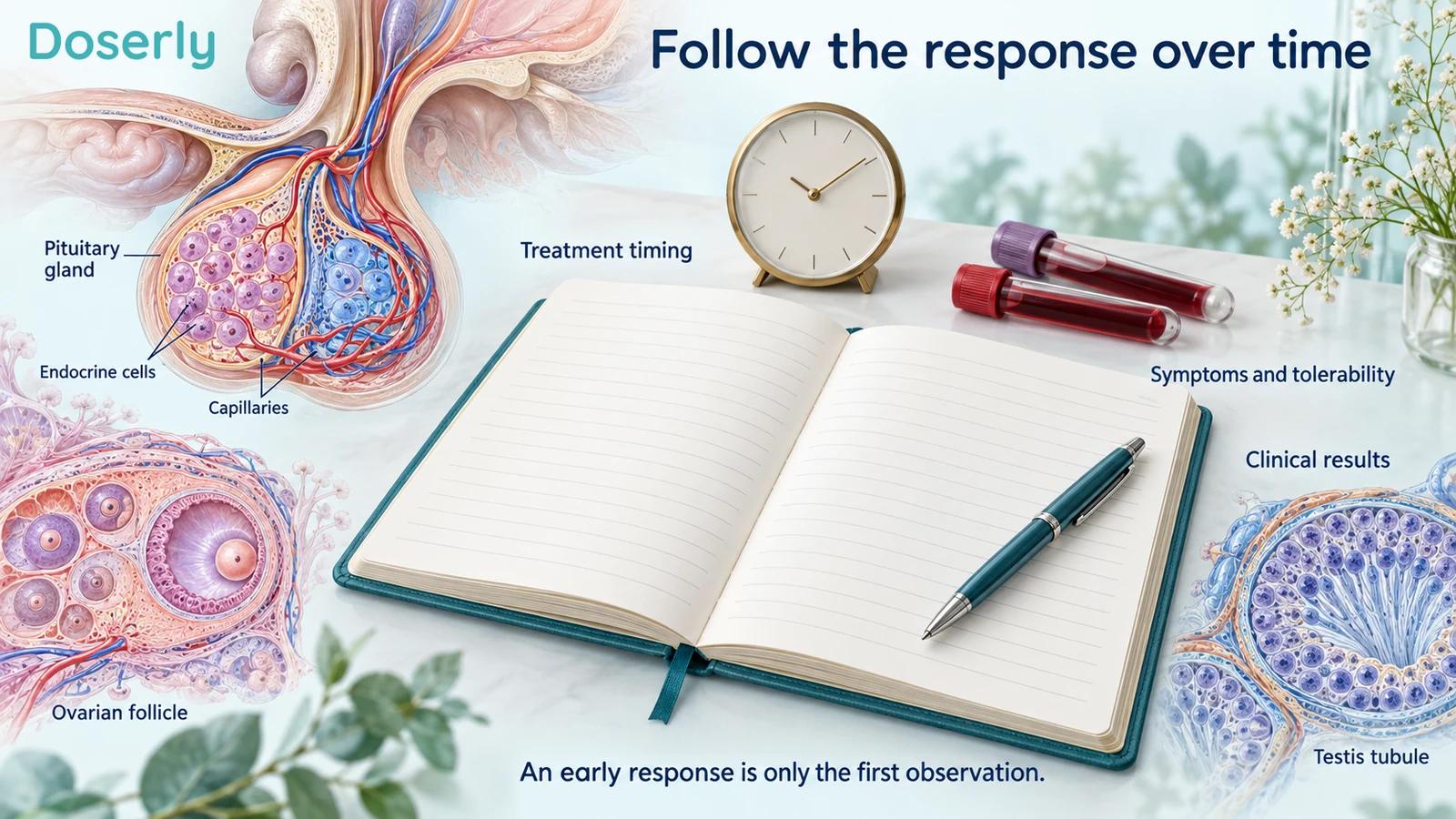
The first response may not be the later response
Repeated exposure can change responsiveness. This is particularly important when an acute peptide experiment is used to support continuing treatment.
In women with hypothalamic amenorrhea, research comparing kisspeptin-54 schedules found that frequent administration produced substantial loss of hormonal responsiveness, whereas twice-weekly administration produced partial desensitization with retained endocrine responses after eight weeks. These were pharmacological findings about the studied schedules and population. Jayasena and colleagues, 2010.
The finding does not establish an optimal schedule for a reader to adopt. It explains why one strong first-day response cannot settle the question of continuing effect. A longer trial needs repeat measurements under comparable conditions and clinical endpoints that remain relevant throughout follow-up.
It also means that a later change should not automatically trigger dose escalation. Different timing, delivery problems, concurrent medicines or changes in the underlying condition may need consideration. The clinical team should interpret the pattern before deciding what it means.
Safety monitoring belongs beside benefit monitoring
A treatment can produce the desired hormonal change and still cause problems. Monitoring should therefore include tolerability and adverse effects, not only the endpoint most likely to improve.
In the small male pump-versus-gonadotropin study, adverse effects differed between treatment groups: local skin reactions were more prominent with the pump, while acne and breast tenderness were more common with the gonadotropin regimen. The study does not provide a complete risk ranking, but it demonstrates why benefit and burden should be recorded together. Zhang and colleagues, 2019.
A report of no adverse effects in a brief study also has limits. It describes what was observed in that sample and exposure period; it does not establish the absence of rare or delayed harms. The duration and number of people studied are part of a safety claim.
Product quality is a separate issue again. The FDA identifies potential immunogenicity, peptide-impurity and characterization concerns for compounded kisspeptin-10 and notes limited safety information for proposed routes. A normal hormone result cannot resolve those manufacturing and safety uncertainties. FDA compounding safety-risk information.
Baseline information makes follow-up interpretable
A monitoring plan needs a starting point that matches the intended comparison. If the goal is preserving semen characteristics, a prior semen assessment is more relevant than relying only on a pretreatment testosterone value. The EAU guideline places semen analysis within the initial male fertility assessment. If the goal is reducing distressing low desire, the starting symptoms and their impact need to be documented.
The baseline should also identify ongoing treatments. Changes in testosterone, other hormones, medicines or the delivery method can alter interpretation. A later result obtained after several simultaneous changes cannot be confidently attributed to one peptide just because it was the most recently discussed treatment.
This is where a practical record can help. Keep the product name, route, prescribed schedule, administration dates, test dates and relevant symptoms together. Record changes when they occur rather than reconstructing them months later. The aim is to give the clinical team reliable context, not to create a private experiment that replaces care.
An app or notebook can organize this information. It cannot perform a semen analysis, confirm ovulation, validate product quality or decide whether a change is clinically meaningful. The value is in preserving the timeline so professional assessment is better informed.
Decide in advance what will trigger reassessment
Monitoring is more useful when the next decision is explicit. Before treatment begins, the patient and clinical team can discuss when progress will be reviewed, what counts as an inadequate response and which adverse effects or delivery problems require earlier contact.
The review interval should fit the diagnosis and endpoint. Repeating an irrelevant test frequently does not compensate for failing to measure the actual goal. Equally, waiting for a distant fertility endpoint should not mean ignoring tolerability or a practical interruption in treatment.
A plan should also allow the goal to change. Someone who originally prioritized testosterone symptoms may later wish to conceive. That change requires a new discussion of appropriate treatment and monitoring, because the old laboratory target may no longer answer the most important question.
The central question at each review is whether the available observations justify the next step. Sometimes they support continuing. Sometimes they show a need for further evaluation, a different approach or a clearer diagnosis. A rising number alone should not make that decision automatically.
Keep the outcome attached to the evidence
Good monitoring preserves distinctions: pituitary response, gonadal function, sperm production, ovulation, pregnancy, sexual wellbeing and adverse effects. It also preserves the conditions under which each measurement was obtained.
For reproductive peptides, that precision is especially useful because the literature spans short physiological experiments, selected fertility cohorts and early therapeutic research. A finding can be scientifically meaningful without answering every clinical question. Matching the measurement to the goal lets the evidence be useful at its actual level, while keeping the remaining uncertainty visible.
Explore the research
- Gonadorelin product information
- Long-term male GnRH treatment outcomes, 2002
- EAU male infertility guideline
- Male pump-versus-gonadotropin comparison, 2019
- Pulsatile GnRH in FHA: 25-year cohort, 2022
- Endocrine Society FHA guideline
- Kisspeptin in women with HSDD, 2022
- Kisspeptin in men with HSDD, 2023
- Repeated kisspeptin-54 administration, 2010
- FDA compounding safety-risk information