
Peptides
October 16, 2026
Why pulsatile growth-hormone release is not a complete safety argument
On this page
Growth hormone helps regulate growth, body composition and the way the body uses fuel. Your pituitary gland releases it in bursts rather than at one steady rate throughout the day. Sermorelin stimulates that gland, which explains why it is often described as supporting the body's own hormone release.
That distinction is useful, but it doesn't answer the question most people really mean to ask: does stimulating my own growth hormone make treatment safe for me? A hormone can still be released in pulses while its overall exposure, its effects on other hormones or its effects on blood sugar change. Safety has to be studied in the people receiving treatment, over an appropriate period.
For sermorelin, human research includes diagnostic testing, children's growth studies and small studies in older adults. Those studies answer different questions. Understanding what each measured gives a more useful picture than either “it's natural” or “all growth-hormone treatments are the same.” Our sermorelin guide provides broader background; here we'll concentrate on what pulsatility does and doesn't tell us.
What does pulsatile release mean?
A pulse is a temporary increase in secretion followed by a lower level. Several features describe that pattern: how often pulses occur, how high they rise, how long they last and how much hormone is present between them. Two patterns can both be pulsatile while delivering different amounts of hormone over a night.
The hypothalamus, a region of the brain, helps control the pituitary through stimulating and inhibitory signals. Growth hormone then acts on tissues and stimulates production of insulin-like growth factor 1, usually shortened to IGF-1. Feedback from the system helps restrain further release. These relationships explain why a stimulating drug does not behave identically to giving growth hormone directly.
Sermorelin is a synthetic version of the first 29 amino acids of growth-hormone-releasing hormone. The historical Geref 50 product information describes its use to assess pituitary responsiveness. This requires a functioning pituitary response; it is not simply replacement hormone entering the blood. Archived Geref diagnostic information.
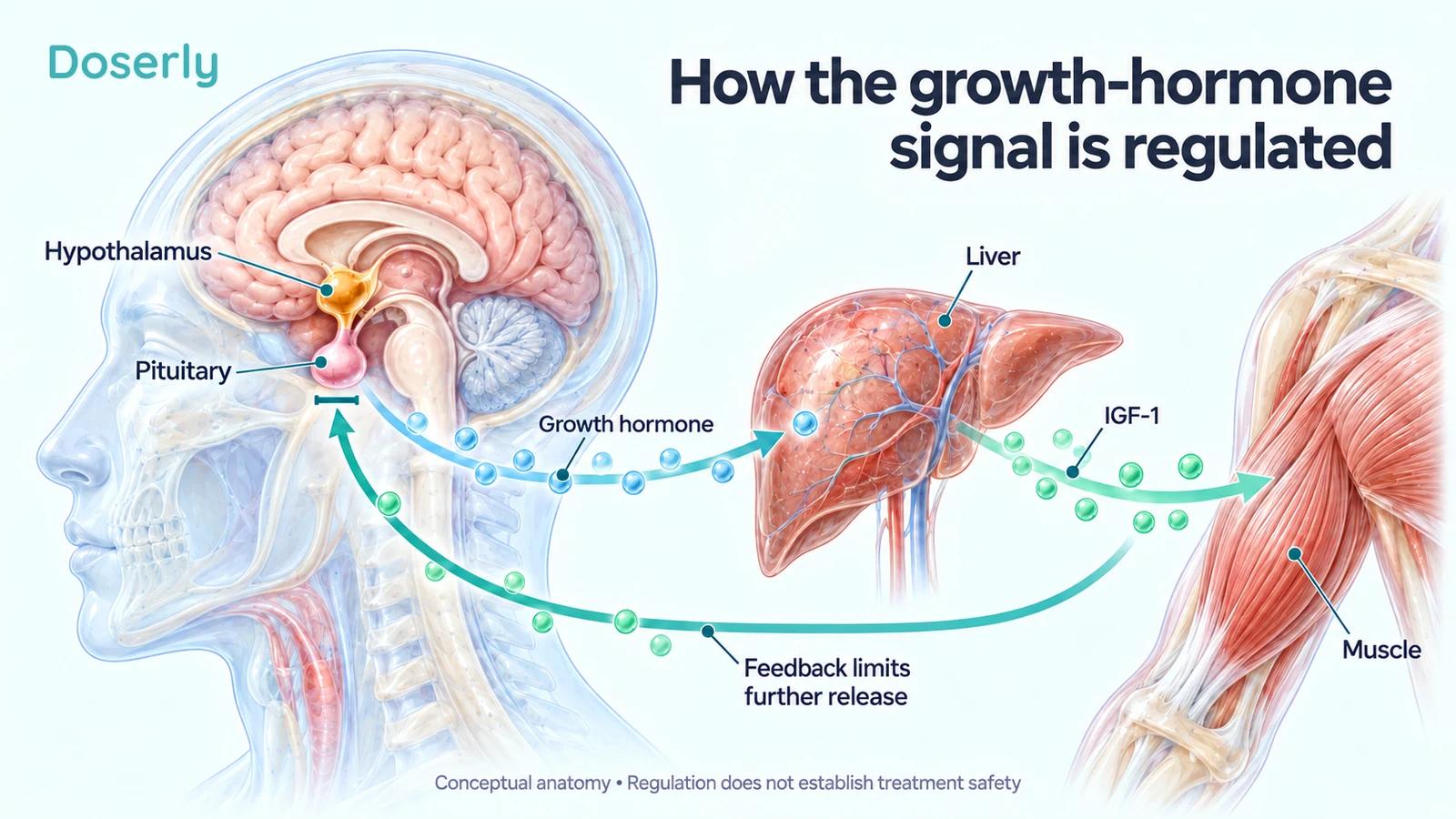
Preserving a pattern isn't the same as preserving the amount
Imagine comparing two nights of hormone measurements. On both nights, levels rise and fall. On the second night, the peaks are larger or the level between peaks is higher. Calling both nights “pulsatile” is correct, but it leaves out the changes that might matter clinically.
A human tesamorelin study illustrates this distinction. Thirteen men received the GHRH analogue for two weeks, with measurements before treatment, during treatment and after withdrawal. Researchers found increases in overnight growth hormone, pulse size and basal secretion, alongside increased IGF-1. Insulin-stimulated glucose uptake did not change significantly over that short period. This was tesamorelin, not sermorelin, and the study did not establish long-term safety. It shows why preserved pulses and increased exposure can occur together. Stanley and colleagues.
A complete treatment explanation would address how much the pattern changed, what happened downstream and whether people experienced worthwhile benefits or adverse effects. “The body still controls release” describes part of the mechanism. It is not a measurement of the person's total response.
What does the sermorelin research actually show?
One 1994 study enrolled 18 prepubertal children with idiopathic short stature, meaning their short stature was not explained by the growth-hormone deficiency criteria used in the study. They received GHRH(1-29)NH2 for a year. Growth velocity increased, but fasting glucose, insulin and IGF-1 also rose. Overnight growth-hormone levels and responses to testing declined during treatment. Kirk and colleagues.
Hormonal responsiveness, growth and metabolic measurements moved in different directions. The study does not tell us how often adults receiving a different regimen develop diabetes. It does show that a response involving the body's own hormone system can coexist with changes that deserve monitoring.
In a separate six-week study, 11 healthy older men received nightly GHRH(1-29). Overnight growth-hormone secretion increased, while IGF-1, body composition and glucose measurements did not change significantly. Some strength or endurance tests improved, but there was no placebo group. The absence of significant adverse effects in such a small, short study cannot establish the frequency of uncommon or delayed problems. Vittone and colleagues.
A child being evaluated for growth is different from an older adult hoping to improve strength. Treatment schedules and duration differed, too. Neither population provides a shortcut to a long-term safety claim for a contemporary adult clinic regimen. The question is not whether these studies are useful; it is which questions they can reasonably answer.
Why glucose deserves its own discussion
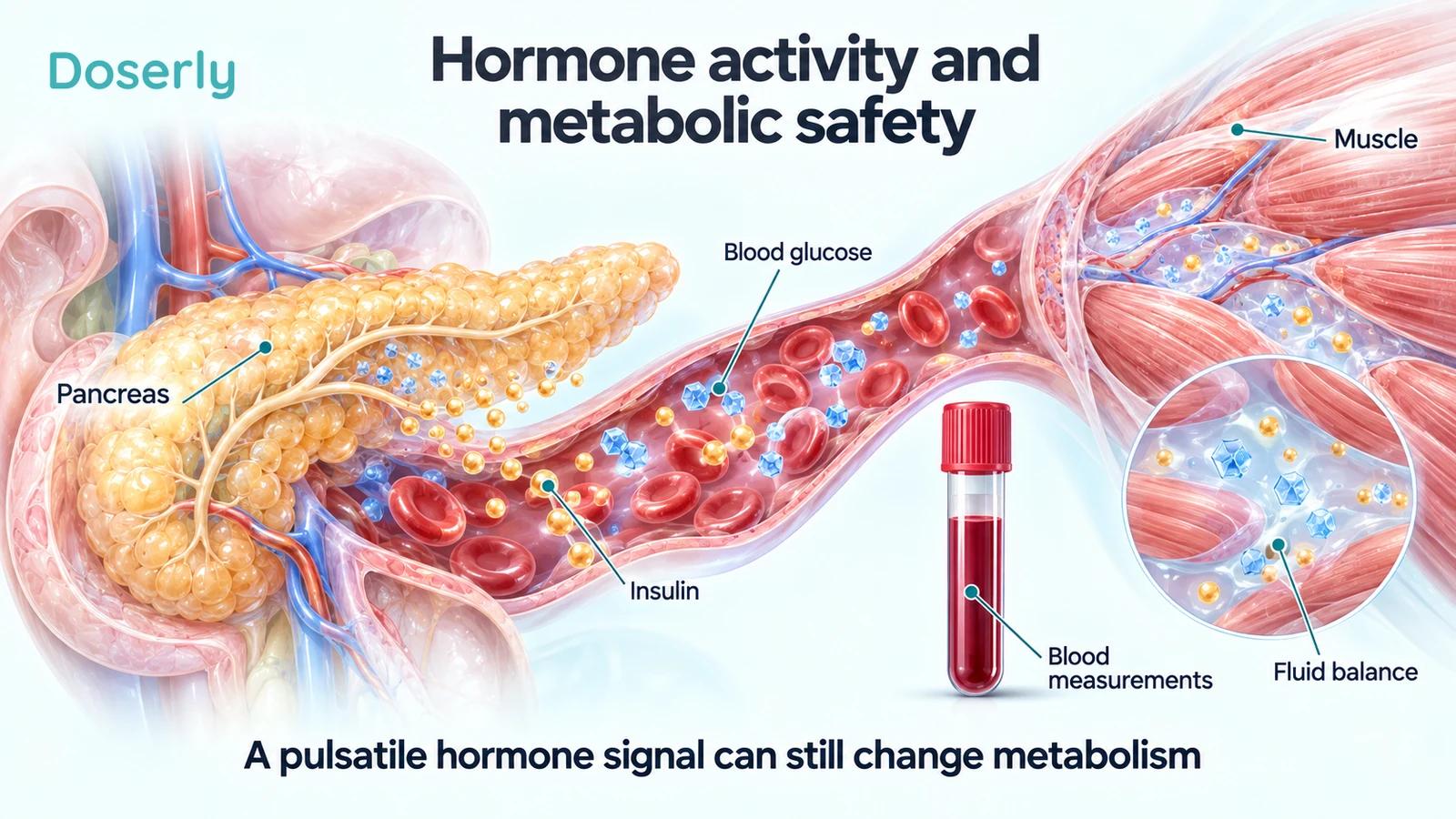
Blood glucose is the amount of sugar circulating in the bloodstream. Insulin helps tissues use and store that fuel. A treatment affecting the growth-hormone system may change this balance, so a reassuring statement about hormone feedback doesn't replace checking metabolic effects.
The relevant question isn't simply whether the average glucose measurement stayed the same. Clinicians also need to know whether some participants developed abnormal values, whether people at higher baseline risk were studied and how long follow-up lasted. A stable group average can coexist with clinically important changes in a smaller number of people.
Tesamorelin's prescribing information provides a separate, better-characterized example. It calls for assessment of glucose before treatment and monitoring during use, and describes glucose intolerance and diabetes risk. Those instructions belong to tesamorelin and cannot be converted into a sermorelin risk percentage. They demonstrate that stimulating endogenous growth-hormone release does not remove the need for metabolic surveillance. Egrifta WR prescribing information, section 5.4.
Does a higher IGF-1 result mean better health?
IGF-1 can help show that the growth-hormone system has responded. It does not, by itself, show that someone has become stronger, sleeps better or has reduced their future disease risk. Those outcomes need their own measurements.
There is also a difference between interpreting a result against the laboratory's appropriate reference range and trying to reach the highest possible number. The tesamorelin label treats persistent IGF-1 elevation as a safety consideration and notes that the consequences of prolonged elevation are unknown. A biomarker can be evidence of biological activity and a reason to reconsider exposure at the same time. Egrifta WR prescribing information, section 5.2.
A useful question is: “What change in my health are we trying to achieve, and how will we assess it separately from the hormone result?” If the goal is improved daily function, a rising blood marker without a meaningful functional improvement leaves the main goal unanswered.
A low hormone result doesn't establish the diagnosis
Fatigue, reduced exercise tolerance and changing body composition can lead people to consider hormone testing. These symptoms deserve attention, but they are not specific to growth-hormone deficiency. Nor does a single low growth-hormone measurement necessarily indicate that the pituitary cannot make enough hormone: sampling between pulses can produce a low value.
The Endocrine Society's adult growth-hormone-deficiency guideline explains that confirmation usually requires stimulation testing, with exceptions in certain established genetic or structural conditions. The clinical history and other pituitary findings matter. This guideline concerns diagnosing and treating actual deficiency; it is not an endorsement of sermorelin for healthy aging. Adult growth-hormone-deficiency guideline.
Getting the diagnosis right changes the discussion. Correcting a documented hormone disorder involves a different balance of expected benefit and risk from treating a nonspecific symptom in someone without that disorder. A persuasive explanation of pulsatility can't resolve an uncertain diagnosis.
What about the claim that feedback prevents overdose?
Feedback may limit a response under some conditions. That is different from establishing that every possible exposure is harmless. A drug's concentration, duration of effect, route, formulation and the person's underlying physiology all remain relevant.
The archived Irish diagnostic Geref information specifically says that acute-overdose data were unavailable. Its preclinical tolerance information is not a human guarantee, and a single supervised diagnostic exposure is not the same as repeated long-term treatment. The document also describes precautions and adverse effects despite the drug acting through the pituitary. Archived Geref information, sections 4.4–4.9.
A claim that overdose is impossible needs direct support. It cannot be deduced from the existence of a feedback loop. Equally, the absence of adequate overdose research does not establish that a particular prescribed exposure is harmful. It identifies a question the available evidence does not settle.
Product quality is a separate safety question
Even an accurate description of a molecule says little about the contents of a particular vial. Concentration, contamination, storage and labeling are product questions. Hormonal feedback cannot protect someone from all of those problems.
FDA explains that compounded drugs are not FDA-approved and are not reviewed for safety, effectiveness and quality before marketing in the same way as approved products. Compounding can meet medical needs, but it does not make every preparation equivalent to an older approved product. FDA on compounded-drug risks.
A safety discussion should identify the exact product as well as the molecule. “Sermorelin stimulates your own hormone” and “this preparation has appropriate quality controls” are separate statements, requiring separate support.
What would make the treatment discussion more useful?
Start with the problem being treated. Describe what has changed, how long it has been happening and what would count as a worthwhile improvement. Then ask which evidence matches your diagnosis, age and proposed treatment.
A useful follow-up plan distinguishes three things: whether the hormone system responds, whether you feel or function better, and whether unwanted effects emerge. Those can move independently. Recording treatment changes, symptoms and laboratory dates can help a clinician see that pattern without assuming that every change has the same cause.
For example, a person might report better sleep at the same time that they begin exercising regularly and change medication. A dated record preserves those details. It cannot prove which change caused the improvement, but it avoids treating a hormone result as the only relevant event. The same record can capture symptoms that otherwise disappear from memory by the next appointment.
Ask what would lead to reassessment if the expected benefit fails to appear, symptoms develop or laboratory measurements move outside the intended range. There is no universal schedule established by the word “pulsatile.” The plan has to fit the actual treatment and clinical situation.
Sermorelin's mechanism explains why the drug is studied and why pituitary function matters. It does not replace evidence about outcomes, product quality or monitoring. The sermorelin guide's evidence section is a useful next step for comparing the human studies behind those discussions.
Sources
- Kirk et al., 1994: GHRH(1-29)NH2 in children with idiopathic short stature.
- Vittone et al., 1997: nightly GHRH(1-29) in older men.
- Stanley et al., 2011: tesamorelin, GH pulsatility and insulin sensitivity.
- Archived Irish Geref 50 diagnostic product information.
- Egrifta WR prescribing information.
- Endocrine Society: adult growth-hormone deficiency.
- FDA: compounded-drug risks.