
Peptides
October 16, 2026
Why pulsatile gonadorelin is different from occasional injections
On this page
Gonadorelin is a manufactured version of gonadotropin-releasing hormone, or GnRH, the signal that tells the pituitary gland to release reproductive hormones. It can help replace a missing hypothalamic signal in selected fertility disorders. But the timing of that replacement is part of the treatment: a pump delivering repeated small pulses is a different intervention from an occasional injection of the same molecule.
That distinction matters when someone cites successful fertility research to support a much less frequent schedule. The research may be real, yet the proposed treatment may leave out the feature that made the studied intervention work. The right comparison includes the diagnosis, delivery pattern and outcome, not just the name on the vial.
Here we'll examine the human evidence behind pulsatile delivery, including older direct comparisons and longer fertility cohorts. We'll also explain why a pump is not a general solution for every low sperm count. The Doserly gonadorelin guide provides background on its diagnostic and therapeutic uses.
What the pituitary receives
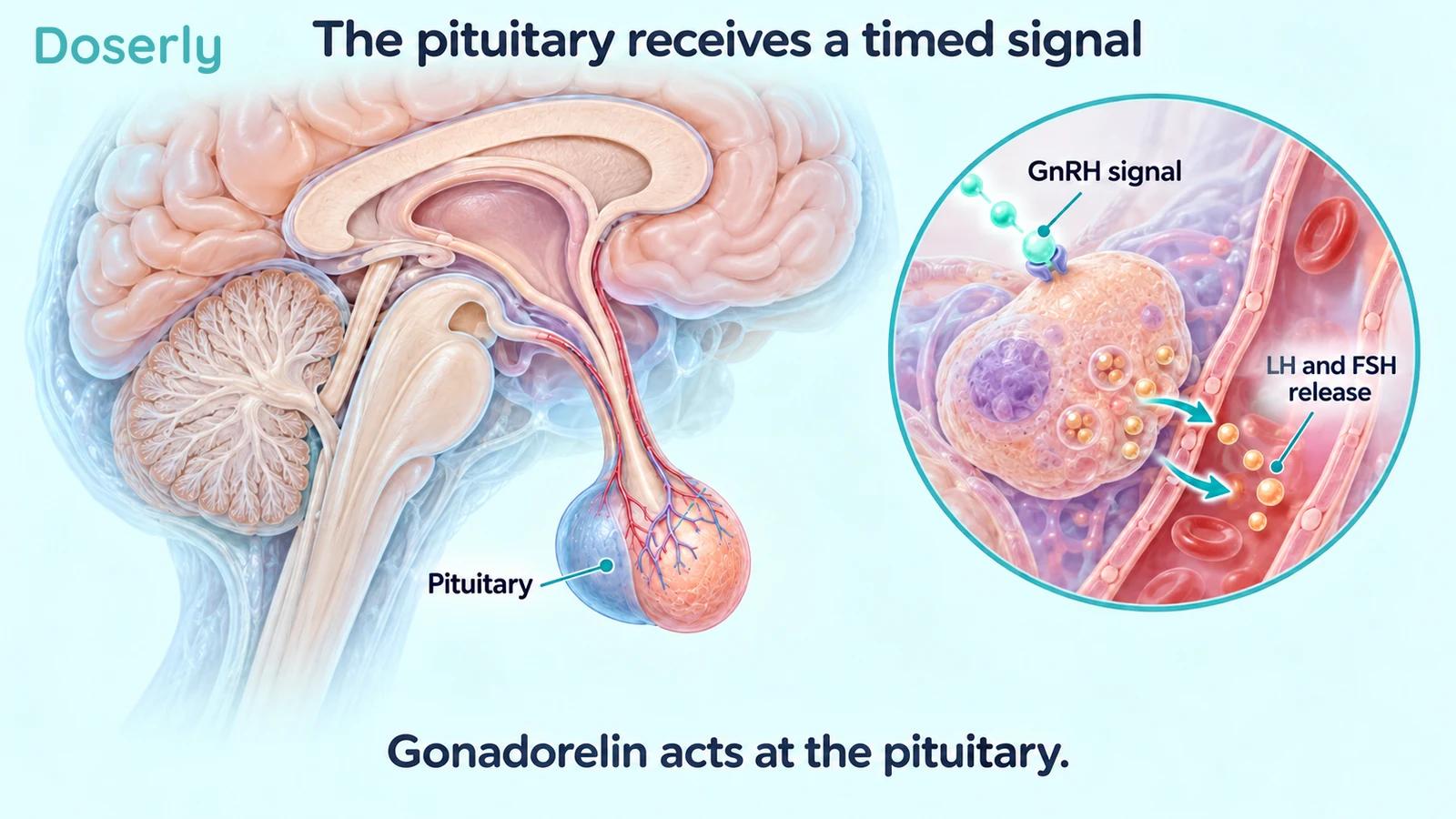
The hypothalamus is a region at the base of the brain that coordinates several hormonal functions. It releases GnRH into a small circulation connecting it with the pituitary. Pituitary cells then release luteinizing hormone (LH) and follicle-stimulating hormone (FSH). In men, these signals support testosterone production and sperm development through different testicular cells.
Gonadorelin acts at this pituitary step. Its blood half-life is short: the UK product information describes approximately four minutes. A half-life is the time over which the concentration falls by half; it is not a precise clock for when every downstream effect disappears. Gonadorelin product information.
A brief signal can trigger a hormone response that outlasts the circulating peptide. Nevertheless, reproducing one response occasionally does not establish that the reproductive system receives adequate stimulation across the rest of the day or week. The interval between signals matters along with their size.
What “pulsatile” means in this research
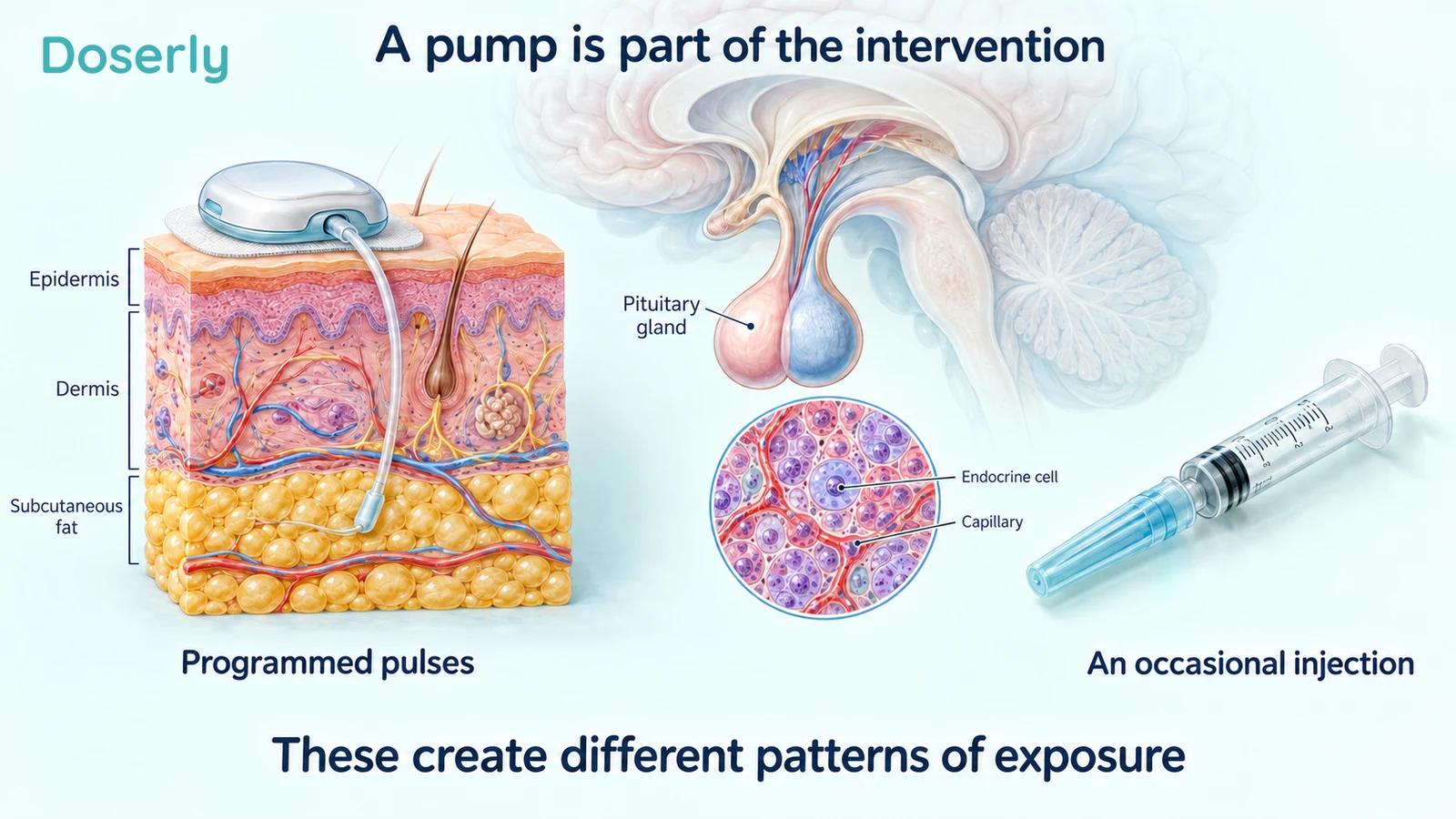
Pulsatile delivery means repeated discrete administrations separated by intervals without another pulse. It is different from a continuous infusion that maintains steady exposure. It is also different from using the word “pulse” loosely for any injection given on a calendar.
In reproductive research, pumps have delivered pulses throughout the day and night at intervals measured in minutes or hours. The pump automates a recurring signal that would be difficult to reproduce manually. Researchers adjust treatment according to the clinical setting and measured response; there is no single schedule that should be inferred for everyone from an illustration.
A historical comparison makes the distinction concrete. A 1987 study treated 30 men with incomplete idiopathic hypogonadotropic hypogonadism, a disorder of insufficient gonadotropin stimulation. It compared twice-daily subcutaneous injections with small pump-delivered pulses every 90 minutes. The report favored the pump for endocrine responses, sperm production and fertility. Shargil, 1987.
This is a small, older study in carefully selected patients, not a modern large randomized trial of current clinic regimens. Its useful message is that delivery pattern was explicitly part of the comparison. The result cannot be reduced to “gonadorelin improved fertility” while dropping the pump from the description.
Why simply giving a larger amount is not equivalent
The total amount administered and the way it is distributed through time are separate features. Several small signals can generate a different pituitary response from a larger signal delivered once. A weekly total therefore cannot establish biological equivalence between two schedules.
An older study illustrates the limitations of repeated larger injections. Six people with isolated gonadotropin deficiency received subcutaneous releasing hormone two or three times daily. Four were men treated for six months; two had a transient testosterone rise, but testosterone subsequently remained at pretreatment levels in all four. Their testes still responded to hCG, which acts downstream of the pituitary. Rabin and McNeil, 1981.
That result does not prove every non-pump schedule fails. It does show that administering a substantial amount repeatedly did not reliably reproduce sustained downstream function in those patients. Raising the amount is not an evidence-based substitute for understanding the timing problem.
The short half-life supports taking timing seriously, but it cannot, by itself, tell us which schedule improves fertility. Clinical results are still needed. Pharmacology can explain why two regimens differ without supplying a validated alternative regimen.
Frequency can change the response over time
A physiological study in eight healthy men administered GnRH pulses every two hours for 88 hours. Researchers then stopped the pulses in four men and increased their frequency to hourly in the other four. LH changed over time after both interventions, rather than instantly settling into a simple new level. Sauder and colleagues, 1988.
This was a short hormone experiment, not a fertility treatment trial. Its contribution is showing that the pituitary's response depends on the pattern and its recent history. A blood sample immediately after changing frequency can differ from a sample taken after the system has had time to respond.
The experiment also helps explain why a single high LH result is incomplete. It may confirm that a signal elicited release at that moment. It does not measure average stimulation across an interval, establish normal endogenous pulses or demonstrate sperm production. A clinician needs measurements that match the intended treatment goal.
What longer pump treatment has achieved
A 2002 cohort followed 76 men with idiopathic hypogonadotropic hypogonadism receiving pulsatile GnRH for 12–24 months. LH normalized in 97% and testosterone in 93%. Response varied with prior pubertal development, baseline inhibin B and a history of undescended testes. Among men with no prior pubertal development, 18% remained without sperm in the ejaculate despite treatment. Pitteloud and colleagues, 2002.
Those findings are clinically useful because they separate hormone restoration from the more demanding task of developing sperm production. They also show that treatment duration can extend over many months and that the starting condition matters.
For a patient, the appropriate expectation is therefore individualized. A normal testosterone result may be an encouraging early response, but it does not guarantee that semen parameters will normalize on the same timetable. The cohort did not study occasional injections added to testosterone replacement therapy, so its success cannot establish fertility preservation in that different situation.
A more recent comparison with gonadotropin treatment
A study published in the 2019 issue of American Journal of Men's Health compared a gonadorelin pump with cyclical hCG and human menopausal gonadotropin treatment in 28 men with congenital hypogonadotropic hypogonadism. Ten received the pump and 18 received the gonadotropin regimen. Assignment was not randomized.
The median time until sperm appeared was six months with the pump and 14 months with the comparator. Sperm appeared in 90% and 83.3%, respectively; the difference in those proportions was not statistically significant. Skin reactions were a common pump-related problem. Zhang and colleagues.
The earlier appearance of sperm is potentially important, but the small nonrandomized design limits causal certainty. Also, the comparison was with a particular combined gonadotropin regimen, not hCG alone, and not every possible fertility treatment. These details help prevent a specific finding from becoming an overly broad claim that pumps are always superior.
A pump does not make an unsuitable diagnosis suitable
Oligozoospermia means a low sperm concentration. It describes a finding, not its cause. Some men with low sperm counts lack sufficient hypothalamic signaling; others have a different problem despite gonadotropin levels that are not deficient.
A small 1985 study treated four men with idiopathic oligozoospermia and normal gonadotropin status using pulsatile releasing hormone for three months. It found no improvement in ejaculate volume, sperm concentration or motility. Pulsatile treatment in idiopathic oligozoospermia.
Four participants cannot settle every question about this population. The result nevertheless illustrates a basic clinical point: correcting a missing signal is different from adding more signal when that is not the established problem. A delivery method with a useful role in GnRH deficiency does not become a general fertility enhancer.
A full assessment should determine whether the difficulty involves signaling, testicular function, sperm transport or another factor. Without that distinction, even accurately reproducing a research schedule may target the wrong part of the problem.
Why diagnostic injections don't answer the treatment question
Gonadorelin is also used in stimulation testing. A single administered signal followed by blood sampling asks whether pituitary gonadotropin-producing cells respond. A normal response is useful information about that response on the test day.
The UK label explicitly limits the interpretation: the single test does not establish the cause of a subnormal response or measure pituitary gonadotropic reserve. It complements clinical assessment. Gonadorelin product information.
A diagnostic response therefore cannot be converted into a long-term treatment success claim. If LH rises after a test, researchers have not thereby shown that occasional use maintains adequate testicular stimulation, preserves sperm during another hormone treatment or improves the chance of pregnancy. Those questions require treatment observations and appropriate outcomes.
What the practical treatment includes
A pump-based intervention includes more than the peptide. It involves an appropriate formulation, a compatible delivery system, an infusion site, training and follow-up. If delivery stops or the site becomes problematic, the exposure pattern changes. These practical details affect whether the studied intervention is actually being received.
The tolerability findings in the 28-man comparison make that tangible. A treatment can improve an endocrine or semen outcome while causing local problems that matter to daily life. The burden of wearing and maintaining a device should be weighed alongside the expected benefit, rather than treated as irrelevant to efficacy.
It is reasonable to ask a specialist how treatment response will be followed and who handles device or supply problems. The answer should come from the treating service and the specific product instructions, not from improvising a pump schedule based on an old paper. Our gonadorelin route and delivery section explains why formulations and routes need to be distinguished.
What to ask when pump research is cited
The most useful question is straightforward: “Was the treatment in the study the same as the treatment being proposed?” Ask about the diagnosis, whether testosterone was being used concurrently, whether delivery was pulsatile and what outcome actually improved.
If the goal is sperm production, ask for semen outcomes rather than only a testosterone result. If the claim concerns pregnancy, find out whether pregnancy was measured and how other fertility factors were considered. If a different schedule is proposed, ask what direct evidence supports that change.
Pulsatile gonadorelin has a meaningful clinical research history in selected disorders of reproductive signaling. Its benefits are best understood as evidence about a complete intervention: the right patient, repeated timed delivery and outcome-specific follow-up. An occasional injection may contain the same peptide, but it requires its own evidence for the result being promised.
Explore the research
- UK gonadorelin product information: mechanism, short half-life and diagnostic limits.
- Shargil, 1987: twice-daily injections versus a pulsatile pump.
- Rabin and McNeil, 1981: failure of sustained response with repeated injections.
- Sauder et al., 1988: changing pulse frequency.
- Pitteloud et al., 2002: 76 men followed for 12–24 months.
- Zhang et al., 2019: pump versus cyclical gonadotropins.
- 1985 study of pulsatile treatment in idiopathic oligozoospermia.