
Peptides
October 16, 2026
Pigmentation isn't proof of protection from skin cancer
On this page
A darker skin tone is evidence that pigmentation changed. It is not a measurement of future skin-cancer risk. That distinction matters when discussing afamelanotide, also known by its earlier name Melanotan I, because some human studies have measured tanning and short-term responses to ultraviolet radiation.
Those studies are scientifically relevant. They suggest that stimulating pigment-related pathways can alter how skin responds to a controlled exposure. But they do not establish that using a tanning peptide prevents melanoma or other skin cancers over years.
The evidence needs to be separated into four questions: Does the substance increase pigment? Does it reduce a particular short-term UV effect? Does it improve a disease-specific symptom? Does it change long-term cancer incidence? A positive answer to one does not supply the answer to the others.
Why the biology is plausible
Afamelanotide acts at the melanocortin-1 receptor, or MC1R, and increases production of eumelanin, the darker form of melanin. The approved Scenesse label describes this pigment response as occurring independently of sunlight or artificial UV exposure. Scenesse prescribing information.
Melanin has a role in the skin’s response to light, so investigating this pathway is reasonable. The mistake is to turn a plausible protective mechanism into a completed prevention claim.
A mechanism identifies something the treatment can influence. A clinical outcome asks what ultimately happens to people. Between those two are questions about the magnitude and duration of the effect, other biological pathways, adverse effects, and changes in behavior. Those questions still apply when the mechanism sounds particularly convincing.
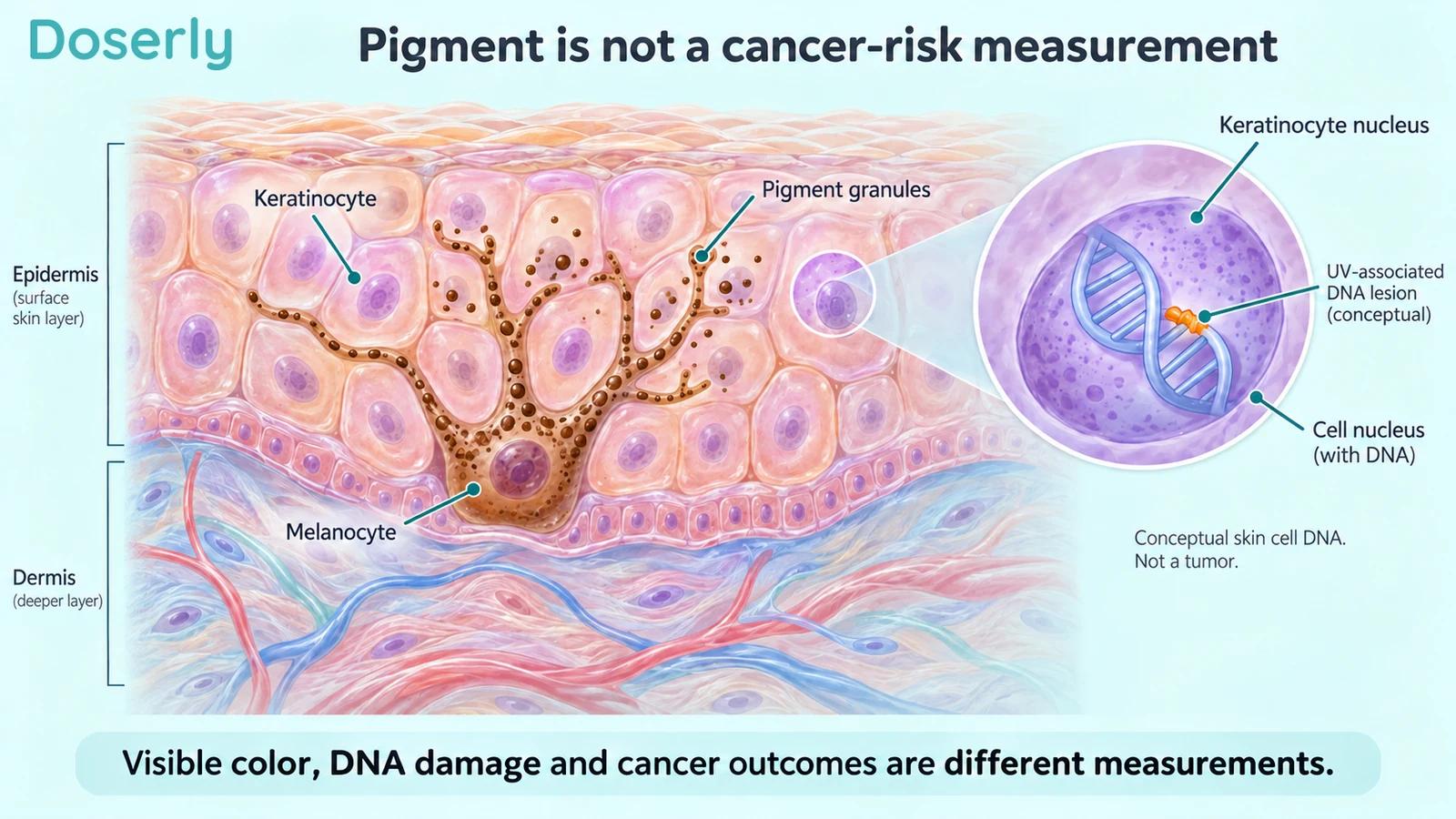
The early tanning trials established a visible response
A 1991 randomized trial enrolled 28 healthy White men with different tanning histories. Participants received the synthetic melanotropin or placebo, and all used high-potency sunscreen. Researchers measured skin color over time and found darkening in the active-treatment groups. Original tanning trial.
That study helped establish that pigmentation could be stimulated without deliberately seeking UV exposure. Its outcome was skin darkening, not cancer incidence. Its small, selected population and short observation period also limit what it can say about long-term use in a broader population.
It is therefore accurate to describe the trial as evidence of a tanning effect. Describing it as proof of safer long-term tanning would add a conclusion the study was not designed to test. The distinction is especially important when historical injection research is used to advertise a modern product with a different formulation.
What the 65-person UV study actually found
A 2006 trial involving 65 volunteers examined pigmentation and skin responses to a controlled UV challenge. In participants with low baseline minimal erythema doses, treatment was associated with fewer sunburn cells after exposure. The investigators also reported reduced thymine-dimer formation in the epidermal basal layer. Barnetson and colleagues.
A sunburn cell is a damaged cell identified in tissue, not simply a red patch visible in a photograph. Thymine dimers are a form of UV-associated DNA damage. These are useful experimental endpoints because they provide information beyond whether skin looks darker.
Nevertheless, the reported percentage reduction in one marker cannot be relabeled as the same percentage reduction in cancer risk. The trial did not follow a large population for incident cancers, and its controlled challenge differs from years of variable everyday exposure. Its findings support further research; they do not establish an individual protective allowance.
A newer small study remains an acute experiment
A September 2026 exploratory study tested nine healthy adults before and shortly after an afamelanotide implant. Researchers applied controlled UVB dose series to different skin sites and measured redness and pigmentation. The overall erythema dose-response decreased, while the increase in minimal erythema dose was not statistically significant. Griffin and colleagues.
That distinction matters. “Less redness across the tested doses” and “a reliably higher threshold before redness” are related but different findings. The study did not include a parallel placebo group, involved a small sample, and assessed an acute response. Some authors disclosed research relationships with the manufacturer.
It would be misleading to call this a skin-cancer prevention trial. It also would be misleading to dismiss it as meaningless simply because it is small. It contributes a specific human observation whose significance depends on confirmation, replication and the outcome being claimed.
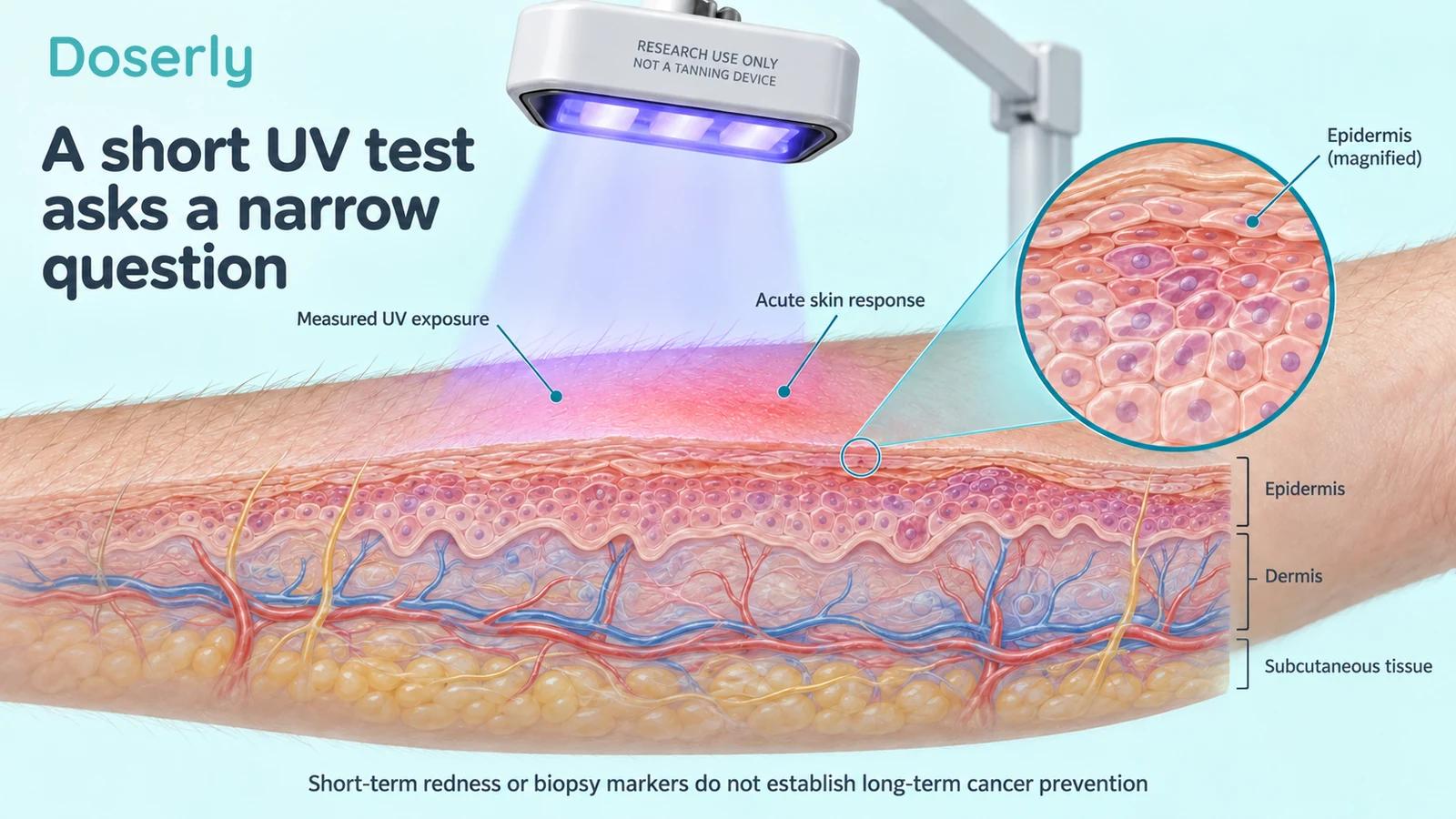
Why a marker cannot supply a cancer-risk percentage
A laboratory or short-term clinical marker can be associated with a disease process without fully predicting the effect of an intervention on that disease. To use it as a substitute for a long-term outcome, researchers need evidence that changes in the marker reliably capture the treatment’s relevant benefits and harms.
For example, a reduction in one DNA-damage measurement does not describe every type of injury, every skin cell, every exposure pattern or the response over repeated use. Nor does it establish whether a person changes their behavior because they feel protected.
This is why the wording of the claim matters. “Reduced a measured UV-damage marker in a small study” preserves the observation. “Prevents skin cancer” requires evidence about a different outcome. The gap is not resolved by placing the two phrases next to the same before-and-after photograph.
EPP treatment has a different clinical purpose
Scenesse is approved in the United States to increase pain-free light exposure in adults with a history of phototoxic reactions from erythropoietic protoporphyria. EPP involves light-sensitive protoporphyrin, with visible light playing an important role. Its painful reactions are not interchangeable with ordinary UV sunburn. Scenesse label, EPP consensus guideline.
Improved light tolerance in EPP can be a substantial benefit without establishing cancer prevention. Patients can gain meaningful function while still needing protection and monitoring.
This is also why the approved implant should not be used as a general endorsement of online tanning preparations. The tested product, patient population, intended benefit and medical follow-up all matter. The Doserly Melanotan I guide explains these distinctions in the broader evidence context.
What the FDA’s 2019 safety review can tell us
The FDA’s 2019 risk review did not identify an increased melanoma signal in the afamelanotide data it assessed. It discussed clinical trials and European follow-up, including some patients with up to ten years of exposure, and supported continued skin monitoring and longer-term surveillance. FDA risk assessment.
That is reassuring within the scope of the reviewed evidence. It is not proof that risk is zero, a comparison establishing cancer prevention, or a current census of every person ever exposed.
The review also described uncertainty about atypical melanocytic lesions in one treated participant. Safety assessments can contain both an absence of a clear population-level signal and individual findings requiring attention. Those observations should be read together rather than selectively quoting only the most reassuring sentence.
What melanoma case reports cannot settle
A 2026 report described five melanomas in situ in one patient who reported recent tanning-bed exposure, Melanotan II followed by Melanotan I, and anabolic hormone use. The history also included prior UV exposure, numerous atypical moles and a family history of melanoma. Original case report.
The report is a reason to take changing lesions seriously. It cannot determine which exposure caused the cancers, whether lesions were already present, or the added risk per user. There was no untreated comparison group and no reliable denominator of similarly exposed people.
Calling the case proof that Melanotan I causes melanoma would overstate it. Calling it proof that the drug was uninvolved would also overstate it. The medically useful response to this uncertainty is assessment of suspicious changes and careful safety surveillance, not confident causal claims in either direction.
Less burning is not permission for more UV
Both UVA and UVB can damage skin. Visible sunburn is an acute response; it does not provide a complete account of cumulative injury. FDA guidance explicitly distinguishes protection against sunburn from broader claims about skin cancer and aging. FDA UV information, FDA sunscreen guidance.
This matters behaviorally. If someone stays outside longer because they no longer notice redness as quickly, their total exposure changes. A laboratory result obtained at a fixed UV dose cannot tell us the net effect of that different pattern.
The absence of an immediate burn is therefore a poor reason to stop established protection. It is also not a test of whether an unapproved peptide product is authentic or safe. A visible response can occur without answering either question.
What protection and monitoring still involve
The American Academy of Dermatology recommends shade, protective clothing and broad-spectrum, water-resistant sunscreen with SPF 30 or higher, along with avoiding tanning beds. These measures remain relevant when skin color changes. AAD prevention guidance.
For someone with EPP, those general UV measures need to sit alongside individualized advice about the visible-light sensitivity of their disease. A standard sunscreen label does not answer every EPP protection question.
The Scenesse label recommends full-body skin examinations twice yearly because existing moles and freckles can darken and new pigmented lesions may appear. A new, changing, itching or bleeding spot deserves clinical attention rather than being dismissed as an expected tan. That recommendation is about observation and assessment; it does not mean every pigment change represents cancer.
What a credible prevention claim would need
A persuasive claim would identify the exact product and population, measure clinically relevant cancers over adequate follow-up, and account for baseline risk and UV exposure. It would report adverse effects and uncertainty as carefully as favorable findings.
Until such evidence supports the proposed use, the defensible conclusion remains narrower: afamelanotide can increase pigmentation, has disease-specific benefits in EPP, and has shown effects on some short-term UV responses. None of those findings makes a cosmetic tanning product an established skin-cancer prevention treatment.
When evaluating a claim, look for the outcome the researchers actually counted. Skin color, tissue markers, pain-free time and cancer diagnoses belong to different questions. Keeping those questions separate makes room for promising science without turning it into a promise the studies have not established.
Sources
- Scenesse prescribing information.
- Levine et al.: 1991 tanning trial.
- Barnetson et al.: pigmentation and UV-damage trial.
- Griffin et al.: 2026 acute UV-response study.
- EPP consensus guideline.
- FDA: 2019 Scenesse risk assessment.
- Vadner and Smith: 2026 melanoma case report.
- FDA: ultraviolet radiation.
- FDA: sunscreen protection.
- AAD: skin-cancer prevention.