
Peptides
October 16, 2026
Why online retatrutide cannot borrow a trial's quality assurances
On this page
Retatrutide is being developed to influence three hormone receptors involved in metabolism: those for GLP-1, GIP and glucagon. The weight-loss findings have understandably attracted attention. If you have struggled to find effective treatment, a vial advertised under the same name may look like a way to access the medicine researchers are studying.
But a clinical trial answers a question about a specified product supplied through a research program. It does not test every product subsequently sold with that molecule's name on the label. Evidence that retatrutide can produce weight loss and evidence that a particular vial contains suitable injectable medicine are different kinds of evidence. One cannot substitute for the other.
This distinction is practical. It concerns what enters the body, how much is delivered, whether the preparation remains suitable during storage, and who evaluates symptoms if something goes wrong. Our retatrutide guide explains the compound's biology and clinical research; here we'll focus on what a trial can tell you about product quality.
What did researchers actually test?
The 2023 phase 2 obesity trial randomized 338 adults to weekly retatrutide or placebo for 48 weeks. Participants had obesity, or overweight with a weight-related condition. The highest target-dose group had an estimated average weight reduction of 24.2% at week 48, compared with 2.1% with placebo. Gastrointestinal adverse events were common, and heart-rate increases were also observed. Those findings came from a defined intervention, comparison and follow-up process. Primary trial report.
It would be reasonable to read that result as evidence that the trial treatment had substantial biological effects. It would be a different claim to say that an online powder is chemically identical, has the advertised amount, remains stable after shipment, and can be prepared safely for injection. The obesity trial did not collect and test those unrelated products.
Even an authentic molecule is only part of a finished medicine. The preparation also includes its concentration, other ingredients, container, manufacturing process and conditions of use. When someone says a seller offers “the same peptide,” ask which of those features has actually been established. A shared ingredient name does not answer all of them.
What sits behind an investigational medicine?
In the United States, an investigational new drug application includes manufacturing information as well as the proposed clinical study. FDA describes information about composition, stability, manufacturing controls, investigator qualifications and clinical protocols. These are connected: researchers need to know what they are administering before interpreting what happens to participants. FDA explanation of an IND.
The chemistry, manufacturing and controls submission addresses the drug substance and finished drug product. Requirements are appropriate to the stage of development; an early investigational product is not the same thing as a fully approved commercial medicine. FDA explicitly notes that the amount of information varies with the investigation's phase, duration and formulation. FDA clinical-investigation quality requirements.
That qualification matters. A trial is not a promise that every risk is already understood. Research exists partly because important questions remain unanswered. Nevertheless, a documented research supply and an investigator-led protocol create a basis for identifying the exposure and responding to problems. Buying an unrelated vial does not enroll someone in that system.
Identity, amount and purity are separate questions
Identity asks whether the material is the intended substance. Strength asks how much active substance is present. Purity concerns other substances that may accompany it, including impurities introduced during production or products of degradation. These terms describe related attributes, but they are not interchangeable.
For example, knowing that an analytical sample contains the intended peptide does not, by itself, establish how much active peptide is in every vial. Conversely, weighing a powder does not establish that all its mass is the active compound. Other ingredients and water can contribute to the total. The point is not that a specific seller has failed a test; it is that one answer cannot settle several different questions.
FDA's manufacturing-quality explanation emphasizes systems that control identity, strength, quality and purity. It also explains why testing a small sample at the end cannot replace a reliable manufacturing process. Equipment, procedures, staff training and investigation of deviations contribute to the result. FDA explanation of current good manufacturing practice.
This is why an impressive-looking purity percentage needs context. What method was used? What did it measure? Which sample was submitted? Does the report identify the relevant batch? Those questions determine the scope of a result. They are not a recipe for personally certifying an injectable product from a downloadable certificate.
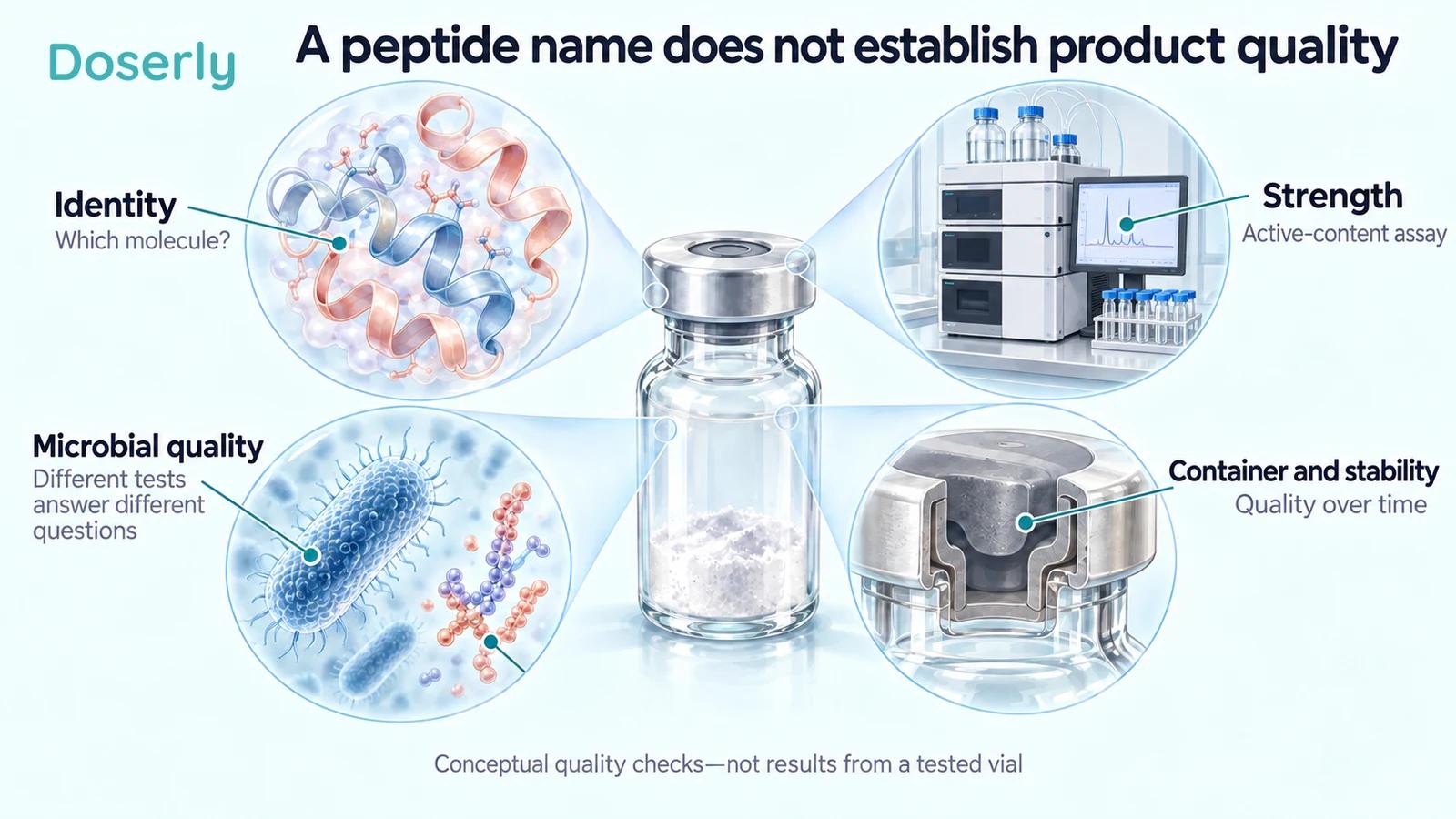
What a certificate of analysis can leave unanswered
A certificate of analysis can be useful when it is authentic, traceable to a relevant sample and interpreted within the test's limits. It is not automatically meaningless, and it is not automatically comprehensive. A report may address a chemical attribute without addressing sterility, the final packaged product or what happened after testing.
Consider a hypothetical report showing satisfactory chemical results for a sample before filling. That report could be accurate while leaving a later filling problem undetected. A report for one batch also does not tell us what was in a different batch. These are examples of why traceability matters, not accusations about any named laboratory or supplier.
There is a further distinction between a test result and a clinical conclusion. A laboratory may correctly identify a compound yet provide no evidence about the appropriateness of administering it to a particular person. Medical suitability depends on the person's condition, other medicines and the treatment evidence. Chemical analysis and clinical assessment answer different questions.
A useful way to read a certificate is therefore to ask, “What exactly does this document establish?” Avoid silently expanding that answer into “This is equivalent to the product used in a clinical trial.” Equivalence would require relevant evidence across the product's important characteristics, rather than reassurance from its appearance or terminology. FDA manufacturing-quality framework.
Why injectable quality includes more than chemical purity
An injection bypasses protective barriers that normally separate the environment from internal tissues. Manufacturing a sterile injectable therefore involves controls designed to prevent microbial contamination. FDA has separate guidance for sterile drug products produced by aseptic processing, reflecting the particular demands of that work. FDA aseptic-processing guidance.
Sterility and endotoxin testing are also distinct. Endotoxins are bacterial components that can trigger harmful inflammatory responses; detecting living microorganisms and assessing endotoxin are different analytical tasks. FDA's dedicated pyrogen and endotoxin guidance addresses that additional quality question. A chemical purity result does not supply either answer. FDA discussion of pyrogen and endotoxin testing.
A clear-looking solution is not a laboratory result. Nor does adding a sterile liquid establish that the original powder, container and subsequent preparation meet injectable-quality requirements. Appearance can reveal some obvious problems, but the absence of a visible problem cannot certify all the attributes that matter.
The appropriate conclusion is not that every online vial is known to be contaminated. It is that unknown quality remains unknown. Reassurance needs evidence specific to the product and its preparation; the existence of a successful trial supplies no missing sterility or endotoxin result.
Storage instructions need product-specific evidence
Stability means maintaining relevant quality characteristics over time under specified conditions. Temperature, light, formulation and container can all matter. Stability testing examines the actual product and proposed storage conditions; an expiration date is more than a guess based on a molecule's name. ICH stability-testing guideline.
A powder in one container and a prepared solution in another are different situations. A storage statement for a research formulation cannot simply be transferred to an unrelated powder, and a statement about an unopened container cannot automatically describe repeated use after opening. The available evidence must match the question being asked.
This creates a limitation for online advice such as “all peptides last this long in the refrigerator.” Even if a rule seems familiar, familiarity does not establish stability for a particular preparation. Without relevant data, giving a precise number of days would create confidence the evidence does not justify.
The same reasoning applies to shipping. Knowing that a parcel eventually arrived cold would not reconstruct its entire journey or establish the product's permitted temperature excursions. Product quality depends on documented conditions and validated limits, rather than a single reassuring observation at delivery.
Clinical oversight is part of the trial context
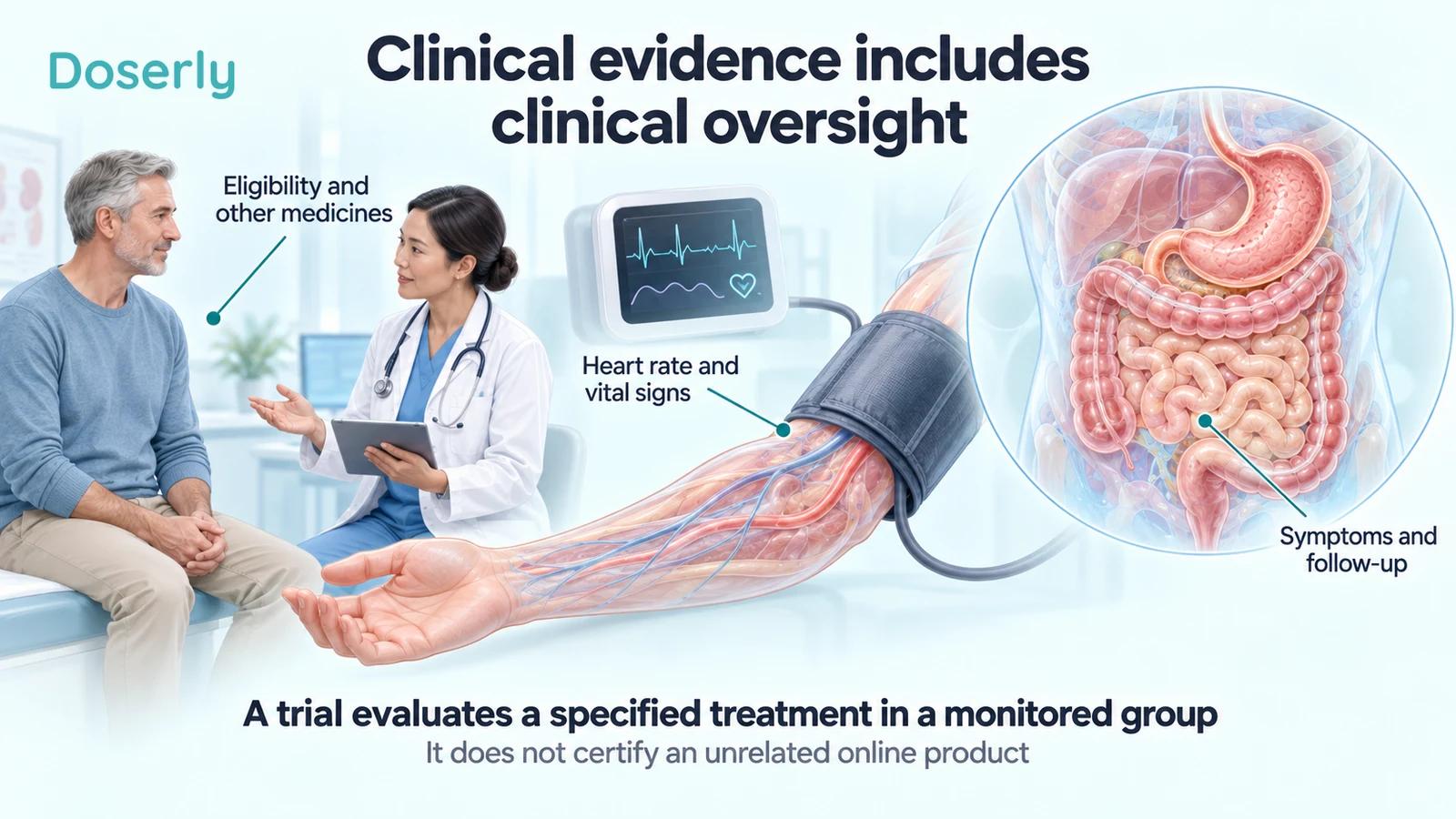
Product quality does not eliminate side effects. The retatrutide phase 2 trial observed gastrointestinal symptoms despite controlled supply and clinical supervision. Researchers also assessed safety rather than relying solely on the scale. A product can be correctly manufactured and still be unsuitable or poorly tolerated by an individual. Retatrutide trial.
Monitoring gives those experiences context. Investigators can document symptoms, review other medicines, assess whether further evaluation is needed and decide how a participant's treatment should proceed. The trial's eligibility criteria also affect whom the findings describe. A person excluded from the study should not assume that the study has answered their particular safety question.
Keeping a medication and symptom record can improve a clinical conversation, but a record cannot verify a vial's contents. Similarly, a dosing calculator can perform arithmetic only on the information entered. Correct arithmetic does not correct an uncertain concentration or turn a nonclinical product into the trial formulation.
Where does this leave someone seeking treatment?
As checked on October 15, 2026, FDA states that retatrutide and cagrilintide are not components of FDA-approved drugs and cannot be used in compounding under federal law. It also warns against products falsely marketed for research while being sold to consumers for human use. These are US regulatory statements; they should not be presented as a description of every country's law. FDA's current statement.
If the attraction is better weight management, discuss that goal directly with a clinician. Useful questions include which available treatment fits your health history, what outcomes you can reasonably expect, and how tolerability will be assessed. If you are interested in research participation, ask about an actual registered study and its eligibility requirements rather than treating a commercial purchase as participation.
If you already possess or have used an unverified product, an honest account of the product name, packaging, timing and symptoms is more useful to a clinician than assuming it matches a trial. Retain identifying information so that a suspected product problem can be investigated. FDA provides a MedWatch route for reporting adverse events and quality concerns on its unapproved-drug information page.
The promising clinical question is whether a carefully characterized treatment improves health enough to justify its risks. That question deserves good research. The separate question about an online vial deserves product-specific evidence—and remains unanswered when all we have is a familiar name and a link to somebody else's trial.
Sources
- Retatrutide phase 2 obesity trial, 2023: studied population, intervention, weight changes and adverse events.
- FDA, investigational new drug applications: clinical-research framework.
- FDA, chemistry, manufacturing and controls: phase-appropriate product requirements.
- FDA, current good manufacturing practice: manufacturing controls and limits of sampling.
- FDA, sterile products made by aseptic processing: sterile manufacturing.
- FDA, pyrogen and endotoxin testing: a separate quality assessment.
- ICH Q1A(R2), stability testing: product, container and storage.
- FDA, unapproved GLP-1 drugs: current US position and reporting.