
TRT
October 16, 2026
Why one low testosterone result can be a misleading story
On this page
A flagged testosterone result can feel like an explanation arriving at last. The fatigue, reduced interest in sex, or change in how you feel now appears to have a number attached. It is understandable to want the next step to be treatment rather than another blood draw.
But a testosterone measurement describes the sample collected at a particular time, under particular conditions. It does not by itself establish a persistent deficiency, explain every symptom, or identify why the level is low. Repeating the test is part of making the result more useful—not a claim that the symptoms are unimportant.
The Endocrine Society recommends diagnosing hypogonadism when compatible symptoms or signs accompany unequivocally and consistently low testosterone. Its guidance calls for repeat morning, fasting testing and investigation of the cause. The society reiterated the importance of appropriate diagnosis in its 2026 statement on TRT. Endocrine Society guideline, 2026 statement
The time of collection can change the story
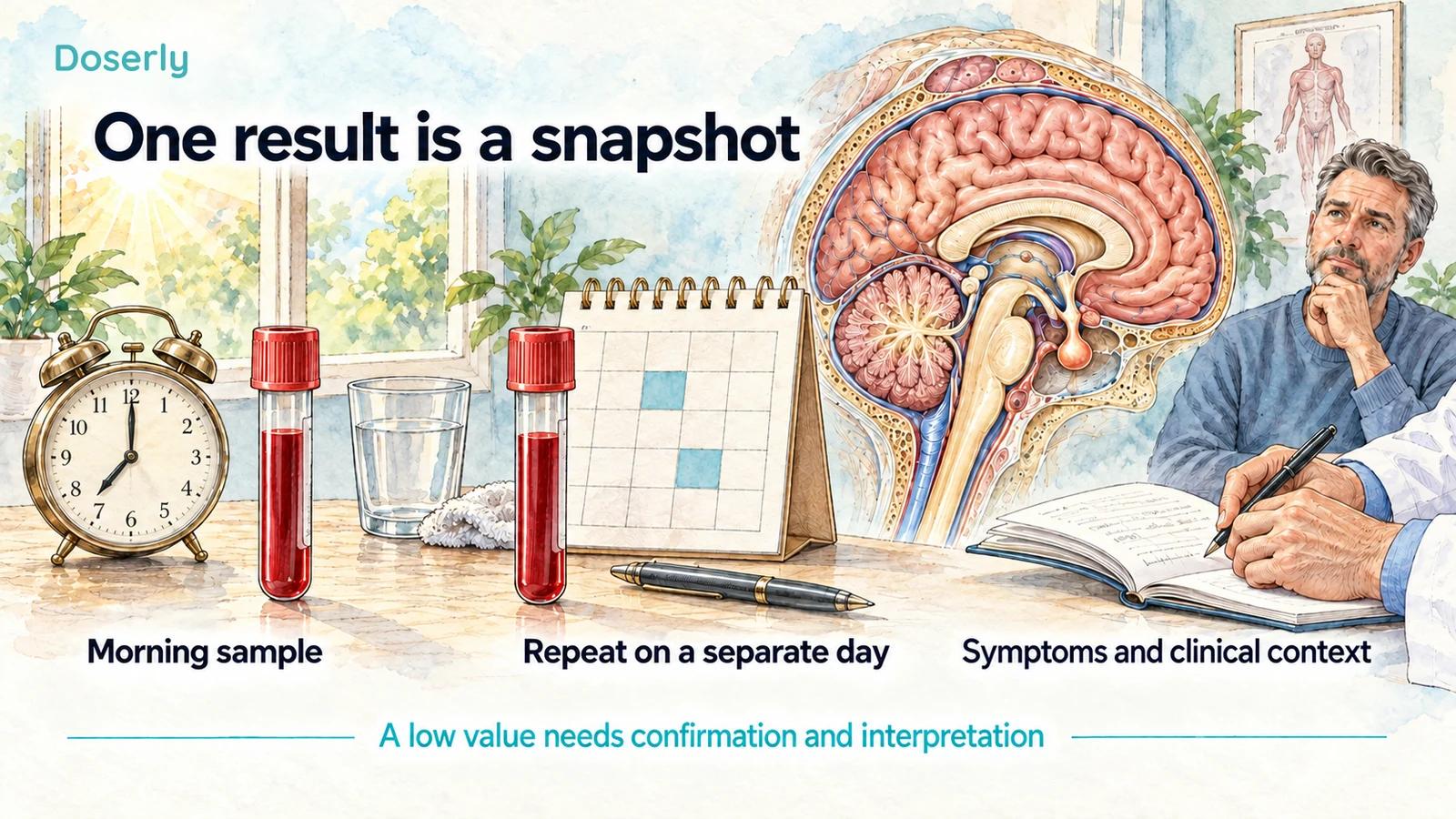
Testosterone varies over the day. In a study of 66 men aged 30–80, investigators collected samples at repeated morning and afternoon visits. Among men aged 30–40, levels at 4 p.m. were about 20–25% lower than at 8 a.m.; the difference was smaller in older men. Seventeen participants who had at least one afternoon value below 300 ng/dL had values above that threshold at all three morning visits. Brambilla and colleagues' sampling study
This does not mean that every low afternoon result is harmless or can be corrected by adding a fixed percentage. The findings describe a population pattern, with individual variation. They explain why the collection time matters when deciding whether a result reflects a persistently low level.
The practical distinction is between a clue and a diagnosis. A low result collected late in the day can be a reason to arrange appropriate follow-up. It should not automatically be treated as equivalent to repeated low measurements collected under diagnostic conditions. Likewise, a repeat result should be interpreted with the symptoms and the rest of the assessment rather than used to erase the original concern.
If you work nights or have an unusual sleep schedule, tell the clinician before arranging testing. “Morning” instructions should be discussed in the context of your actual schedule; this article does not provide a validated alternate clock time for shift workers. That detail is more useful than silently treating an overnight work period as an ordinary night's sleep.
Food and testing conditions also matter
In a study of 74 men undergoing a 75-gram oral glucose tolerance test, average testosterone fell after glucose ingestion. Among 66 participants with normal baseline testosterone, 10 temporarily crossed below the study's low-testosterone threshold. This was a defined glucose challenge, not proof that every breakfast lowers every man's testosterone by the same amount. Caronia and colleagues' glucose study
A later study using mass-spectrometry measurements also found transient testosterone reductions after a glucose load or a mixed meal in healthy men. These experiments support attention to preparation when interpreting a sample; they do not supply a formula for converting a nonfasting result into a fasting one. Glucose and mixed-meal study
Professional guidance is not completely identical on preparation. The Endocrine Society recommends fasting morning measurements. The AUA guideline requires two early-morning measurements on separate occasions but did not insist on fasting in its published diagnostic discussion. Follow the instructions given for your clinical assessment and tell the clinician how the sample was collected, especially when comparing results obtained under different conditions. Endocrine Society guideline, AUA guideline
There is no benefit in trying to engineer a low result or a reassuringly high one. The goal is to obtain a representative measurement under conditions that make interpretation more reliable. Bring the actual report, collection time, and relevant preparation details rather than only remembering that the result was “low.”
Two tests answer a different question from one test
A single test asks what was measured on that occasion. Repeated testing asks whether the finding persists. The AUA notes biological and assay variability and recommends two early-morning total-testosterone measurements on separate occasions. When one is below 300 ng/dL and another is normal, the guideline leaves the decision about a third measurement to clinical judgment. It also requires symptoms or signs for the clinical diagnosis; the number alone is insufficient. AUA guideline
That distinction helps when results straddle a threshold. A hypothetical result of 290 followed by 315 ng/dL is not the same pattern as two clearly low results, but it also does not prove that a person's symptoms are imaginary. The clinician must consider testing conditions, measurement method, symptom pattern, and whether additional evaluation is appropriate. These example values are not a treatment rule.
It is useful to keep the units and laboratory reference range with each value. Total testosterone is commonly reported in ng/dL or nmol/L, while free testosterone may use other units. Comparing the raw numbers without checking units can produce a dramatic-looking difference that is only a reporting difference. A screenshot cropped to the number may omit the very information needed to understand it.
Repeating tests indefinitely until a preferred result appears is not the purpose. A planned assessment should explain what each additional measurement would resolve. If the pattern remains unclear, ask what uncertainty is left and what decision depends on it.
Total testosterone and free testosterone are related, but different
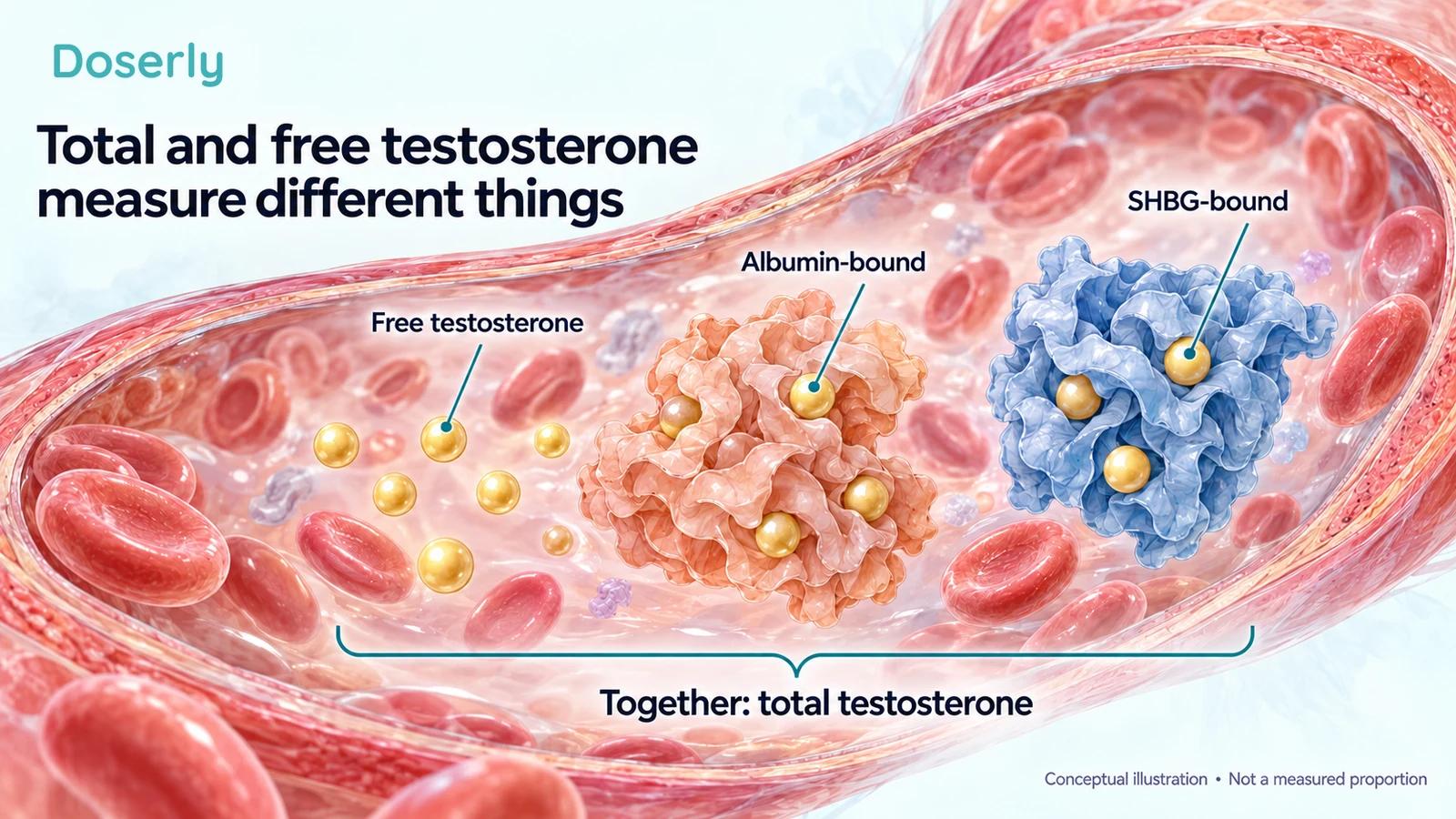
Most circulating testosterone is bound to proteins, including sex hormone-binding globulin, or SHBG, and albumin. The unbound fraction is called free testosterone. Total testosterone includes the bound and unbound portions. A change in binding proteins can therefore affect how the total result relates to the free fraction.
The full Endocrine Society guideline recommends assessing free testosterone when total testosterone is near the lower limit or when a condition alters SHBG. It recommends equilibrium dialysis or an appropriate calculation using total testosterone, SHBG, and albumin, and advises against direct analog free-testosterone immunoassays because of inaccuracy. Calculated values depend on the inputs and method; “free T” is not a single interchangeable test across every laboratory. Full clinical guideline
A study of 3,334 community-dwelling men aged 40–79 illustrates why the distinction can matter. Men with normal total but low calculated free testosterone reported more androgen-related symptoms, while men with low total but normal calculated free testosterone did not show the same pattern of deficiency features. This was an observational comparison, not a randomized trial proving who would benefit from treatment. European Male Ageing Study analysis
The implication is to interpret the measurements together when clinically indicated, rather than pick whichever number supports a desired conclusion. Low total testosterone with a normal free result and normal total testosterone with a low free result raise different questions. Neither combination can be interpreted properly without symptoms, laboratory methods, and the wider history.
A confirmed low level still needs an explanation
The next question is why testosterone is low. Hypogonadism can arise from a problem in the testes or from the brain–pituitary signals that regulate them. The Endocrine Society recommends measuring luteinizing hormone and follicle-stimulating hormone to help distinguish primary testicular from secondary pituitary–hypothalamic hypogonadism, followed by further evaluation when indicated. Endocrine Society guideline
That is more informative than treating all low values as the same disease. The cause can affect which additional tests are useful, what treatment is considered, and whether a potentially reversible contributor should be addressed. A low number is not itself a map of where the problem originates.
The society's patient resource notes that severe illness, poor nutrition, excessive exercise, and certain medicines can temporarily lower testosterone. Opioid pain medicines, corticosteroids, obesity, sleep disorders, and other medical conditions can be relevant to the assessment. Some contributors may be reversible; others require a specific diagnosis and treatment plan. Do not stop prescribed medication to prepare for a test without medical advice. Endocrine Society patient resource
This is why a complete medication and supplement list matters. Include prescribed testosterone or anabolic-steroid exposure if relevant, rather than assuming it is unrelated to the current result. The clinician needs to know what the test is measuring in context. A diagnostic sample before treatment and a monitoring sample while taking testosterone are not the same clinical question.
Fertility plans belong in this conversation early. The Endocrine Society recommends against starting testosterone therapy in men planning fertility in the near term. A desire for children can change the appropriate evaluation and treatment discussion; it should not be discovered only after a replacement prescription has been started. Endocrine Society guideline
Symptoms deserve attention even when the laboratory picture is unclear
Fatigue, lower motivation, reduced sexual interest, and changes in physical function can occur for several reasons. The presence of symptoms does not prove a hormone cause, and a result within a reference range does not mean there is nothing worth investigating. The useful outcome of testing is a clearer clinical assessment, not simply a yes-or-no label attached to a person.
For example, someone may have a low initial result during illness, a normal repeat after recovery, and persistent fatigue. The repeat changes the evidence for persistent testosterone deficiency. It does not resolve the fatigue. The next conversation should address the continuing symptom rather than treating the laboratory result as the end of care.
Conversely, someone with repeated low results and compatible symptoms needs more than reassurance that levels change over time. Variability is a reason to confirm a finding, not a reason to dismiss a confirmed pattern. A good assessment uses uncertainty to decide what to check next and then updates the conclusion when the evidence becomes clearer.
Doserly's TRT blood-work guide can help organize the reports and questions. The beginner guide provides broader treatment context. Use them to prepare for a clinical discussion rather than to select a target number independently.
Keep diagnostic testing separate from monitoring an existing prescription. Once testosterone is being administered, the formulation and the interval between treatment and the blood draw become part of the interpretation. The untreated morning-testing studies described here do not establish a universal sampling time for every treated patient. Ask the prescriber which timing applies to the actual product, and record that timing with the result rather than comparing unlike samples. Full clinical guideline
Make the follow-up appointment answerable
Bring the complete reports and a concise account of what prompted testing. Note the collection date and time, whether you followed the requested preparation, whether you were unwell, and any major medication or treatment changes. Describe the symptoms in concrete terms: when they began, whether they fluctuate, and what they interfere with.
Then ask what the current evidence supports. Is there a consistently low result? Would free testosterone or binding-protein assessment clarify the picture? Is there a reason to investigate testicular or pituitary function? Which potential contributors are being considered? If treatment is proposed, what symptom benefit and monitoring plan would justify continuing it?
These questions do not require you to become your own endocrinologist. They help ensure that a laboratory finding becomes part of a coherent explanation. One low testosterone result may be important, but its importance comes from confirmation, symptoms, and cause—not from the red flag beside the number alone.
Sources
- Endocrine Society guideline resources
- Endocrine Society 2026 TRT statement
- Diurnal variation and clinical testosterone measurement
- Testosterone after an oral glucose load
- Testosterone after glucose or mixed-meal feeding
- AUA testosterone-deficiency guideline
- Full Endocrine Society clinical guideline
- Free testosterone and symptoms in the European Male Ageing Study
- Endocrine Society patient resource: hypogonadism