
Peptides
October 16, 2026
LL-37 and infections: why antimicrobial activity isn't an antibiotic replacement
On this page
LL-37 is part of the human body's defense against microbes. Researchers can also make it in a laboratory and test how it affects bacteria. Those experiments have produced interesting findings, including effects on bacterial communities called biofilms. They do not establish that an LL-37 product can replace an antibiotic prescribed for an infection.
The distinction is practical. An infection treatment has to reach the relevant tissue, remain active there, improve an outcome that matters to the patient and have an acceptable safety profile. Killing or disrupting bacteria under selected laboratory conditions answers only part of that question. For LL-37, the surrounding fluid, bacterial enzymes and interactions with other treatments can change the result.
If you are interested because of a persistent wound, recurring gastrointestinal symptoms or concern about antibiotic resistance, the research is worth understanding. The most useful starting point is the specific condition you want treated, rather than the broad label “antimicrobial.” Our LL-37 guide compares the available human studies and their routes of administration.
What does an antimicrobial experiment actually measure?
Researchers may measure whether bacteria grow, survive, attach to a surface or form a structured community. Those are related outcomes, but they are not identical. A substance can change attachment without killing the organism. It can reduce growth at one concentration while having little effect at another.
A commonly reported measurement is the minimum inhibitory concentration, or MIC: the lowest concentration preventing visible growth under a specified test's conditions. It is a laboratory measurement, not a ready-made human dose. An injected amount in micrograms cannot be converted directly into that tissue concentration without knowing distribution, binding, breakdown and clearance.
This matters for interpreting LL-37. In a 2008 study of Pseudomonas aeruginosa, biofilm inhibition appeared at a concentration well below the concentration needed to inhibit free-growing bacteria. The investigators examined changes in attachment, movement and bacterial signaling. Their work demonstrated that an antibiofilm effect could be different from a bactericidal effect, meaning direct killing. Overhage and colleagues.
It would be misleading to translate the result into “LL-37 eliminates chronic infections.” The experiment did not measure recovery, relapse, hospitalization or survival in patients. It identified a biological effect that might help guide drug development.
Why biofilms attract attention
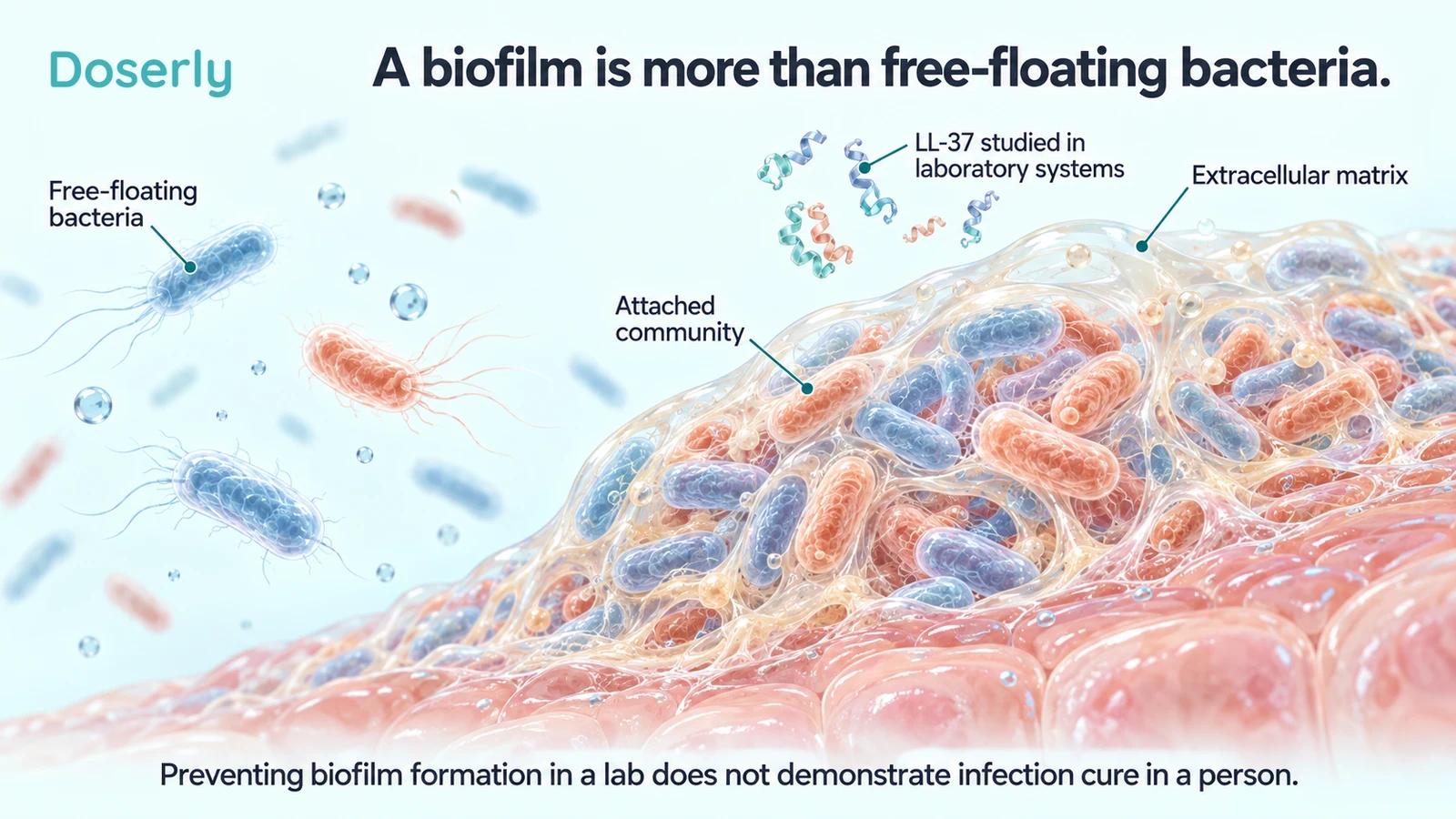
A biofilm is a community of microbes associated with a surface and surrounded by material they produce. That organization can matter in persistent infections, which explains the interest in treatments that interfere with it. But “biofilm” has also become a vague explanation for many unresolved symptoms.
The 2008 LL-37 study used a defined bacterial system. It did not establish that every hard-to-treat symptom comes from a biofilm or that all bacterial species respond identically. The authors also examined existing biofilms, but that still occurred in laboratory conditions. Primary biofilm study.
A later experiment comparing several host-defense peptides further illustrates how assay conditions and the particular peptide influence the result. It separately examined prevention of attachment and effects on established Pseudomonas biofilms. That separation matters because preventing a community from forming is a different challenge from treating an established infection. 2018 experimental comparison.
For a reader, the useful question is what was actually demonstrated: less attachment, reduced biofilm mass, fewer surviving bacteria or a patient recovering from infection. Those findings should retain their specific names. Combining them under the word “eradication” overstates what most laboratory studies can show.
Blood and tissue fluid can change the result
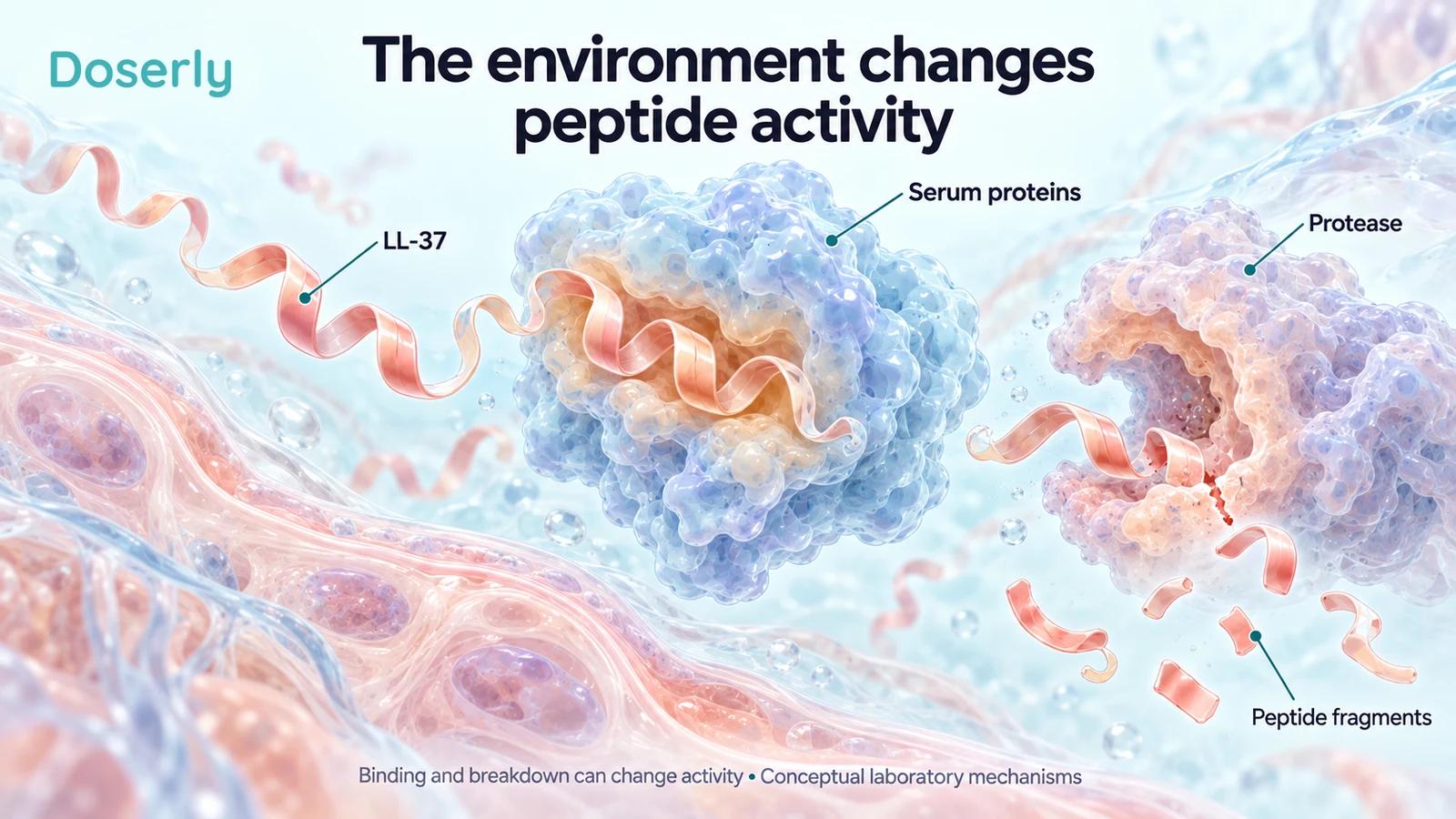
A laboratory culture medium is not the same environment as blood, wound fluid or intestinal contents. Substances in these environments can interact with a peptide and alter how much remains available to act on bacteria.
A 2005 study compared LL-37 with modified fragments and analogues, examining antibacterial activity, cell toxicity, immune-cell attraction and inhibition by serum. It found that modifying the molecule could change these properties, including sensitivity to serum's inhibitory effects. Ciornei and colleagues.
That result has two implications. First, a strong effect in one test medium may not persist in a more biologically complex setting. Second, a modified peptide is not automatically interchangeable with native LL-37. A favorable finding for a fragment cannot be assigned to a full-length product just because the names are related.
It also explains why “higher concentration” isn't a complete answer. The desired microbial effect must be considered alongside effects on human cells. Development requires establishing a useful exposure range, not merely finding an amount that damages bacteria in a dish.
Bacterial enzymes can cut the peptide
Some bacteria produce protein-cutting enzymes called proteases. These can affect proteins involved in the host response as well as other materials around the organism.
In a study of enzymes produced by Staphylococcus aureus, aureolysin broke down LL-37 and reduced its antibacterial activity. Another enzyme, V8 protease, generated a fragment that retained activity in the tested system. The effect therefore depended on how the peptide was cut, not simply on whether any breakdown occurred. Sieprawska-Lupa and colleagues.
This is a concrete reason to avoid describing LL-37 as universally resistant to bacterial defenses. It is also a reason not to describe every peptide fragment as inactive. The organism, enzyme and resulting molecule all matter.
For treatment development, researchers would need to establish whether a preparation remains active at the infected site long enough to help. That may involve formulation work or developing a different molecule. Those possibilities are scientifically interesting, but they do not validate a product already being sold for self-administration.
Adding LL-37 to an antibiotic is not automatically beneficial
Because two substances have antimicrobial properties, it is tempting to assume their combination must be stronger. Interactions need testing. One substance can change the organism or its environment in ways that alter the other's action.
A 2020 study found that LL-37 exposure reduced vancomycin susceptibility in a particular community-associated methicillin-resistant S. aureus strain. The finding involved bacterial experiments, a mathematical model and an infection model using Galleria mellonella, an insect larva. The reduced susceptibility was described as non-inheritable; it was not presented as a new stable genetic resistance trait. Friberg and colleagues.
This does not show that LL-37 invariably interferes with vancomycin in patients, and it should not be used to predict an individual treatment failure. It does show why a combination cannot be assumed to help based on the separate descriptions of its ingredients. The organism and exposure conditions need to be studied together.
If an infection is not improving, the appropriate next question is why: the diagnosis, organism, drug exposure, infected site and need for other care may all be relevant. Adding an untested peptide introduces another variable without necessarily addressing the cause of failure.
Do wound trials establish infection treatment?
The available topical wound research is more clinically direct than a bacterial dish experiment, but its outcomes still need to be read carefully. In the small 2023 diabetic-foot study, 25 participants received LL-37 cream or placebo for four weeks. The reported granulation-tissue improvement was not accompanied by a demonstrated between-group reduction in aerobic bacterial counts or the measured inflammatory markers. Diabetic-foot trial.
Granulation tissue helps describe the wound bed. It is not the same endpoint as curing an infection. A study can generate a promising wound-repair observation without demonstrating that the preparation replaces antibiotics.
There is a related distinction in ordinary leg-ulcer care. NICE notes that many ulcers are colonized with bacteria without being clinically infected. Antibiotics are used when clinical signs support infection, rather than simply because an open wound contains organisms. NICE NG152.
These distinctions prevent two opposite mistakes: treating every bacterial finding as an infection requiring antibiotics, and treating a laboratory antimicrobial effect as adequate evidence to replace necessary infection care. The clinical condition determines what needs treatment.
What about SIBO, IBS and “gut healing”?
These terms are often grouped together in peptide discussions, but they refer to different questions. Small intestinal bacterial overgrowth, or SIBO, concerns excessive bacteria in the small intestine associated with gastrointestinal symptoms. Its evaluation and management are addressed in a dedicated American College of Gastroenterology guideline. A proposed replacement treatment would need evidence in that population, with an appropriate diagnostic approach and meaningful symptom outcomes. ACG SIBO guideline.
Irritable bowel syndrome, or IBS, describes a pattern including recurring abdominal pain and altered bowel movements. It is a disorder of gut-brain interaction; symptoms are real even without visible structural damage. IBS should not automatically be treated as proof of a bacterial infection or a wound in the intestinal lining. NIDDK explanation.
The LL-37 literature sometimes cited for gut benefits includes a study of KR-12, a shorter fragment, in chemically induced mouse colitis. Researchers studied inflammation scores and bacterial changes in several models; the work did not test an LL-37 injection regimen in people with IBS or SIBO. Fabisiak and colleagues.
A mouse colitis result can identify a research direction. It cannot establish that a person with bloating has the same disease process, that full-length LL-37 will reproduce the fragment's effects, or that an unspecified “gut-healing” course is effective. Clarifying the diagnosis is more useful than selecting a treatment from a shared symptom label.
What would convincing human infection evidence include?
A useful trial would identify the infection, study a defined preparation and route, and compare it with appropriate care. If the proposal is to add LL-37, the trial should measure what the addition contributes. If the proposal is to replace an established treatment, it needs to test that replacement directly under ethically appropriate conditions.
The organism also matters. A favorable result against one tested strain does not establish activity against every cause of infection, and a mixed microbial community introduces a different question from an isolated laboratory culture.
The outcomes should include how people feel and function, whether infection resolves and returns, and adverse effects. Laboratory counts can support those findings but should not replace them. Researchers would also need information about exposure at the relevant site and the consequences of repeated treatment.
For compounded LL-37, FDA identifies insufficient safety information and potential concerns involving immunogenicity, impurities and characterization of the active substance. An absence of a well-measured risk estimate is not evidence that the risk is negligible. FDA compounding safety page.
A more useful discussion than “natural antibiotic”
When someone recommends LL-37, ask which infection it is intended to treat and which human study supports that use. Ask whether the study administered the same molecule, preparation and route, and whether it measured infection resolution rather than only bacterial behavior or tissue markers.
Bring the names of prescribed medicines and any peptide products into that conversation. A clear record of symptoms, test results and treatment changes helps the clinician assess what is happening. Don't replace a prescribed infection treatment based on an in-vitro result or a claim that a peptide cannot encounter resistance.
LL-37 remains a useful scientific subject precisely because its actions are varied and context dependent. Understanding those actions can explain both the interest in future drugs and the limits of current treatment claims. The LL-37 risks section offers further background on the uncertainties surrounding administered products.
Sources
- Overhage et al., 2008: LL-37 and biofilm formation.
- 2018: inhibition and eradication of Pseudomonas biofilms by host-defense peptides.
- Ciornei et al., 2005: serum, activity and LL-37 analogues.
- Sieprawska-Lupa et al., 2004: bacterial protease degradation.
- Friberg et al., 2020: vancomycin susceptibility.
- Miranda et al., 2023: diabetic-foot cream trial.
- NICE: infected leg ulcers.
- ACG: SIBO guideline.
- NIDDK: IBS definition.
- Fabisiak et al., 2021: KR-12 in mouse colitis.
- FDA: compounding safety concerns.