
Peptides
October 16, 2026
Why heart rate matters in the retatrutide story
On this page
A medicine can lower body weight while changing the pulse. Those observations are not contradictory: weight, blood pressure, heart rate and heart rhythm describe different parts of physiology. The important question is what the changes mean for the person, both now and over time.
Retatrutide's original obesity trial reported a dose-related increase in heart rate. Researchers have also studied how the molecule affects isolated heart tissue. Together, those findings make cardiac effects a legitimate part of the retatrutide discussion. They do not establish either that a faster pulse is harmless or that it proves the medicine damages the heart.
Reading this evidence well requires separating three questions: what was measured in people, what a laboratory experiment can explain, and what evidence would show a net cardiovascular benefit or harm.
Heart rate, rhythm and contraction strength are different measurements
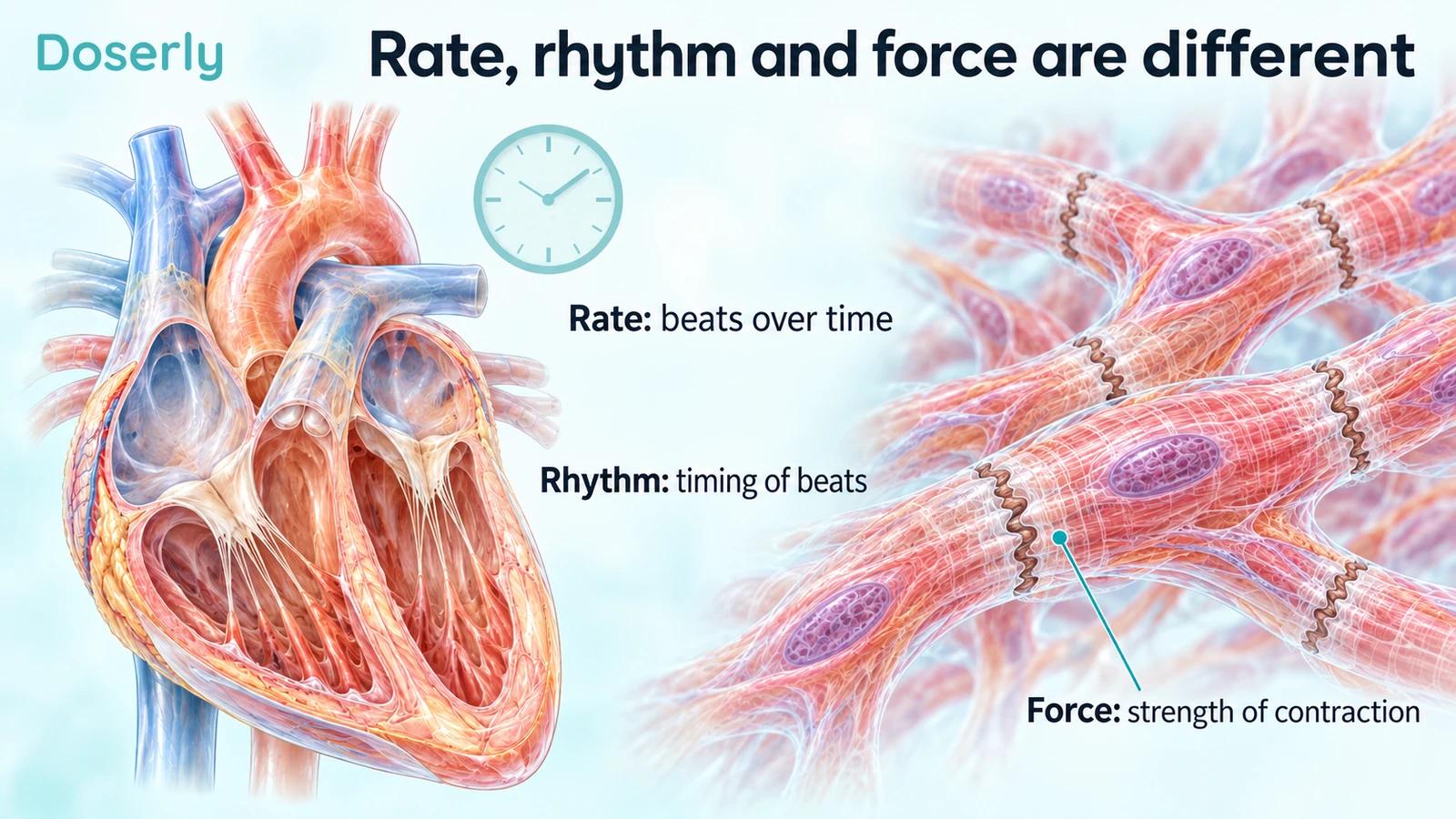
Heart rate is the number of beats over time, commonly expressed as beats per minute. Rhythm concerns the timing and organization of those beats. A rate can be faster while remaining regular; an abnormal rhythm is a different finding.
Contractile force is how strongly a piece of heart muscle contracts under the conditions being measured. Researchers call a change in force an inotropic effect and a change in beating rate a chronotropic effect. These words are useful because the retatrutide laboratory studies did not all measure the same thing.
Blood pressure is another measurement. A lower pressure does not logically cancel a higher pulse, any more than one improved laboratory result cancels a new symptom. Each needs to be interpreted in context. The American Heart Association explains the distinction between pulse and pressure and why activity, position, emotions and medicines affect heart rate. AHA heart-rate guidance.
A person noticing pounding or fluttering is describing palpitations. That sensation deserves attention, but it does not identify an electrical rhythm diagnosis on its own. AHA palpitations guidance.
What the phase 2 trial found in people
The 2023 obesity trial randomized 338 adults to retatrutide dose groups or placebo for 48 weeks. Investigators reported that heart rate increased in a dose-dependent pattern, reached its highest average change around 24 weeks, and declined afterward. Phase 2 trial.
That description should remain intact. “Declined afterward” does not mean “every participant returned to their own baseline,” and “peaked at 24 weeks” does not mean a person should wait six months before reporting a concerning pulse change.
The paper also describes reported cardiac arrhythmias as mild or moderate apart from one severe prolonged-QT event in a participant receiving ondansetron. That detail should not be compressed into “there were no rhythm events,” nor does it prove that one medicine alone caused the severe event.
The trial was designed primarily to study weight change. Its safety observations are meaningful, but a study of this size and duration cannot precisely settle every uncommon rhythm risk or long-term cardiovascular outcome. It supplies a reason to monitor and investigate, not an all-purpose verdict.
Why an average pulse curve cannot answer an individual symptom
Consider an illustrative example unrelated to the trial's measured results: two people can contribute to the same average increase even if one has almost no change and the other has a larger rise. A group mean conceals that variation.
Timing matters too. A pulse measured after climbing stairs is not equivalent to one recorded after sitting quietly. A clinic measurement, a wearable's daily resting estimate and an overnight average may each summarize different conditions. Comparing them as if they were interchangeable can manufacture a trend that is partly a measurement difference.
That does not mean a wearable observation is unimportant. It means the observation becomes more useful when accompanied by the measurement method, activity context and symptoms. “My watch says 85” tells less than “my usual morning resting estimate has risen over several days and I feel lightheaded.”
A trial's average trajectory should therefore guide questions, not override a person's symptoms. The size, persistence and setting of the change matter, as does the person's existing cardiovascular history.
What the mouse atrial experiment adds
In a 2025 laboratory study, researchers exposed isolated mouse atrial tissue to retatrutide. The right atrial preparations beat spontaneously; left atrial preparations were electrically stimulated. Retatrutide increased the beating rate in the right atrial preparations but did not increase contraction force in the left atrial preparations under the tested conditions. Mouse atrial study.
Experiments using receptor and signaling inhibitors supported a role for glucagon-receptor signaling through cAMP and protein kinase A in that mouse rate response. These are components of intracellular signaling, not a clinical diagnosis.
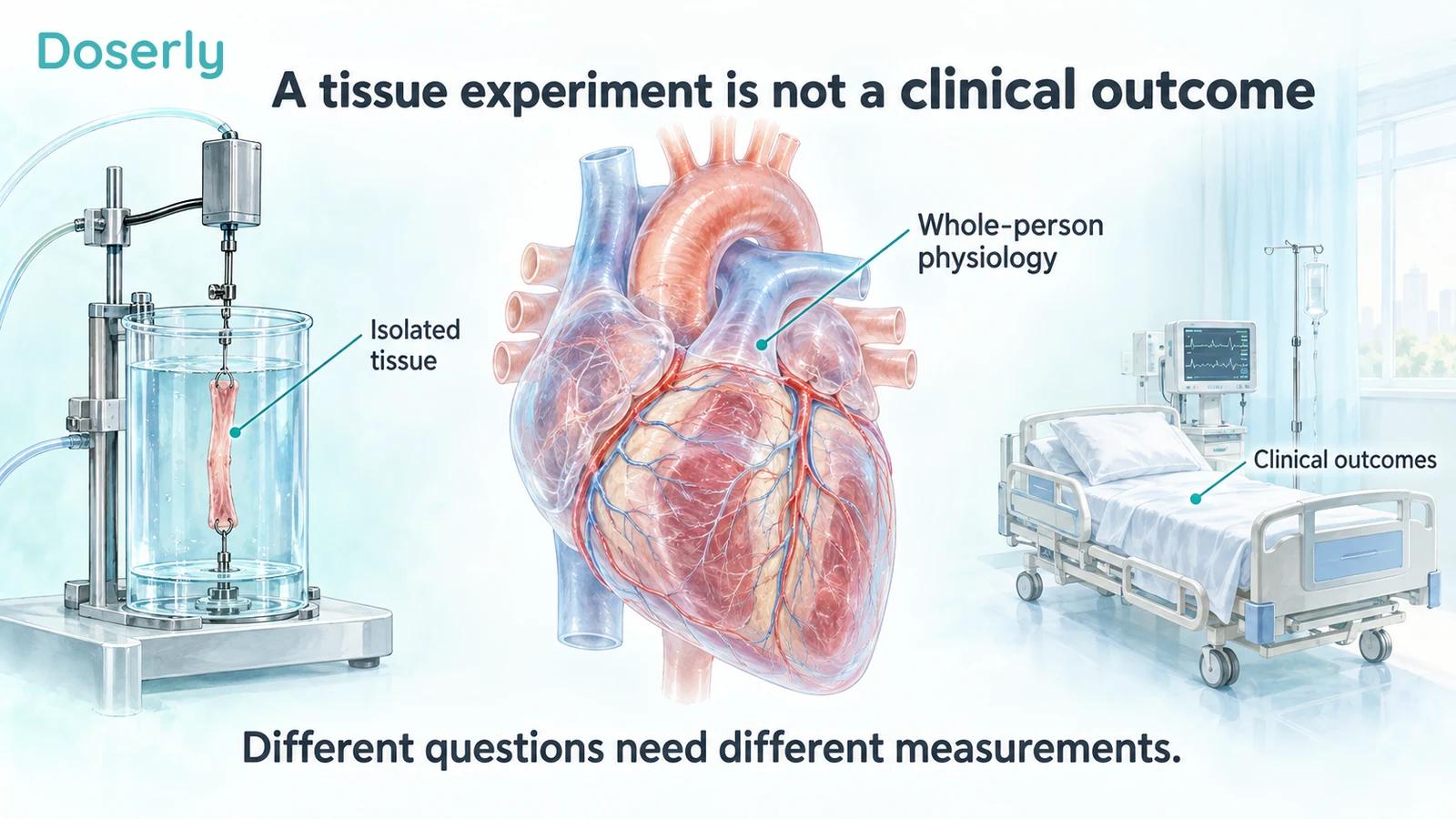
The experiment offers a plausible direct cardiac mechanism to investigate. Its boundaries are equally useful: isolated mouse tissue, controlled bath exposure and a particular set of measurements. It cannot establish how much of a person's pulse change is caused by that pathway.
It also shows why “retatrutide stimulates the heart” is too vague. In this experiment, rate and force did not behave identically. Naming the measurement prevents a laboratory result from being stretched into a broader claim.
Human heart tissue is more relevant, but it is still not a treatment trial
A separate study used right atrial tissue obtained during heart surgery from 29 adults with severe coronary disease. Investigators electrically paced the preparations and measured contraction force while adding retatrutide. Force increased with exposure; the effect was enhanced in experiments using cilostamide, which reduces breakdown of the signaling molecule cAMP. Human atrial study.
This is human tissue evidence. It is not evidence from 29 people taking retatrutide as a treatment. The tissue was studied outside the body, and the measured endpoint was force under laboratory conditions.
That difference is particularly important for pulse claims. Electrically paced tissue contracting more strongly does not directly show a person's resting heart rate rising. Nor does a stronger contraction in an atrial strip prove improved pumping function or reduced heart-failure admissions.
The paper was published online in July 2025 and appears in a 2026 journal volume. Those dates refer to the same experiment, not two independent studies.
Laboratory blockers are not a recipe for managing a faster pulse
Mechanistic papers often add other substances to test a hypothesis. If blocking a receptor changes the tissue's response, that helps identify a possible pathway. If preventing cAMP breakdown amplifies the response, that helps researchers understand signaling.
It does not follow that a reader should combine medicines to reproduce or suppress those effects. Concentrations in an organ bath, selected tissue and whole-body treatment are different circumstances. Drug exposure, other organs and an individual's conditions all change the clinical question.
For the same reason, a laboratory result involving propranolol does not establish a general rule that beta blockers will or will not manage someone's symptoms. A clinician chooses treatment based on the actual diagnosis and the person's overall situation, not a single isolated-tissue experiment.
The appropriate translation is a research question: which pathways contribute to the observed human response, and do they matter clinically? Turning the paper into an improvised combination protocol skips the evidence needed to answer that question.
Weight loss and lower risk markers do not settle cardiovascular outcomes
Retatrutide now has published phase 3 evidence, including TRIUMPH-1's weight and obesity-related symptom outcomes. Those results improve the clinical evidence base, but their existence does not turn every favorable metabolic change into proof of fewer heart attacks or deaths. TRIUMPH-1 publication.
A cardiovascular outcomes trial counts prespecified events in a relevant population over time. It asks about the net effect of treatment, incorporating beneficial and adverse influences that a single biomarker cannot summarize.
TRIUMPH-Outcomes, registered as NCT06383390, is designed to evaluate serious cardiovascular and kidney outcomes in adults with overweight or obesity and established atherosclerotic cardiovascular disease and/or chronic kidney disease. Its sponsor summary describes that prospective question. It is a study plan, not a completed result demonstrating protection. TRIUMPH-Outcomes.
This is why neither extreme is justified: “the pulse rose, so the drug must worsen cardiovascular outcomes” and “weight fell, so cardiovascular safety is settled.” Both claims substitute one piece of physiology for the outcome that must actually be studied.
What makes a pulse record useful in a clinical conversation?
If a study team or clinician asks for monitoring, use the method and schedule they recommend. For a personal record, consistency is more informative than repeatedly checking at unrelated moments. Note whether a value is resting, during activity or from a device's calculated daily summary.
Include symptoms and timing rather than only the number. A brief account of dizziness, breathlessness, chest discomfort or palpitations gives context that a graph alone cannot provide. Record recent illness, activity and medication changes as part of the history rather than deciding in advance which one caused the change.
For someone exposed to a product sold as retatrutide, product identification matters too: packaging, source, dates and the actual amount used are relevant information for the clinician. An honest account helps distinguish a possible drug effect from other explanations and from product-quality concerns.
This record is a conversation aid. It is not a home diagnostic test for an arrhythmia, and it does not establish a safe ceiling for continued investigational-product use.
When symptoms deserve prompt attention
A sudden very high or very low pulse for you, especially with chest pain, shortness of breath, dizziness or fainting, warrants emergency assessment. Do not wait for a trial's average pulse curve to predict what will happen next. AHA guidance.
Persistent or recurrent palpitations also merit medical evaluation. Depending on the history, assessment may include an ECG, longer rhythm monitoring or evaluation for other contributors. The AHA notes that palpitations can occur even when recorded rhythm is normal, while some rhythm disorders require treatment. AHA palpitations guidance.
A familiar symptom label cannot replace that assessment. “This is a known side effect” describes a possibility; it does not establish that the present episode is uncomplicated or safe to ignore.
The practical meaning of the evidence
Heart-rate change belongs in the retatrutide story because it was observed in human research and has plausible mechanisms worth studying. The most defensible account keeps the levels of evidence separate: a trial pulse pattern, a mouse rate experiment, a human tissue-force experiment and a prospective outcomes program.
Retatrutide remains investigational as of this article's October 15, 2026 source check. The FDA warns that unapproved products marketed with research-only labels are of unknown quality and may be harmful. Their label does not make them equivalent to controlled trial supply. FDA statement.
For broader context, the Doserly retatrutide guide explains the molecule and development program. For a new pulse change, the useful next step is clinical interpretation of the actual pattern and symptoms, not a mechanistic guess or a self-directed medication adjustment.
Sources
- NEJM: phase 2 obesity trial and heart-rate observations.
- Mouse atrial experiment: rate and force studied separately.
- Human atrial experiment: contraction force outside the body.
- TRIUMPH-Outcomes: prospective cardiovascular and kidney trial.
- AHA: understanding heart rate.
- AHA: palpitations and medical evaluation.
- NEJM: TRIUMPH-1 phase 3 publication.
- FDA: unapproved GLP-1 product concerns.